
Antares launch set for no earlier than August 22
Orbital ATK has scheduled the first Antares launch since its failure in October 2014 for no earlier than August 22.
Orbital ATK has scheduled the first Antares launch since its failure in October 2014 for no earlier than August 22.
Weather for the next Falcon 9 launch, which will lift a Dragon capsule to ISS at 12:44 AM (eastern) Monday morning, looks excellent.

On Christmas Eve 1968 three Americans became the first humans to visit another world. What they did to celebrate was unexpected and profound, and will be remembered throughout all human history. Genesis: the Story of Apollo 8, Robert Zimmerman's classic history of humanity's first journey to another world, tells that story, and it is now available as both an ebook and an audiobook, both with a foreword by Valerie Anders and a new introduction by Robert Zimmerman.
The print edition can be purchased at Amazon or any other book seller. If you want an autographed copy the price is $60 for the hardback and $45 for the paperback, plus $8 shipping for each. Go here for purchasing details. The ebook is available everywhere for $5.99 (before discount) at amazon, or direct from my ebook publisher, ebookit. If you buy it from ebookit you don't support the big tech companies and the author gets a bigger cut much sooner.
"Not simply about one mission, [Genesis] is also the history of America's quest for the moon... Zimmerman has done a masterful job of tying disparate events together into a solid account of one of America's greatest human triumphs."--San Antonio Express-News
An evening pause: This instrumental music, used as the theme music for the 1970s television show, Soul Train, has only one significant vocal line: “People all over the world!” I think the visuals used here, of Earth taken from the International Space Station, make that line seem especially appropriate.
Hat tip James Stephens.
Fourteen attendees of a San Jose Trump rally on June 2 have filed a class-action suit against the city, the mayor, and the police chief for their failure to protect them from rioters.
“Law-abiding citizens leaving the Trump rally were victimized by being forced by armed police to walk into a riot in full swing where many were assaulted while police looked on,” said the plaintiffs’ attorney, Harmeet K. Dhillon, who is also the vice chair of the California Republican Party.
Dhillon says her clients range from a 14-year-old who was assaulted by two different individuals and denied assistance by the San Jose Fire Department to a 71-year-old woman whose glasses were ripped off and destroyed by three rioters. She said it was made clear that the “inaction” of 250 San Jose police officers “was colored by political viewpoint considerations.”
As documented at the time, the San Jose police actually arranged things so that the Trump supporters were forced to take a detour that would put them directly in the path of the violent protesters, and then stood down and watched them get attacked.
I hope they win big, and bankrupt the mayor and the police chief.

Now available in hardback and paperback as well as ebook!
From the press release: In this ground-breaking new history of early America, historian Robert Zimmerman not only exposes the lie behind The New York Times 1619 Project that falsely claims slavery is central to the history of the United States, he also provides profound lessons about the nature of human societies, lessons important for Americans today as well as for all future settlers on Mars and elsewhere in space.
“Zimmerman’s ground-breaking history provides every future generation the basic framework for establishing new societies on other worlds. We would be wise to heed what he says.” —Robert Zubrin, founder of the Mars Society.
All editions are available at Amazon, Barnes & Noble, and all book vendors, with the ebook priced at $5.99 before discount. All editions can also be purchased direct from the ebook publisher, ebookit, in which case you don't support the big tech companies and the author gets a bigger cut much sooner.
Autographed printed copies are also available at discount directly from the author (hardback $29.95; paperback $14.95; Shipping cost for either: $6.00). Just send an email to zimmerman @ nasw dot org.
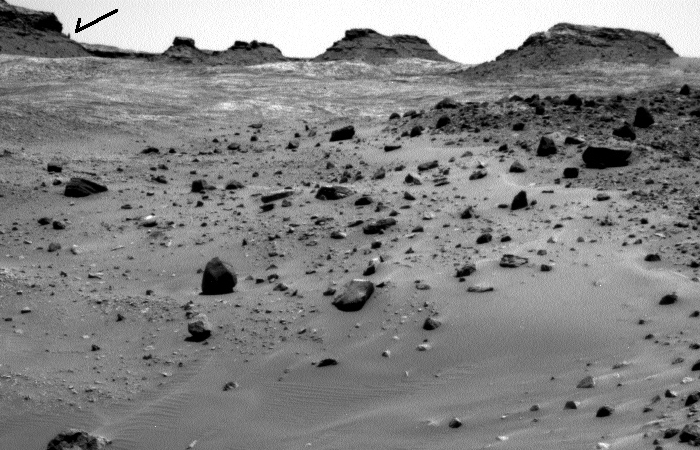
The image above is a panorama I have created from the raw images taken by Curiosity’s left navigation camera today, using this image for the left half and this image for the right half. They show the terrain in front of the rover, including the balanced rock on the horizon, indicated by the arrow.
I have no idea what route the science team plans, but looking at all of the images, as well as their desire to get a closer look at the rock, I suspect they will head up to the left on the smoother ground, aiming almost directly at the balanced rock. I also suspect that they will eventually veer right before getting to the rock, since the rover can’t go over the rough terrain in that area. Stay tuned to find out.
Good news: Despite the opposition of Speaker Paul Ryan (R-Wisconsin), the conservative Freedom Caucus in the House is demanding a vote on the House floor on the impeachment of IRS head John Koskinen.
Two points: First, the vote is not guaranteed, as the motion put forth now will expire during the summer recess. The caucus will have to re-introduce it when Congress reconvenes in September, something they say they will do.
Second, Ryan’s resistance to having this vote does not speak well for him, considering the outrageous stonewalling by Koskinen in connection with IRS scandal, including lying to Congress and participating in the destruction of evidence that had been specifically requested by Congress. It also helps confirm the accusations of Ryan’s opponent in the August 9 Republican primary, Paul Nehlen, that Ryan is not the conservative he claims to be.
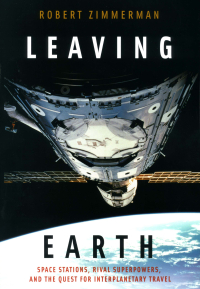
Leaving Earth: Space Stations, Rival Superpowers, and the Quest for Interplanetary Travel, can be purchased as an ebook everywhere for only $3.99 (before discount) at amazon, Barnes & Noble, all ebook vendors, or direct from my ebook publisher, ebookit.
If you buy it from ebookit you don't support the big oppressive tech companies and I get a bigger cut much sooner.
"Leaving Earth is one of the best and certainly the most comprehensive summary of our drive into space that I have ever read. It will be invaluable to future scholars because it will tell them how the next chapter of human history opened." -- Arthur C. Clarke
It appears that Donald Trump has chosen Indiana governor Mike Pence as his vice presidential running mate.
This article provides a detailed look at Pence’s background, which is decidedly conservative and tightly linked with tea party philosophy.
Trump’s choice here is definitely encouraging. It suggests that his claimed conversion to conservative values might actually be sincere (though clearly shallow), because it suggests he is looking for conservatives to help him figure out how to be a conservative. As I’ve said repeatedly, the best way to make sure Trump governs as a constitutional conservative is to surround him with constitutional conservatives. This choice indicates that he is not going to resist that possibility.
Let me add that picking Pence could help Trump significantly in garnering support from the status quo Republicans that have been resisting him, since these same people respect Pence highly.
Let me also add one cautionary note. I have a memory of Pence at one point waffling on conservative principles for political gain, but I cannot at all remember the context or situation. Thus, it is important to remind ourselves repeatedly that these are all politicians, and that their interest is not necessarily that of the nation’s but of their own self-interest, which means getting elected. At any time they could toss the Constitution in the trash heap if that is what they think will get them votes. UPDATE: This article outlines Pence’s waffling as governor in Indiana, confirming my reservations about him.
It is therefore very important to not only surround Trump with conservatives, all politicians must be surrounded by voters who demand they defend our rights and our freedoms, as defined by the Constitution. Only then can we be reasonably assured that those rights will be defended.

Cool image time! The most recently released Dawn image of Ceres, cropped on the right, included these bright streaks running down the side of an unnamed crater. They are especially intriguing because they so much resemble the seepage lines scientists have found on slopes on Mars. On Mars the lines appear to come and go on a seasonal basis, while on Ceres they appear to have been caused by a one-time event, after which not much has changed. In both cases, however, they appear to be caused by some liquid seepage that came from below the surface.
The competition heats up: DARPA outlines its goals for its Experimental Spaceplane program (XS-1).
Key to the effort is DARPA’s recognition that since 2000 under the government’s EELV program, launch costs for the military had increased significantly, while the launch rates appears to slow.
According to DARPA’s presentation, the Pegasus, Minotaur, and Antares launch vehicles only fly one DoD mission per year at a cost of ~$55 million USD per flight.
SpaceX’s Falcon 9 currently performs ~3-6 DoD missions per year at a contract price equal to or greater than $54 million USD per flight.
That price per flight then jumps dramatically for United Launch Alliance’s (ULA’s) Atlas V and Delta IV launch vehicle families – which currently perform about 8 DoD flights per year for a cost per flight in excess of $400 million USD. [emphasis mine]
ULA claims that they charge the Air Force an average of $225 million per launch. DARPA says it is $400 million. Either way, that is a lot higher than the $83 million that SpaceX charged for its first Air Force contract.
The article then provides a nice overview of the XS-1 program, which like NASA’s commercial space program is asking private companies to come up with the new designs and technologies rather than have the government try to do it. All DARPA is doing is laying out their basic requirements, fly 10 times in 10 days for less than $5 million per flight.
The program is now shifting to its second phase, which will call for actual construction proposals late this year, with the hope of test flights by 2019.
The competition heats up: Work on the factories that will build and assembly Russia’s new Angara rocket appear to be nearing completion.
The article is an excellent overview of the entire Angara program. It also includes a number of interesting nuggets of information that might explain events of the past as well as Russia’s future success or failure of Angara.
For example, the repeated problems with Proton’s Briz-M upper station in 2012 could have been caused by the shift of much of its production from the Khrunichev factories near Moscow to a newly absorbed company located in Siberia. The move was made to take advantage of lower costs in Siberia while letting the company sell off land in Moscow.
Beginning in 2009, PO Polyot was to take responsibility for the production of the Briz-KM upper stage for the Rockot booster, as well as Rockot’s adapter rings and the payload fairings. Also, the manufacturing of all key elements for the Angara-1.2 version of the rocket would end up in Omsk as well. Additionally, the Ust-Katav Wagon-building Plant, UKVZ, would produce components for Angara and its KVTK upper stage, along with sections of the Proton rocket and the Briz-M upper stage.
As for Angara, the article suggests that Russia is struggling to make it as inexpensive to launch as Proton:
» Read more
The competition heats up: Iridium prepares the first 10 of a total of 81 new satellites for launch on SpaceX’s Falcon 9 in September.
The Iridium Next program is a $3 billion investment by Iridium, according to Matt Desch, Iridium’s chief executive officer. Iridium’s purchase of 81 satellites represents approximately $2.2 billion of that cost, Desch said, and the company’s launch contract with SpaceX for seven Falcon 9 flights was valued at $492 million when the parties signed it in 2010. That was the largest commercial launch contract in history until last year’s 21-launch order by satellite Internet provider OneWeb with Arianespace.
The first 10 Iridium Next satellites will fly on a Falcon 9 rocket in September, followed by a second launch as soon as December with the next batch. Iridium managers will give the go-ahead for the second launch once the first 10 satellites finish initial in-orbit tests, Desch said. The other five launches should occur about once every two months next year to fill out the Iridium Next fleet 485 miles (780 kilometers) above Earth. Iridium’s contract with SpaceX calls for all the missions to fly on newly-built Falcon 9s, a situation unlikely to change any time soon since insurance arrangements for the initial launches have been finalized.
But Desch said he is open to purchasing reused Falcon 9 boosters in the future “if they’re the right price.”
To meet this schedule SpaceX’s launch schedule will have to ramp up considerably from its present rate of one launch about every three weeks.
An evening pause: I especially like the use of digital sounds mixed with the standard orchestra.
Hat tip Edward Thelen.
Update on the November Democratic primary: Donald Trump was quoted in a news article today that he really doesn’t care that much it the Republicans retain their majority in the Senate.
When I asked him recently whether the party’s maintaining its majority in the Senate meant anything to him, he replied: “Well, I’d like them to do that. But I don’t mind being a free agent, either.” Trump has shown similarly little interest in helping his party’s committees build the sort of war chests typically required in a campaign year. After winning the presidential nomination on a shoestring budget and with fewer paid staff members than the average candidate for governor, he has been visibly reluctant to help build much in the way of national campaign infrastructure, sending a clear message to his fellow Republicans: This fall, you’re on your own. [emphasis in original]
I strongly advice all my readers to read the analysis at the link. From all accounts, Trump’s campaign effort sure does look like he is a Democratic wolf in Republican sheep’s clothing, and that this prediction describing an actual Trump administration will prove amazingly accurate.
Finding out what’s in it: The third Obamacare co-op in the past two weeks has failed. .
Illinois regulators took steps Tuesday to shut down Land of Lincoln Health, a 3-year-old startup that lost $90 million in 2015 and more than $17 million through May 31. Illinois Department of Insurance officials announced they are seeking a court order allowing the state to take over Land of Lincoln Health and prepare the company for liquidation. The department’s acting director, Anne Melissa Dowling, will work with the federal government to establish a 60-day special enrollment period for Land of Lincoln policyholders to find and purchase new health coverage.
This leaves the count at 16 failures out of 23 Obamacare co-ops. And there will be more. The economics of the co-ops never made sense, dependent as they were on gigantic and unaffordable subsidizes from the government. In fact, none of the economics of any of Obamacare make sense, which is why the whole monstrous law has raised costs for everyone and made being a doctor a far worse bureaucratic nightmare than it was before the law was passed.
It is a good thing the American people have woken up and decided to nominate candidates for President who are avowed conservatives with proven track records for limiting the power of government. Oh wait…
This story, about how Attorney General Loretta Lynch refused during testimony to Congress this week to admit the clear illegality of giving classified information to people without clearance, should not surprise anyone. Nor should her partisan willingness to protect Democratic politicians like Hillary Clinton.
Before she was even ratified by the Republican-led Senate in 2015, she was exposed as someone who was easily willing to ignore the law during her nomination hearings. As I wrote then,
The video of Lynch’s non-answer to Cruz’s question is quite shocking. I dare you to watch it and tell me afterward that this administration and Democratic Party is not a threat to your freedom and rights.
Cruz was not afraid to buck the trend and vote against her. The majority of the Republicans in Congress however were, as always, wimps, and let the Democrats get her approved. We are paying for this now.
A volcano near Rome that last erupted 36,000 years ago is now showing signs of re-awakening.
Scientists previously assumed Colli Albani, a 15-kilometer (9-mile) semicircle of hills outside Rome, was an extinct volcano since there was no record of it having erupted in human history. But in recent years, scientists have observed new steam vents, earthquakes and a rise in ground level in the hills and surrounding area. These observations, along with new evidence of past eruptions and satellite data, indicate Colli Albani is starting a new eruptive cycle and could potentially erupt in 1,000 years from now, according to a new study published in Geophysical Research Letters, a journal of the American Geophysical Union.
The competition heats up: A partnership between two British space companies, a smallsat manufacturer and a space antenna operator, will team up to build and test a new smallsat communications satellite in lunar orbit.
The SSTL-GES Lunar Pathfinder team are already working on the initial baseline design, with technical assistance from the European Space Agency (ESA). SSTL are designing a series of lunar communication satellites and will be building on their heritage of small satellite platforms in Low Earth orbit and Medium Earth orbit to go beyond Earth’s orbit for the first time. GES are upgrading one of the famous antennas at their Goonhilly site in Cornwall, UK, into a deep space ground asset, which will be the first element in a commercial deep space network. In addition, GES will provide a dedicated mission operations centre situated in Cornwall.
What is interesting about this is that this is a private effort to develop a modern commercial deep space communications network for future planetary missions. It would be competitive with NASA’s Deep Space Network, which presently is the only game in town and is generally made up of upgraded 1960s based technology. This new network would also eventually include a dedicated network of smallsats scattered through the solar system to act as communications relays. This is something that NASA does not provide, depending instead on the communications instruments of the planetary missions themselves.
The competition heats up: The European Space Agency has signed a research contract for 10 million euros with Reaction Engines to build a ground-based prototype of its hypersonic rocket engine.
While ground testing is always necessary, I am not sure what they gain by building a solely ground-based prototype. Hypersonic engines use the oxygen in the atmosphere, much like jet engines. Their operation however is dependent on altitude as well as the speed in which they are traveling, neither of which is easily tested on the ground.
This project is also one part of the United Kingdom’s new space agency program.
Embedded below the fold. I spent a large portion of the podcast talking about the medical problems caused by long-term weightlessness, and how it might limit our ability to send humans to other planets. We also touched on the possible consequences to space policy should Donald Trump pick Newt Gingrich as his VP.
» Read more
The competition heats up: Rocket Lab has signed a three launch contract with the smallsat Earth resources satellite company Planet (formerly Planet Labs).
The contract covers three dedicated launches of Dove satellites built by San Francisco-based Planet, formerly known as Planet Labs, on Electron vehicles. The companies did not announce terms of the deal, although Rocket Lab quotes a list price of $4.9 million per Electron launch on its website.
Mike Safyan, director of launch and regulatory affairs for Planet, said in an interview during the International Space Station Research and Development Conference here that the number of satellites that each launch will carry is still being determined, but will likely be between 20 and 25. Each Dove is a three-unit cubesat with a mass of about five kilograms.
If this report as well as previous ones are correct, the first Electron rocket launch will happen before the end of this year.