Pluto: the world’s largest lava lamp

In comparing the New Horizons’ data with computer simulations, scientists have determined that the frozen nitrogen in the heart-shaped Sputnik Planum region rises and sinks as the nitrogen is heated from below.

McKinnon and colleagues believe the pattern of these cells stems from the slow thermal convection of the nitrogen-dominated ices that fill Sputnik Planum. A reservoir that’s likely several miles deep in some places, the solid nitrogen is warmed by Pluto’s modest internal heat, becomes buoyant and rises up in great blobs – like a lava lamp – before cooling off and sinking again to renew the cycle. The computer models show that ice need only be a few miles deep for this process to occur, and that the convection cells are very broad. The models also show that these blobs of overturning solid nitrogen can slowly evolve and merge over millions of years. Ridges that mark where cooled nitrogen ice sinks back down can be pinched off and abandoned, resulting in Y- or X-shaped features in junctions where three or four convection cells once met.

1 comment

Longest and deepest rail tunnel opens

After 17 years of construction, the world’s longest and deepest rail tunnel has opened today in Switzerland.

If you take into account the two main tubes that comprise the Gotthard Base Tunnel and its various shafts, cross passages and access tunnels, it actually has 152 km (94 mi) of tunnels in total. It is also said to have virtually no gradients.

The initial idea for the tunnel was conceived 68 years ago, but the plans were redrawn on a number of occasions. Once construction finally commenced, there were 2,400 workers on site at peak times. Nine workers also lost their lives during the build.

0 comments

Genesis cover

On Christmas Eve 1968 three Americans became the first humans to visit another world. What they did to celebrate was unexpected and profound, and will be remembered throughout all human history. Genesis: the Story of Apollo 8, Robert Zimmerman's classic history of humanity's first journey to another world, tells that story, and it is now available as both an ebook and an audiobook, both with a foreword by Valerie Anders and a new introduction by Robert Zimmerman.

The print edition can be purchased at Amazon or any other book seller. If you want an autographed copy the price is $60 for the hardback and $45 for the paperback, plus $8 shipping for each. Go here for purchasing details. The ebook is available everywhere for $5.99 (before discount) at amazon, or direct from my ebook publisher, ebookit. If you buy it from ebookit you don't support the big tech companies and the author gets a bigger cut much sooner.


The audiobook is also available at all these vendors, and is also free with a 30-day trial membership to Audible.
 

"Not simply about one mission, [Genesis] is also the history of America's quest for the moon... Zimmerman has done a masterful job of tying disparate events together into a solid account of one of America's greatest human triumphs."--San Antonio Express-News

New data challenges consensus on galaxy formation

The uncertainty of science: A new study has found that the accepted consensus for the formation of large elliptical galaxies does not work, and that, rather than forming from the merger of smaller spiral galaxies, ellipticals formed in place from the material at hand.

From the press release [pdf].

“We started from the data, available in complete form only for the closer galaxies and in incomplete form for the more distant ones, and we filled the ‘gaps’ by interpreting and extending the data based on a scenario we devised” comments Mancuso. The analysis also took into account the phenomenon of gravitational lensing, which allows us to observe very distant galaxies belonging to ancient cosmic epochs.

In this “direct” manner (i.e., model-independent) the SISSA group obtained an image of the evolution of galaxies even in very ancient epochs (close, in a cosmic timescale, to the epoch of reionization). This reconstruction demonstrates that elliptical galaxies cannot have formed through the merging of other galaxies, “simply because there wasn’t enough time to accumulate the large quantity of stars seen in these galaxies through these processes”, comments Mancuso. “This means that the formation of elliptical galaxies occurs through internal, in situ processes of star formation.

The important take-away of this result is that it shows that the present theory of galaxy formation, where smaller spiral galaxies merge to form larger elliptical galaxies, does not fit the data. And if a theory does not fit the data, it must be abandoned.

5 comments

Conscious Choice cover

Now available in hardback and paperback as well as ebook!

From the press release: In this ground-breaking new history of early America, historian Robert Zimmerman not only exposes the lie behind The New York Times 1619 Project that falsely claims slavery is central to the history of the United States, he also provides profound lessons about the nature of human societies, lessons important for Americans today as well as for all future settlers on Mars and elsewhere in space.

 
Conscious Choice: The origins of slavery in America and why it matters today and for our future in outer space, is a riveting page-turning story that documents how slavery slowly became pervasive in the southern British colonies of North America, colonies founded by a people and culture that not only did not allow slavery but in every way were hostile to the practice.  
Conscious Choice does more however. In telling the tragic history of the Virginia colony and the rise of slavery there, Zimmerman lays out the proper path for creating healthy societies in places like the Moon and Mars.


“Zimmerman’s ground-breaking history provides every future generation the basic framework for establishing new societies on other worlds. We would be wise to heed what he says.” —Robert Zubrin, founder of the Mars Society.


All editions are available at Amazon, Barnes & Noble, and all book vendors, with the ebook priced at $5.99 before discount. All editions can also be purchased direct from the ebook publisher, ebookit, in which case you don't support the big tech companies and the author gets a bigger cut much sooner.


Autographed printed copies are also available at discount directly from the author (hardback $29.95; paperback $14.95; Shipping cost for either: $6.00). Just send an email to zimmerman @ nasw dot org.

Airbus Safran begin Ariane 6 engine tests

The competition heats up: In its effort to build Ariane 6 by 2020, Airbus Safran has begun testing of that rocket’s upper stage Vinci engine.

This test phase, set to last until September, will include running the engine repeatedly as well as for as long as 1,000 seconds. Once they have determined the engine’s design, behavior, and overall thrust, they will be able to design and build the upper stage.

0 comments

Orbital ATK successfully completes Antares test fire

The competition heats up: Orbital ATK today successfully completed a 30 second test fire of the first stage of its redesigned Antares rocket, using new Russian rocket engines.

The primary goal of the test was to verify the functionality of the integrated first stage, including new engines, modified Stage 1 core, avionics, thrust vector control and pad fueling systems in an operational environment. During the test, a number of operational milestones were met including full propellant loading sequence, launch countdown and engine ignition and shut down commands, as well as multiple throttle settings including full engine power. The test also validated the launch pad’s operation, including propellant tanking and the use of the water deluge system to protect the pad from damage and for noise suppression.

Orbital ATK will now purge and clean the engines of residual propellants and return the first stage used in this test to the Horizontal Integration Facility for full reconditioning prior to its use on the OA-7 mission slated for later this year. The Orbital ATK team will continue to prepare the Antares rocket that will launch the OA-5 mission, which is in the final stages of integration, systems testing and check-out in preparation for launch this summer.

They hope to launch a Cygnus capsule on Antares around July 6.

2 comments

Leaving Earth cover

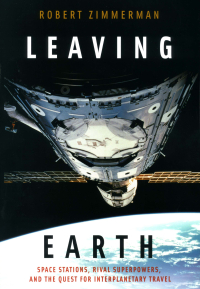
Leaving Earth: Space Stations, Rival Superpowers, and the Quest for Interplanetary Travel, can be purchased as an ebook everywhere for only $3.99 (before discount) at amazon, Barnes & Noble, all ebook vendors, or direct from my ebook publisher, ebookit.

If you buy it from ebookit you don't support the big oppressive tech companies and I get a bigger cut much sooner.


Winner of the 2003 Eugene M. Emme Award of the American Astronautical Society.

 
"Leaving Earth is one of the best and certainly the most comprehensive summary of our drive into space that I have ever read. It will be invaluable to future scholars because it will tell them how the next chapter of human history opened." -- Arthur C. Clarke

Obamacare forces small businesses to drop employee health benefits

Finding out what’s in it: An IRS ruling from 2013, based on Obamacare and now going into effect, will force small businesses that offer alternatives to health insurances to drop those alternatives, or face hefty fines.

This ruling applies to businesses with fewer than 50 employees, who supposedly were going to be unaffected by Obamacare. Previously, they could offer their employees stipends to buy insurance themselves, as individuals. Obamacare bans this, requiring the business to either join Obamacare, which is too expensive, or face fines if they provide the stipends. So, the wonderful law that Obama and the Democrats passed instead leaves these workers with less than they had before.

7 comments

Rosetta almost lost during weekend

Because Rosetta’s star tracker became confused by dust particles, the spacecraft lost contact with Earth, went into safe mode, and required the entire weekend for engineers to regain control.

“We lost contact with the spacecraft on Saturday evening for nearly 24 hours,” says Patrick Martin, ESA’s Rosetta mission manager. “Preliminary analysis by our flight dynamics team suggests that the star trackers locked on to a false star – that is, they were confused by comet dust close to the comet, as has been experienced before in the mission.” This led to spacecraft pointing errors, which triggered the safe mode. Unfortunately the star trackers then got hung in a particular sub mode requiring specific action from Earth to recover the spacecraft.

“It was an extremely dramatic weekend,” says Sylvain Lodiot, ESA’s Rosetta spacecraft operations manager.”

The spacecraft has been diving to within only a few miles of the surface of Comet 67P/C-G, which means it is flying close to the comet’s coma. The increased dust in that region has confused the star tracker in the past, but this appears to have been the most serious event yet.

0 comments

The B-1 Lancer Bomber

An evening pause: One reason we have a Memorial Day is to honor those who have died to keep us free. We also remember them to remind us that the sacrifice was necessary.

I think it is long past time to repeat the same effort, no matter the cost, and use this plane’s payload a lot more than we are. There are people in the Middle East who are gleefully killing people for the sake of power. We should no longer tolerate them.

Hat tip Rocco.

4 comments

Premature engine cutoff on Soyuz upper stage

During a successful Soyuz rocket launch of a Russian Glonass GPS satellite last week, it appears that the engine for the rocket’s upper stage cut off prematurely, requiring the third stage to fire longer to get the satellite into its proper orbit.

This scenario is almost identical to what happened with the most recent Atlas 5 launch. There is as yet no word on why it happened, or if the Russians plan to investigate it.

2 comments

XCOR layoffs, ending Lynx?

In the heat of competition: XCOR has laid off the staff working on its Lynx suborbital spaceplane.

The company has apparently decided to focus on those things that are generating revenues. Lynx was years behind schedule, unfinished with no prospect for profit, as it was only a prototype, not the spaceplane that could be used to fly tourists.

As much as I am not surprised (I have been skeptical of XCOR’s Lynx suborbital project since they announced it in 2008), I am saddened, because I really did want them to succeed.

1 comment

More enraged anti-American protests against Trump

Feel the hate: Though there was less violence than previous anti-Trump protests, the protesters yesterday in San Diego, as shown by this report, illustrated several things about what they stand for.

First, they hate the United States. Just look at the plethora of Mexican flags, as well as the signs, including one that proudly reads, “America was never great,” with the word America made of dripping blood.

Second, they hate Trump. Once again, their signs and behavior, including attacking any Trump supporters that happened walk by, prove this.

Three, they hate knowledge. In this case the sign that reads “We are all women! Mexican! Muslim! Love trumps hate!” illustrates this, since it incoherently supports women and Islam at the same time, somehow forgetting that Islam is probably the world’s most aggressive oppressive of women.

Four, they hate whites, demonstrated by the signs that read “Brown power will rise!!!” and “Black and Brown lives matter” (found here).

I could go on. What I really want to note is that these people, who also make very clear their leftwing agenda, simply hate. The anger and intolerance of those they disagree with or have a skin color (white) they don’t like, is obvious and disgusting. What I find interesting is the left has always been this way, but for some reason they no longer feel a need to disguise it.

15 comments

NASA to try module expansion again on Saturday

NASA will try again on Saturday to expand the privately built BEAM module on ISS.

They think the reason the module didn’t inflate as planned the first time is because it has been packed ready for launch for more than fifteen months, ten months longer than originally planned.

That extra time in a tight squeeze might explain why the first inflation attempt didn’t go as planned. BEAM’s Kevlar-like fabric “layers have a memory to them,” Lisa Kauke, BEAM deputy program manager at Bigelow Aerospace, said during today’s teleconference. “The longer they’re packed, the more they’re compressed, and then it takes a little while for the shape to return.” This interpretation is bolstered by the fact that BEAM continued to expand overnight Thursday into Friday morning, even though no more air was being pumped in, Crusan said.

0 comments
1 1,050 1,051 1,052 1,053 1,054 1,759