The swamp comes up with a swamp solution for promoting space

Like pigs at the trough

A group of senators last week announced the re-introduction of a bill they had proposed previously in 2023 that they claim would encourage new spaceport development across the United States. From their press release:

Today, U.S. Senators John Hickenlooper, John Cornyn, Ben Ray Luján, and Roger Wicker introduced the bipartisan Spaceport Project Opportunities for Resilient Transportation (SPACEPORT) Act, which would encourage the development of commercial spaceports through the modernization of the Federal Aviation Administration’s (FAA) Space Transportation Infrastructure Matching (STIM) grant program.

Spaceports, including the Colorado Air and Space Port in Adams County, are ground-based launch and reentry sites that can be used to support public and private ventures into space. “Spaceports are Colorado’s gateway to the commercial space boom, and we need to prioritize that infrastructure if we want to stay at the top of the space industry,” said Hickenlooper. “American space exploration has come a long way, but we can and should go even further,” said Cornyn. “By investing in our spaceport infrastructure, this legislation helps ensure the U.S. space industry remains competitive and is prepared to handle future national security threats.”

Though two of these four senators are Republicans (Cornyn and Wicker), the political leanings of this group is decidedly uni-party and establishment based. Polls for example show that Cornyn is not liked by conservatives in Texas, and will lose a primary challenge from the state’s attorney general Ken Paxton. Wicker doesn’t have the same polling issues, but he has also taken positions that suggests he is a willing member of the Republican establishment that has resisted change for decades.

And the actual bill [pdf] itself proves that all four senators are pure swamp. It doesn’t do anything to directly support spaceport development, as Hickenlooper and Cornyn claim. Instead, it would create a $10 million grant fund that the transportation secretary could hand out willy-nilly each year to political friends and buddies. It would also require the heads of Transportation, Defense, Commerce, and NASA to issue a report every four years that simply reviews the state of America’s space industry and describes it.

The bill does nothing to reduce regulation, the main obstacle blocking the U.S. rocket and space industry. If anything, it allows that red tape to flourish by creating this slush fund that politicians can later use to bribe private companies. The report itself will require more bureaucrats and paperwork, and will act to prevent that bureaucracy from doing its regulatory responsibilities, thus slowing license approvals further.

Introducing a bill like this does not guarantee passage of course. It failed previously in 2023. I suspect it is even more likely to fail now, because the trend appears to be moving away from this kind of funding and legal gabblygook.

2 comments

Failed launch by Iran

Though information is at present scarce and contradictory, Iran in the past few days appears to have made one or two launch attempts, either of a missile system near Tehran or of its orbital Zoljanah rocket from its Semnan spaceport to the east.

According to this Newsweek report, the launch was of a “suspected missile system … near its capital, Tehran.”

According to this tweet from astronomer Jonathan McDowell, who monitors such activity, it was a “possible failed orbital launch attempt … of an IRGC Zoljanah launch vehicle from Semnan, Iran.”

There is also this tweet from Iran media, which calls it a “missile” and a “test” that failed.

I think these conflicting reports are describing the same launch. If its the latter, then the question is whether it was a Zoljanah rocket, and if so was it attempting its first orbital launch after two suborbital tests in ’21 and ’22?

4 comments

Genesis cover

On Christmas Eve 1968 three Americans became the first humans to visit another world. What they did to celebrate was unexpected and profound, and will be remembered throughout all human history. Genesis: the Story of Apollo 8, Robert Zimmerman's classic history of humanity's first journey to another world, tells that story, and it is now available as both an ebook and an audiobook, both with a foreword by Valerie Anders and a new introduction by Robert Zimmerman.

The print edition can be purchased at Amazon or any other book seller. If you want an autographed copy the price is $60 for the hardback and $45 for the paperback, plus $8 shipping for each. Go here for purchasing details. The ebook is available everywhere for $5.99 (before discount) at amazon, or direct from my ebook publisher, ebookit. If you buy it from ebookit you don't support the big tech companies and the author gets a bigger cut much sooner.


The audiobook is also available at all these vendors, and is also free with a 30-day trial membership to Audible.
 

"Not simply about one mission, [Genesis] is also the history of America's quest for the moon... Zimmerman has done a masterful job of tying disparate events together into a solid account of one of America's greatest human triumphs."--San Antonio Express-News

South Korean rocket startup Innospace wins launch and marketing contract with German broadcast company

The South Korean rocket startup Innospace announced last week that it has signed a $5.8 million launch with the German broadcast company Media Broadcast Satellites (MBS) to not only launch two MBS satellites in 2026 and 2028 using its Hanbit rocket, but to have MBS market the rocket in Germany.

Under the agreement, INNOSPACE will carry out two HANBIT launch missions to deploy MBS satellites into Low Earth orbit (LEO), with one launch in 2026 and the other planned by 2028. In both launch missions, MBS satellites will serve as the primary payloads, with priority in launch scheduling and orbit determination.

INNOSPACE also signed a separate contract on the same day, officially appointing MBS as its exclusive agent for launch service sales and marketing within Germany, marking the company’s entry into the European space launch market. Following the contract, MBS will exclusively distribute launch services based on the HANBIT series to satellite customers in Germany.

Innospace has not yet launched Hanbit. It had hoped to attempt the first launch in July, but in May it delayed it to the end of 2025 due to issues found in a first stage pump. The launch itself will take place at Brazil’s long abandoned Alcântara spaceport on that nation’s northeast coast.

4 comments

Avio wins U.S. launch contract for its Vega-C rocket

Capitalism in space: In what I think is a first, the Italian rocket company Avio has won a Vega-C launch contract without any participation from the European Space Agency’s (ESA) commercial division Arianespace.

The contract is also with an American company, SpaceLaunch, to put an “institutional Earth observation satellite” in orbit in 2027.

The significance of the deal is that Avio is now successfully marketing and selling its Vega-C rocket, without the middleman Arianespace taking a cut. As part of the shift of ESA and Europe to the capitalism model, whereby it no longer runs things but acts merely as a customer, it also freed Avio from the clutches of Arianespace. Previously, Avio built the rocket for that government agency, which then marketed and sold it to satellite companies. Avio had no control over profit or price. In fact, it didn’t really own its own rocket.

This absurd situation is now ending. There are still a handful of Vega-C launches that were contracted for under Arianespace, but after these Avio will be completely in charge. This deal, announced yesterday, is the beginning of that process.

2 comments

Conscious Choice cover

Now available in hardback and paperback as well as ebook!

From the press release: In this ground-breaking new history of early America, historian Robert Zimmerman not only exposes the lie behind The New York Times 1619 Project that falsely claims slavery is central to the history of the United States, he also provides profound lessons about the nature of human societies, lessons important for Americans today as well as for all future settlers on Mars and elsewhere in space.

 
Conscious Choice: The origins of slavery in America and why it matters today and for our future in outer space, is a riveting page-turning story that documents how slavery slowly became pervasive in the southern British colonies of North America, colonies founded by a people and culture that not only did not allow slavery but in every way were hostile to the practice.  
Conscious Choice does more however. In telling the tragic history of the Virginia colony and the rise of slavery there, Zimmerman lays out the proper path for creating healthy societies in places like the Moon and Mars.


“Zimmerman’s ground-breaking history provides every future generation the basic framework for establishing new societies on other worlds. We would be wise to heed what he says.” —Robert Zubrin, founder of the Mars Society.


All editions are available at Amazon, Barnes & Noble, and all book vendors, with the ebook priced at $5.99 before discount. All editions can also be purchased direct from the ebook publisher, ebookit, in which case you don't support the big tech companies and the author gets a bigger cut much sooner.


Autographed printed copies are also available at discount directly from the author (hardback $29.95; paperback $14.95; Shipping cost for either: $6.00). Just send an email to zimmerman @ nasw dot org.

SpaceX launches 28 Starlink satellites

The beat goes on. SpaceX early this morning successfully placed another 28 Starlink satellites in orbit, its Falcon 9 rocket lifting off from Cape Canaveral in Florida.

The first stage completed its eleventh flight, landing on a drone ship in the Atlantic.

The leaders in the 2025 launch race:

121 SpaceX
54 China
13 Russia
12 Rocket Lab

SpaceX now leads the rest of the world in successful launches, 121 to 93.

4 comments

Blue Origin wins contract to bring NASA’s Viper rover to the Moon

NASA yesterday awarded Blue Origin a contract to use its Blue Moon lunar lander to transport the agency’s troubled Viper rover to the Moon’s south pole region.

The CLPS task order has a total potential value of $190 million. This is the second CLPS lunar delivery awarded to Blue Origin. Their first delivery – using their Blue Moon Mark 1 (MK1) robotic lander – is targeted for launch later this year to deliver NASA’s Stereo Cameras for Lunar-Plume Surface Studies and Laser Retroreflective Array payloads to the Moon’s South Pole region.

With this new award, Blue Origin will deliver VIPER to the lunar surface in late 2027, using a second Blue Moon MK1 lander, which is in production. NASA previously canceled the VIPER project and has since explored alternative approaches to achieve the agency’s goals of mapping potential off-planet resources, like water.

The contract does not guarantee this mission. NASA has several options along the way to shut things down, depending on the milestones Blue Origin achieves. The first of course is the success of that first lunar lander.

The announcement does not make clear how NASA is going to pay for the work needed to finish Viper. VIPER was originally budgeted at $250 million. When cancelled in 2024 its budget had ballooned to over $600 million, and that wasn’t enough to complete the rover for launch. Moreover, after getting eleven proposals from the private sector companies to finish and launch Viper, in May 2025 NASA canceled that solicitation.

It is very likely Blue Origin is picking up the tab, but if so the press release does not say so.

10 comments

Leaving Earth cover

Leaving Earth: Space Stations, Rival Superpowers, and the Quest for Interplanetary Travel, can be purchased as an ebook everywhere for only $3.99 (before discount) at amazon, Barnes & Noble, all ebook vendors, or direct from my ebook publisher, ebookit.

If you buy it from ebookit you don't support the big oppressive tech companies and I get a bigger cut much sooner.


Winner of the 2003 Eugene M. Emme Award of the American Astronautical Society.

 
"Leaving Earth is one of the best and certainly the most comprehensive summary of our drive into space that I have ever read. It will be invaluable to future scholars because it will tell them how the next chapter of human history opened." -- Arthur C. Clarke

September 19, 2025 Quick space links

Courtesy of BtB’s stringer Jay. This post is also an open thread. I welcome my readers to post any comments or additional links relating to any space issues, even if unrelated to the links below.

13 comments

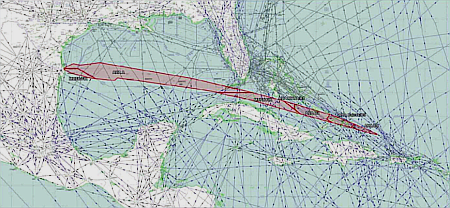
FAA releases proposed revisions to environmental assessment at Boca Chica to accomodate full orbital testing and return of both Superheavy and Starship

The planned return trajectories for both Superheavy and Starship
The planned return trajectories for both
Superheavy and Starship

The FAA today released [pdf] a new draft of the environmental assessment of SpaceX’s Superheavy/Starship operations at Boca Chica that will allow for full orbital flights as well as for both to return to that launchpad.

The two maps to the right show the two planned return paths for Superheavy (top) and Starship (bottom) as it comes back from orbit. In both cases the ships will return to Boca Chica to be caught by tower chopsticks. The reassessment analyzed the impacts of these trajectories, including its impact on aviation traffic, and concluded the proposal was acceptable. From its conclusion:

The 2022 PEA [Programmatic Environmental Assessment] and April 2025 Tiered EA [environmental assessment] examined the potential for significant environmental impacts from Starship-Super Heavy launch operations at the Boca Chica Launch Site and defined the regulatory setting for impacts associated with Starship-Super Heavy. The areas evaluated for environmental impacts in this Tiered EA include aviation emissions and air quality; noise and noise-compatible land use; hazardous materials; and socioeconomics. In each of these areas, the FAA has concluded that no significant impacts would occur as a result of the Proposed Action. [emphasis mine]

This approval is still only a draft. It must go through a public comment period, ending October 20, 2025. There will also be a virtual public meeting on October 7, 2025. Information about submitting comments or participating in that virtual meeting can be found here.

Such meetings are likely to see the leftist anti-Musk crowd come out in droves, screeching how we are all gonna die if these launches are allowed. The FAA will nod its head, and then ignore the Chicken Littles and approve this plan.

The plan itself tells us that SpaceX is definitely gearing up the first orbital flights of Starship next year, along with the first attempts to catch it with the tower chopsticks.

2 comments

Inexplicable very large patterns found in Saturn’s upper atmosphere

Beads and arms in Saturn's upper atmosphere
Click for original image.

Using the Webb Space Telescope’s infrared capabilities, scientists have detected several different and inexplicable large atmospheric structures linked somehow to the gas giant’s north pole aurora.

The two images to the right, cropped, reduced, and annotated to post here, show both types of newly discovered features.

The international team of researchers, comprising 23 scientists from institutions across the UK, US and France, made the discoveries during a continuous 10-hour observation period on 29 November 2024, as Saturn rotated beneath JWST’s view. The team focused on detecting infrared emissions by a positively charged molecular form of hydrogen, H3+, which plays a key role in reactions in Saturn’s atmosphere and so can provide valuable insights into the chemical and physical processes at work. JWST’s Near Infrared Spectrograph allowed the team to simultaneously observe H₃⁺ ions from the ionosphere, 1,100 kilometres above Saturn’s nominal surface, and methane molecules in the underlying stratosphere, at an altitude of 600 kilometres.

In the electrically-charged plasma of the ionosphere, the team observed a series of dark, bead-like features embedded in bright auroral halos. [top picture] These structures remained stable over hours but appeared to drift slowly over longer periods.

Around 500 kilometres lower, in Saturn’s stratosphere, the team discovered an asymmetric star-shaped feature [bottom picture]. This unusual structure extended out from Saturn’s north pole towards the equator. Only four of the star’s six arms were visible, with two mysteriously missing, creating a lopsided pattern.

A more accurate word for the “beads” I think would be “patches”, as they are not small but major dark regions that appear to rotate with the planet, as do the arms. Both also seem to be related to each other as their rotations match, though one sits about 300 miles lower in the atmosphere. As noted in the press release, “the processes that are driving the patterns may influence a column stretching right through Saturn’s atmosphere.”

All guesses. All we have at this point is a truly intriguing observation.

1 comment
1 125 126 127 128 129 2,928