SpaceX launches 23 more Starlink satellites

It just keeps going and going: SpaceX today successfully launched another 23 Starlink satellites, its Falcon 9 rocket lifting off from Cape Canaveral.

The first stage completed its fifteenth flight, landing on a drone ship in the Atlantic.

The leaders in the 2024 launch race:

47 SpaceX
18 China
6 Russia
5 Rocket Lab

American private enterprise now leads the world combined in successful launches, 54 to 30. SpaceX by itself now leads the rest of the world, including other American companies, 47 to 37.

1 comment

A supernova factory

A supernova factory

Cool image time! The picture to the right, cropped, reduced, and sharpened to post here, was taken by the Hubble Space Telescope in 2023 as part of a survey of galaxies where recent supernovae have occurred. One occurred in 2020 in this galaxy, which is about 240 million light years away and dubbed UGC 9684.

Remarkably, the 2020 supernova in this galaxy isn’t the only one that’s been seen there — four supernova-like events have been spotted in UGC 9684 since 2006, putting it up there with the most active supernova-producing galaxies. It turns out that UGC 9684 is a quite active star-forming galaxy, calculated as producing one solar mass worth of stars every few years! This level of stellar formation makes UGC 9684 a veritable supernova factory, and a galaxy to watch for astronomers hoping to examine these exceptional events.

This image provides scientists a high resolution baseline should another supernova occur. It will not only make it easier to spot a future supernova, it also increases the chances that the progenitor star that went boom could be identified.

0 comments

Genesis cover

On Christmas Eve 1968 three Americans became the first humans to visit another world. What they did to celebrate was unexpected and profound, and will be remembered throughout all human history. Genesis: the Story of Apollo 8, Robert Zimmerman's classic history of humanity's first journey to another world, tells that story, and it is now available as both an ebook and an audiobook, both with a foreword by Valerie Anders and a new introduction by Robert Zimmerman.

The print edition can be purchased at Amazon or any other book seller. If you want an autographed copy the price is $60 for the hardback and $45 for the paperback, plus $8 shipping for each. Go here for purchasing details. The ebook is available everywhere for $5.99 (before discount) at amazon, or direct from my ebook publisher, ebookit. If you buy it from ebookit you don't support the big tech companies and the author gets a bigger cut much sooner.


The audiobook is also available at all these vendors, and is also free with a 30-day trial membership to Audible.
 

"Not simply about one mission, [Genesis] is also the history of America's quest for the moon... Zimmerman has done a masterful job of tying disparate events together into a solid account of one of America's greatest human triumphs."--San Antonio Express-News

Watching the first manned launch of Boeing’s Starliner capsule

UPDATE: Launch scrubbed due to an issue on the upper stage. When a new launch date is announced I will put up a new post.

———————–
The first manned launch of Boeing’s Starliner capsule is presently targeting a 10:34 pm (Eastern) launch tonight from Cape Canaveral, lifting off on ULA’s Atlas-5 rocket.

The flight will carry two NASA astronauts, Butch Wilmore and Suni Williams, and will dock with ISS a little over 24 hours later for a week of testing docked to the station.

The live stream for tonight’s launch is embedded below. Though that coverage will include several prelaunch and post launch press conferences, the key coverage of the launch itself will begin at 6:30 pm (Eastern) on May 6th, about four hours before the launch itself. It will also include the capsule’s docking with ISS on May 8th. Most of the prelaunch coverage will be NASA PR, even though the only time NASA is participating significantly is when ISS is involved. Boeing is operating the capsule and ULA is operating the launch.

» Read more

5 comments

Another Starship/Superheavy update

Link here. The report details the extensive work being done by SpaceX engineers and construction crews at Boca Chica, not only upgrading and testing the 30th Starship and 11th Superheavy prototypes that will fly on the fourth orbital test flight but also improving and expanding the launch facilities there.

A static fire test of both vehicles could happen in the next week or so, though this remains uncertain.

Though it appears that SpaceX will be ready to fly by mid- to late-May, the key factor on when that fourth test flight occurs remains this:

…there is still no news on when Flight 3’s mishap investigation will be completed.

That investigation is being conducted by SpaceX. Once submitted to the FAA that agency will have to review it and issue its own conclusions (essentially rubber-stamping it), something that is guaranteed to take time. In the past it took the FAA from two to seven months to do this rubberstamping, with the time shortening after each flight. There have been indications that it hopes to reduce that time even further with this and later flights. We should therefore expect it to take anywhere from one to four weeks this time.

Thus, a May launch remains unlikely, as I predicted from the get-go. Expect the launch to occur in June, which though delayed will still be an improvement over the FAA’s past red-tape approval processes.

2 comments

Conscious Choice cover

Now available in hardback and paperback as well as ebook!

From the press release: In this ground-breaking new history of early America, historian Robert Zimmerman not only exposes the lie behind The New York Times 1619 Project that falsely claims slavery is central to the history of the United States, he also provides profound lessons about the nature of human societies, lessons important for Americans today as well as for all future settlers on Mars and elsewhere in space.

 
Conscious Choice: The origins of slavery in America and why it matters today and for our future in outer space, is a riveting page-turning story that documents how slavery slowly became pervasive in the southern British colonies of North America, colonies founded by a people and culture that not only did not allow slavery but in every way were hostile to the practice.  
Conscious Choice does more however. In telling the tragic history of the Virginia colony and the rise of slavery there, Zimmerman lays out the proper path for creating healthy societies in places like the Moon and Mars.


“Zimmerman’s ground-breaking history provides every future generation the basic framework for establishing new societies on other worlds. We would be wise to heed what he says.” —Robert Zubrin, founder of the Mars Society.


All editions are available at Amazon, Barnes & Noble, and all book vendors, with the ebook priced at $5.99 before discount. All editions can also be purchased direct from the ebook publisher, ebookit, in which case you don't support the big tech companies and the author gets a bigger cut much sooner.


Autographed printed copies are also available at discount directly from the author (hardback $29.95; paperback $14.95; Shipping cost for either: $6.00). Just send an email to zimmerman @ nasw dot org.

Russia to NASA: We’ll wait a bit before putting our astronauts on Starliner

Even though Russia and NASA have a barter deal whereby one astronaut from each country flies free on each flight of its spacecraft, Russia it appears will forego flying any Russians on Boeing’s Starliner capsule for the immediate future.

At the May 3 briefing, though, NASA officials said it was unlikely that a Russian cosmonaut would be assigned to Starliner-1 [the first operational flight after the first manned demo flight launching today]. “We expect, on the Roscosmos side, they’re more likely to want to see a long-duration flight also, so we think they’ll want to start to fly with us on Starliner-2,” said Dana Weigel, NASA ISS program manager.

That would appear to disrupt the ongoing series of seat exchanges between NASA and Roscosmos. “We’re still working through that with our Roscosmos counterparts. It’s our desire to continue to do integrated crew,” she said, adding that NASA and Roscosmos don’t have an agreement yet in place for exchanging crews in the timeframe that will include Starliner-1.

This isn’t a surprise. Russia made the same decision with SpaceX’s Dragon manned capsule, waiting until it had flown a few times before agreeing to allow its astronauts on it. With Boeing Russia might be more hesitant, consider the problems Starliner has had in development plus the overall quality control issues known to exist at Boeing.

1 comment

Leaving Earth cover

Leaving Earth: Space Stations, Rival Superpowers, and the Quest for Interplanetary Travel, can be purchased as an ebook everywhere for only $3.99 (before discount) at amazon, Barnes & Noble, all ebook vendors, or direct from my ebook publisher, ebookit.

If you buy it from ebookit you don't support the big oppressive tech companies and I get a bigger cut much sooner.


Winner of the 2003 Eugene M. Emme Award of the American Astronautical Society.

 
"Leaving Earth is one of the best and certainly the most comprehensive summary of our drive into space that I have ever read. It will be invaluable to future scholars because it will tell them how the next chapter of human history opened." -- Arthur C. Clarke

German rocket startup Hyimpulse completes suborbital test launch

The German rocket startup Hyimpulse yesterday succesfully completed its first suborbital test launch, launching from the Southern Launch spaceport on the south coast of Australia.

The 12-metre, 2.5-tonne test rocket dubbed “SR75” lifted off shortly after 0500 GMT from a launch site in Koonibba, South Australia. It is capable of carrying small satellites weighing up to 250 kg (551 pounds) to an altitude of up to 250 km (155 miles) while being fuelled by paraffin, or candle wax, and liquid oxygen.

Paraffin can be used as a cheaper and safer alternative fuel for rockets, reducing satellite transportation costs by as much as 50%, according to HyImpulse.

The company hopes to launch its SL-1 rocket on its first orbital test flight next year.

13 comments

The pro-Hamas campus mobs were almost as barbaric as Hamas itself

Library destroyed by pro-Hamas mob

With the mobs of pro-Hamas protesters finally cleared from many occupied college campuses, we are now finding out just how much these rioters resembled the Hamas barbarians whose effort to murder Jews these protesters supported.

To the right is a screen capture from video taken during a short walk through of the inside of the Portland State University’s Millar Library, following the removal of the pro-Hamas rioters. The place was trashed in the most childish way. You can seem more evidence here. As noted by that report:

Paint splattered on floors. Spray-painted messages and screeds covering walls. Furniture moved and overturned. Security cameras disabled. Fire extinguishers missing and entrances blocked by stacks of chairs. “We’ve got our work cut out for us,” a facilities manager at Portland State University said Thursday as he examined the destruction left behind after a three-day occupation by pro-Palestinian protesters in Millar Library.

It also was reported that rare archival materials were stolen by the student mob.

The situation was the same at numerous universities. » Read more

12 comments

SpaceX last night launched another 23 Starlink satellites

The bunny is so fast I missed one: Last night, only a few hours after SpaceX launched two satellites for Maxar, out of Vandenberg in California, the company followed this with another launch of 23 Starlink satellites out of Cape Canaveral in Florida.

The first stage completed its 19th launch, landing successfully on a drone ship in the Atlantic.

The leader board that I posted earlier today for the Chang’e-6 launch thus gave the wrong totals for SpaceX and the American launch industry. Below are the corrected numbers for the 2024 launch race:

46 SpaceX
18 China
6 Russia
5 Rocket Lab

American private enterprise now leads the world combined in successful launches, 53 to 30. SpaceX by itself still leads the rest of the world, including other American companies, 46 to 37.

Hat tip to reader MDN to letting me know.

2 comments

Curiosity’s journey in Gediz Vallis approaching its end

Panorama taken on May 1, 2024
Click for original image.

Overview map
Click for interactive map.

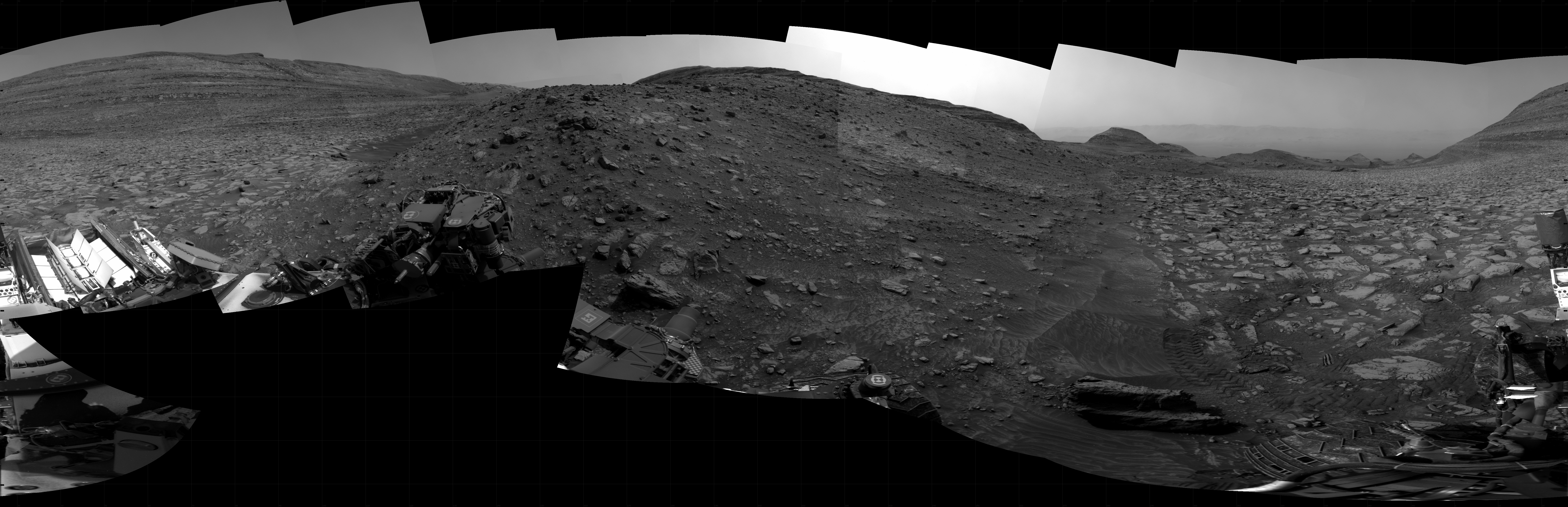
Cool image time! The panorama above, cropped, reduced, enhanced, and annotated to post here, was created using 31 pictures taken by Curiosity’s right navigation camera on May 1, 2024. It looks uphill into Gediz Vallis, the slot canyon that the rover has been traversing since August 2022.

The overview map to the right gives the context. The blue dot marks Curiosity’s present position. The red dotted line, on both the panorama and the overview indicate the rover’s planned route, with the white dotted line marking the route it actually traveled. The yellow lines indicate approximate the area covered by the panorama.

Coming into view inside Gediz Vallis is that small outcrop in the center of the canyon that the science team has targeted for inspection for years. It will be the last spot the rover visits in Gediz Vallis before turning west to head uphill in a parallel canyon. To see that route look at the map in this September 2023 post. Curiosity will travel west past two canyons before turning uphill again in the third.

Even then, Curiosity will still be in the low foothills at the base of Mount Sharp. The peak, blocked from view by the mountain’s lower flanks, is still 26 miles away and about 16,000 feet higher up. The journey to get there has really only begun, even after a dozen years exploring Gale Crater.

0 comments

Scientists observe orangutan use plant to heal a wound

In what might be the most sophisticated medical treatement yet seen by a wild animal, scientists in 2022 observed an orangutan named Rakus treat a face wound with a poultice it made from a plant known by locals to have medicinal value.

Rakus was observed eating the stems and leaves of the creeper akar kuning (Fibraurea tinctoria), which local people use to treat diabetes, dysentery and malaria, among other conditions. Orangutans in the area rarely eat this plant.

In addition to eating the leaves, Rakus chewed them without swallowing and used his fingers to smear the juice on his facial wound over seven minutes. Some flies settled on the wound, whereupon Rakus spread a poultice of leaf-mash on the wound. He ate the plant again the next day. Eight days after his injury, his wound was fully closed.

Other animals have been seen using plants or insects for medicinal reasons, but none had done anything as complicated as Rakus. Nor have researchers of orangetans ever seen another do anything similar in more than two decades of research. It is thus unclear how Rakus knew what to do. Did he figure it out on the spot, or had he seen it done in the past by others when unobserved?

5 comments

Lockheed Martin withdraws bid to buy Terran Orbital

Lockheed Martin yesterday withdrew its early March offer to buy the satellite manufacuture Terran Orbital, purchasing the shares it did not already own for approximately $500 million.

No reason was given, but it appears the other shareholders at Terran Orbital objected to the purchase, and Lockheed probably decided the fight wasn’t worth it.

In that proposal, Lockheed offered to acquire the roughly two-thirds of Terran Orbital stock it did not already own. Lockheed also proposed to pay more than $70 million to buy outstanding stock warrants and either assume or repay $313 million in Terran Orbital debt, putting the total value of the proposal at more than $500 million.

Lockheed, besides being a major investor in Terran Orbital, is a major customer of the company, buying dozens of its smallsat buses for programs such as satellites for the Space Development Agency. Lockheed said in its offer letter that it accounted for 81% of Terran Orbital’s backlog.

Terran Orbital responded to the proposal March 4 with a stockholder rights plan, or “poison pill” move, to prevent a hostile takeover. It acknowledged the proposal and said an independent board committee would evaluate it as part of an ongoing strategic review.

Both companies now say they will continue to work together in the future.

0 comments

China launches Chang’e-6 sample return mission to the far side of the Moon

Chang'e-6 landing zone

The new colonial movement: China today successfully launched its Chang’e-6 sample return mission to the far side of the Moon, its Long March 5 rocket lifting off from its coastal Wenchang spaceport. Unlike the Long March 5B, whose core stage reaches an unstable orbit and later crashes uncontrolled somewhere on Earth, the core stage of Long March 5 does not, and thus returns to Earth immediately, over the ocean.

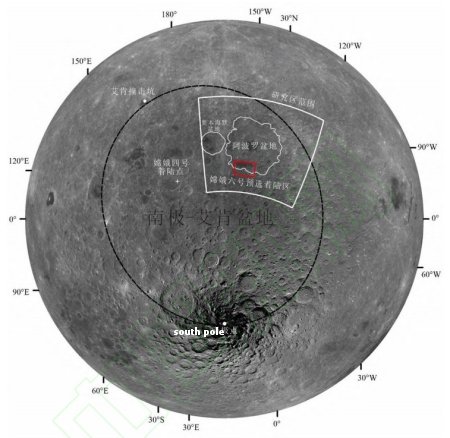
The graphic from the right, released by China’s state-run press, shows the landing zone in red on the far side. The target is the southern rim area of Apollo Crater, marked by the uneven white outline. Apollo sits inside the South Aitken Basin, one of the Moon’s largest impact basins, 1,600 miles across, and roughly indicated by the black circle. The circle to the left of Apollo indicates Van Karman crater, where Chang’e-4 landed in 2019 with the Yutu-2 rover, both still operating.

The mission includes a lunar orbiter, a lander, an ascent vehicle, and an Earth sample return capsule. If all goes as planned, the samples will return to Earth in 53 days.

The leaders in the 2024 launch race:

45 SpaceX
18 China
6 Russia
5 Rocket Lab

American private enterprise still leads the world combined in successful launches, 52 to 30. SpaceX by itself still leads the rest of the world, including other American companies, 45 to 37.

6 comments

May 2, 2024 Quick space links

Courtesy of BtB’s stringer Jay. This post is also an open thread. I welcome my readers to post any comments or additional links relating to any space issues, even if unrelated to the links below.


3 comments

SpaceX launches two commercial Earth imaging satellites

The bunny rolls on. SpaceX today successfully launched two commercial Earth imaging Worldview Legion satellites, its Falcon 9 rocket lifting off from Vandenberg in California.

The first stage successfully completed its 20th flight, landing back at Vandenberg. This is the third Falcon 9 booster to fly twenty times. SpaceX now has two such boosters in its fleet, and is now working to upgrade its whole booster fleet to capable of flying forty times. The two fairings on this mission also completed their thirteenth and sixteenth flights, respectively.

The leaders in the 2024 launch race:

45 SpaceX
17 China
6 Russia
5 Rocket Lab

American private enterprise now leads the rest of the world combined in successful launches 52 to 29, while SpaceX by itself still leads the rest of the world, including other American companies, 45 to 36.

0 comments

Pro-American UNC frat boys: Don’t hold a party, use the money more effectively!

UNC Frat boys protecting American flag

Earlier this week a group of college students belonging to the Pi Kappa Phi fraternity at North Carolina University (UNC) put their bodies between a mob of pro-Hamas protesters and the American flag, as shown in the picture on the right. That mob had been attempting to remove Old Glory and replace it with the Palestinian flag. Video of the incident can be seen here, with the Hamas mob throwing bottles and garbage at the UNC students, while other American students circle about in-between, holding up the Israeli flag in defiance.

The story quickly went viral in the conservative press. Then someone set up a Gofundme fundraiser to thank the students: “Pi Kappa Phi Men Defended their Flag. Throw ’em a Rager”. As noted by John Noonan, the origanizer:

Commie losers across the country have invaded college campuses to make dumb demands of weak University Administrators.

But amidst the chaos, the screaming, the anti-semitism, the hatred of faith and flag, stood a platoon of American heroes. Armored in Vineyard Vines and Patagonia, fueled by Zyn and White Claws, these triumphant Brohemians protected Old Glory from the unwashed Marxist horde — laughing at their shrieks and wails and shielding the Stars & Stripes from Soviet missiles.

These boys… no, men, of the UNC Chapel Hill Pi Kappa Phi, gave the best to America and now they deserve the best. Help us raise funds to throw this frat the party they deserve, a party worth of the boat-shoed Broleteriat who did their country proud.

To the shock of everyone, the money poured in. Within days more than 13,000 people had donated over $450K, with some donations topping five and ten thousand each.

Noonan now says he has found “a world class event planner [Susan Ralston] and she is already hard at work. She worked in the White House and knows what she’s about.” Noonan and GoFundMe is also attempting to identify every student seen holding up or defending the flag. It appears the goal is to to put together a big event that will not only be a great party but a political campaign rally.

I say that’s a big mistake. » Read more

29 comments

Sunspot update: A minor uptick in sunspot activity in April

It is that time of the month again. Yesterday NOAA posted its monthly update of its graph tracking the number of sunspots on the Sun’s Earth-facing hemisphere. As I have done now for every month since I began this website in 2010, I have posted this updated graph below, with several additional details to provide some larger context.

In April the number of sunspots on the Sun went up somewhat, the count rising to the highest level since the count hit its peak of activity last summer. The sunspot number in April, 136.5, was however still significantly less than the 2023 peak of 160. Thus it appears the Sun is likely still the middle saddle of a doubled-peaked relatively weak solar maximum, with the Sun doing what I predicted in February 2024:
» Read more

1 comment

NASA IG: Major technical problems with Orion remain unsolved

Orion's damage heat shield
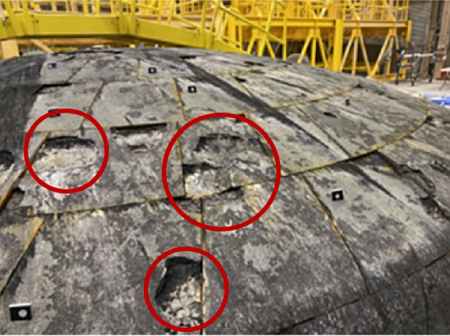
Damage to Orion heat shield caused during re-entry,
including “cavities resulting from the loss of large chunks”

A just released report [pdf] by NASA’s inspector general has found the major technical problems discovered after the first unmanned Artemis mission of Orion around the Moon remain unsolved, and threaten the safety of the astronauts that NASA plans to send around the Moon on the second Artemis mission.

The problems with Orion are threefold and are quite serious, involving its heat shield, separation bolts, and power distribution.

Specifically, NASA identified more than 100 locations where ablative thermal protective material from Orion’s heat shield wore away differently than expected during reentry into Earth’s atmosphere. Engineers are concurrently investigating ways to mitigate the char loss by modifying the heat shield’s design or altering Orion’s reentry trajectory.

In addition, post-flight inspections of the Crew Module/Service Module separation bolts revealed unexpected melting and erosion that created a gap leading to increased heating inside the bolt. To mitigate the issue for Artemis II, the Orion Program made minor modifications to the separation bolt design and added additional thermal protective barrier material in the bolt gaps.

NASA also recorded 24 instances of power distribution anomalies in Orion’s Electrical PowerSystem. While NASA has determined that radiation was the root cause and is making software changes and developing operational workarounds for Artemis II, without a permanent hardware fix, there is increased risk that further power distribution anomalies could lead to a loss of redundancy, inadequate power, and potential loss of vehicle propulsion and pressurization.

Moreover, like with any engineering system, without understanding the residual effects of introducing design and operational changes, it will be difficult for the Agency to ensure that the mitigations or hardware changes adopted will effectively reduce the risks to astronaut safety.

This is not all.
» Read more

21 comments
1 235 236 237 238 239 1,764