December 9, 2024 Quick space links

Courtesy of BtB’s stringer Jay. This post is also an open thread. I welcome my readers to post any comments or additional links relating to any space issues, even if unrelated to the links below.

As Jay noted to me in his email, not much news today. I have been working on a long essay outlining my recommendations for NASA and Jared Isaacman, should he cancel SLS and Orion as I expect he will. Hopefully it will be finished by tomorrow. I might post it here, or see if some other venue might be interested.

  • Blue Origin’s CEO touts its prep work on New Glenn on the launchpad
    Blue Origin also sent out an email today saying the Blue Ring demo payload for the launch is also ready. Yet, the key quote from the tweet above was this:: “While we wait for regulatory approvals for hotfire and launch…” Why the hell is the FAA holding up this launch? For what reason? Or is it simply that the agency wants to be an equal opportunity red tape destroyer of everyone?
11 comments

“Thar’s ice in them hills!”

Overview map

Thar's ice in them hills!
Click for original image.

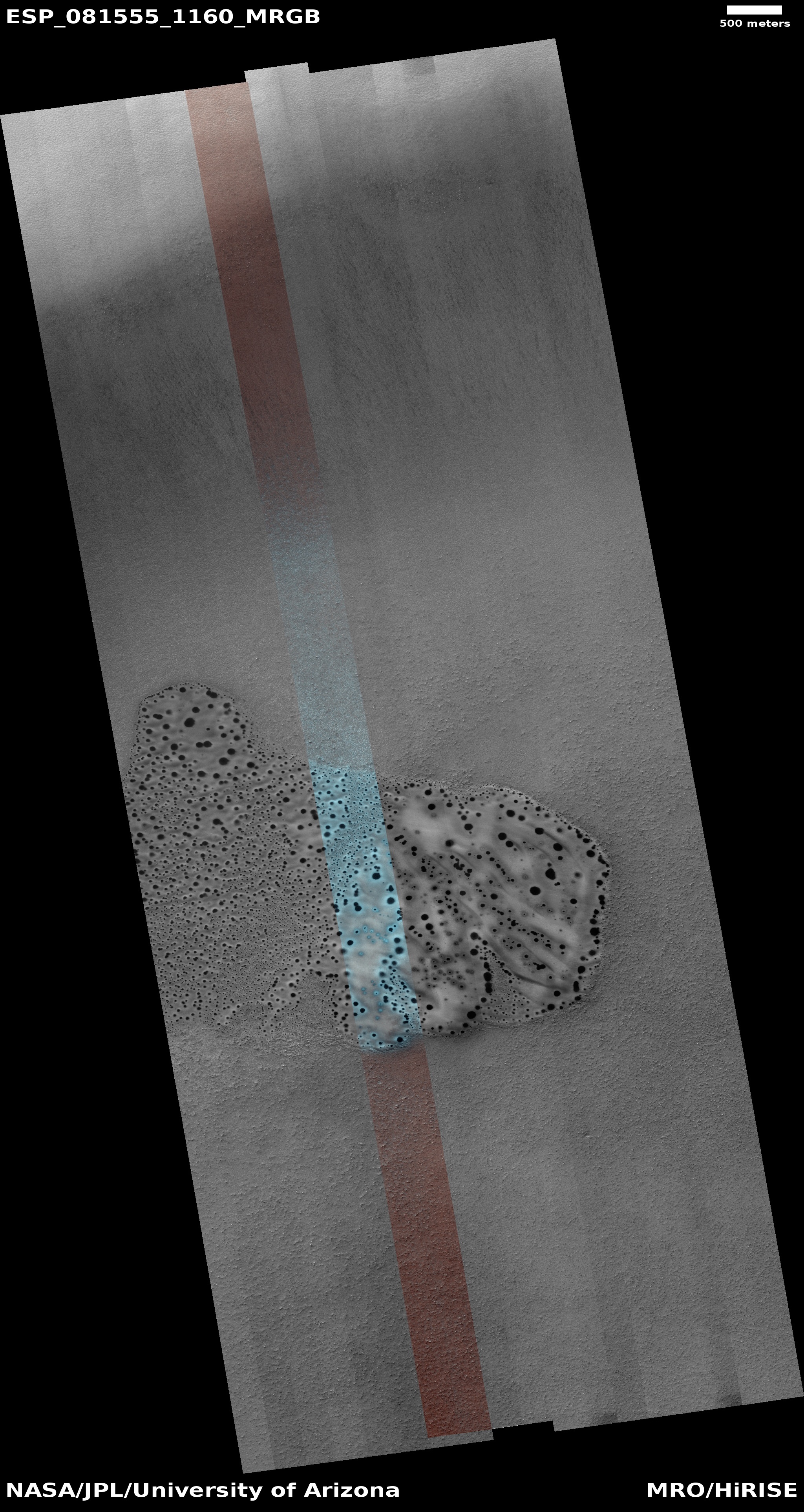
Cool image time! The picture to the right, cropped, reduced, and sharpened to post here, was taken on September 25, 2024 by the high resolution camera on Mars Reconnaissance Orbiter (MRO). It shows what the camera team labels as a “mound in the southern highlands.”

The mound in question sits in the center of the sunken depression, and at the highest resolution shows its top to be cracked and broken, as if something is attempting to break out by pushing up from below.

Everything about this picture screams near-surface ice. The cracked mound suggests ice sublimating into gas, which applies pressure to the surface and thus the cracks. The depression suggest that much of the near-surface ice at this location has already disappeared, causing the ground to sag. All the craters lack upraised rims. If caused by impacts, the ground here was soft enough that the impactor simply sank into the ground. Imagine dropping a rock you’ve heated into snow. It would simply leave a hole.

But there’s more. The white dot in the overview map above marks the location. In the inset, the lighter area surrounding this depression resembles an ice sheet that is slowly sublimating away. There are also other similar depressions in that lighter area. The lighter area also has fewer craters than the darker regions nearby, suggesting that this ice sheet covers the older impacts.

The location is in the southern cratered highlands in a mid-latitude region where many images indicate the existence of layers of ice deep below ground. This picture is more evidence of the same, but it also indicates the presence of ice very close to the surface as well.

The orbital data continues to tell us that Mars is not a dry desert like the Sahara, but an icy desert like Antarctica. There will be plenty of water for future colonists. All they will have to do is stick a shovel in the ground, dig it up, and process it.

0 comments

Genesis cover

On Christmas Eve 1968 three Americans became the first humans to visit another world. What they did to celebrate was unexpected and profound, and will be remembered throughout all human history. Genesis: the Story of Apollo 8, Robert Zimmerman's classic history of humanity's first journey to another world, tells that story, and it is now available as both an ebook and an audiobook, both with a foreword by Valerie Anders and a new introduction by Robert Zimmerman.

The print edition can be purchased at Amazon or any other book seller. If you want an autographed copy the price is $60 for the hardback and $45 for the paperback, plus $8 shipping for each. Go here for purchasing details. The ebook is available everywhere for $5.99 (before discount) at amazon, or direct from my ebook publisher, ebookit. If you buy it from ebookit you don't support the big tech companies and the author gets a bigger cut much sooner.


The audiobook is also available at all these vendors, and is also free with a 30-day trial membership to Audible.
 

"Not simply about one mission, [Genesis] is also the history of America's quest for the moon... Zimmerman has done a masterful job of tying disparate events together into a solid account of one of America's greatest human triumphs."--San Antonio Express-News

Ten stupid academic studies funded by the federal government

Campus Reform last week posted a list of ten academic studies funded by federal government that any sane person would not only consider stupid, but an utter waste of money.

Number 1 on the list was a grant of almost a half million dollars to researchers at Reed College in Oregon to study the gambling habits of pigeons. The researchers claimed the study would shed light on human gambling behaviors, but if you believe that then you would likely also fork over your life savings to buy the Brooklyn Bridge.

Of the ten studies listed, the National Institute of Health (NIH) and the National Science Foundation (NSF) funded four each, while the National Endowment for the Humanities and the National Cancer Institute funded one each.

National Cancer Institute’s study is surely going to help cure cancer, as it gave $7 million to the con artists faking as researchers at Stanford University to build an AI toilet equipped with cameras to scan the user’s waste and backside.

The studies were done at a range of other major universities, including Cornell, the University of California, the University of Illinois, and the University of Connecticut. Most are publicly funded institutions.

This list demonstrates clearly the bankruptcy of the government agencies involved and justifies any effort to slash their budgets by significant amounts. It does more however. It shows us the bankruptcy of the academic community as well. If scientists at major universities think this drivel is valid research, then we know they are teaching their students garbage as well. The public funding to these colleges should be slashed also.

7 comments

Conscious Choice cover

Now available in hardback and paperback as well as ebook!

From the press release: In this ground-breaking new history of early America, historian Robert Zimmerman not only exposes the lie behind The New York Times 1619 Project that falsely claims slavery is central to the history of the United States, he also provides profound lessons about the nature of human societies, lessons important for Americans today as well as for all future settlers on Mars and elsewhere in space.

 
Conscious Choice: The origins of slavery in America and why it matters today and for our future in outer space, is a riveting page-turning story that documents how slavery slowly became pervasive in the southern British colonies of North America, colonies founded by a people and culture that not only did not allow slavery but in every way were hostile to the practice.  
Conscious Choice does more however. In telling the tragic history of the Virginia colony and the rise of slavery there, Zimmerman lays out the proper path for creating healthy societies in places like the Moon and Mars.


“Zimmerman’s ground-breaking history provides every future generation the basic framework for establishing new societies on other worlds. We would be wise to heed what he says.” —Robert Zubrin, founder of the Mars Society.


All editions are available at Amazon, Barnes & Noble, and all book vendors, with the ebook priced at $5.99 before discount. All editions can also be purchased direct from the ebook publisher, ebookit, in which case you don't support the big tech companies and the author gets a bigger cut much sooner.


Autographed printed copies are also available at discount directly from the author (hardback $29.95; paperback $14.95; Shipping cost for either: $6.00). Just send an email to zimmerman @ nasw dot org.

SpaceX launches 23 Starlink satellites

SpaceX just after midnight (Eastern) tonight successfully launched another 23 Starlink satellites, its Falcon 9 rocket lifting off from Cape Canaveral in Florida.

The first stage completed its second flight, landing on a drone ship in the Atlantic.

The leaders in the 2024 launch race:

128 SpaceX
59 China
16 Russia
13 Rocket Lab

American private enterprise now leads the rest of the world combined in successful launches 147 to 91, while SpaceX by itself leads the entire world, including American companies, 128 to 110.

3 comments

Tim McLaughlin – NYC&C Scale Model Railroad

An evening pause: The view from the front cab during runs of four elevated & subway lines, filmed October 14, 2012.

Hypnotic, and epic in its own way. There are times where it looks and sounds exactly as I remember it, riding on the front car of a NYC subway train, looking out that front window. Nice way to start the weekend.

Hat tip Wayne DeVette.

10 comments

Leaving Earth cover

Leaving Earth: Space Stations, Rival Superpowers, and the Quest for Interplanetary Travel, can be purchased as an ebook everywhere for only $3.99 (before discount) at amazon, Barnes & Noble, all ebook vendors, or direct from my ebook publisher, ebookit.

If you buy it from ebookit you don't support the big oppressive tech companies and I get a bigger cut much sooner.


Winner of the 2003 Eugene M. Emme Award of the American Astronautical Society.

 
"Leaving Earth is one of the best and certainly the most comprehensive summary of our drive into space that I have ever read. It will be invaluable to future scholars because it will tell them how the next chapter of human history opened." -- Arthur C. Clarke

Strange flat layers on Mars

Strange layers on Mars

Cool image time! The picture to the right, rotated, cropped, reduced, and enhanced to post here, was taken on July 16, 2024 by the high resolution camera on Mars Reconnaissance Orbiter (MRO). It shows what MRO’s camera team labels as “layers near ridge in Argyre Planitia.”

The layers are strange because there is so little topographic difference between them. Though the ground slopes downward from the south to the north, dropping about 1,300 feet, it does so almost smoothly. The layers show relatively little topographic relief.

And what caused the circular shape? Is it evidence of a buried crater? And if so, why so little relief at its rim?

As always, the overview map provides some answers.
» Read more

0 comments

Iran launches its Simorgh orbital rocket

Iran today announced it has successfully placed several small payloads into orbit, its Simorgh rocket lifting off from its interior Semnan spaceport.

The Simorgh carried what Iran described as an “orbital propulsion system,” as well as two research systems to a 400-kilometer (250-mile) orbit above the Earth. A system that could change the orbit of a spacecraft would allow Iran to geo-synchronize the orbits of its satellites, a capability Tehran has long sought.

It also carried the Fakhr-1 satellite for Iran’s military, the first time Iran’s civilian program is known to have carried a military payload.

This was Iran’s fourth launch in 2024, doubling the launch record it had set in 2023.

The leader board for the 2024 launch race remains unchanged:

127 SpaceX
59 China
16 Russia
13 Rocket Lab

American private enterprise still leads the rest of the world combined in successful launches 146 to 91, while SpaceX by itself leads the entire world, including American companies, 127 to 110.

1 comment

Hubble takes a different look at quasar 3C 273

Hubble's different views of 3C 273
Click for original image.

One of the most studied objects in the sky is the quasar 3C 273, located about 2.5 billion light years away and the first quasar ever to be identified, in 1963. What makes it especially interesting is the 300,000-light-year-long jet that shoots out from it.

Astronomers have now used the Hubble Space Telescope to take a different view of 3C 273, using the telescope’s coronograph to block the central bright light so that the surrounding dimmer features can be seen. The two images to the right, reduced and sharpened to post here, show what this new image (bottom) reveals when compared to an earlier Hubble image (top).

The new Hubble views of the environment around the quasar show a lot of “weird things,” according to Bin Ren of the Côte d’Azur Observatory and Université Côte d’Azur in Nice, France. “We’ve got a few blobs of different sizes, and a mysterious L-shaped filamentary structure. This is all within 16,000 light-years of the black hole.”

Some of the objects could be small satellite galaxies falling into the black hole, and so they could offer the materials that will accrete onto the central supermassive black hole, powering the bright lighthouse.

What makes this observation even more outstanding is that the image was produced by using Hubble’s Space Telescope Imaging Spectrograph (STIS) as the coronograph to block the bright center of 3C 273. This improvisation of STIS has been done many times before, but it remains a great example of clever thinking by the astronomers who use Hubble.

4 comments

ESA to provide ground station communications support for India’s manned Gaganyaan missions

The new colonial movement: The European Space Agency (ESA) has now signed an agreement with India’s space agency ISRO whereby ESA will provide ground station communications support for India’s manned Gaganyaan missions.

The first unmanned test flights are planned for next year, with the first manned Gaganyaan mission targeting 2026.

3 comments

Japan’s space agency admits first launch of its new Epsilon-S rocket will be delayed

Japan’s space agency JAXA yesterday admitted that the first launch of its new Epsilon-S rocket — intended to be cheaper and competitive with the new rockets being developed worldwide — will be delayed because of the explosion that occurred during a static fire test on November 26, 2024.

The news reports in the Japanese press don’t provide much information. It appears the investigation into the explosion is still on-going, and that the cause of the failure has not yet been identified. Because of this, JAXA has been forced to cancel the planned March 2025 date for Epsilon-S’s inaugural flight.

JAXA should get out of the business of building rockets, as its track record is really horrible. The Japanese government has already told it to do so, but it is clearly dragging its feet, not wanting to give up the turf it has controlled for decades.

0 comments

Why Orion’s heat shield problems give Jared Isaacman the perfect justification to cancel all of SLS/Orion

Orion's damage heat shield
Damage to Orion heat shield caused during re-entry in 2022,
including “cavities resulting from the loss of large chunks”

In yesterday’s press conference announcing new delays in NASA’s next two SLS/Orion Artemis missions to the Moon, agency officials were remarkably terse in providing details on why large chunks of Orion’s heat shield material broke off during its return to Earth in 2022 during the first Artemis mission. That damage, shown to the right, is one of the main reasons for the newly announced launch delays.

All they really said was that the damage was caused during re-entry, the atmosphere causing more stress than expected on the heat shield.

Today NASA finally released a more detailed explanation.

Engineers determined as Orion was returning from its uncrewed mission around the Moon, gases generated inside the heat shield’s ablative outer material called Avcoat were not able to vent and dissipate as expected. This allowed pressure to build up and cracking to occur, causing some charred material to break off in several locations.

…During Artemis I, engineers used the skip guidance entry technique to return Orion to Earth. … Using this maneuver, Orion dipped into the upper part of Earth’s atmosphere and used atmospheric drag to slow down. Orion then used the aerodynamic lift of the capsule to skip back out of the atmosphere, then reenter for final descent under parachutes to splashdown.

[Ground testing during the investigation showed] that during the period between dips into the atmosphere, heating rates decreased, and thermal energy accumulated inside the heat shield’s Avcoat material. This led to the accumulation of gases that are part of the expected ablation process. Because the Avcoat did not have “permeability,” internal pressure built up, and led to cracking and uneven shedding of the outer layer.

In other words, instead of ablating off in small layers, the gas build-up caused the Avcoat to break off in large chunks, with the breakage tending to occur at the seams between sections of the heat shield.
» Read more

51 comments
1 268 269 270 271 272 2,930