Maurice Jarre – Lawrence of Arabia
An evening pause: Performed by the BBC Concert Orchestra. I think this makes for a good way to start the weekend. If you have time, get the movie and watch it. One of the greatest ever made.
Hat tip Doug Johnson.
An evening pause: Performed by the BBC Concert Orchestra. I think this makes for a good way to start the weekend. If you have time, get the movie and watch it. One of the greatest ever made.
Hat tip Doug Johnson.

What the modern college education is becoming: “But
Brawndo’s got what plants crave. It’s got electrolytes!”
Because of an approximate 10% drop in enrollment since 2017, the University of North Carolina at Greensboro has now announced major cuts to many academic programs, while leaving untouched its many racially-based programs.
Five majors are being completely eliminated, according to a recent announcement from Chancellor Franklin Gilliam: anthropology, geography, physics, physical education and religious studies. Three language minors — Chinese, Russian, and Korean — are also on the chopping block. The university is also ending 12 graduate programs and is pausing admissions in its masters drama program.
These cuts were detailed in an announcement by the university’s chancellor, Franklin D. Gilliam, Jr. Interestingly, his announced cuts left entirely untouched the small Diversity, Equity, and Inclusion (DEI) office is he runs from within his office. Nor did the cuts include the university’s Office of Intercultural Engagement, which appears entirely focused on favoring the queer agenda and students who advocate it. The cuts also left intact the college’s black studies and its women’s, gender, and sexuality departments, both of which might be popular but neither contribute much to providing students a real education.
» Read more

On Christmas Eve 1968 three Americans became the first humans to visit another world. What they did to celebrate was unexpected and profound, and will be remembered throughout all human history. Genesis: the Story of Apollo 8, Robert Zimmerman's classic history of humanity's first journey to another world, tells that story, and it is now available as both an ebook and an audiobook, both with a foreword by Valerie Anders and a new introduction by Robert Zimmerman.
The print edition can be purchased at Amazon or any other book seller. If you want an autographed copy the price is $60 for the hardback and $45 for the paperback, plus $8 shipping for each. Go here for purchasing details. The ebook is available everywhere for $5.99 (before discount) at amazon, or direct from my ebook publisher, ebookit. If you buy it from ebookit you don't support the big tech companies and the author gets a bigger cut much sooner.
"Not simply about one mission, [Genesis] is also the history of America's quest for the moon... Zimmerman has done a masterful job of tying disparate events together into a solid account of one of America's greatest human triumphs."--San Antonio Express-News

Click for original image.
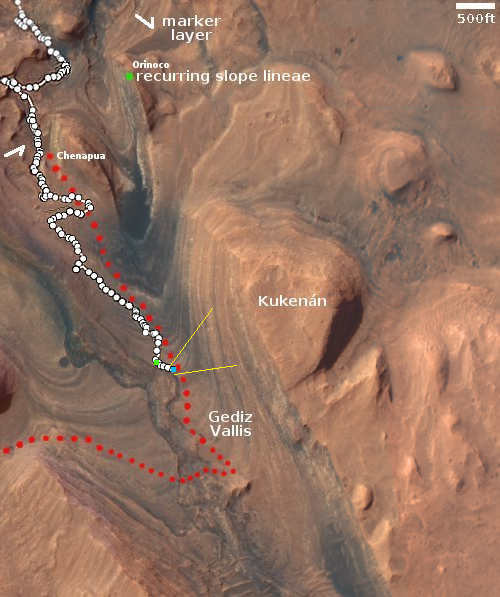
Click for interactive map.
Cool image time! The picture above, brightened slightly to post here, was taken on February 15, 2024 by the right navigation camera on the Mars rover Curiosity. It looks east at the looming cliff face of the mountain Kukenan that the rover has been traveling beside for the last six months. On the overview map to the right the yellow lines indicate roughly the area covered by this picture. The blue dot marks Curiosity’s present position, while the green dot marks its position on February 5, 2024. As you can see, the rover is making slow but steady progress uphill into Gediz Vallis.
This image illustrates the alien landscape of Mars quite beautifully. First, there is absolutely no life in this picture. On Earth you would be hard pressed to find any spot on the surface that doesn’t have at least some plant life.
Second, there is the rocky layered nature of this mountain. When the Curiosity science team first announced its future route plans (the red dotted line) to drive into this canyon back in 2019, the orbital images of these layers from Mars Reconnaissance Orbiter (MRO) had suggested the terrain here would be reminiscent of The Wave in northern Arizona, a smooth series of curved layers smoothed nicely over time by the wind.
As you can see, there is no smoothness here. Instead, every single layer here is infused with broken rock, suggesting that each layer is structurally weak. As erosion exposes each, the layer breaks up, crumbling into the chaos in this picture. The curved nature of the terrain at the bottom of the picture however does suggest that some sort of flow once percolated down this canyon, either liquid water or glacial ice, carving the layers into this curved floor.
With the FAA finally giving its okay (six months late), Rocket Lab has now begun the orbital maneuvers required to bring Varda’s small manufacturing capsule back to Earth at the Utah test range.
For more than eight months in space, Rocket Lab’s 300kg-class spacecraft has successfully provided power, communications, ground control, and attitude control to allow Varda’s capsule to grow Ritonavir crystals, a drug commonly used as an antiviral medication for HIV and hepatitis C.
Due to the initial planned reentry date being adjusted from late 2023, Rocket Lab’s spacecraft has been required to operate for more than double its intended orbital lifespan, which it has done without issue.
If all goes as planned, the capsule will land on February 21, 2024. Whether those drugs are still viable and sellable remains unknown. The delay due to government red-tape might have made them useless.
Nonetheless, a success in recovering those samples, viable or not, would establish Varda’s business plan. With three more missions planned, all to be launched and controlled by Rocket Lab, it will be positioned well for the future, its capsule a method for manufacturing a number of products in weightlessness that are needed on Earth but can only be made in space.

Now available in hardback and paperback as well as ebook!
From the press release: In this ground-breaking new history of early America, historian Robert Zimmerman not only exposes the lie behind The New York Times 1619 Project that falsely claims slavery is central to the history of the United States, he also provides profound lessons about the nature of human societies, lessons important for Americans today as well as for all future settlers on Mars and elsewhere in space.
“Zimmerman’s ground-breaking history provides every future generation the basic framework for establishing new societies on other worlds. We would be wise to heed what he says.” —Robert Zubrin, founder of the Mars Society.
All editions are available at Amazon, Barnes & Noble, and all book vendors, with the ebook priced at $5.99 before discount. All editions can also be purchased direct from the ebook publisher, ebookit, in which case you don't support the big tech companies and the author gets a bigger cut much sooner.
Autographed printed copies are also available at discount directly from the author (hardback $29.95; paperback $14.95; Shipping cost for either: $6.00). Just send an email to zimmerman @ nasw dot org.
The fake kerfuffle in the past few days about a so-called new “serious national security threat” from Russia’s space capabilities is simply the Washington swamp suddenly discovering capabilities that Russia has had for decades and has been working to improve repeatedly, discovered suddenly and pushed in our state-run press (the Washington Post, the New York Times, the Guardian, NBC, the Associated Press, ) to help that swamp lobby for passage of the Senate foreign aid bill, that spends $90 billion for the military and for the Ukraine, Taiwan, and Israel.
The key facts are highlighted below in this quote from the Washington Post propaganda piece about this story:
Exactly what the new Russia weapon is remains unclear, but the system is a “serious national security threat,” in the words of U.S. Rep. Michael R. Turner (R-Ohio), chairman of the House Intelligence Committee. “I am requesting that President Biden declassify all information relating to this threat so that Congress, the Administration, and our allies can openly discuss the actions necessary to respond to this threat,” Turner wrote in a statement Wednesday.
In his briefing to reporters Thursday, [White House spokesman John] Kirby would say only that the system is “an antisatellite capability that Russia is developing.” [emphasis mine]
My heart be still. Lordy, the Russians are developing an anti-sat capability! Will wonders never cease.
This is not news. There is nothing here that we haven’t known about the Russian anti-satellite efforts now for decades. Turner and the White House are simply pushing this story now to create a crisis and panic to force the House to approve the Senate bill, even though there is great opposition to it. That opposition sees the bill has spending billions to protect other countries, while doing nothing to protect our own.
Sadly, we are ill-served by our modern press in this manner, which is all-in on this propaganda.
India’s space agency ISRO yesterday successfully deorbited its defunct Cartosat-2 satellite, using the satellite’s leftover fuel to bring it down in a controlled manner, about three decades sooner than its orbit would have decayed naturally.
The satellite was launched in 2007 to provide detailed ground images of India, and completed its mission in 2019. As noted in ISRO’S press release:
ISRO opted to lower its perigee using leftover fuel to comply with international guidelines on space debris mitigation. This involved reducing collision risks and ensuring safe end-of-life disposal, following recommendations from organizations like the United Nations Committee on the Peaceful Uses of Outer Space (UN-COPOUS) and the Inter-Agency Space Debris Coordination Committee (IADC).
While such actions are a good thing, that governments in India and Europe are suddenly making a big deal about it now — after almost 3/4s of a century of inaction — is not for those reasons, but to lay the political groundwork for allowing the international community, led by the UN, to impose new regulations on all space efforts, both government and private.
Be warned. They are the government, and they are here to help you.

Leaving Earth: Space Stations, Rival Superpowers, and the Quest for Interplanetary Travel, can be purchased as an ebook everywhere for only $3.99 (before discount) at amazon, Barnes & Noble, all ebook vendors, or direct from my ebook publisher, ebookit.
If you buy it from ebookit you don't support the big oppressive tech companies and I get a bigger cut much sooner.
"Leaving Earth is one of the best and certainly the most comprehensive summary of our drive into space that I have ever read. It will be invaluable to future scholars because it will tell them how the next chapter of human history opened." -- Arthur C. Clarke
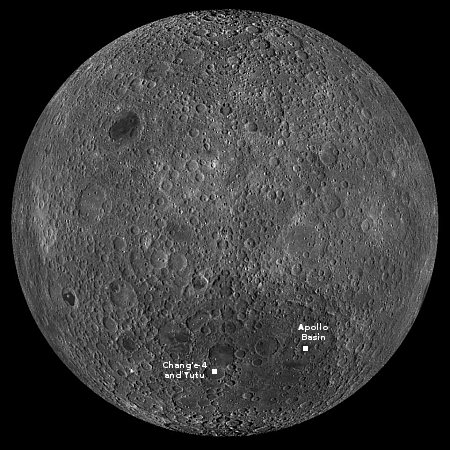
The Moon’s far side. Click for interactive map.
China is now working to a May 2024 launch of its Chang’e-6 lunar sample return mission to bring back about four pounds of material from the far side of the Moon.
The map to the right, created from a global mosaic of Lunar Reconnaissance Orbiter (LRO) imagery, shows the planned location of Chang’e-6’s landing site, in Apollo Basin. The landing site of China’s previous mission to the Moon’s far side, Chang’e-4 and its rover Yutu, is also shown. Both are still operating there, since landing five years ago on January 2, 2019.
Chang’e-6’s mission will be similar to China’s previous lunar sample mission, Chang’e-5, which included a lander, ascender, orbiter, and returner. It launched in November 23, 2020, landed a week later, and within two days grabbed its samples and its ascender lifted off. The samples were back on Earth by December 16, 2020.
There are indications however that Chang’e-6 might spend more time on the surface before its ascender lifts off with samples.
Uruguay yesterday became the 36th nation to sign the Artemis Accords, originally conceived during the Trump administration as a political maneuver to get around the legal restrictions against private ownership imposed by the Outer Space Treaty.
It is unclear where Uruguay stands with these goals. The last two signatories, Belguim and Greece, hinted in their public statements that their goals were far different, aimed more at imposing the modern leftist globalist agenda instead (“You will own nothing and be happy.”)
At present these are the nations who have signed on: Angola, Argentina, Australia, Bahrain, Belgium, Brazil, Bulgaria, Canada, Columbia, Czech Republic, Ecuador, France, Germany, Greece, Iceland, India, Israel, Italy, Japan, Luxembourg, Mexico, the Netherlands, New Zealand, Nigeria, Poland, Romania, Rwanda, Saudi Arabia, Singapore, South Korea, Spain, the United Kingdom, the United Arab Emirates, the Ukraine, the United States and Uruguay.
The competing alliance of communist nations, led by China, includes only Russia, Venezuala, Pakistan, Belarus, Azerbaijan, and South Africa. Former deep Soviet bloc nations like Bulgaria and Romania, as well as previously very Marxist Angola, joined the American alliance, suggesting that these two space alliances are not a return of the Cold War of the 20th century. Instead, it appears that both alliances are untrustworthy when it comes to individual rights, freedom, and limited government. Both have tensions within each, with many leaders in both groups working both against and for these ideals, with a large plurality likely focused on power and control, not human freedom.
The U.S. can do much good here, if its leadership stands firmly for freedom (to paraphrase John Kennedy). Sadly, its leadership today does not do this, and it is very unclear whether future leaders will do so either.
An evening pause: Hat tip Diane Zimmerman.

Click for original image.
Cool image time! The picture to the right, cropped, reduced, and enhanced to post here, was taken on October 2, 2023 by the high resolution camera on Mars Reconnaissance Orbiter (MRO).
The science team labeled this a “lava margin.” The darker material on the right is apparently a newer deposit of lava, flowing on top of the lighter lava on the left. The newer deposit is only about three feet thick, so it had to have flowed fast almost like water to cover this large area with such a thin layer before freezing. Even so, this new lava layer has a roughness greater than the older layer below it. Either the older layer is smoother because of erosion from wind over eons, or the lava in these two layers was comprised of slightly different materials that froze with different textures.
The small ridges appear to be wrinkle ridges, created when material shrinks as it freezes.
This margin marks the edge of a very large flood lava event, as illustrated by the overview map below.
» Read more
Courtesy of BtB’s stringer Jay. This post is also an open thread. I welcome my readers to post any comments or additional links relating to any space issues, even if unrelated to the links below.
This will be Jay’s last quick space links post until March 11th, as he is off to the Solomon Islands as part of a ham radio DX expedition. For those other hams who want to try to make contact with him during this expedition, the call sign is H40WA.
Note too that posting has been light today because of software issue that prevents me from uploading images. I hope it will be fixed momentarily.
Arrival is now in seven days.
Launch time will be on February 17, 2023 at 4:04 am (Pacific).
Astronomers hope the data will help solve the mystery of both dark energy and dark matter.
Environmentalists dubbed this “The pale blue dot image.”
It would fly past Jupiter in December 1973, and operate until 1997 on its journey outward beyond the solar system.
He invented the telescope, discovered the Galilean moons of Jupiter, and proved that Copernicus was right, the Sun is the center of the solar system.
SpaceX today successfully launched another 22 Starlink satellites, its Falcon 9 rocket lifting off from Vandenberg in California at 1:34 pm Pacific.
This was the launch scrubbed yesterday, and its launch today means the company completed three launches in less than 24 hours. The first stage successfully completed its second flight, landing on a drone ship in the Pacific.
15 SpaceX
8 China
2 Iran
2 Russia
American private enterprise now leads the entire world combined 17 to 14 in successful launches, with SpaceX by itself is leading the rest of the world combined (excluding American companies) 15 to 14.

The material found inside the sample return
capsule. Click for original image.
Curators cataloging the material returned by OSIRIS-REx’s sample capsule from the asteroid Bennu have now completed weighing the material,l and have discovered that the spacecraft grabbed more than twice as much material from Bennu as planned.
NASA’s OSIRIS-REx spacecraft delivered 4.29 ounces (121.6 grams) of material from asteroid Bennu when it returned to Earth on Sep. 24, 2023; the largest asteroid sample ever collected in space and over twice the mission’s requirement. The mission team needed at least 60 grams of material to meet the mission’s science goals, an amount that had already been exceeded before the Touch-and-Go Sample Acquisition Mechanism (TAGSAM) head was completely opened.
More than 60 grams were recovered outside the capsule that had stuck to it during touch-and-go operations. Once they were able to open the capsule and weigh the material inside, they found it had captured as much stuff, so that in total the mission brought back a double complement of material.
This material will now be distributed to scientists worldwide for study. It is likely that it will overturn almost all assumptions presently held about the make-up of the solar system’s asteroid population, since previous to the recent asteroid sample return missions of OSIRIS-REx and Japan’s Hayabusa-2 our only samples came from material that survived after burning through the Earth’s atmosphere. That journey resulted in an incomplete and biased census, with the most delicate material destroyed.
The Space Force today announced it has cancelled a major multi-satellite contract with Northrop Grumman, worth almost a billion dollars, because of cost overruns and scheduling delays.
Northrop was formally notified last month of the termination within “our restricted Space Business,” the defense contractor said in a regulatory filing, using jargon for classified programs. The filing offered no details on the classified satellite or the reasons it was called off, which were provided by people who commented on condition of anonymity because of its secret status.
Based on previous contract announcements, this cancellation appears to be the contract awarded to Northrop Grumman in August 2023, as part of two awards, one to Northrop and the second to Lockheed Martin, with each building 36 satellites of a 72 satellite communications constellation. The Northrop contract was valued at $733 million.
Apparently in the six months since, the Space Force found that Northrop Grumman wasn’t doing a satisfactory. Whether Lockheed Martin will pick up the contract to replace Northrop however is not clear. The Space Force might put it up for bid again.
As had been threatened by Elon Musk, SpaceX has now officially filed to move its incorporation home from Delaware to Texas, taking with it signicant tax dollars.
SpaceX, which was incorporated in the famously corporation-friendly Delaware, filed to relocate its business incorporation with the Texas Secretary of State, Bloomberg reported.
SpaceX CEO Elon Musk publicly railed against the Diamond State and a judge’s decision to void his $55 billion Tesla pay package.
Another Musk company, Neuralink, has also shifted its incorpoation from Delaware to Nevada.
None of this involves the movement of any physical facilities. However, Musk is making it very clear once again that if a state government interferes unreasonably with his business operations, he will leave it. He did this by the actual shifting previously large parts of SpaceX operations from California to Texas when California government officials attempted to punish him for remaining open during the Wuhan panic. Now he is doing the same to Delaware because it appears one judge decided he didn’t like Musk’s Tesla’s pay package, even though 80% of the company’s stockholders approved.
After more than six months of paper-pushing, the FAA has finally agreed to let the commercial in-space manufacturing startup Varda land its orbiting capsule in Utah.
After months of effort and one rejected application, Varda Space Industries said Feb. 14 it has received a license from the Federal Aviation Administration to return a capsule from its first mission.
The FAA’s Office of Commercial Space Transportation issued a reentry license for Varda’s W-Series 1 spacecraft. The license will allow the company to land a capsule from that spacecraft at the Utah Test and Training Range (UTTR) and neighboring Dugway Proving Ground west of Salt Lake City. Varda said that reentry is scheduled for Feb. 21.
…The company had hoped to return the capsule as early as mid-July, but said then was still working with the FAA to obtain a reentry license, required for any commercial spacecraft returning to Earth. One issue the company said it was facing was that it was the first company seeking a reentry license under new regulations called Part 450 intended to streamline the licensing process, but which some companies reported difficulties adjusting to. [emphasis mine]
The highlighted sentence dishonestly implies it has been the companies that are having problems adjusting to these so-called “streamlined” regulations, when the truth is that the FAA has been the one having the problem. Since Part 450 was established all FAA appovals have slowed to a crawl, when previously the FAA moved much faster.
In fact, that sentence is proven dishonest in the article’s very next paragraphs, which describe how the July approval didn’t happen because two government agencies couldn’t get their act together. Varda really had nothing to do with this lack of approval.
The capsule contains pharmaceuticals for sale on Earth that can not be manufactured in gravity. For the government to delay their return almost half a year simply because of red-tape is disgusting, especially because this delay might end up destroying the startup entirely. It is even more disgusting in that these government agencies have had had no problem approving the return of NASA capsules from space, to this very same Utah range.
Embedded below the fold in two parts.
To listen to all of John Batchelor’s podcasts, go here.
» Read more

SpaceX has successfully launched Intuitive Machines commercial Nova-C-class Odysseus lunar lander, its Falcon 9 rocket lifting off from Cape Canaveral at 1:05 am (Eastern) on February 15th.
This was the third launch in less than eleven hours today, and the second launch by SpaceX. The first stage successfully completed its 18th flight, landing back at Cape Canaveral.
The green dot on the map to the right shows the planned landing site for Odysseus, next to a crater with a permanently shadowed interior, though it will have no way to travel into it. This will also be the closest landing to the Moon’s south pole, and if all goes well, will take place eight days from today, where it will operate for about ten Earth days. You can find out more about the lander’s payloads and mission from the press kit [pdf].
It must be emphasized that like India’s Vikram lander and Pragyan rover, Japan’s SLIM lander, and Astrobotic’s Peregrine lander, Odysseus is mostly an engineering test to prove out the landing systems. If this spacecraft does any science on the lunar surface that will be a bonus.
The leaders in the 2024 launch race:
14 SpaceX
8 China
2 Iran
2 Russia
American private enterprise now leads the entire world combined 16 to 14 in successful launches, with SpaceX by itself is now tied the rest of the world combined (excluding American companies) 14 to 14.
Russia today (February 15th in Kazakhstan) successfully used its Soyuz-2 rocket to launch a Progress freighter to ISS.
As happens on launches from Kazakstan to ISS, the rocket’s core stage and strap-on boosters crashed within Kazakstan inside planned crash zones.
This was supposed to be the third launch today, but SpaceX’s second launch today, this time of 22 Starlink satellites, was scrubbed due to weather and reschduled 24 hours till tomorrow at Vandenberg. There is still one more launch scheduled today, SpaceX launching Intuitive Machines Nova-C lunar lander at 9:57 pm (Pacific).
The leaders in the 2024 launch race:
13 SpaceX
8 China
2 Iran
2 Russia
American private enterprise still leads the entire world combined 15 to 14 in successful launches, with SpaceX by itself now trailing the rest of the world combined (excluding American companies) 13 to 14.
An evening pause: A nice song for Valentine’s Day.
Hat tip Cotour.