
The Allman Brothers Band – Jessica
An evening pause: Performed live 1982.
Hat tip Mike Nelson.
An evening pause: Performed live 1982.
Hat tip Mike Nelson.
Courtesy of BtB’s stringer Jay, who I must also thank for sending me the Twitter links showing the Russian Progress freighter hole.
This acquisition occurred just days after Launcher revealed the complete failure of its first orbital tug in orbit shortly after deployment. Vast will continue Launcher’s tug and rocket engine operations, but abandon its plans to build its own rocket.
On this same rocket Celestis is also flying ashes or DNA from many actors or creators from Star Trek.

On Christmas Eve 1968 three Americans became the first humans to visit another world. What they did to celebrate was unexpected and profound, and will be remembered throughout all human history. Genesis: the Story of Apollo 8, Robert Zimmerman's classic history of humanity's first journey to another world, tells that story, and it is now available as both an ebook and an audiobook, both with a foreword by Valerie Anders and a new introduction by Robert Zimmerman.
The print edition can be purchased at Amazon or any other book seller. If you want an autographed copy the price is $60 for the hardback and $45 for the paperback, plus $8 shipping for each. Go here for purchasing details. The ebook is available everywhere for $5.99 (before discount) at amazon, or direct from my ebook publisher, ebookit. If you buy it from ebookit you don't support the big tech companies and the author gets a bigger cut much sooner.
"Not simply about one mission, [Genesis] is also the history of America's quest for the moon... Zimmerman has done a masterful job of tying disparate events together into a solid account of one of America's greatest human triumphs."--San Antonio Express-News

Cool image time! The picture to the right, cropped, reduced, and sharpened to post here, was taken October 16, 2016 and released today by the Lunar Reconnaissance Orbiter (LRO) science team. It shows a three-mile-wide unnamed crater that impacted on the rims of two other lunar impacts, one larger but the other monumental.
The trio of impact events that resulted in this spectacular corner of the Moon occurred over nearly four billion years of lunar history; first, the Orientale basin (>3.7 billion years), Lowell W (one to three billion years), and finally, this unnamed crater (likely <100 million years).
The Orientale Basin is about 500 miles wide, and is one of the most distinct large features on the lunar surface, a gigantic bowl with three concentric rings surrounding it. Because it is near the eastern limb of the near side, it wasn’t until the space age before a good overhead view of this major lunar geological impact basin was seen. Lowell W is about 11 miles wide.
The overview map below shows the context between Lowell W and this small crater, with the yellow lines indicating the area covered by the picture above.
» Read more
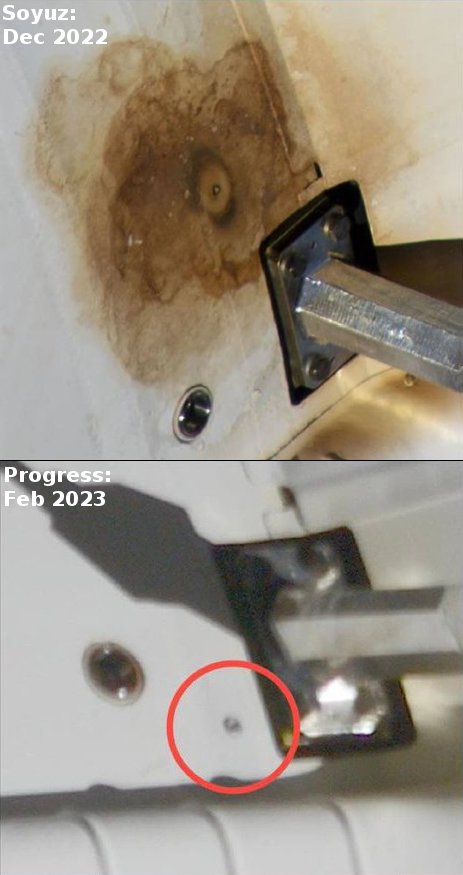
Roscosmos officials today released a close-up image taken on February 17, 2023 of what they think is the hole in the Progress freighter that caused a leak in its coolant system on February 11th.
The picture was taken shortly after the freighter undocked from ISS to be de-orbited over the Pacific. To the right is a comparison of pictures taken of that Progress hole and the hole that occurred in December on the Soyuz spacecraft docked to ISS. The comparison was first created by this Twitter user but rearranged by me to post here. The red circle in the bottom image marks what the Russians identify as the Progress hole. The top image shows the hole that caused an almost identical leak in a Soyuz capsule in December. The Russians say the Progress hole is about 12 millimeters in diameter, and to their mind was caused “by an external influence,” same as the Soyuz hole.
This conclusion however is suspect. If you look at the best resolution version of the picture of the Progress hole (available here), there appears to be material surrounding the hole, as if the hole broke from the inside, not from an outside impact. (Because the resolution is poor, however, this conclusion is uncertain.)
More telling is that, as both pictures show, the two holes are almost in the exact same place on these two spacecraft. As noted by the Twitter user who first made this picture comparison, “I can’t even calculate the odds of 2 spacecraft being struck in almost the same place, within weeks of each other.”
That the Soyuz leak caused so much staining and the Progress leak has none is also puzzling.
Were these leaks both caused by the impact of a micrometeoriod or piece of space junk, as the Russians now claim? Or was one by sabotage or sloppy production work on the ground? Or were both? One impact might make sense, but two at almost the same spot? It defies logic or the percentages for two impacts so similar to occur so close together in time.
Sabotage however in the same area is very conceivable, especially considering that the Russians have never explained the cause of the hole that was drilled in a Soyuz capsule in 2018, a hole that was drilled and then patched, before launch.

Now available in hardback and paperback as well as ebook!
From the press release: In this ground-breaking new history of early America, historian Robert Zimmerman not only exposes the lie behind The New York Times 1619 Project that falsely claims slavery is central to the history of the United States, he also provides profound lessons about the nature of human societies, lessons important for Americans today as well as for all future settlers on Mars and elsewhere in space.
“Zimmerman’s ground-breaking history provides every future generation the basic framework for establishing new societies on other worlds. We would be wise to heed what he says.” —Robert Zubrin, founder of the Mars Society.
All editions are available at Amazon, Barnes & Noble, and all book vendors, with the ebook priced at $5.99 before discount. All editions can also be purchased direct from the ebook publisher, ebookit, in which case you don't support the big tech companies and the author gets a bigger cut much sooner.
Autographed printed copies are also available at discount directly from the author (hardback $29.95; paperback $14.95; Shipping cost for either: $6.00). Just send an email to zimmerman @ nasw dot org.

Mott (l) and Connolly, eager to use race to
defame an innocent white man
Bring a gun to a knife fight: A home appraiser, Shane Lanham, who was publicly accused by two Johns Hopkins professors, Nathan Connolly and Shani Mott, of being a bigot and racist by valuing their home less because they are black, has now filed a countersuit, noting that the accusation was based on data so faulty “a first-year undergraduate” would immediately reject it.
[T]heir claims would fail to pass basic academic muster if treated as scholarship, Lanham argued in his counterclaim, which includes a suit for defamation. The racism claims achieved national coverage such as in ABC News. The resulting allegations have harmed Lanham’s business and reputation, according to the lawsuit.
“Dr. Connolly and Dr. Mott’s ill-conceived ‘experiment’ involving different appraisers, a seven-month gap, and intervening changes in market conditions would not withstand even basic scrutiny in the serious academic environment in which they work,” Lanham’s counterclaim stated. The lawsuit noted that the professors “failed to disclose the sale of the similar house next door to their home that sold only a month after Mr. Lanham and 20/20 Valuations’ appraisal for $7,000 less than the amount of the appraisal.”
You can read Lanham’s countersuit here [pdf]. He is requesting, at a minimum, $250K in compensatory damages and $250K in punitive damages.
This story began when Connolly and Mott asked Lanham (who is white) and his company, 20/20 Valuations, to appraise their house. When they were unhappy with his appraisal, they decided to get another appraisal, but this time do what they themselves called a ““whitewashing experiment.” For the second appraisal they removed all evidence that a black family owned the house, to the extent of having a white friend present himself as the owner instead. The second appraisal, done months later, came up with a higher price.
» Read more
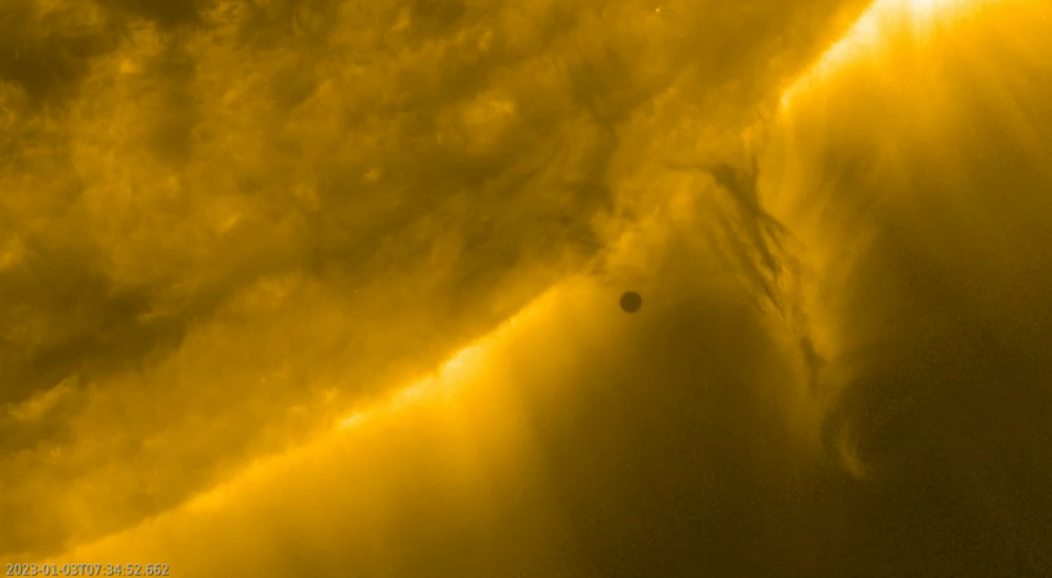
Click for full movie.
The European probe Solar Orbiter successfully filmed Mercury as it crossed in front of the Sun — from the spacecraft’s perspective — on January 3, 2023.
The transit was captured by several different instruments on Solar Orbiter, as shown at the link. The picture above is a screen capture from the short movie made by its Extreme Ultraviolet Imager. The black disk is Mercury, moving from the left to the right. In the background the limb of the Sun can be seen, with a distinct feature flaring out from that limb.
For Solar Orbiter, this particular transit offered a valuable chance to calibrate the instruments. “It is a certified black object travelling through your field of view,” says Daniel Müller, Solar Orbiter Project Scientist at ESA. Thus, any brightness recorded by the instrument within Mercury’s disc must be caused by the way the instrument transmits its light, called the point spread function. The better this is known, the better it can be removed. So be studying this event, the quality of the Solar Orbiter data can be ever further improved.
If the transit also produced some spectacular images, so much the better.

Leaving Earth: Space Stations, Rival Superpowers, and the Quest for Interplanetary Travel, can be purchased as an ebook everywhere for only $3.99 (before discount) at amazon, Barnes & Noble, all ebook vendors, or direct from my ebook publisher, ebookit.
If you buy it from ebookit you don't support the big oppressive tech companies and I get a bigger cut much sooner.
"Leaving Earth is one of the best and certainly the most comprehensive summary of our drive into space that I have ever read. It will be invaluable to future scholars because it will tell them how the next chapter of human history opened." -- Arthur C. Clarke

Click for original image.
The ground-based Very Large Telescope (VLT) in Chile has successfully taken a picture of an exoplanet four to six times larger than Jupiter that is circling its star at about the same distance as Saturn.
That picture, cropped to post here, is to the right. Other data from other observatories had suggested the star AF Leporis, 87.5 light years away, might have an exoplanet, so astronomers decided to focus VLT on it to see if it could spot it.
AF Leporis is about as massive and as hot as the sun, ESO wrote in the statement, and in addition to its one known planet the star also has a disk of debris similar to the solar system’s Kuiper Belt. AF Leporis is, however, much younger than the sun. At 24 million years old, it is about 200 times younger than our star. This young age makes AF Leporis and its planetary system especially intriguing for astronomers as it can provide important insights into the evolution of our own solar system.
To snap this picture, the VLT had to use adaptive optics to smooth out the fuzziness produced by the Earth’s atmosphere, while also blocking out the star’s own light (as shown by the black disk in the image).
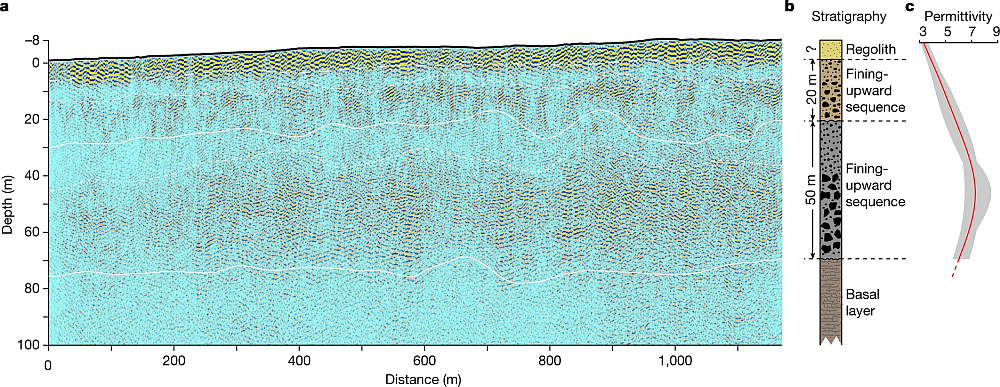
The data from Zhurong’s ground-penetrating radar instrument.

Zhurong’s final location is somewhere in the blue circle.
China’s continued silence about Zhurong — which should have come out of hibernation sometime in late December-early January — suggests the Mars rover did not survive the Martian winter, which this year was also lengthened near the end by some additional dust storms.
Zhurong went into hibernation in May 2022, at the start of winter, with plans to awaken in December. Like the helicopter Ingenuity and the lander InSight, it depends on solar power, and had to contend with a very relatively severe winter dust season this Martian year.
Even though the Chinese press has loudly touted Tianwen-1’s first two years in Mars orbit, it has made little or no mention of Zhurong, a silence that is deafening.
The silence is also foolish, because China has nothing to be ashamed of concerning Zhurong. The mission was only supposed to operate for 90 days. Instead it lasted more than a year, traveling much farther than planned. Most important, the data from its radar instrument (shown above) showed that, at this location at 25 degrees north latitude, there is no underground ice to a depth of 260 feet. That data confirmed that the Martian equatorial regions below 30 degrees latitude are very dry, with any underground ice existing rarely if at all. The icy regions above 30 degrees latitude do not appear to extend much farther south than that latitude.
An evening pause: Performed live 1989.
Hat tip Judd Clark.
Courtesy of BtB’s stringer Jay.
The tweet links to an article describing the general growth of Texas’s space industry, much of it coming from companies fleeing California’s Stalinist government regulations.
It is kind of funny that this official felt he needed to do this, since every one of those “journalists” knows he or she is really employed by the government and knows everything they write must serve that government. Why underline China’s authoritarian rule?
There had been some conflicting reports about the exact launch date. This announcement ends that confusion.
The tweet shows a short video quickly illustrating the present state of the constellation. It almost literally covers the Earth.

Dean Bill Treanor: He uses 1984 as
his instruction manual
They’re coming for you next: When student William Spruance gave a speech challenging the COVID jab and mask policies at Georgetown Law School, which required for example masks on students but not on teachers, university officials attempted to not only cancel him from the college, they tried to destroy him entirely.
They not only suspended him from the campus (thus preventing him from attending classes), they demanded he undergo a psychiatric evaluation while also waiving his right to medical confidentiality. On top of this, they threatened to report him to state bar associations if he did not cooperate fully.
The story at the link, written by Spruance, has a lot more horrifying nuance. Rather rehash it completely, I strongly advise my readers to go there and read it all. This quote though justifies fully Spruance’s reasonable skepticism of Georgetown’s irrational Wuhan flu policies:
» Read more

Click for original image.
Almost always it is impossible to understand a high resolution image from Mars Reconnaissance Orbiter (MRO) unless you also take a wider view. Today’s cool image to the right, rotated, cropped, reduced, and sharpened to post here, is a perfect example.
Taken on January 6, 2023, it shows what the science team labeled as a “rocky deposit on crater floor.” To my eye however none of this appeared tremendously rocky. Instead, what I saw was a curved and layered flow feature whose ancient age was suggested by the many later craters scattered across its surface.
Still, its origin was unclear. It isn’t ice, not only because of its apparent resistance from disturbance from those later crater impacts but because it is located at about 20 degrees north latitude, in the dry equatorial regions of Mars. If lava, what is its source? As I noted, a wider look was necessary to answer that question.
» Read more
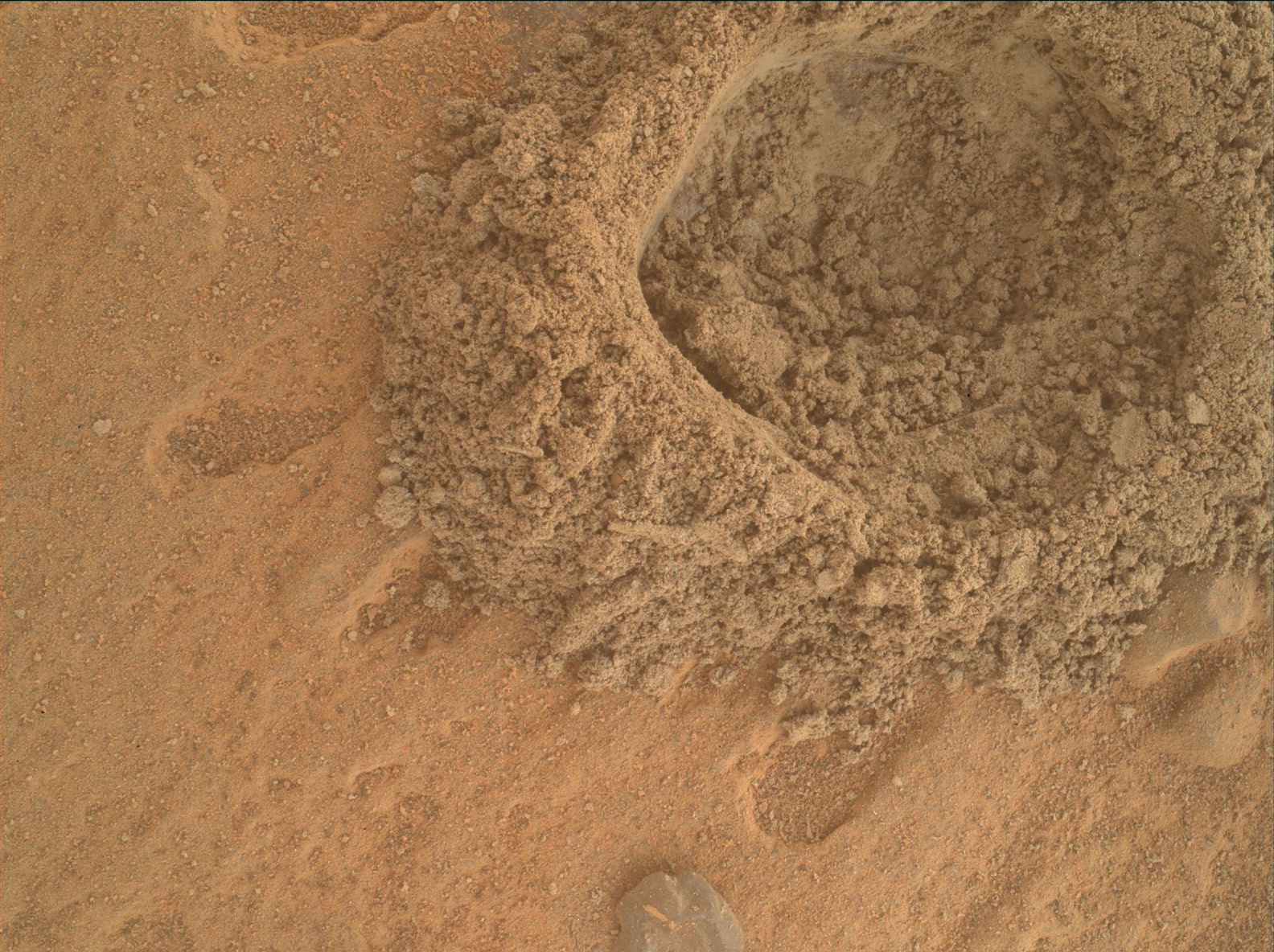
Click for original image.
For the fourth time this past weekend Curiosity’s drill was unable to penetrate the hard rock of what scientists have labeled “the marker layer”, a distinct feature seen at approximately the same elevation at many places on the flanks of Mount Sharp on Mars.
The image to the right, cropped and reduced to post here, shows that the drill was once again only able to drill a eighth to a quarter inch, not enough to gather samples for testing.
This was our fourth attempt to drill this marker band, and we gave it our best shot from both a geology and engineering perspective. Unfortunately these rocks do not want to cooperate – they’re hard and they weather into resistant and recessive beds which make them very challenging to drill. So the team made the difficult decision to get back on the road, without a drill sample from this location
Click for interactive map.
According to India’s space agency ISRO, its next lunar lander/rover, Chandrayaan-3, has successfully passed testing to make sure it can function without issues in the harsh electromagnetic environment of space.
Magnetic Interference/ Electro – Magnetic Compatibility) test is conducted for satellite missions to ensure the functionality of the satellite subsystems in the space environment and their compatibility with the expected electromagnetic levels.
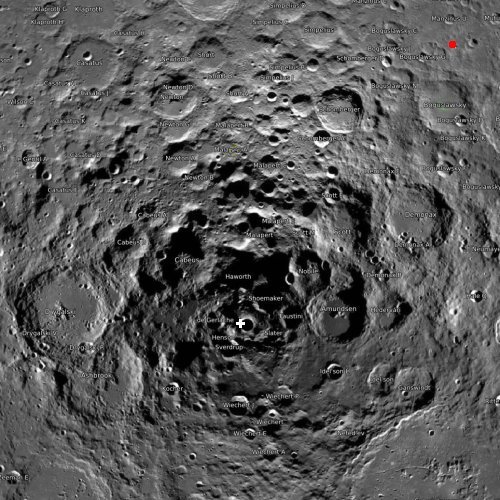
The spacecraft, which will carry a rover to the Moon’s south pole regions (the red dot on the map to the right), is tentatively scheduled for launch anywhere from June to the end of ’23, depending on the news story you read.
The first orbital tug, dubbed Orbiter SN1, of the startup company Launcher failed shortly after deployment from a SpaceX Falcon 9 rocket on January 3, 2023.
The vehicle communicated with a ground station on its first scheduled pass after deployment while on battery power. “We also communicated with the vehicle for the duration of expected battery life,” the company said.
However, the Hawthorne, California-based company said the spacecraft could not get into the proper attitude so that its solar cells could generate power, which it blamed on “an orientation control issue caused by a fault in our GPS antenna system.” That, in turn, kept Orbiter from deploying its satellite payloads.
The tug was carrying payloads from eight customers, four of which were satellites to be deployed while the others would remain on the tug, using it as the base of operations.
The company presently has plans to launch upgraded tugs on two different Falcon 9 launches, in June and October respectively.
After undocking the Progress freighter from ISS yesterday, Russian astronauts on the station rolled it so that all sides of its service module could be photographed and inspected in the hope of spotting the leak in its coolant system that sprung on February 11th.
No visual damage has been detected at the Progress MS-21 spacecraft after it undocked from the International Space Station. “After the Progress MS-21 cargo spacecraft undocked from the International Space Station’s Poisk mini-research module, footage was made of its exterior surface and no visual damage was detected,” the statement [from Roscosmos] reads.
Initially the Russians postponed its de-orbit as they considered the idea of redocking the freighter to another port on the Russian half of ISS in order to inspect it more closely, but eventually they decided to fore-go that plan and de-orbit it on February 19th, one day later.
In watching the live stream of the undocking and the roll maneuver, I thought I saw a partial reddish-orange stain, similar to the stain around the hole that occurred in the Soyuz capsule in December, but it was mostly hidden behind other equipment and the Russians seemed to not consider this significant.
SpaceX tonight used its Falcon 9 rocket to launch an Inmarsat communications satellite from Cape Canaveral, Florida.
This was SpaceX’s second launch today. The first stage successfully landed on a drone ship in the Atlantic, completing its third flight. Both fairings were also previously flown.
The 2023 launch race:
12 SpaceX
5 China
2 Russia
1 Rocket Lab
1 Japan
1 India
American private enterprise now leads China 13 to 5 in the national rankings, and the entire world combined 13 to 9. By itself SpaceX leads the world combined 12 to 9.
Embedded below the fold in two parts.
To listen to all of John Batchelor’s podcasts, go here.
» Read more
An evening pause: Performed live 1990. He really tickles those ivories with joy.
Hat tip Diane Zimmerman.
Courtesy of BtB’s stringer Jay, except for the last two.
That date, reported by Roscosmos two days ago, is three days earlier than the date listed at the link. Unless something has changed and not been reported, I would favor the earlier reported date.
Looks very clean and sleek, but also has taken decades to build.
Live stream is here, scheduled to go live around 6:15 pm Pacific. Following undocking the freighter will be maneuvered so that the leak in its coolant system on its service module can be photographed.
The language in the screen capture at the link is typical bureaucratic blather, but the bottom line is that the military is no longer limiting bidding on launch contracts to just SpaceX and ULA, a foolish program I have begging the military to abandon for years. At this point they will let others bid on missions that are less risk tolerant. Expect with time this policy to loosen even more, as more competition can only save the military money, while providing it more redundancy and capability.
The telescope will orbit close to Tiangong-3, and according to images at the link, will dock with the station for maintenance.
Though in this case the panel is likely right, I don’t take anything it says seriously. It has been so wrong so many times in the past, clearly biased against private space while favoring NASA, its analysis is simply worthless. I only include the link to its report now for completeness.
SpaceX has 30 days to respond. Considering the increased hostility by the bureaucracy to SpaceX since Biden took office, I think it is understandable to think this is simply another bureaucratic attack for political reasons.
It appears the problem simply requires a software upload of that instrument, which cannot be done for another few weeks because the spacecraft is in a blackout period due to orbital mechanics.
That timeline remains in flux, and will be finalized in early March when they decide on when to begin fueling the service module. Once that happens, they need to launch with 60 days. Expect an actual launch date to announced around then.