Starlink and SES team up to provide broadband service to cruise lines

SpaceX’s Starlink constellation and SES’s satellites in higher orbits are forming a partnership to provide cruise ships better global coverage for broadband.

The SES Cruise mPowered + Starlink service would mostly use SpaceX’s low Earth orbit network (LEO) and satellites in medium Earth orbit (MEO) from SES. In northern and southern regions, apart from the poles where there is no service, SES vice president of product management for maritime products Gregory Martin said their joint offering would leverage its geostationary satellites.

SES would sell and manage the multi-orbit service when it becomes operational later this year and SpaceX would get a cut of the sales, Martin told SpaceNews in an interview.

It appears by partnering their services, the two companies make the deal better for cruise companies.

3 comments

The orbits of the nearest stars orbiting the Milky Way’s central black hole are impossible to predict

The uncertainty of science: Using a computer program developed in 2018 that can predict with accuracy the orbits of more than three interacting objects, scientists have found that the orbits of the 27 nearest stars orbiting the Milky Way’s central black hole, Sagittarius A* (pronounced A-star) are impossible to predict after only a very short time.

“Already after 462 years, we cannot predict the orbits with confidence. That is astonishingly short,” says astronomer Simon Portegies Zwart (Leiden University, the Netherlands). He compares it to our solar system, which is no longer predictable with confidence after 12 million years. “So, the vicinity of the black hole is 30,000 times more chaotic than ours, and we didn’t expect that at all. Of course, the solar system is about 20,000 times smaller, contains millions of times less mass, and has only eight relatively light objects instead of 27 massive ones, but, if you had asked me beforehand, that shouldn’t have mattered so much.”

According to the researchers, the chaos emerges each time in roughly the same way. There are always two or three stars that approach each other closely. This causes a mutual pushing and pulling among the stars. This in turn leads to slightly different stellar orbits. The black hole around which those stars orbit is then slightly pushed away, which in turn is felt by all the stars. In this way, a small interaction between two stars affects all 27 stars in the central cluster. [emphasis mine]

To my mind, the quote by the scientist above should be considered the most absurd statement by a scientist ever spoken, except that nowadays scientists make such idiotic statements all the time. To think that such different conditions wouldn’t produce different results suggests a hubris that is astonishing for a person supposedly trained in the scientific method.

Regardless, these results suggest that acquiring an understanding of the dynamics that created these stars is going to be very difficult, if not impossible. The conditions change so rapidly, and in an unpredictable manner, that any theory proposed will be simply guessing.

4 comments

Genesis cover

On Christmas Eve 1968 three Americans became the first humans to visit another world. What they did to celebrate was unexpected and profound, and will be remembered throughout all human history. Genesis: the Story of Apollo 8, Robert Zimmerman's classic history of humanity's first journey to another world, tells that story, and it is now available as both an ebook and an audiobook, both with a foreword by Valerie Anders and a new introduction by Robert Zimmerman.

The print edition can be purchased at Amazon or any other book seller. If you want an autographed copy the price is $60 for the hardback and $45 for the paperback, plus $8 shipping for each. Go here for purchasing details. The ebook is available everywhere for $5.99 (before discount) at amazon, or direct from my ebook publisher, ebookit. If you buy it from ebookit you don't support the big tech companies and the author gets a bigger cut much sooner.


The audiobook is also available at all these vendors, and is also free with a 30-day trial membership to Audible.
 

"Not simply about one mission, [Genesis] is also the history of America's quest for the moon... Zimmerman has done a masterful job of tying disparate events together into a solid account of one of America's greatest human triumphs."--San Antonio Express-News

Jools Holland and the Playboys – Highwire

An evening pause: For those familiar with the 1960s British television show, Danger Man (which in the U.S. was titled Secret Agent) starring Patrick McGoohan (more famous for the later spy series The Prisoner), this music will be very familiar. It was written by Edwin Astley, was the theme music for the second iteration of the British release. In the American release it was used as background music throughout the show. You can watch the entire series here. It has what I call muscle, and is well worth your time.

Hat tip Wayne DeVette.

1 comment

September 12, 2023 Quick space links

Courtesy of BtB’s stringer Jay.


0 comments

Conscious Choice cover

Now available in hardback and paperback as well as ebook!

From the press release: In this ground-breaking new history of early America, historian Robert Zimmerman not only exposes the lie behind The New York Times 1619 Project that falsely claims slavery is central to the history of the United States, he also provides profound lessons about the nature of human societies, lessons important for Americans today as well as for all future settlers on Mars and elsewhere in space.

 
Conscious Choice: The origins of slavery in America and why it matters today and for our future in outer space, is a riveting page-turning story that documents how slavery slowly became pervasive in the southern British colonies of North America, colonies founded by a people and culture that not only did not allow slavery but in every way were hostile to the practice.  
Conscious Choice does more however. In telling the tragic history of the Virginia colony and the rise of slavery there, Zimmerman lays out the proper path for creating healthy societies in places like the Moon and Mars.


“Zimmerman’s ground-breaking history provides every future generation the basic framework for establishing new societies on other worlds. We would be wise to heed what he says.” —Robert Zubrin, founder of the Mars Society.


All editions are available at Amazon, Barnes & Noble, and all book vendors, with the ebook priced at $5.99 before discount. All editions can also be purchased direct from the ebook publisher, ebookit, in which case you don't support the big tech companies and the author gets a bigger cut much sooner.


Autographed printed copies are also available at discount directly from the author (hardback $29.95; paperback $14.95; Shipping cost for either: $6.00). Just send an email to zimmerman @ nasw dot org.

Today’s blacklisted American: Innocent man sentenced one-year in prison for appearing as George Washington in the Capitol on January 6

Isaac Yoder at the Capitol
Isaac Yoder at the Capitol, dressed as George Washington

They’re coming for you next: When Isaac Yoder put on his home-made costume of George Washington and went to the demonstrations on January 6, 2021, he was doing what he had been doing for years, making his statement about the roots of American liberty and free speech at many different protests. His goal wasn’t solely to protest the election of Joe Biden. He was there as much to remind everyone where our freedoms came from, “to honor the memory and legacy” of our Founding Fathers.

The Biden Department of Justice however didn’t like this innocent expression of free speech. It arrested Yoder, and has gotten him sentenced to a one year prison term for “Parading, Demonstrating, or Picketing in a Capitol Building,” actions that the First Amendment to the Constitution expressly permits, and in fact outlaws our federal government from prohibiting.

A Missouri man walked into the U.S. Capitol on January 6, 2021, dressed as George Washington. He caused no damage, engaged in no violence, and was even recorded peacefully speaking with police before leaving. For daring to dress as America’s pre-eminent Founding Father and symbolically rebuking our corrupt ruling class, Isaac Yoder was surveilled for seven months, eventually arrested, fined, and sentenced to a year in prison.

When Yoder arrived, the worst protests had ended, and the Capitol police had already opened the doors and were letting people quietly walk through the building. But he was part of a protest against Joe Biden, the Washington ruling class, and its control of the Federal government, and that could not be allowed, even though he was dressed as George Washington.
» Read more

11 comments

Weird rocks on Mars

Weird rocks seen by Curiosity and Perseverance
For original images, go here and here.

Time for two cool images, this time from both of the American rovers on Mars.

The left picture above was taken on September 9, 2023 by the high resolution mast camera on Curiosity. It shows what appears to be a many-layered but rounded rock which appears typical of the many boulders that cover the terrain through which Curiosity is presently traveling. In the past the layered rocks that Curiosity has observed lower on the flanks of Mount Sharp have not been rounded. Instead, the delicate layers have often extended outward at the rock’s edges, almost like paper or threads. For some reason, the layers in the rocks here have been eroded smooth, suggesting they were once covered by flowing water or ice, able to round the rough edges in a way that Mars’ thin atmosphere can’t.

What is puzzling is the location, higher on Mount Sharp. One would expect the reverse, with such erosion more typical lower on the mountain and uneroded delicate layers more common higher on the mountain.

The right picture above was taken on September 8, 2023 by one of the high resolution mast cameras on the rover Perseverance in Jezero Crater, about 5,000 miles to west of Curiosity. It shows a rock whose shape is so strange it is hard to fathom a geological process that would result in this form. Possibly the rock was a surface layer on a larger round boulder, and the normal freeze-thaw cycle of Mars caused it crack off as one piece. The lump in the middle however makes this explanation questionable.

Also puzzling is the curved shape. On Mars almost no geological layers have been found that are curved. They are generally flat and horizontal, reflecting the lack of tectonic processes that on Earth often twist and squash layers.

2 comments

Leaving Earth cover

Leaving Earth: Space Stations, Rival Superpowers, and the Quest for Interplanetary Travel, can be purchased as an ebook everywhere for only $3.99 (before discount) at amazon, Barnes & Noble, all ebook vendors, or direct from my ebook publisher, ebookit.

If you buy it from ebookit you don't support the big oppressive tech companies and I get a bigger cut much sooner.


Winner of the 2003 Eugene M. Emme Award of the American Astronautical Society.

 
"Leaving Earth is one of the best and certainly the most comprehensive summary of our drive into space that I have ever read. It will be invaluable to future scholars because it will tell them how the next chapter of human history opened." -- Arthur C. Clarke

Ingenuity completes 58th flight on Mars

Overview map
Click for interactive map.

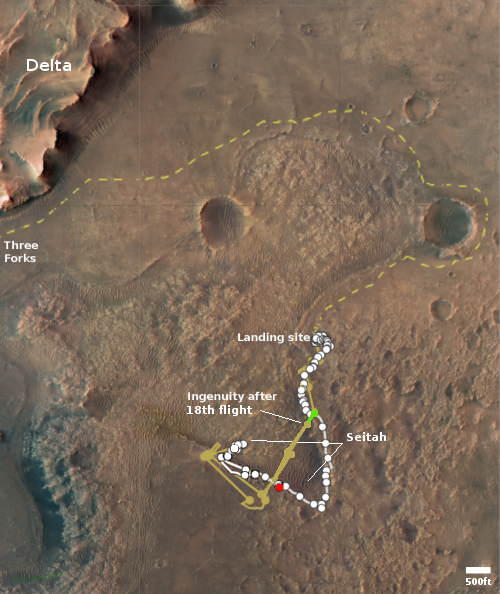
Ingenuity yesterday successfully completed its 58th flight on Mars, flying 571 feet to the northwest for 107 seconds at a height of 33 feet.

The overview map above shows with the green line the approximate route of the helicopter. Though the Ingenuity engineering team has updated the flight log (at the link above), the route has not yet been added to the Perseverance interactive map. I am guessing at that route based upon the flight plan posted on September 7, 2023, which stated the rover would head northwest as well as image science targets. That suggests it was flown above Perseverance’s planned route, as indicated by the red dotted line.

This particular flight was different than recent flights, which have generally lasted slightly longer and covered a slightly longer distance, probably so the helicopter could find a safe landing spot. This time Ingenuity landed about 23 seconds early, though the distance traveled was still slightly longer. The difference once again was almost certainly caused by the helicopter’s software picking a good landing spot. It just got above its planned landing spot sooner than expected, found a good pad, and then landed.

The blue dot marks Perseverance’s present location. It is presently moving west to reach what the scientists consider an important geological contact between two layers.

0 comments

Repeating moonquakes on Moon found to be caused by remaining sections of Apollo 17’s LM

Scientists reviewing the archive seismic data produced by the seismometers placed on the Moon by the Apollo missions have discovered that repeating small moonquakes in that data were actually caused by base of Apollo 17’s Lunar Module (LM) that provided a launchpad for the part of the LM that lifted the astronauts off the Moon.

Triangulating the origin of the mystery quakes, researchers surprisingly realized they came from the Apollo 17 lunar lander base, which expands and vibrates each morning as it becomes heated by the sun.

“Every lunar morning when the sun hits the lander, it starts popping off,” Allen Husker, a Caltech research professor of geophysics who worked on the project, said in a statement. “Every five to six minutes another one, over a period of five to seven Earth hours. They were incredibly regular and repeating.”

That the extreme range of temperatures experienced by the LM could cause detectable quakes as the LM base expanded suggests strongly how difficult it is for a spacecraft to survive the lunar night lasting 14 Earth days. For all we know, that base has now literally fallen apart due to these stresses. This in turn suggests it is highly unlikely that India’s Pragyan rover will come back to life when the sun rises on September 22, 2023.

3 comments

Lucy gets first images of its first target asteroid, Dinkinesh

The asteroid Dinkinesh as seen by Lucy

The asteroid probe Lucy has obtained its first images of Dinkinesh, the first of the ten asteroids the spacecraft is hoping to visit during its twelve year voyage to the Trojan asteroids.

The image to the left shows the motion of that asteroid over a two day period when Lucy was getting the pictures.

Lucy took these images while it was 14 million miles (23 million km) away from the asteroid, which is only about a half-mile wide (1 km). Over the next two months, Lucy will continue toward Dinkinesh until its closest approach of 265 miles (425 km) on Nov. 1, 2023. The Lucy team will use this encounter as an opportunity to test out spacecraft systems and procedures, focusing on the spacecraft’s terminal tracking system, designed to keep the asteroid within the instruments’ fields of view as the spacecraft flies by at 10,000 mph (4.5 km/s). Lucy will continue to image the asteroid over the next months as part of its optical navigation program, which uses the asteroid’s apparent position against the star background to determine the relative position of Lucy and Dinkinesh to ensure an accurate flyby. Dinkinesh will remain an unresolved point of light during the long approach and won’t start to show surface detail until the day of the encounter.

Lucy’s primary targets are asteroids in the two Trojan groups that orbit the Sun in the two Lagrange points in same orbit as Jupiter, fore and aft of the gas giant by 60 degrees. For a map of Lucy’s full mission profile, go here.

4 comments

Frank Rubio on ISS sets new record for an American in space

Though Frank Rubio was only supposed to do a six month mission, a leak on the Soyuz capsule that brought him and his two crewmates into space has resulted in all three doing a mission exceeding one year, and setting a new record for an American in space.

Today Rubio broke the old American record of 355 days, set by Mark Vande Hei in 2022. When they return on September 27, 2023, all three will have spent 371 days in space, the third longest manned mission in history, exceeded only by Sergei Avdeyev’s 381 in 1999 and Valeri Polyakov’s 437 in 1994-1995, both on Russia’s Mir space station.

Based on my interviews with Polyakov and Musa Manarov (who was on the first mission with Vladimir Titov to spend one year in space — 366 days total — in 1988) for my book Leaving Earth, it will take Rubio about one year to fully recover from this mission, though he will likely be able to function almost normally within a month or so.

It remains interesting that these American records set by Rubio and Vande Hei occurred because of decisions by the Russians, not the American space agency NASA. NASA has consistently resisted doing long missions on ISS, even though this is exactly the kind of medical research required if we are to send humans on multi-year missions to Mars and beyond. Even more embarrassing, the longest NASA planned mission, flying Scott Kelly for 340 days, was touted by NASA as a year-long mission, even though it was never going to and did not achieve that distinction.

In doing this research the Russians have always led, and appear to continue to do so on ISS.

0 comments

SpaceX launches 21 Starlink satellites

SpaceX last night launched 21 Starlink satellites from Vandenberg in California, using its Falcon 9 rocket.

The first stage completed its eleventh flight, landing on a drone ship in the Pacific.

The leaders in the 2023 launch race:

64 SpaceX
42 China
12 Russia
7 Rocket Lab
7 India

In the national rankings, American private enterprise now leads China in successful launches 74 to 42. It also now leads the entire world combined, 74 to 67, while SpaceX by itself now trails the rest of the world (excluding American companies) only 64 to 67.

0 comments
1 505 506 507 508 509 2,929