Hayabusa-2 landing on Ryugu delayed until January

Because of the roughness of the surface of Ryugu, the Hayabusa-2 science team has decided to delay the landing of the spacecraft on the asteroid from the end of this month until late January at the earliest.

JAXA project manager Yuichi Tsuda said they needed more time to prepare the landing as the latest data showed the asteroid surface was more rugged than expected.

“The mission … is to land without hitting rocks,” Tsuda said, adding this was a “most difficult” operation. “We had expected the surface would be smooth … but it seems there’s no flat area.”

.

This decision is a wise one. They will have the ability to land very precisely, and this will give them time to find the least risky spot. It does indicate however that the landing itself is going to be risky, which is probably why they want more time to gather data beforehand. Should the landing fail, the mission will essentially be over. This way they can maximize what they learn.

0 comments

Genesis cover

On Christmas Eve 1968 three Americans became the first humans to visit another world. What they did to celebrate was unexpected and profound, and will be remembered throughout all human history. Genesis: the Story of Apollo 8, Robert Zimmerman's classic history of humanity's first journey to another world, tells that story, and it is now available as both an ebook and an audiobook, both with a foreword by Valerie Anders and a new introduction by Robert Zimmerman.

The print edition can be purchased at Amazon or any other book seller. If you want an autographed copy the price is $60 for the hardback and $45 for the paperback, plus $8 shipping for each. Go here for purchasing details. The ebook is available everywhere for $5.99 (before discount) at amazon, or direct from my ebook publisher, ebookit. If you buy it from ebookit you don't support the big tech companies and the author gets a bigger cut much sooner.


The audiobook is also available at all these vendors, and is also free with a 30-day trial membership to Audible.
 

"Not simply about one mission, [Genesis] is also the history of America's quest for the moon... Zimmerman has done a masterful job of tying disparate events together into a solid account of one of America's greatest human triumphs."--San Antonio Express-News

Blue Origin delays New Shepard and New Glenn

Capitalism in space: Blue Origin announced yesterday that they are delaying the first manned test flights of their suborbital New Shepard spacecraft until next year.

The announcement also outlined their planned test launch schedule for their orbital New Glenn rocket, now set to launch for the first time in 2021, delayed from 2020 as previously announced.

I find it interesting that the same day the Air Force announces that it is giving this company a half billion dollars for development of this rocket, the company reveals that it is delaying the launch for one year. To my mind, the extra money should have helped them keep their schedule, instead of causing a delay.

What instead happens in Washington, however, is that the subsidized companies now stretch out their program in order to get more government money, focused more on that cash then on building anything. Witness for example Boeing and SLS.

What makes this strange is that Blue Origin already has plenty of capital, to the tune of about a billion per year, from Jeff Bezos. His investment should really be plenty for this company to do what it needs to do.

2 comments

Audit of SLS predicts more cost overruns and delays

Ever get a feeling of deja vu? A report by NASA’s inspector general yesterday slammed NASA and Boeing for their management of the SLS program, noting that the first unmanned launch will likely be delayed further and the cost for the program will go up another $4 billion.

The much-anticipated premiere of NASA’s Space Launch System rocket will likely see yet another push to the right, this time beyond mid-2020, as the program faces billions in cost overruns, according to a scathing audit released Wednesday by the agency’s Office of Inspector General.

Originally slated to launch from Kennedy Space Center’s pad 39B in December 2017, a 322-foot-tall version of the rocket known as SLS Block 1 will likely still be unprepared for a liftoff on the uncrewed Exploration Mission-1 by June 2020, auditors said. Even if teams could technically meet that deadline, NASA would need to offer Boeing, the contractor building the first two core stages, an infusion of $1.2 billion: $800 million to secure first stage delivery to KSC by December 2019 and an additional $400 million to make sure EM-1 launches by June 2020.

“Consequently, in light of the Project’s development delays, we have concluded NASA will be unable to meet its EM-1 launch window currently scheduled between December 2019 and June 2020,” a portion of the 50-page report reads.

The report [pdf] states that Boeing’s budget will have to double to $8 billion to meet these demands. In truth, SLS has cost the taxpayers a lot more than that, probably in the range in excess of $30 billion, if you add up all the yearly appropriations from Congress specifically applied to this rocket project and extend them through the first manned launch, now probably not taking place prior to 2024. (See my policy paper, Capitalism in Space, to see the breakdown.)

If this audit is correct, and I see no reason not to believe it, it will have taken the modern NASA more than twenty years to build and launch a single manned capsule, with a total cost of over $60 billion.

SpaceX built Falcon 1, Falcon 9, Falcon Heavy, Dragon cargo, and Dragon manned in about half that time, for a cost of about $2 billion. Falcon Heavy alone cost $500 million, and took only seven years.

From whom would you buy the product?

8 comments

Conscious Choice cover

Now available in hardback and paperback as well as ebook!

From the press release: In this ground-breaking new history of early America, historian Robert Zimmerman not only exposes the lie behind The New York Times 1619 Project that falsely claims slavery is central to the history of the United States, he also provides profound lessons about the nature of human societies, lessons important for Americans today as well as for all future settlers on Mars and elsewhere in space.

 
Conscious Choice: The origins of slavery in America and why it matters today and for our future in outer space, is a riveting page-turning story that documents how slavery slowly became pervasive in the southern British colonies of North America, colonies founded by a people and culture that not only did not allow slavery but in every way were hostile to the practice.  
Conscious Choice does more however. In telling the tragic history of the Virginia colony and the rise of slavery there, Zimmerman lays out the proper path for creating healthy societies in places like the Moon and Mars.


“Zimmerman’s ground-breaking history provides every future generation the basic framework for establishing new societies on other worlds. We would be wise to heed what he says.” —Robert Zubrin, founder of the Mars Society.


All editions are available at Amazon, Barnes & Noble, and all book vendors, with the ebook priced at $5.99 before discount. All editions can also be purchased direct from the ebook publisher, ebookit, in which case you don't support the big tech companies and the author gets a bigger cut much sooner.


Autographed printed copies are also available at discount directly from the author (hardback $29.95; paperback $14.95; Shipping cost for either: $6.00). Just send an email to zimmerman @ nasw dot org.

Soyuz upper stage fails, forces emergency landing of manned capsule

During a manned Soyuz launch today the rocket’s upper stage failed, forcing an emergency landing of the Soyuz capsule.

A normally reliable Soyuz FG rocket malfunctioned two minutes after liftoff from Kazakhstan Thursday, forcing a Russian cosmonaut and his NASA crewmate to execute an emergency abort and a steep-but-safe return to Earth a few hundred miles from the launch site. Russian recovery crews reported the crew came through the ordeal in good shape. “NASA astronaut Nick Hague and Russian cosmonaut Alexey Ovchinin are in good condition following today’s aborted launch,” NASA Administrator Jim Bridenstine tweeted from Kazakhstan.

…two minutes and two seconds after liftoff, just a few seconds after the rocket’s four liquid-fueled strap-on boosters separated from the central core stage, something went wrong. Long-range tracking cameras showed the strap-ons and what appeared to be multiple other objects falling away from the rocket.

“Failure of the booster,” a translator called out, presumably relaying a report from Ovchinin to Russian mission control near Moscow. “Failure of the booster.” Moments later, he confirmed the Soyuz had separated from the rocket’s upper stage, saying “we are in weightlessness.”

During their descent they experienced g-loads as high as about 7 g’s, which is high but not unprecedented or even close to a record.

The quote above calls the Soyuz “normally reliable.” That description applied up until about a decade ago. In the past decade there have been several failures of that rocket, though all previous failures occurred with an unmanned payload.

With this failure the need to get the American commercial capsules operational has become very urgent, since we now have no way to get humans up to ISS. The astronauts on board ISS have Soyuz capsules for return, but no one can come up to replace them.

For example, one of the reasons cited for delaying the first SpaceX unmanned test flight from December into 2019 was scheduling difficulties at ISS. This might change now and allow an earlier flight.

I have embedded video of the launch below the fold.
» Read more

14 comments

Leaving Earth cover

Leaving Earth: Space Stations, Rival Superpowers, and the Quest for Interplanetary Travel, can be purchased as an ebook everywhere for only $3.99 (before discount) at amazon, Barnes & Noble, all ebook vendors, or direct from my ebook publisher, ebookit.

If you buy it from ebookit you don't support the big oppressive tech companies and I get a bigger cut much sooner.


Winner of the 2003 Eugene M. Emme Award of the American Astronautical Society.

 
"Leaving Earth is one of the best and certainly the most comprehensive summary of our drive into space that I have ever read. It will be invaluable to future scholars because it will tell them how the next chapter of human history opened." -- Arthur C. Clarke

Israeli private Moon mission delayed by SpaceX

Because of a launch delay announced by SpaceX, the launch of a private Israeli Moon lander has been delayed from December until early 2019.

SpaceIL said Elon Musk’s SpaceX firm, whose rockets are set to carry the unmanned probe into space, had informed it of “a delay of a number of weeks to the beginning of 2019.”

SpaceIL stressed that the delay was SpaceX’s decision, noting in a statement that tests on their craft, shaped like a pod and weighing some 585 kilograms (1,300 pounds), were proceeding successfully.

As a secondary payload, the SpaceIL mission is at the mercy of SpaceX’s primary mission. It is unclear why SpaceX delayed the launch.

0 comments

Why Modern Music Is Awful

An evening pause: I find it interesting that almost all of the pop stars mentioned in this video have never been posted here as an evening pause. I want and like variety, and the main take-away from this video is the increasing sameness of modern music. Blah.

In sense, this video is an instruction manual for everyone who wants to send me a suggestion for an evening pause. It tells you the kind of music I will likely not be interested in, should you suggest it to me. To put it simply, if it sounds like everything else produced today, then it won’t get cast in the audition.

8 comments

Betty Grissom, widow of Mercury astronaut Gus Grissom, passes away

R.I.P. Betty Grissom, the widow of Mercury astronaut Gus Grissom, who died in the Apollo 1 launchpad fire in 1967, passed away today at 91 after a sudden illness.

The article makes a big deal about her successful lawsuit against North American Rockwell, the manufacturer of the Apollo capsule. I think we should instead emphasize her own courage, allowing her to agree and support her husband as he risked and lost all to help the United States win the race to the Moon.

0 comments

Air Force awards contracts to ULA, Northrop Grumman, Blue Origin

The competition heats up: The Air Force today announced contract awards to ULA, Northrop Grumman, and Blue Origin to help further the development of their new rockets.

The award to Blue Origin will be for development of the New Glenn Launch System. The award to Northrop Grumman Innovation Systems is for development of the OmegA Launch System. The award to United Launch Alliance will be for development of the Vulcan Centaur Launch System.

The Launch Service Agreements will facilitate the development of three domestic launch system prototypes and enable the future competitive selection of two National Security Space launch service providers for future procurements, planned for no earlier than fiscal year 2020.

The press release makes no mention of the amount of money being granted to these companies. Personally, I’d rather the government gave nothing until it actually bought real launch services from these companies, but it can only help the Air Force to have four different launch companies (when you include SpaceX) to draw upon. And the competition will force all four to reduce their costs and be creative.

Update: One of my readers in the comments below provided this link outlining the money granted for each contract, with ULA getting just under $1 billion, Northrop Grumman getting just under $800 million, and Blue Origin getting $500 million. This is not chicken-feed, and is in essence a subsidy for all three companies. The large amounts will act to discourage cost-savings, and in my opinion is a mistake. Whenever government bodies provide these kinds of subsidies prior to the deliver of services, the cost for the services inevitably is higher.

4 comments

Honeycombs on Mars

honeycombs on Mars

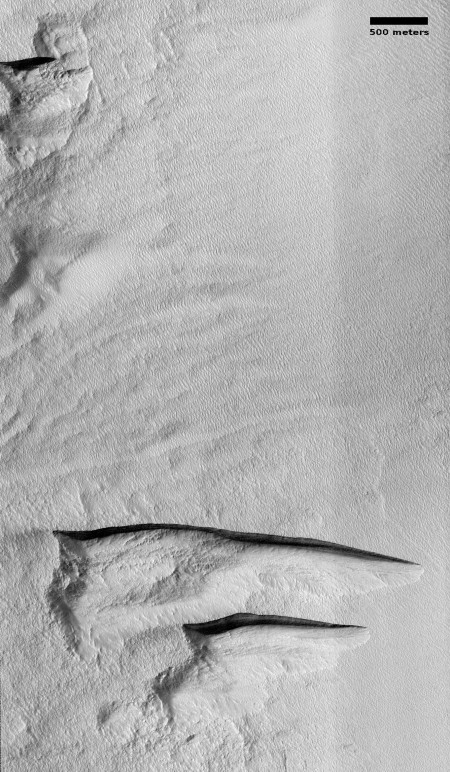
Cool image time! The image on the right, cropped to post here, came from the October 3, 2018 image release from the high resolution camera on Mars Reconnaissance Orbiter (MRO). It shows what the science team labels “honeycomb shapes in Ismeniae Fossae.” If you click on the image you can see the full picture.

This particular image does not include a caption so don’t ask me how this feature formed, as I really haven’t the faintest theory, and the MRO science team didn’t provide me one.

It is clear that dust has gathered in small dunes within these honeycombs. That provides no help, however, as the larger honeycombs are surrounded on their ridges by complex smaller ridge patterns that remind me vaguely either of rimstone dams in caves, or of the doodles you might draw during a boring class.

In a river bed?

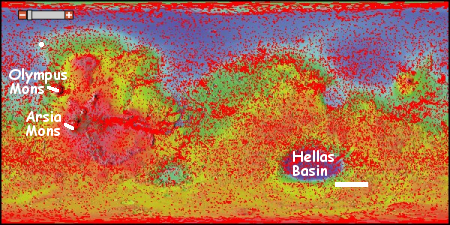
Increasing the mystery is the location of this feature. The image to the right, annotated to indicate where the insert above is located, shows that the honeycombs are formed at the bottom of what looks like a valley or shallow gorge. The full image emphasizes this, as the terrain to the north and south is a flat plateau above that valley.

That the honeycombs only occur in one small area on that valley floor further deepens the mystery. Unfortunately, MRO has not taken a lot of high resolution images of this area, which is located on the rough plateau region that drains down into the lower northern plains at 39.7 degrees north latitude and 39.9 degrees east longitude. MRO’s wide field camera has covered the area thoroughly, however, revealing it to be a very fractured and complex terrain with many criss-crossing ravines generally draining to the north and east into the northern plains. Scattered throughout this area are many other strange features not that dissimilar from the honeycombs, though not yet photographed at high resolution.

I must emphasize that the drainage path is not that clear, and almost seems chaotic, as if the water, instead of flowing downhill toward the plains, mostly seeped downward through the ground in an almost random pattern, dissolving the gorges because these were fracture or fault zones that were easily eroded.

Why these honeycombs should exist still remains baffling. Maybe they are features of a more resistance material, but if so, that still does not explain their strange shapes.

This is where I will leave this. Mars is wonderfully strange. It will be a fascinating experience to walk on its surface and see it up close.

1 comment

Honoring the Apollo 8 astronauts

Apollo 8 astronauts Frank Borman, Bill Anders, Jim Lovell

They are still here. Fifty years after becoming the first humans to leave Earth orbit and travel to another world, a mission that NASA believed only had a 50-50 chance of success, the three Apollo 8 astronauts are still with us, hale and hearty despite the passing of many years.

On October 6 the Museum of Science and Technology honored all three men with a magnificent event. The picture on the right was taken during that event, shortly after the three men, Frank Borman, Bill Anders, and Jim Lovell (from left to right) had posed for a typical group shot. It far better reveals their personalities, with Borman looking outward, Anders thoughtful, and Lovell laughing.

Borman and Lovell are ninety years old, while Anders is about to turn eight-five on October 17. Yet, all three remain as sharp as they were in 1968, when they circled the Moon. Only the wear and tear of age and time is slowing them down. It was an honor to see them again and shake their hands. It was also sad, as it was clear that time stops for no one, no matter how deserving. Flying to the Moon on a mission that many thought incredibly risky couldn’t stop them. Time unfortunately will.

We are blessed to still have them. Once again during the dinner presentation they talked of their mission, kidding each other repeatedly about what had happened, and talking about why they went and what they thought the future might hold. Borman was pessimistic about the future of space, but then he remains fixated on the concept of a government program for space. Anders meanwhile was in touch with the rise of private commercial space, and advocated that it is where the future lies.

Lovell was Lovell, as always a space cadet, enthused for the future exploration of space, no matter how we do it.

This event is likely only the beginning. Over the next year there are going to many similar events, celebrating the fiftieth anniversary the 1960s Apollo triumph, right through to the landing in July. To me, however, it will always be Apollo 8 that had the most historical impact. Everything that happened afterward merely reinforced what that flight taught us.

Below the fold are two more pictures from the event.
» Read more

3 comments

China plans next Long March 5 launch for January 2019

The new colonial movement: China has begun the assembly of the third Long March 5 rocket for its next launch, now set for January 2019.

The article provides the most detailed information yet released about the failure during the rocket’s second launch:

The cause was determined to be damage to the turbopump on one of the two cryogenic YF-77 first stage engines, prompting a redesign of the structure and test-firing in Xi’an.

This is still somewhat vague, though it does confirm that the rocket engine needed a redesign.

Should this January 2019 launch go well, it will allow China to move forward on all of its ambitious space exploration plans, including the building of its own space station, numerous robotic missions to the Moon and Mars, followed eventually with manned missions to the Moon.

0 comments

Update on SpaceX’s effort to recover/reuse its rocket fairings

Link here. Key paragraph:

SpaceX recently began seriously attempting to recover Falcon 9 payload fairings, albeit almost exclusively during West Coast launches in order to let Mr. Steven attempt to catch the parasailing halves in the Pacific Ocean. Thus far, SpaceX engineers and technicians have not yet solved the challenging problems, although fairing halves have reportedly landed as few as 50 meters from Mr. Steven’s grasp and at least five have been recovered intact after landing gently on the ocean surface. On the East Coast, Falcon fairings are not nearly as lucky, typically alternating between smashing directly into the ocean and landing gently upon it, depending SpaceX’s need for experimental recovery data.

The article outlines some of the technical issues they have been facing, as well as how pieces of some fairings have been recovered many hundreds of miles away by fishermen.

0 comments

An update on China’s Chang’e-4 lunar lander

Link here. Chang’e-4 is set to land on the far side of the Moon, sometime in December. The article provides some additional details, including information about the likely landing site in Von Kármán crater. It also notes that there are three launches planned at the spaceport prior to the December launch, and that any issue on any of those launches could delay Chang’e-4’s lift-off. .

1 comment

UAE passes a space law

The new colonial movement: The United Arab Emuirates Cabinet has passed a space law, supposedly designed to encourage the development of their space sector.

I say “supposedly” because of this:

“Although the details of the new law are not yet publicly available, I believe it has tremendous potential and am excited by the UAE’s incorporation of educational guidelines into the legal framework,” said Sunil Thacker, senior partner at the STA law firm.

It is even unclear whether this lawyer has seen the language. He is quoted extensively, raving about the wonders this new law will bring, but states no specifics. In the top-down sheik-run UAE, he has no other choice.

0 comments

Ceres’s poles have shifted by as much as 36 degrees

A new analysis of Dawn data suggests that the poles of Ceres have wandered by as much as 36 degrees, and the data also adds further support for the existence of a liquid water layer between the dwarf planet’s crust and mantle.

“The most surprising aspect of this paper is to me the observation that the pole of Ceres must have followed an indirect path to its current pole. A multi-step reorientation could mean that the equatorial density anomaly was still evolving during the reorientation, and this could be because the crust and mantle were weakly rotationally coupled, allowing the crust to start reorienting while the mantle would lag behind,” Tricarico said. “If crust and mantle are allowed to shift with respect to one another, that could point to a layer of reduced friction between crust and mantle, and one of the possible mechanisms to reduce friction could be an ancient water ocean beneath the crust.”

In other words, the crust and mantle are not locked together. Imagine a baseball where the ballcover is not tightly held to the inner core, and slides around it. (Boy there are a lot of pitchers who wish they could get a hand on that baseball.) The cause of that looseness on Ceres is possibly because of a liquid layer in-between the crust and the mantle.

Need I note that there are uncertainties here?

0 comments
1 817 818 819 820 821 1,760