
The Danish National Symphony Orchestra – For A Few Dollars More
An evening pause: Composed by Ennio Morricone.
Hat tip Wayne DeVette.
An evening pause: Composed by Ennio Morricone.
Hat tip Wayne DeVette.
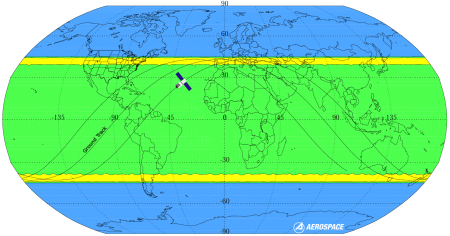
China’s first space station, Tiangong-1, is now predicted to crash to Earth in a window that has been narrowed to four days centered on April 1. The map to the right shows the station’s most likely landing areas, with yellow the most likely, green less likely, and blue not at all. Essentially, there is about a 50-50 chance the station will come down in the north mid-latitudes, with about a 70 percent chance it will land in water if it does so.
Thus, the odds of the station hitting a populated area is not large, but it definitely exists. We will not know the exact area of impact until very close to the moment the station finally comes down.

On Christmas Eve 1968 three Americans became the first humans to visit another world. What they did to celebrate was unexpected and profound, and will be remembered throughout all human history. Genesis: the Story of Apollo 8, Robert Zimmerman's classic history of humanity's first journey to another world, tells that story, and it is now available as both an ebook and an audiobook, both with a foreword by Valerie Anders and a new introduction by Robert Zimmerman.
The print edition can be purchased at Amazon or any other book seller. If you want an autographed copy the price is $60 for the hardback and $45 for the paperback, plus $8 shipping for each. Go here for purchasing details. The ebook is available everywhere for $5.99 (before discount) at amazon, or direct from my ebook publisher, ebookit. If you buy it from ebookit you don't support the big tech companies and the author gets a bigger cut much sooner.
"Not simply about one mission, [Genesis] is also the history of America's quest for the moon... Zimmerman has done a masterful job of tying disparate events together into a solid account of one of America's greatest human triumphs."--San Antonio Express-News
Capitalism in space: As SpaceX prepares to introduce its final Falcon 9 design, dubbed Block 5, it also plans to use up its stock of old used boosters, with four of the six launches scheduled through the end of April using previously flown boosters.
The article’s review of SpaceX’s stock suggests that the company will only have two used boosters after these launches. It also notes that the company appears to have decided that these earlier Falcon 9 designs can only fly two or three times safely, and that it will be the Block 5 final design that they hope will finally be the booster that can fly repeatedly and reliably.
Since NASA won’t let astronauts fly on anything other than Block 5, and insists it fly at least seven times successfully before the agency will allow its astronauts on it, SpaceX has a lot at stake with this final design. If it has problems, the company will be in trouble. If not, the company will cement the dominate position it presently holds in the launch industry.
Doug Messier has compiled a detailed and what appears to be a complete list of all Russian/Soviet launch failures going back to 1988. As he says, “Launch failures are not a bug in the system, they’re a feature.”
What struck me most about his graph is the number of Soyuz rocket failures. For decades, various versions of this rocket have been used to bring astronauts up to either Mir or ISS, and because there have not been any launch failures during those manned launches, the impression given is that the Soyuz is one of the most reliable rockets in existence. Messier’s table proves that impression false, and also tells us that the Russians, and the United States, have been very lucky that no lives have been lost in the past three decades on any Soyuz launches.
The table also illustrates why commercial customers have been so quick to shift their business from the Russians to SpaceX. The Russians have not provided a very good or reliable product. Since 1988 there have only been two years, 2001 and 2003, in which the Russians had no failures. And the table indicates that their failure rate has increased in the past decade.

Now available in hardback and paperback as well as ebook!
From the press release: In this ground-breaking new history of early America, historian Robert Zimmerman not only exposes the lie behind The New York Times 1619 Project that falsely claims slavery is central to the history of the United States, he also provides profound lessons about the nature of human societies, lessons important for Americans today as well as for all future settlers on Mars and elsewhere in space.
“Zimmerman’s ground-breaking history provides every future generation the basic framework for establishing new societies on other worlds. We would be wise to heed what he says.” —Robert Zubrin, founder of the Mars Society.
All editions are available at Amazon, Barnes & Noble, and all book vendors, with the ebook priced at $5.99 before discount. All editions can also be purchased direct from the ebook publisher, ebookit, in which case you don't support the big tech companies and the author gets a bigger cut much sooner.
Autographed printed copies are also available at discount directly from the author (hardback $29.95; paperback $14.95; Shipping cost for either: $6.00). Just send an email to zimmerman @ nasw dot org.
Embedded below the fold in two parts.
» Read more
Because engineers wished more time, India has delayed the launch of its second unmanned Moon mission, Chandrayaan-2, from April to October.
Union Minister of State in the Prime Minister’s Office, in-charge of the Department of Space, Jitendra Singh had on 16 February last said the lunar mission under which the Isro will for the first time attempt to land a rover on the moon’s south pole, will be launched in April.
Sivan (head of ISRO) had earlier said the window to launch the Rs800 crore mission was between April and November 2018. While the “targeted date” was April, Isro would launch the mission in October or November, he had said.
This is a very ambitious mission, so pushing the launch back to October seems quite reasonable. That they are aiming for the south pole is also smart, especially since NASA has abandoned that location as a target to instead build a giant Potemkin village orbiting the Moon, where it can accomplish nothing.
Posted between Flagstaff and Phoenix as we head back from a very successful four-day caving expedition in the Grand Canyon.

Leaving Earth: Space Stations, Rival Superpowers, and the Quest for Interplanetary Travel, can be purchased as an ebook everywhere for only $3.99 (before discount) at amazon, Barnes & Noble, all ebook vendors, or direct from my ebook publisher, ebookit.
If you buy it from ebookit you don't support the big oppressive tech companies and I get a bigger cut much sooner.
"Leaving Earth is one of the best and certainly the most comprehensive summary of our drive into space that I have ever read. It will be invaluable to future scholars because it will tell them how the next chapter of human history opened." -- Arthur C. Clarke
An evening pause: Sentimental but right. And a nice way to end the week.
Hat tip Jim Mallamace.
An evening pause: This was first a hit in 1968 for Merillee Rush & The Turnabouts. Juice Newton brought it back in 1981 and it was a hit again. Both versions are unique and worth listening to.
The omnibus budget that Congress plans to pass this week for 2018 gives NASA $20.7 billion, significantly more than requested and funding almost every pork project Congress could conceive of, including a second mobile launcher for SLS.
The budget gives SLS and Orion more than $3 billion, funds all the Earth science and education projects the Trump administration wished to cut, as well as WFIRST, which the Trump administration wants to cancel because of cost overruns. In general, the NASA budget is a microcosm of the entire spending bill, which does nothing to cut any program anywhere, including Obamacare and a number of liberal programs that the Republicans have repeatedly promised to shut down, until they are in a position to do so. Then they act like leftist Democrats and fund everything.
This is posted between Tucson and Phoenix. I am heading up to the Grand Canyon for a four day cave expedition, which is why I can’t do a more thorough analysis. This really isn’t necessary however, as it is very clear that the Republican leadership in Congress are continuing their corrupt passion for spending money that does not exist. And they wonder why they may lose seats in 2018.
An evening pause: It is amazing how modern technology can allow artists like this the ability to create something so unique, so quickly, on the fly.
Hat tip t-dub.
Summary: Curiosity continues its exploration of Vera Rubin Ridge, including several drilling attempts. Opportunity is halfway down Perseverance Valley.
For a complete list of all past updates going back to July 2016, see my February 8, 2018 update.
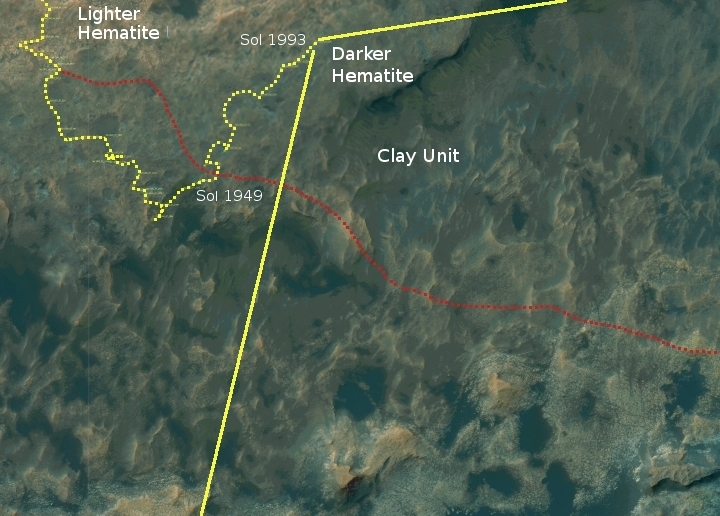
For the overall context of Curiosity’s travels, see Pinpointing Curiosity’s location in Gale Crater.
Since my February 8, 2018 update, the Curiosity science team has apparently been loath to leave Vera Rubin Ridge. They had begun the trek to the northeast that would take them towards the exit ridge heading to the southeast, as indicated by the dotted red line on the traverse map above, but then continued past that planned route to continue to the northeast. Along the way they attempted to drill twice using an improvised approach that they hoped would bypass the drill’s stuck feed mechanism, without apparent success.
The panorama below is looking to the west and south, as indicated by the yellow lines in the image above.
» Read more
A Russian Soyuz rocket today successfully launched three astronauts to ISS.
The leaders in the 2018 launch standings:
8 China
5 SpaceX
3 Japan
3 ULA
3 Russia
2 Europe
The U.S. and China remain tied at 8 in the race between nations.
The August launch by SpaceX of a communications satellite created the largest rocket shockwave in the atmosphere ever measured.
In the new study, Lin and his colleagues used GPS signals to determine how the FORMOSAT-5 launch affected the upper atmosphere. They found Falcon 9’s vertical trajectory created a circular shock wave above the western United States that had never before been seen from a rocket launch. The only similarly-shaped shock wave Lin had seen was from an eruption of Russia’s Sarychev volcano in June 2009.
Not only was the shock wave circular, it was also the largest one Lin had ever seen – roughly four times the area of California. In the new study, he ran computer simulations of rocket launches and found the momentum from a vertical trajectory would tend to create a much stronger atmospheric disturbance than a curved one, which could explain why the shock wave was so large.
In addition to creating a gigantic shock wave, the launch created a hole in the ionosphere above California. Water vapor in the rocket’s exhaust reacted with the ionosphere’s charged particles to create a hole in the plasma layer that took up to two hours to recover.
The rocket’s vertical trajectory was because the overall payload was light. Heavier payload cause the trajectory to curve more as the rocket rises.
Link here. The article takes a detailed look to try to find out the unnamed commercial company behind the mid-April launch, and learns that it will be a suborbital launch, and that the company might be one called Astra Space.
Alaska Aerospace signed a contract with Astra Space in 2017 to support launches of that company’s vehicle from PSCA, according to the minutes of an Alaska Aerospace board of directors meeting in August 2017.
Alaska Aerospace “has a contract with Astra to support the first four launches of their small liquid fuel commercial launch vehicle from PSCA. The first launch is planned for December 2017,” the minutes state. It added that it would be the first liquid-propellant launch from the spaceport, which previously had hosted only solid-fuel rockets. “This will be a very innovative launch.”
Minutes from a Nov. 2 meeting of the Alaska Aerospace board stated that “Astra is moving forward” with plans, holding weekly planning teleconferences and paying a $100,000 deposit for a launch date. That launch was planned at that time for “possibly February or later.”
It appears the company is doing work for both NASA and DARPA, the latter of which might explain the secrecy. Or maybe the company is taking the Blue Origin approach, keeping things close to the vest until they are sure of success.
The new colonial movement: Japan’s government has created a $940 million fund that will be used to help new space companies get started.
The funds will be made available through investments and loans over the next five years, as part of a government-led initiative to double Japan’s more than $11 billion space industry. With less than 20 Japanese space start-ups currently operating, many see this as critical to helping new companies cover costs such as research or applying for patents. “We believe this will be remembered as a turning point for our burgeoning industry,” Takeshi Hakamada, CEO and founder of lunar exploration start-up ispace, said in a statement.
Ispace has received government backing in the past, including during a recent $90.2 million round of funding that included Suzuki Motor and Japan Airlines. Founded seven years ago, ispace is stepping beyond the Google-backed Lunar XPRIZE competition to fund two exploration missions to the moon, with the first by the end of 2019 and the second by the end of 2020.
The Japanese government is setting up an agency to manage the funds and connect start-ups with local talent from organizations such as the Japan Aerospace Exploration Agency or the rocket-building arm of Mitsubishi Heavy Industries. Initially, start-ups will be eligible to each receive about $100,000 in aid to help present concepts to investors. Promising ventures and more mature companies will be able to tap into the rest of the $940 million fund to further development.
More details here.
The most interesting aspect however of this new effort is the decision by Japan to also review its space law in order to encourage private ownership in space.
Japan also announced it is considering new laws and policies that would allow businesses to own plots of land developed on the moon, in a similar manner to the laws passed by the United States and Luxembourg. So far, the U.S. and Luxembourg are the only two countries in the world to have passed laws giving corporations ownership of materials mined in space, but only after they’ve been extracted. That legal framework has seen the tiny European country attract dozens of space companies, with another 70 space companies looking to establish in Luxembourg, according to Deputy Prime Minister Etienne Schneider.
They will find, as have the U.S. and Luxembourg as well as UAE, the United Kingdom, and a number of other countries that have reviewed the Outer Space Treaty, that this legal framework under this treaty will not work well, and still leaves the ownership rights of private companies very vulnerable. To protect property rights in space, either the Outer Space Treaty has to be changed to allow the establishment of national borders and laws, or dumped entirely.
Embedded below the fold in two parts.
» Read more
An evening pause: This performance is a tribute to the 1970s art-rock group, Mahavishnu Orchestra. They add a bit of country to the sound, which works surprisingly well. Ignore the bad camerawork and focus on the music, which somehow for me works for the first day of spring.
Hat tip Diane Zimmerman.
My two hour appearance with David Livingston on the Space Show last night is now available and can be downloaded as a podcast here.
This show was particularly interesting because of the high quality of questions from the callers. In fact, in many ways I think it might have been one of my most interesting Space Show appearances in a long time. Definitely worth a listen.
Astronomers now think they have pinned the orbits of about 340 comets to another star’s close approach to our solar system 70,000 years ago.
About 70,000 years ago, when the human species was already on Earth, a small reddish star approached our solar system and gravitationally disturbed comets and asteroids. Astronomers from the Complutense University of Madrid and the University of Cambridge have verified that the movement of some of these objects is still marked by that stellar encounter. At a time when modern humans were beginning to leave Africa and the Neanderthals were living on our planet, Scholz’s star – named after the German astronomer who discovered it – approached less than a light-year from the Sun. Nowadays it is almost 20 light-years away, but 70,000 years ago it entered the Oort cloud, a reservoir of trans-Neptunian objects located at the confines of the solar system.
This discovery was made public in 2015 by a team of astronomers led by Professor Eric Mamajek of the University of Rochester (USA). The details of that stellar flyby, the closest documented so far, were presented in The Astrophysical Journal Letters.
Now two astronomers from the Complutense University of Madrid, the brothers Carlos and Raúl de la Fuente Marcos, together with the researcher Sverre J. Aarseth of the University of Cambridge (United Kingdom), have analyzed for the first time the nearly 340 objects of the solar system with hyperbolic orbits (very open V-shaped, not the typical elliptical), and in doing so they have detected that the trajectory of some of them is influenced by the passage of Scholz´s star.
It is likely that the close approach influenced a lot more objects, many of which might not have yet arrived in the inner solar system. Moreover, their computer models suggest that the star might have come closer to the Sun than 0.6 light years.
A school shooter today in Maryland was stopped by armed officer before the shooter had killed anyone.
St. Mary Co. Sheriff Tim Cameron on shooting at Great Mills HS: shooting happened in hallway; shooter, a student, fired at a female student, another was student hit. Armed school resource ofc, a deputy, exchanged shots w/ shooter; shooter & female student in critical condition
The shooter has since died.
It is unclear if the shooter here was aiming to kill as many as possible, or was involved in personal conflict. Either way, the incident illustrates the wisdom of having armed protection available, either by teachers or police officers.