Tom Scott – The Library of Rare Colors
A evening pause: This is something that is technologically complex that we all take entirely for granted.
Hat tip Jeff Poplin.
A evening pause: This is something that is technologically complex that we all take entirely for granted.
Hat tip Jeff Poplin.
Though the Hubble Space Telescope returned to science operations on March 12th after going into safe mode, its wide field camera did not.
Engineers however now report that they have successfully restored the camera to operations as well. The reason for the delayed restoration exemplifies Hubble’s aging status.
Analysis showed that voltage levels in WFC3 power supplies have slowly decreased over time as their electronics aged. The electronics experience colder temperatures when the hardware is turned off in safe mode. This factor coupled with the power the instrument components draw as they are turned back on contributed to the small voltage fluctuation that suspended WFC3 recovery operations. Further detailed analysis indicated that it would be safe to slightly reduce the low voltage limit to avoid a future suspend, and it would be safe to recover the instrument to its science state.
The instrument has now been safely recovered. Standard calibration of the instrument and other pre-observation activities will be conducted this week.
All the telescope’s equipment has been adjusted in recent years to deal with the varying ages of its instruments and its main structure. For example, this wide field camera was installed during the last shuttle serving mission in 2009, and is therefore one of Hubble’s newest components. It however is now more than a decade old, and thus needs careful handling to function properly.
Other components are far older, such as the primary motor to open and close the telescope’s “lens cap”. That failed during this safe mode, forcing engineers to switch to a back up motor to control the cap. Whether they can recover that primary motor is presently unclear, though unlikely.
Expect more such issues in the coming years.
On Christmas Eve 1968 three Americans became the first humans to visit another world. What they did to celebrate was unexpected and profound, and will be remembered throughout all human history. Genesis: the Story of Apollo 8, Robert Zimmerman's classic history of humanity's first journey to another world, tells that story, and it is now available as both an ebook and an audiobook, both with a foreword by Valerie Anders and a new introduction by Robert Zimmerman.
The print edition can be purchased at Amazon or any other book seller. If you want an autographed copy the price is $60 for the hardback and $45 for the paperback, plus $8 shipping for each. Go here for purchasing details. The ebook is available everywhere for $5.99 (before discount) at amazon, or direct from my ebook publisher, ebookit. If you buy it from ebookit you don't support the big tech companies and the author gets a bigger cut much sooner.
"Not simply about one mission, [Genesis] is also the history of America's quest for the moon... Zimmerman has done a masterful job of tying disparate events together into a solid account of one of America's greatest human triumphs."--San Antonio Express-News
They’re coming for you next: Google’s YouTube has now blacklisted more than 30,000 videos simply because they stated conclusions relating to COVID-19 vaccines that either contradicted or challenged opinions or conclusions held by the World Health Organization or other governmental health authorities.
The headline is only listing the videos removed by YouTube because they state conclusions relating to various coronavirus vaccines that YouTube disagrees with. It turns out this is only the tip of the iceberg.
» Read more
Capitalism in space: According to this Starship update, the 11th Starship prototype is scheduled for its static fire dress rehearsal countdown today, with the possibility of its first flight as early as tomorrow.
This paragraph about SpaceX’s overall Starship program however is more significant:
Following SN11’s flight, SpaceX will move on to SN15, 16, and 17, alongside testing with Super Heavy prototypes BN1 and BN2, before shooting for an orbital launch with SN20 and BN3. In typical SpaceX-style, that orbital launch has an astonishing – and unlikely – “by July 1” target. At the very least, this target portrays SpaceX’s Starship drive to push the vehicle into operation.
The reason they are going directly from prototype #11 to #15 is because they scrapped #s 12, 13, and 14 after the flights of #9 and #10. They had learned enough, and those scrapped prototypes would not have taught them anything. Instead, they incorporated the learned changes to #15 and will fly that next.
The July 1st launch date is certainly overly optimistic. It also signals the company’s determination to try to get that first orbital flight off this year. Based on their pace, it would be foolish to dismiss this as a possibility.
It also signals what I think is an internal unstated goal within SpaceX to have Starship beat SLS into orbit. Nor would anyone be wise to consider that impossible. In fact, I consider it quite likely.
Now available in hardback and paperback as well as ebook!
From the press release: In this ground-breaking new history of early America, historian Robert Zimmerman not only exposes the lie behind The New York Times 1619 Project that falsely claims slavery is central to the history of the United States, he also provides profound lessons about the nature of human societies, lessons important for Americans today as well as for all future settlers on Mars and elsewhere in space.
“Zimmerman’s ground-breaking history provides every future generation the basic framework for establishing new societies on other worlds. We would be wise to heed what he says.” —Robert Zubrin, founder of the Mars Society.
All editions are available at Amazon, Barnes & Noble, and all book vendors, with the ebook priced at $5.99 before discount. All editions can also be purchased direct from the ebook publisher, ebookit, in which case you don't support the big tech companies and the author gets a bigger cut much sooner.
Autographed printed copies are also available at discount directly from the author (hardback $29.95; paperback $14.95; Shipping cost for either: $6.00). Just send an email to zimmerman @ nasw dot org.
Capitalism in space: SpaceX early this morning successfully launched another 60 Starlink satellites into orbit using its Falcon 9 rocket.
The company also successfully used a first stage for a record ninth time, landing it on its drone ship in the Atlantic. The booster did all nine flights in just over two years.
The 2021 launch race:
8 SpaceX
6 China
3 Russia
1 Rocket Lab
1 Virgin Orbit
1 Northrop Grumman
1 India
The U.S. now leads China 11 to 6 in the national rankings.
According to a report today in the Russian press, the air in the Zvezda module of ISS continued to leak away slowly during a test, following this week’s repair of two cracks in the module’s hull.
At about 07:00 GMT on Saturday, ISS cosmonaut Sergei Ryzhikov told a specialist at the Mission Control Center, located near Moscow, that the pressure in the intermediate chamber of the Zvezda module was 678 millimetres of mercury. The pressure stood at 730 millimetres of mercury on Friday evening, right after the hatch of the compartment was closed. Thus, the pressure in the chamber decreased by 52 millimetres of mercury over 11.5 hours.
Based on the thorough nature of the two repairs, this leak must be coming from another very tiny leak that has not yet been detected. Though the leak is very slow and thus not an immediate threat to the astronauts on board, it suggests once again that the leaks are coming from stress fractures resulting from Zvezda’s 20-plus years in orbit. If so, the problem is very serious indeed. Zvezda is the central module for ISS. Replacing it will not be simple or easy.
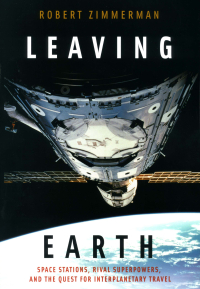
Leaving Earth: Space Stations, Rival Superpowers, and the Quest for Interplanetary Travel, can be purchased as an ebook everywhere for only $3.99 (before discount) at amazon, Barnes & Noble, all ebook vendors, or direct from my ebook publisher, ebookit.
If you buy it from ebookit you don't support the big oppressive tech companies and I get a bigger cut much sooner.
"Leaving Earth is one of the best and certainly the most comprehensive summary of our drive into space that I have ever read. It will be invaluable to future scholars because it will tell them how the next chapter of human history opened." -- Arthur C. Clarke
China successfully used its Long March 4C rocket to launch three military ocean reconnaissance satellites on Friday, March 13, 2021 (in China).
The article also includes some details about the upcoming schedule of launches in connection with China’s space station, beginning with the April 29th launch of the station’s first module, Tianhe-1, followed in May by the launch and docking of its unmanned Tianzhou-2 cargo freighter, and then followed by the first crew in June.
The 2021 launch race:
7 SpaceX
6 China
3 Russia
1 Rocket Lab
1 Virgin Orbit
1 Northrop Grumman
1 India
The U.S. still leads China 10 to 6 in the national rankings.
An evening pause: Performed live 1995.
Hat tip Jim Mallamace, who added, “A time before cell phones waved in everyone’s hand. A time where crowds were in the moment. A time when there were crowds.”
I would add it was a time when people were also not afraid, but lived life with spirit and exuberance, ignoring its natural risks because to pay attention to them would make life intolerable.
Enjoy your weekend. Get out of your house. Do something grand. And do it with as many people as you can find.
Today’s cool image on the right, rotated, cropped, and reduced to post here, is part of a series of cool images that have repeatedly shown the blobby and squishy look of crater impact sites in the Martian northern lowland plain dubbed Utopia Planitia. Taken on January 2, 2021 by the high resolution camera on Mars Reconnaissance Orbiter (MRO), it shows the southeast rim of a very distorted crater that appears filled with glacial material and is also surrounded by an apron of smooth material.
At 42 degrees north latitude, it is somewhat expected to find evidence of glacial-like features in such a crater. Moreover, throughout the 30 to 60 degree mid-latitude band in Utopia Planitia are found numerous such blobby craters (other examples found here, here, and here), all suggesting that the impact occurred on a flat plain with a layer of water ice close to the surface. The heat of the impact melted that ice layer. In such a circumstance, the crater rims were easily deformed because as liquid water (for a short time) it could flow into any number of shapes.
At least that’s my theory. According to Colin Dundas of the U.S. Geological Survey’s Astrogeology Science Center in Arizona,
The exact processes that create the patterns are still debated. The flattened/degraded rims are not necessarily related to this morphology, as such craters can have sharp rims, so they may relate to post-impact modification.
In other words, later erosion after the crater formed could have rounded the rim and maybe even distorted it from a circle.
Regardless, the processes that made this crater rim look as it does were clearly widespread, as shown in the wider view below, provided by the context camera on MRO.
» Read more
They’re coming for you next: The Undergraduate Student Government (USG) Governing Board at the University of Connecticut has condemned its student president, Mike Hernández, because he is supporting campus legislation that would protect the free speech rights of students.
The bill, which was introduced by sixth semester junior political science and economics double major Isadore Johnson, aims to protect students and their right to freely express their opinions within student government and also at UConn as a whole.
Opponents of the bill, however, have argued the legislation gives students a free pass to express casual racism, homophobia and misogyny without consequence, and have expressed concern over Hernández’s support of the bill.
The board is using as its trigger to condemn Hernández a single comment he supposedly made privately to another student, where he allegedly said that affirmative action legislation as well as rules forbidding anyone from saying anything offensive about minorities is equivalent “to treating minorities like children.” From that board’s statement, which was approved by this board by a vote of 8-1, with one abstention:
» Read more
According to the Russian state-run press, Russian astronauts have completed their repair work on the ISS module Zvezda and are about to seal the module to test their work.
“The crew of the International Space Station has completed the repair and recovery work on the hull of the Zvezda module. In the coming days, Sergei Ryzhikov and Sergei Kud-Sverchkov will close the hatches in the Zvezda module to check the atmospheric level,” the press office said.
Previous reports suggested the astronauts had located a total of two cracks, both now sealed.
The larger question however remains. Are the cracks stress fractures, and if so do they suggest that Zvezda’s 20-year-old hull is beginning to fail? The Russians have been very silent about these questions, though they have admitted the possibility once or twice, almost as an aside.
Nor has NASA been forthcoming. The American space agency has apparently joined the Russians in keeping this problem out of the news, at all costs. Once, the employees at NASA were Americans who demanded openness from Russia and from themselves. No more. Increasingly our government workers are indistinguishable from Soviet apparatchiks, whose main goal was to protect the government from bad press.
If Zvezda’s hull is failing then ISS faces some very serious engineering issues. They can be solved, but not by silence and sticking one’s head in the sand.
Engineers have fixed the computer software issue that caused the Hubble Space Telescope to go into safe mode this week, and are preparing it to return to full science operations.
It appears the problem was caused by a software upgrade that caused a conflict.
More serious however was this problem, which could have damaged the telescope beyond repair had it had been randomly pointed at the Sun during safe mode.
In entering safe mode on Sunday, however, the team discovered that the aperture door located at the top of the telescope failed to automatically close. This door is a safeguard designed to keep the Sun’s damaging light and heat out of the telescope’s interior, protecting its sensitive instruments and their surroundings. It serves as a safety net if Hubble accidently points in the direction of the Sun due to an error or hardware problem.
…The team has looked at spacecraft engineering data, run various tests, and verified that the door did indeed remain open despite the commands and power being sent to close it. Additional attempts to move the door by sending commands from the ground to its primary motor also failed to make the door move. However, the same commands sent from the ground to its backup motor did indicate movement, and that motor is now set as the primary motor. The team is looking at options to further reduce any associated risk.
It appears the primary motor that moves the door has failed. Fortunately there is a backup motor, but this is just one more item where the telescope has lost redundancy. We are very lucky that during safe mode the telescope didn’t end up pointing at the Sun, even for a very short time, for that would have ended Hubble’s operation for good. I suspect the safe mode software includes protections against that occurrence, but the possibility nonetheless existed.