
Stratolaunch’s Roc airplane completes another test flight

Stratolaunch today announced that it has successfully completed the third capture-carry test using its giant Roc airplane, carrying an engineering test version of its Talon vehicle, designed to do hypersonic flight tests for the Air Force.

The flight was the tenth for the company’s launch platform Roc and marks the beginning of routine flight operations in Vandenberg Space Force Base’s Western Range off California’s central coast. The flight, which lasted a total of five hours, performed risk reduction by practicing a variety of separation profiles and confirming telemetry between Roc and Talon-A vehicles and Vandenberg Space Force Base’s communication assets, assuring that back-up telemetry data collection will occur during future flight tests.

Pending results of post-flight data analysis, the team will progress toward a separation test in the coming weeks, enabling the company to perform its first hypersonic flight in 2023.

There is a lot of potential test capability for Roc and Talon, not just with hypersonic missiles and aircraft. If Stratolaunch succeeds in fulfilling this Air Force contract, it will likely garner a good amount of additional business.
0 comments

Diesel fuel spill at Air Force surveillance facility on Hawaiian mountaintop

The Air Force reported today that about 700 gallons of diesel fuel spilled out on January 29, 2023 at Air Force’s surveillance telescope facility on top of Haleakala on the island of Maui.

The spill occurred at the Maui Space Surveillance Complex, which tracks satellites and space debris using several telescopes atop Haleakala, a dormant volcano. “Due to a mechanical issue, a diesel fuel pump for an on-site backup generator failed to shut off” Sunday night, the Air Force said in a news release.

At about 8 a.m. Monday, maintenance personnel discovered the failure and shut off the transfer pump, the Air Force said.

Since 2021 the military has had two other accidents at different Hawaiian facilities. Considering the hostile political atmosphere there for any facility not run by “native Hawaiians”, this new fuel spill could not have come at a worse time. Expect pressure to mount to remove this facility.

5 comments

General Atomics wins Air Force contract to build technology test lunar satellite

General Atomics yesterday announced that it has been awarded an Air Force Research Laboratory (AFRL) contract to build a satellite to test a variety of technologies in near lunar space.

The AFRL Oracle spacecraft program is intended to demonstrate advanced techniques to detect and track objects in the region near the Moon that cannot be viewed optically from the Earth or from satellites in traditional orbits such as geosynchronous earth orbit (GEO). The anticipated launch date for the Oracle spacecraft is late 2025.

While this is good business for General Atomics, the company is not selling its product to the Air Force, but building what the Air Force wants, making the spacecraft government owned. This is how the space industry functioned in the United States for almost a half century after Apollo, generally accomplishing little for great cost. Much better in the long run if the military bought this kind of product from private companies, who developed it for profit and for sale not just to the military.

5 comments

X-37B returns successfully to Earth after 908 days in orbit

One of the two X-37B reusable mini-shuttles that Boeing built for the military successfully returned to Earth early this morning after completing 908 days in orbit, a new longevity record.

This was the sixth mission of the crewless reusable plane, built by Boeing and jointly operated by the U.S. Space Force and the Air Force Rapid Capabilities Office. Known as Orbital Test Vehicle 6, it launched to orbit May 17, 2020, on a United Launch Alliance Atlas 5 rocket.

On this mission the X-37B carried several U.S. military and NASA science experiments, including a Naval Research Laboratory project to capture sunlight and convert it into direct current electrical energy, and the U.S. Air Force Academy’s FalconSat-8, which remains in orbit.

It appears, based on the amount of information released after landing, that the Space Force is making more of what it does and will do on this and future X-37B flights more public.

6 comments

Advanced Space wins lunar orbiter contract with Air Force

Advanced Space, the company that is presently running the CAPSTONE mission that will arrive in lunar orbit on November 13th, has won a $72 million contract with the Air Force Research Laboratory to build and operate a new experimental lunar orbiter.

The mission, dubbed Oracle, is targeting a 2025 launch and will operate in lunar orbit for two years.

“Our primary goals for the program are to advance techniques to detect previously unknown objects through search and discovery, to detect small or distant objects, and to study spacecraft positioning and navigation in the XGEO realm,” said James Frith, the principal investigator. XGEO refers to the space beyond geosynchronous orbit out to the moon. Oracle will operate in the vicinity of Earth-moon Lagrange Point 1, about 200,000 miles from Earth. The GEO belt, by comparison, is about 22,000 miles above Earth.

An additional goal of Oracle is to help mature AFRL’s green propellant technology. “While there are no specific plans yet to refuel Oracle, AFRL wants to encourage civil and commercial development of on-orbit refueling services,” said Frith.

The federal government’s transition from the building rockets, spacecraft, and satellites to simply buying them from the private sector continues. In the past, when the Air Force attempted to design and build everything, a project like this would have cost at least five times more and taken two to five times longer to get launched. Now, it hires Advanced Space to do it, and gets what it wants quickly for lower cost.

1 comment

Ursa Major makes rocket engine deal with Air Force

Capitalism in space: Ursa Major announced today that the Air Force has awarded it a contract to test and qualify its Hadley rocket engines for future military space missions.

Ursa Major will also be providing the Air Force Research Lab with statistically significant data sets from extensive testing of multiple Hadley engines, including measurements of specific impulse, or ISP, combustion stability, vibration and shock profiles, and range of inlet pressures and temperatures.

Hadley will be qualified using similar metrics according to an internal test plan based on industry guidelines and best practices, focusing on engine life, operating space, functional requirements, and performance. The qualification test campaign under this effort will include runtime at and beyond the extremes of the power level and mixture ratio targets, demonstrating that Hadley operates safely and reliably within the power level and mixture ratio required for missions of DOD interest.

Ursa Major was founded by the engineers who developed SpaceX’s Merlin engine. It has already won a number of rocket engine contracts, including an order for 200 Hadley engines from rocket startup Phantom Space., and a contract with Northrop Grumman to replace the Russian-built engines on its Antares rocket with Ursa Major’s larger Arroway engine. [Ed: Ursa Major doesn’t have this contract, Firefly does. Ursa Major’s Arroway is simply comparable and competitive for the same business.]

Getting the Hadley engine certified by the Air Force will instantly make this engine more appealing to numerous rocket companies. In fact, it will make Ursa Major as a company more appealing. If this certification moves forward quickly, expect the Air Force to follow with a certification program for the larger Arroway engine. And if that occurs this engine might supplant other engines produced by Aerojet Rocketdyne and Blue Origin, especially because it appears that Ursa Major is using the same manufacturing philosophies of SpaceX, focusing not so much on design as assembly-line manufacturing, as shown by its 200 engine contract with Phantom.

Thus, it appears focused on producing many engines at less cost, and quickly.

3 comments

Stratolaunch unveils first Talon-A test vehicle

The pylon and Talon test vehicle attached to Roc
Click for original image.

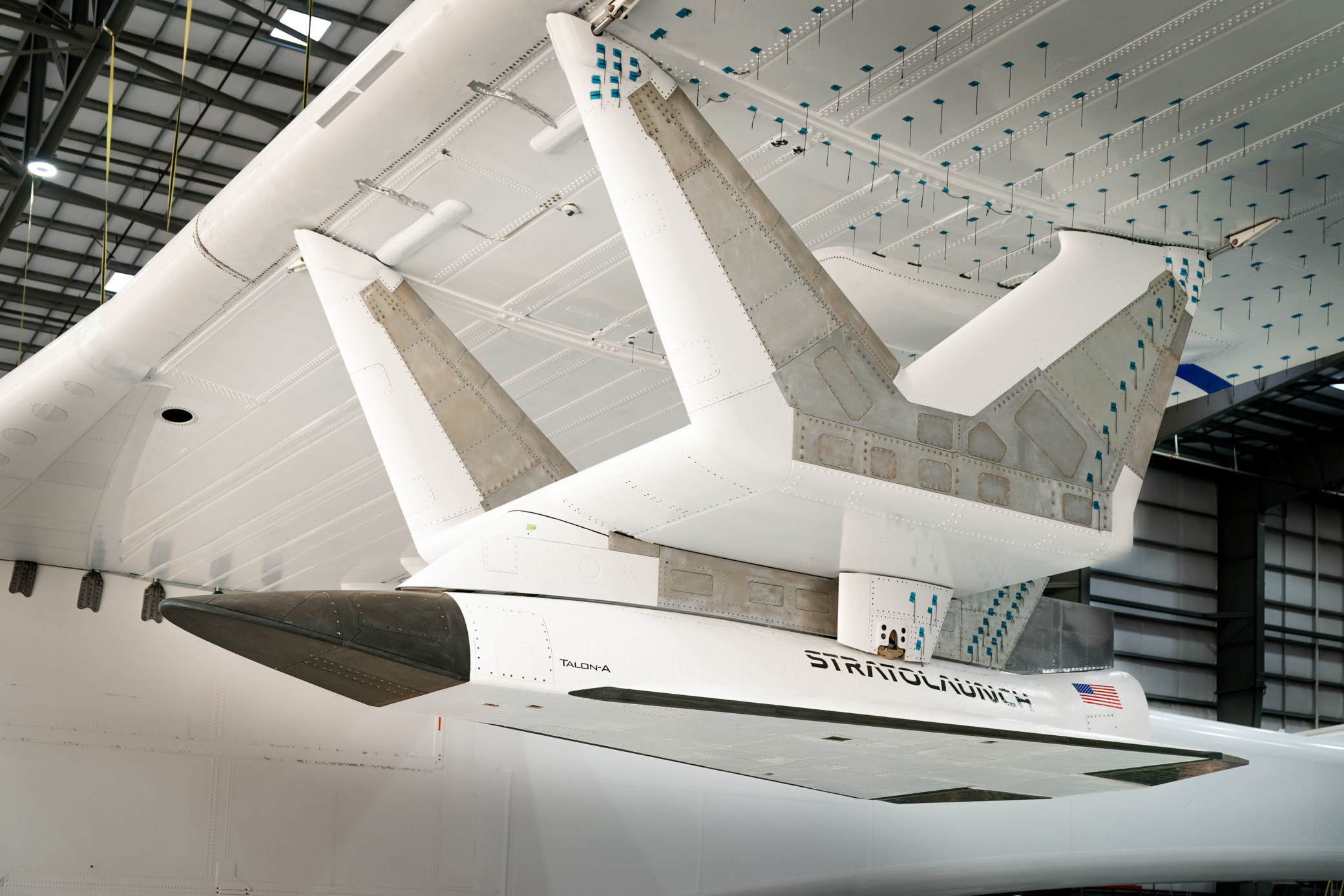
Capitalism in space: Stratolaunch yesterday released the first pictures of its first Talon-A test vehicle, dubbed TA-0, to be used to test in-flight the pylon on the company’s giant Roc airplane that the Talon-A will be attached to.

The photo to the right, reduced, enhanced, and annotated to post here, shows the test vehicle attached to the pylon which hangs from the bottom of Roc’s wing. From the press release:

The pylon, which was introduced during Roc’s fifth test flight on May 4, will be used to carry and release Talon-A hypersonic vehicles. The hardware is comprised of a mini-wing and adapter that is constructed with aluminum and carbon fiber skins. It weighs approximately 8,000 pounds and occupies 14 feet of Roc’s 95-foot center wingspan, allowing for adequate space between the aircraft’s dual fuselages for safe vehicle release and launch. The custom structure also features a winch system that will load Talon-A vehicles onto the platform from the ground, expediting launch preparation and reducing the need for ground support.

Although this first version of Talon-A will not be powered in flight, its future iterations will be rocket-powered, autonomous, reusable testbeds carrying customizable payloads at speeds above Mach 5. TA-0 will continue functional and integration testing in the coming months, culminating in a captive carry and vehicle flight later this year. After completing TA-0 separation testing, the company will transition to flying its first hypersonic test vehicle, TA-1. The team has also started fabrication of a third vehicle, TA-2, the first fully reusable hypersonic test vehicle.

The development and initial testing of Talon-A is partly funded from a contract with the Air Force. If successful, the Air Force will likely move on to purchasing actual hypersonic test flights.

0 comments

Stratolaunch completes 5th test flight of giant Roc airplane

Capitalism in space: Stratolaunch yesterday successfully completed the fifth test flight of its giant Roc airplane, now being designed for testing hypersonic vehicles in flight.

You can read the press release here [pdf], which stated the following:

The fifth flight debuted a new pylon on the aircraft’s center wing that will be used to carry and release Talon-A hypersonic vehicles. The hardware is comprised of a mini-wing and adapter that is constructed with aluminum and carbon fiber skins. It weighs approximately 8,000 pounds and occupies 14 feet of Roc’s 95-foot center wingspan, allowing for adequate space between the aircraft’s dual fuselages for safe vehicle release and launch. The state-of-the-art structure also features a winch system that will load Talon onto the platform from the ground, expediting launch preparation and reducing the need for ground support.

The company has been building two Talon hypersonic vehicles, and now has a third under construction. This third Talon is intended to be reuseable. All will be used as part of the company’s contract with the Air Force to test hypersonic technology, with the first flights now scheduled for ’23.

2 comments

Orbit Fab wins contract to outfit U.S. military satellites for refueling

Capitalism in space: Orbit Fab has won a $12 million contract to outfit U.S. military satellites with its refueling port.

The funding includes $6 million from the U.S. Air Force and U.S. Space Force, and $6 million from Orbit Fab’s private investors. The contract is for the integration of Orbit Fab’s fueling port, called RAFTI — short for rapidly attachable fluid transfer interface — with military satellites. The port allows satellites to receive propellant from Orbit Fab’s tankers in space.

At present there are no refueling missions scheduled, simply because the satellites that could be refueled are not yet in orbit. Orbit Fab and the military however are discussing an in-orbit demo mission.

0 comments

Stratolaunch wins Air Force hypersonic research contract

Capitalism in space: Stratolaunch today announced [pdf] that is has been awarded by the Air Force contract to study whether its Roc aircraft carrier and Talon-A research craft will be useful in test hypersonic weapons and spacecraft.

Stratolaunch, LLC is pleased to announce a research contract with the U.S. Air Force Research Laboratory (AFRL).

Stratolaunch, under partnership with Booz Allen Hamilton, is on contract with AFRL to examine and assess the feasibility of hypersonic flight tests of a wide range of Air Force experiments and payloads on a frequent and routine basis.

Stratolaunch supports national security objectives for hypersonic offensive and defensive weapons development through the design, manufacture, and operation of a fleet of reusable hypersonic aerospace vehicles air-launched from its globally deployable carrier aircraft, Roc. The company plans to augment existing Department of Defense flight test resources through affordable, commercially contracted, rapid-turnaround hypersonic flight testing for the Department of Defense and its prime contractor partners.

This contract is not to do actual tests, but to study whether Stratolaunch’s equipment can make hypersonic tests easier, cheaper, and more frequent, as the company promises.

2 comments

SpaceX’s Starship gets Air Force point-to-point cargo study contract

Capitalism in space: The Air Force Research Laboratory (AFRL) has signed a $102 million five year contract with SpaceX to study the practicality of using its Starship spacecraft as a method for transporting large cargo point-to-point on Earth.

[Program manager Greg] Spanjers said the SpaceX work is focused in four areas: collecting data from commercial orbital launches and landings; exploring cargo bay designs compatible with U.S. Transportation Command containers [TRANSCOM] and support rapid loading and unloading; researching landing systems that can operate on a variety of terrain; and demonstrating the heavy cargo launch and landing process.

The emphasis on landing options and interoperability with TRANSCOM containers and loading processes is an important element of the project, Spanjers noted, because the department’s vision for how the point-to-point capability could be used is broader than just the commercial business case. While companies are primarily interested in delivering cargo to and from established sites, the military wants to deliver supplies and humanitarian aid to locations that may not have spaceports.

This contract is in many ways similar to NASA’s manned Starship lunar lander contract. Both provide SpaceX some cash for developing a different version of Starship, even as the bulk of development money for building Starship comes from the private investment community.

22 comments

U.S. military adds Blue Origin to its point-to-point space cargo development program

Capitalism in space: The U.S. military on December 17th signed an agreement with Blue Origin to add it to its point-to-point space cargo development program.

The command last year signed similar agreements with SpaceX and with Exploration Architecture Corp. (XArc). Blue Origin is the third company to ink a CRADA [as these development contracts are called] for the rocket cargo program.

Under CRADAs, companies agree to share information about their products and capabilities but the government does not commit to buying anything. U.S. TRANSCOM’s analysis of industry data will inform the newly created “rocket cargo” program led by the Air Force Research Laboratory and the U.S. Space Force. The Air Force in its budget proposal for fiscal year 2022 is seeking $47.9 million to conduct studies and rocket cargo demonstrations. [emphasis mine]

I highlight the total budget of this program to show that this is a very small government program. The cash it provides these three companies is nice, but it is chicken feed when compared with the total cost of development. It certainly will not result in a faster pace at Blue Origin in developing its New Glenn rocket, which is presently two years behind schedule with further delays almost certain because its BE-4 rocket engine is not yet ready for mass production.

Whether the program itself is a good thing, or merely another example of government crony capitalism, is open to question. The practicality of using either Starship or New Glenn for cargo transport remains very unproven, especially for New Glenn, which was not designed with such a purpose in mind and cannot land its upper stage on Earth as Starship can.

5 comments

Russia confirms and defends anti-satellite test

Russia today confirmed that it had done the anti-satellite missile test earlier this week that destroyed one of its defunct satellites and produced a cloud of space junk.

Russia’s Ministry of Defence also issued a Russian-language statement defending the test. The minister-general of the army, Sergei Shoigu, said that the test was successful and that “the resulting fragments do not pose any threat to space activities,” according to a machine-generated translation to English.

The U.S. State Department said Monday that the test created a cloud of space debris made up of over 15,000 objects, calling it a threat to astronauts and cosmonauts, and space activities of all countries. The debris could pose a threat for years to come, experts have said. The space station’s crew had to shelter in their return ships on Monday when the debris cloud was first detected.

Russia’s space agency Roscosmos wrote on Twitter Monday that the space debris cloud “has moved away from the ISS orbit”, which is roughly 250 miles (400 km) above Earth. The space debris tracker LeoLabs estimates the debris cloud is at 273 to 323 miles (440 to 520 km) in altitude. However, “the station is in the green zone,” Roscosmos added.

The Russian claim that the debris at present poses no threat to ISS could very well be true. The trouble is that it appeared to have posed a threat initially, and will likely be a problem in the future. As a signatory of the Outer Space Treaty, Russia was required to avoid such a situation, and chose not to.

The article at the link notes similar tests by China (2007), the U.S. (2008), and India (2019). Of all these anti-satellite tests, only the U.S. targeted a satellite in an orbit so low that the debris posed no threat to operating satellites or manned spacecraft, and was also quickly pulled Earthward to burn up in the atmosphere. India chose a higher satellite whose debris posed less threat, but took longer to burn up and was initially of some concern.

China and Russia could have done the same thing. They did not, and their irresponsibility has badly worsened a problem that already was considered a serious concern.

13 comments

House slams military for not reforming contracting for space missions

Government marches on, to nowhere! The House Appropriations Committee has issued a report strongly criticizing the Air Force and the new Space Force for its failure to reform in any way its contract acquisition management, even though that was the prime reason Congress created the Space Force in the first place.

The report dedicates an entire page to detailing the committee’s dissatisfaction with what it sees as foot-dragging on space acquisition reform — which was one of the primary congressional rationales for the creation of the new space service in the first place. Indeed, the [appropriations committee] reiterates: “The Committee believes the Space Force was established to bring greater attention and focus to fixing its acquisition issues because previous attempts to do so did not produce lasting results.”

The [committee’s] concerns include that that Department of the Air Force — which oversees the Space Force much as the Navy oversees the Marine Corp — still has no clear plan for creating a separate management chain for space acquisition. Similar concerns were voiced at a May hearing by both the chair and ranking members of the HAC defense subcommittee, Rep. Betty McCollum, D-Minn., and Rep. Ken Calvert, R-Calif., respectively.

None of this should be a surprise. The reason the Space Force was advocated by some reformers was to get it out from under Air Force control and allow it to decide for itself what it needed. The belief was that this would streamline contracting and project development.

The fear, which I expressed repeatedly, was that the swamp in Washington would instead use this as an opportunity not to streamline operations but to create a whole new bureaucracy. That is standard operating procedure for government bureaucracies. Any time Congress has mandated a new agency designed to reduce bureaucracy it has for more than a century instead led to a larger bureaucracy, with nothing streamlined.

It appears the latter is what is now happening with the Space Force.

3 comments

Pentagon getting serious of hauling cargo with Starship

Capitalism in space: In the budget proposal submitted by the Biden administration the Pentagon included a request for $47.9 million to help develop the infrastructure it will need to use SpaceX’s Starship rocket as a method for transporting cargo point-to-point on Earth.

“The Department of the Air Force seeks to leverage the current multi-billion dollar commercial investment to develop the largest rockets ever, and with full reusability to develop and test the capability to leverage a commercial rocket to deliver AF cargo anywhere on the Earth in less than one hour, with a 100-ton capacity,” the document states.

Although this does not refer to Starship by name, this is the only vehicle under development in the world with this kind of capability. The Air Force does not intend to invest directly into the vehicle’s development, the document says. However, it proposes to fund science and technology needed to interface with the Starship vehicle so that the Air Force might leverage its capabilities.

Clearly, some Air Force officials are intrigued by the possibility of launching 100 tons of cargo from the United States and having the ability to land it anywhere in the world about an hour later.

The proposal is calling for a fourfold increase in funding for this work, as the Air Force is already spending slightly less than $10 million this year on this work.

The bottom line is that it appears SpaceX already has at least one real customer for its giant rocket. And if the military is that interested now, it likely means many more private customers are beginning to line up.

12 comments

Military admits F-35 is impossible to use, expensive, and an utter failure

Another typical federal project: The military has now admitted that Lockheed Martin’s F-35 fighter jet, a decades-long project to replace the F-16, is an utter failure and must be replaced.

The list of basic problems with the jet are truly appalling.

In spite of its advanced technology and cutting-edge capabilities, the latest stealth fighter suffers from structural flaws and slew of challenges.

Most recent among them is a structural engine flaw and shortage in its production. The F-35’s engine problem is partly based in not being able to deliver them for maintenance as fast as needed, in addition to a problem with the heat coating on its rotor blades which shortens engine lifespan considerably. Defense News described it as a “serious readiness problem”, suggesting that as soon as 2022, nearly 5 to 6 per ent of the F-35 fleet could be effectively grounded as it waits for engine replacements.

Another challenge is the plane’s software. Most modern fighter jets have between 1 to 2 million lines of code in their software. The F-35 averages 8 million lines of code in its software, and it’s suffering from a bug problem. To fix this, the US Department of Defense is asking three American universities to help figure it out.

The fighter jet also suffers from a slightly embarrassing touchscreen problem. After making the switch from hard flipped switches to touch screens, pilots report that unlike a physical switch that you’re confident has been activated, touch screens in the plane don’t work 20 percent of the time says one F-35 pilot.

The worst part of this story is that this kind of incompetence has been par for the course for big federal projects like this for decades. Our government in Washington is corrupt and unqualified to even be dog catcher, but we voters don’t seem to have the courage to fire them. We certainly don’t fire the politicians who appear quite willing to encourage this corruption.

47 comments

SpaceX identifies problem with several engines on booster, requiring replacement

Capitalism in space: SpaceX has identified the issue with several engines on the first stage that caused a launch abort for an Air Force GPS satellite and has replaced those engines.

Since Falcon 9 B1062 suffered a rare last-second launch abort on October 2nd, SpaceX has discovered an issue with several new Merlin 1D booster engines and apparently removed affected engines from Falcon 9 booster B1062, shipped the engines to McGregor, Texas for testing, characterized the bad behavior, and implemented a fix capable of satisfying their strictest customers (NASA and the US military) in roughly three weeks.

The immediate fix appears to be replacing the engines for now as they troubleshoot the issue. They have now rescheduled the launch of the GPS satellite for November 5th.

It also appears that because the company has identified the engine issue and can spot it on any engine it uses, NASA has agreed to set a November 14th launch date for the next manned Dragon mission. They will hold a press conference tomorrow to outline the situation in more detail.

3 comments

Two launches scheduled for tonight, 27 minutes apart

The numerous launch scrubs this past week has created an unprecedented situation tonight, two orbital launches scheduled only 27 minutes apart from two different East Coast spaceports.

First Northrop Grumman will try again to launch its Cygnus cargo freighter to ISS from Wallops Island, Virginia, with the launch scheduled for 9:12 pm (Eastern). The first launch attempt last night was aborted 2:21 seconds before liftoff “after receiving off-nominal data from ground support equipment.”

Second, SpaceX will try to launch two Air Force GPS satellites from Cape Canaveral, Florida, with the launch scheduled for 9:43 pm (Eastern). This launch has been delayed several times because of the repeated launch scrubs of ULA’s Delta 4 Heavy rocket, attempting to launch a military reconnaissance satellite. ULA’s launch had priority for the range, but with it delayed due to the investigation over the T-7 second launch abort on September 30th, the SpaceX’s GPS launch moves up in line.

The first will be live streamed on NASA TV, the second by SpaceX. I have embedded the live streams for both below the fold.
» Read more

7 comments

Boeing strikes deal to avoid harsher ethics probe in NASA’s lunar lander scandal

Boeing has struck a deal with both NASA and the Air Force in order to avoid a harsher and more extensive ethics probe into its part in the NASA lunar lander contract bidding scandal.

The agreement, signed in August, comes as federal prosecutors continue a criminal investigation into whether NASA’s former human exploration chief, Doug Loverro, improperly guided Boeing space executive Jim Chilton during the contract bidding process.

By agreeing to the “Compliance Program Enhancements”, the aerospace heavyweight staves off harsher consequences from NASA and the Air Force – its space division’s top customers – such as being suspended or debarred from bidding on future space contracts. The agreement calls for Boeing to pay a “third party expert” to assess its ethics and compliance programs and review training procedures for executives who liaise with government officials, citing “concerns related to procurement integrity” during NASA’s Human Landing System competition.

Since Loverro resigned in May, Boeing has fired one company attorney and a group of mid-level employees, three people familiar with the actions told Reuters.

The deal seems like a bureaucratic whitewash, designed to take the heat off the company. And since Boeing as a company has many problems, I remain skeptical that any of this will make a difference in getting things fixed.

4 comments
1 2 3 4 11