
An asteroid that winks
An asteroid that winks.
An asteroid that winks.
Newly discovered asteroid follows the Earth as it orbits the Sun, and has been doing it for a quarter million years.
Currently, three other horseshoe companions of the Earth are known to exist but, unlike 2010 SO16, these linger for a few thousand years at most before moving on to different orbits. Also, with an estimated diameter of 200–400 metres, 2010 SO16 is by far the largest of Earth’s horseshoe asteroids. The team has already used the Las Cumbres Observatory’s Faulkes Telescope in an on-going campaign to track the object and refine its orbit further. “It is not that difficult to spot with a medium-sized professional telescope”, says Dr Asher. “It will remain as an evening object in Earth’s skies for many years to come.”
Which near-Earth asteroids are ripe for a visit?
When is an asteroid not an asteroid?
The layered structure of Vesta (core, mantle and crust) is the key trait that makes Vesta more like planets such as Earth, Venus and Mars than the other asteroids, McCord said. Like the planets, Vesta had sufficient radioactive material inside when it coalesced, releasing heat that melted rock and enabled lighter layers to float to the outside. Scientists call this process differentiation.
This question immediately demonstrates once again the terrible mess the International Astronautical Union made when it decided several years ago to define what makes a planet, and came up with a definition that simply doesn’t work. For if Vesta should be considered a planet, why not Pluto?
Get those telescopes out! A asteroid, a quarter-mile in diameter, is going to pass only 200,000 miles from the Earth on November 8, 2011. Key quote:
Although classified as a potentially hazardous object, 2005 YU55 poses no threat of an Earth collision over at least the next 100 years. However, this will be the closest approach to date by an object this large that we know about in advance and an event of this type.
All systems go! Dawn did a camera and instrument checkout last week, in preparation for its summertime arrival at the asteroid Vesta.
First results from the Hayabusa asteroid samples.
A preliminary analysis of asteroid samples returned last year by Japan’s Hayabusa probe show evidence the dust grains have a similar composition to stony meteorites that commonly fall to Earth. . . . The initial research also shows the samples inspected so far contain no organic molecules. Scientists also say the analysis confirms the rocks at Itokawa were formed 4.6 billion years ago at the dawn of the solar system.
Astronomers from the University of Hawaii have taken new images of the potentially dangerous asteroid Apophis in an effort to refine their understanding of its orbital path.
The scientific battle over the meteorite fossil paper continues.
Richard Kerr of Science is attending the annual Lunar and Planetary Science Conference in Texas, and has written a short article describing the reaction of planetary scientists to the meteorite fossil paper by NASA scientist Richard Hoover. Their reaction, hostile and disinterested, isn’t pretty. These two quotes will give you the flavor:
Whether they have closely examined the paper by astrobiologist Richard Hoover of NASA’s Marshall Space Flight Center or only heard about it in the hallways, the reaction is the same: not again.
Rather than taking a look themselves, researchers have other things in mind. One leading scientist half-jokingly suggested hanging Hoover in effigy in the conference center lobby.
A new record! On January 19, the Pan-Starrs telescope in Hawaii discovered 19 near-earth asteroids, the most for a single night of asteroid-hunting by anyone.
On February 4 a very small asteroid, about a yard in diameter, zipped past the Earth at a distance of only 3,400 miles, closer than any previously recorded asteroid.
The Wide-Field Infrared Survey Explorer, WISE, has completed its four month extended mission, finishing a scan of the heavens that discovered more than 33,000 asteroids and comets.
Chicken Little was right! The sky is falling!
From the American Astronomical Society meeting this week:
A team of astronomers, using the data from the Sloan Digital Sky Survey, calculated the galactic orbits of nearly 40,000 low mass stars. These stars are generally M dwarfs, cool, not very bright, and thus generally somewhat close to the Sun since if they are too far away we would not see them. You can read the abstract here, and download their full poster here [pdf].
For the astronomers, the data told them a great deal about the orbital properties of these stars. Though a majority are in circular orbits between 20 to 30 thousand light years from the galactic center, a small minority are in extremely eccentric orbits that travel far out into the galactic halo, as much 260,000 light years. A few others dive inward, getting within 6000 light years of the galactic center.
What made this poster stand out to me, however, was this quote from the abstract:
In addition, we have identified a number of stars that will pass very close to the Sun within the next [billion years]. These stars form the “Nemesis” family of orbits. Potential encounters with these stars could have a significant impact on orbits of Oort Cloud and Kuiper Belt members as well as the planets. We comment on the probability of a catastrophic encounter within the next [billion years].
All told, they found that 18 low-mass cool M dwarf stars that will eventually pass close to the Sun. One star, SDSS J112612.07+152517.6, an M3 star that is about 2,300 light years away, is in an orbit that has it moving right towards us at about 90,000 miles per hour. Its mass is less than half that of the Sun, about 0.4 solar masses. This figure from the poster roughly illustrates the star’s position relative to our solar system over the next billion years:
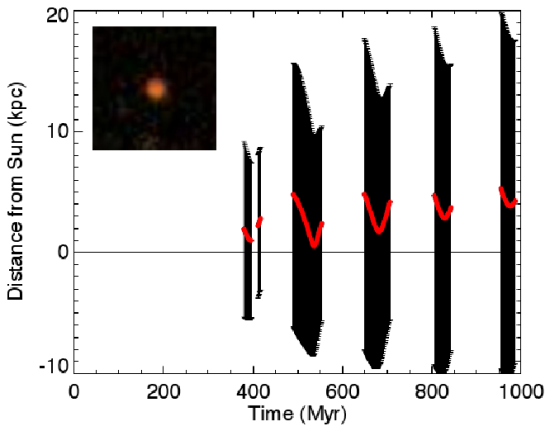
The star itself is shown in the inset. The red curve shows its calculated distance from the Sun over time, with the black area above and below showing the uncertainties of the calculation. As you can see, every hundred million years or so the distance between this star and the Sun shrinks, with the very very very rare possibility that the distance will sometimes shrink to zero!
With 18 stars each doing this every few 100 million years or so, the average time between close approaches is about 5 million years. These results suggest that another star passes close enough to our solar system frequently enough to not only disturb the comets in the Oort cloud, but also possibly affect the orbits of the planets in the outer solar system and Kuiper belt. One wonders, for example, if such an event had some influence on Pluto’s strange orbit.
A proposal to revive a project to send a private science probe to an asteroid.
The original project, NEAP, was proposed back in 1997 by the late Jim Bensen of SpaceDev (now Sierra Nevada). Benson wanted to not only do research, but he planned to claim the asteroid as his property upon landing. Though his proposal never flew, it was clearly a forerunner to today’s resurgence of the private space industry, and in many ways kickstarted that resurgence.
An asteroid discovered more than 100 years ago is actually an extinct comet. And it is coming back to life!
Another scheme to stop a dangerous asteroid: Use a flotilla of solar sails to divert Apophis.