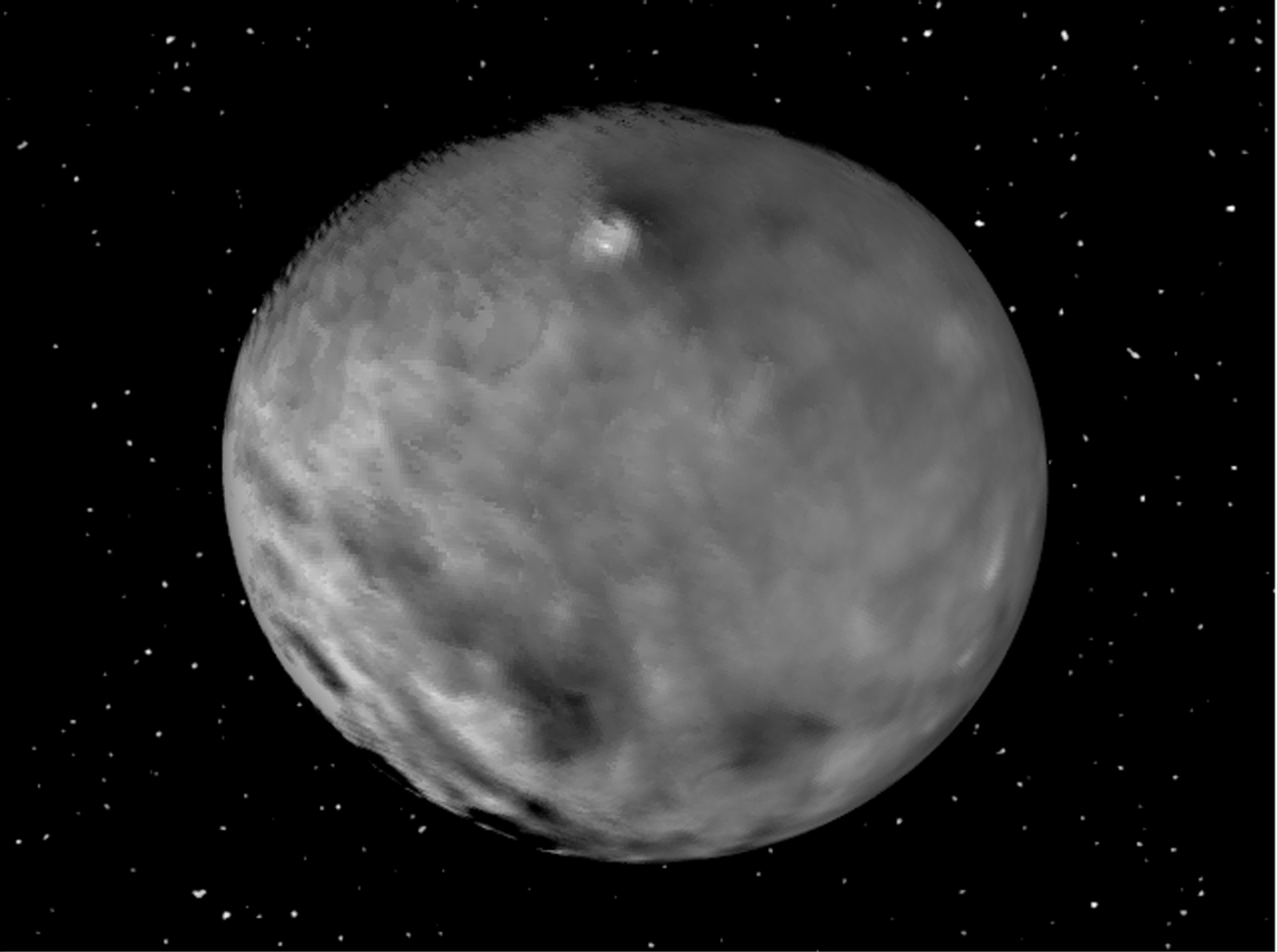
The brightest spot on Ceres has a partner
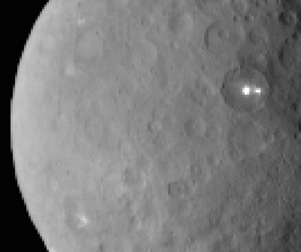
Ceres' double bright spots

Cool images! Dawn’s newest images have revealed that the brightest spot on Ceres, shown on the right in a cropped version of the full image, has a dimmer companion.

“Ceres’ bright spot can now be seen to have a companion of lesser brightness, but apparently in the same basin. This may be pointing to a volcano-like origin of the spots, but we will have to wait for better resolution before we can make such geologic interpretations,” said Chris Russell, principal investigator for the Dawn mission, based at the University of California, Los Angeles.

The spots are still too small for Dawn’s camera to resolve. That they are inside what looks like a crater is very puzzling. If they are water-ice, why are they so bright and distinct? One one think the ice would pile up along the crater wall, but then, that’s what we think based on our experience here on Earth with wind, rain, and our heavy gravity. Ceres is cold, has no atmosphere, and a tiny gravitational field. Every geological process will proceed in a different manner.
6 comments

Ceres comes into focus

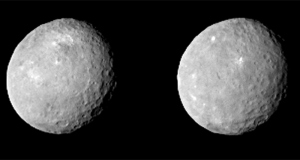
Ceres as since on February 12, 2015 by Dawn

Cool images! The Dawn science team has released new even sharper images of the giant asteroid Ceres, taken by Dawn on February 12 at a distance of 52,000 miles.

Though the surface appears to have many of the typical craters, scientists continue to be puzzled by the bright spots. This newest image suggests that they are ice-filled craters, but don’t hold me to that guess. For one thing, why are only a handful of craters filled with ice, and none of the others?

0 comments

Origin of Chelyabinsk meteorite remains unknown

The uncertainty of science: The origin of the Chelyabinsk meteorite that crashed over that Russian city two years ago remains murky to scientists.

Originally, astronomers thought that the Chelyabinsk meteor came from a 1.24-mile-wide (2 kilometers) near-Earth asteroid called 1999 NC43. But a closer look at the asteroid’s orbit and likely mineral composition, gained from spectroscopy, suggests few similarities between it and the Russian meteor.

The scientists noted in their paper that you really can’t use the similarity of orbits to link different asteroids, as their orbits are chaotic and change too much.

0 comments

OSIRIS-REx to get more fuel for its asteroid mission

In what might be a first for the planetary science/engineering community, an unmanned probe, being built to bring samples back from the asteroid Bennu, is turning out to be lighter than expected, thus allowing engineers to stuff its tanks with extra fuel to extend its mission.

The OSIRIS-REx spacecraft, being built at a Lockheed Martin facility in Denver, is coming in lighter than the lift capability of the Atlas 5 rocket, which will lift off in its โ€œ411โ€ configuration with a four-meter payload fairing, a single-engine Centaur upper stage, and one strap-on solid rocket booster.

The proposal โ€” described as a โ€œheavy launch optionโ€ โ€” would add an extra 341 pounds of fuel to the spacecraftโ€™s fuel tank.

Planetary probes never end up lighter than planned, at least until now. During construction scientists have always found it impossible to resist adding more instruments or capabilities, and thus engineers always struggle to get the spacecraft built within its weight budget. For OSIRIS-REx to have this wonderful problem is surely astonishing.

0 comments

Hayabusa-2 in “tip-top” shape

Launched in December for a 2018 rendezvous with an asteroid, Hayabusa-2 has successfully completed its initial check-out according to Japanese officials.

Checkups on early-phase functionality are being carried out over a three-month period. Although the first Hayabusa had suffered malfunctions of its ion engines, it is confirmed that the four ion engines of Hayabusa-2 are functioning properly, JAXA said. Kuninaka said: โ€œWith the engines functioning, the explorer can set out on its voyage with a lot of leeway. I feel like, โ€˜Way to go!โ€™โ€

0 comments

JPL releases movie of asteroid fly-by

Using 20 radar images of asteroid 2004 BL86 as it flew past Earth on January 26, scientists at JPL have created a movie showing the orbital motion of the asteroid’s moon.

The images also show one of the most spherical asteroids I have ever seen. Like Ceres, the larger size has helped shape the asteroid into a more typical-looking planetary sphere.

0 comments

Asteroid that flew past Earth has its own moon

Radar images of the large asteroid 2004 BL86 as it flew past the Earth today have revealed that it has its own small moon.

The new images also show a second object positioned close to 2004 BL86. Benner told Space.com that the second object is a moon, with a diameter between 164 and 328 feet (50 and 100 m). Previous studies of the light around 2004 BL86 had already identified a moon orbiting the asteroid, and the new images confirm that discovery, he added. About 17 percent of asteroids in 2004 BL86’s size range have smaller objects trailing along with them.

Boulders and other small-scale features on the surface of the asteroid are coming into focus in the new images, as is the overall shape of the asteroid, according to Benner. He compared the object to another asteroid that made a close flyby of Earth six years ago, called 2008 EV5. It appears that 2004 BL86, like 2008 EV5, has an equatorial ridge around its middle, which makes it look “kind of like a muffin, or perhaps a top,” said Benner, who’s based at NASA’s Jet Propulsion Laboratory (JPL) in Pasadena, California.

This data is from radar data collected early in the fly-by, so we should expect even more details to come out in the next day or so.

1 comment

Water flows on Vesta?

Some data produced by Dawn while it was in orbit around the asteroid Vesta have suggested to some scientists that liquid water might have helped create a handful of the surface features on the asteroid.

The theory is interesting and might be true. I also wouldn’t bet a lot of money on it, because this interpretation of the data is somewhat tentative and based on a lot of assumptions.

0 comments
1 49 50 51 52 53 78