Comet impact theory replaced by common house fires

The uncertainty of science: Fused droplets found in many places across the globe and theorized to have come from a comet major impact that caused a major climate change around 13,000 years ago have now been found to have instead come from common house fires.

Since the 1970s when the Walter Alvarez found evidence of an asteroid impact in the Yucatan that could have caused the dinosaur extinction 65 million years ago, planetary scientists have seen asteroid or comet impacts everywhere. After all, impacts are cool disasters that play well to television producers and funding agencies.

Read this story however. It describes some very solid scientific work that wipes out one one of those cool theories, replacing it with something quite mundane.

0 comments

Comet 67P/C-G unveils a scientific surprise

Data from Rosetta of Comet 67P/C-G strongly suggests that the origin of the comets of its class come from a wide range of locations within the early solar system, and that many of these comets might not have delivered the water to Earth as previously believed.

The data also suggests that the Earth’s water came more from asteroids, not comets, something that scientists had not expected.

0 comments

A planetary cubesat mission by Japan

When Japan launched Hayabusa-2 last week it also sent a secondary payload towards the asteroid, a cubesat designed to test the engineering of using minisats for future planetary missions.

PROCYON, which stands for PRoximate Object Close flYby with Optical Navigation, is a 65-kg (143 lb.) spacecraft designed to demonstrate that micro-satellites can be used for deep-space exploration. In addition to testing out micro-sat systems in deep space, the spacecraft is to conduct a close flyby of an asteroid. Developed by the University of Tokyo and JAXA, PROCYON was launched as a secondary payload along with Hayabusa2 on Dec. 3. JAXA reports that controllers have received confirmation that PROCYON was inserted into its planned interplanetary orbit as scheduled two hours after launch.

The spacecraft, which measures only 630 x 550 x 550 mm (24.8 x 21.65 x 21.65 in), has a mission that is divided into nominal and advanced phases.

If this engineering proves viable, which we have every reason to expect, it will open the door to many more planetary missions, costing far less and requiring much smaller rockets to launch.

0 comments

Hayabusa-2 scheduled for launch

Delayed due to weather twice, the launch of Japan’s Hayabusa-2 asteroid probe has now been scheduled for Wednesday.

This probe comes with four mini-rovers and an impactor!

Hayabusa 2’s target is a 1km-wide asteroid labelled 1999 JU3, after the year when it was discovered. It is a C-type asteroid, thought to contain more organic material than other asteroids, and so might again help scientists understand how the Solar System evolved.

The Japanese space agency JAXA intend for Hayabusa 2 to catch up with asteroid 1999 JU3 in 2018. It will land a small cube-shaped probe called MASCOT (Mobile Asteroid Surface Scout) developed by the German Space Agency (DLR) together with French space partners the Centre National d’Etudes Spatiales (CNES). The lander is able to move its centre of gravity so that it can tip itself over in order to move across the asteroid’s surface. The three small rovers, called Minerva-II, will also roam the asteroid, gathering data. Hayabusa 2 also carries an impactor that will blast a 2-metre-wide crater in the asteroid’s surface, which will allow the spacecraft to collect fragments and bring them home for study in the laboratory. The spacecraft itself is designed to touch down briefly three times to gather samples.

0 comments

How a big impact gave Vesta its grooves

New data suggests that when a large impact hit Vesta’s Rheasilvia basin sometime in the past, the entire asteroid was shaken up, producing ripples that eventually surfaced as the giant grooves that circle the asteroid’s equator.

“Vesta got hammered,” said Peter Schultz, professor of earth, environmental, and planetary sciences at Brown and the paper’s senior author. “The whole interior was reverberating, and what we see on the surface is the manifestation of what happened in the interior.”

The research suggests that the Rheasilvia basin on Vesta’s south pole was created by an impactor that came in at an angle, rather than straight on. But that glancing blow still did an almost unimaginable amount of damage. The study shows that just seconds after the collision, rocks deep inside the asteroid began to crack and crumble under the stress. Within two minutes major faults reached near the surface, forming deep the canyons seen today near Vesta’s equator, far from the impact point.

Essentially, for a very very short period of time, immediately after the impact, the solid material of the asteroid acted more like a liquid, producing ripples that immediately settled down as the solid deep equatorial grooves we see today.

0 comments

Rosetta gets in position to release Phalae

Rosetta has successfully maneuvered into position prior to releasing Philae on November 12 for landing on Comet 67P/C-G.

The thruster burn took place starting at 02:09:55 UTC (03:09:55 CET), ran for 90 seconds and, based on an initial analysis of spacecraft radiometric data, delivered a delta-v – change in speed – of 9.3 cm/sec, as confirmed by the Rosetta Flight Dynamics team. It was the second and final of two ‘deterministic’ (i.e. direction and thrust are prepared in advance) manoeuvres that moved Rosetta onto the planned lander delivery orbit, now at a height of about 30 km, which will be maintained right up until the pre-delivery manoeuvre at two hours before separation at 08:35 UTC (09:35 CET) on the morning of 12 November.

…[T]he next planned orbit-changing manoeuvres will occur on the 12th at (a) 2 hours before separation and (b) about 40 minutes after, in between which Philae will be released. The pre-delivery manoeuvre will shift Rosetta’s trajectory so that the orbiter would be on a path so as to pass over the comet at a distance of 5 km, while the separation will occur at 08:35 UTC on board the spacecraft about 22 km (the confirmation signal will arrive on Earth at 09:03 UTC).

Since Philae is a passive lander, firing no thrusters but simply being thrown gently at the comet by Rosetta, the last two burns are crucial. The first literally puts Rosetta on the same collision course as Philae so that when the lander is released it is on a course to hit the comet. The second takes Rosetta out of that collision course, since no one wants it to hit the comet also.

0 comments

Avalanches on an asteroid

A new analysis predicts that when the asteroid Apophis flies past the Earth in 2029, the close fly-by will cause avalanches on the asteroid.

If asteroids pass close to Earth, they begin to experience the effects of our planet’s gravity. Just like the moon pushes and pulls the oceans, creating the tides, asteroids are susceptible to tidal forces from our planet. To judge what effect this will have on Apophis, scientists need to know what it’s made of. Their best guess is based on photos taken by a Japanese spacecraft named Hayabusa, which took detailed pictures of an Apophis-sized asteroid named Itokawa. Those images revealed that the asteroid wasn’t a solid mass of rock spinning through space, but rather a giant clump of debris held together loosely by gravity. “You look at the [Hayabusa] pictures and you’re like, ‘Uh, that’s a pile of rocks, dude.’ It’s very likely that Apophis is similar,” says astrophysicist Derek Richardson of the University of Maryland, College Park.

To show that Earth’s gravity could cause some of these rocks to tumble, Richardson and his colleagues developed a computer model that allowed them to place virtual sand piles across the surface of a model asteroid with roughly the same dimensions as Apophis. By factoring in the gravity from the asteroid, the tidal force from Earth, centrifugal force caused by the asteroid’s rotation, inertial forces, and other effects, the team was able to predict how the particles on the surface of the asteroid would behave on approach. The results confirm that Earth’s tidal forces would be strong enough to cause tiny avalanches on the asteroid, the team reported online ahead of print in Icarus.

Need I note that there are a lot of uncertainties here? Because they are using what is known about a different asteroid, all of their assumptions about Apophis’s properties in their computer model could be very wrong.

Still, this is interesting, because it does demonstrate that an asteroid could be significantly disturbed simply by flying past a planet.

1 comment

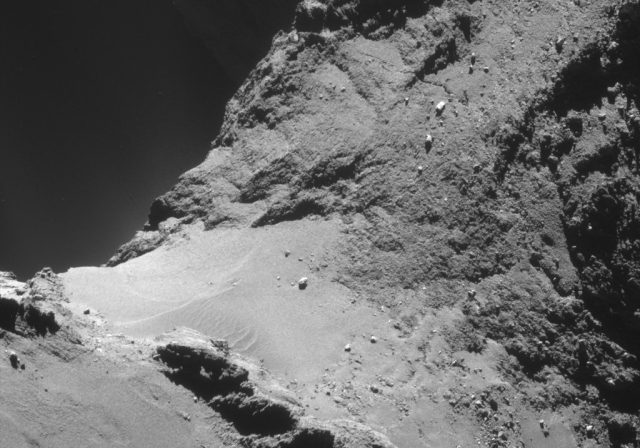
Comet 67P/C-G at 2 feet per pixel

New images from Rosetta, now about 6 miles from the surface of Comet 67P/C-G, show details as small as 2 feet across.

Go to the link to see some images. If you were hiking there, these images would see you.

In related news, the Rosetta team is asking the public to help name the landing site for its Philae lander.

As the location of the first soft landing of a human-made object on a comet, the site, currently identified as Site J, deserves a meaningful and memorable name that captures the significance of the occasion. The rules are simple: any name can be proposed, but it must not be the name of a person. The name must be accompanied by a short description (up to 200 words) explaining why this would make the ideal name for such an historic location. A jury comprising members of the Philae Steering Committee will select the best name from the entries, and the winning proposer will be invited to follow the landing in person from ESA’s mission control centre in Darmstadt, Germany on 12 November.

2 comments

Finding a meteorite 20 years after it hit the ground

By reanalyzing the data that had recorded the fireball twenty years ago, a team of meteorite hunters in the Czech Republic have finally located the remains of a meteorite that landed in 1991 but could not be found.

What is most interesting scientifically about their find is that the pieces they found were from different types of meteorites.

[T]hese four meteorites are of three different mineralogical types. This means that the Benešov meteoroid was heterogeneous and contained at least three different types of material. After the Almahata Sitta fall, this is the second time that such a heterogeneous composition has been found. It raises the possibility that a significant fraction of all asteroids are heterogeneous and that they were strongly reprocessed by collisions with other asteroids in the main belt.

In other words, the meteorite had been a conglomerate of different geological types, which were created in different environments and were later smashed together to form this one rock.

0 comments
1 50 51 52 53 54 78