
Scientists have released a new 28 frame movie of asteroid 2005 YU55
Scientists have released a new 28 frame movie of asteroid 2005 YU55, created as the asteroid zipped past the Earth this past week.
Scientists have released a new 28 frame movie of asteroid 2005 YU55, created as the asteroid zipped past the Earth this past week.
A new analysis of data suggests that the asteroid Lutetia is a leftover fragment from the same original material that formed the Earth, Venus and Mercury.
NASA’s Deep Space Network has captured a radar image of asteroid 2005 YU55, set to buzz past the Earth tomorrow.
Watch asteroid 2005 YU55 buzz the Earth tomorrow with your backyard telescope.
Astronomers prepare for an asteroid fly-by on November 8, using the Earth as the spacecraft.
Large enough to cause regional devastation if it were to hit the Earth, 2005 YU55 is the closest pass by an asteroid this big since 1976, and there won’t be another until 2028. The near miss provides an unparallelled opportunity for radar, optical and infrared observations of a mysterious charcoal-black world similar to the type of asteroid that astronauts may one day set foot on.
Radar bonanza “It’s a bit like a spacecraft fly-by with the Earth being the spacecraft,” says astronomer Don Yeomans at NASA’s Jet Propulsion Laboratory (JPL) in Pasadena, California. “It’s going to be an extraordinary target for radar.”
Amateur astronomers discover near Earth asteroid.
The Dawn scientists have released another spectacular image of the south polar mountain on Vesta whose relative size is three times that of Mount Everest. More information about the image can be found here. From the caption:
The peak of Vesta’s south pole mountain, seen in the center of the image, rises about 13 miles (22 kilometers) above the average height of the surrounding terrain. Another impressive structure is a large scarp, a cliff with a steep slope, on the right side of this image. The scarp bounds part of the south polar depression, and the Dawn team’s scientists believe features around its base are probably the result of landslides.
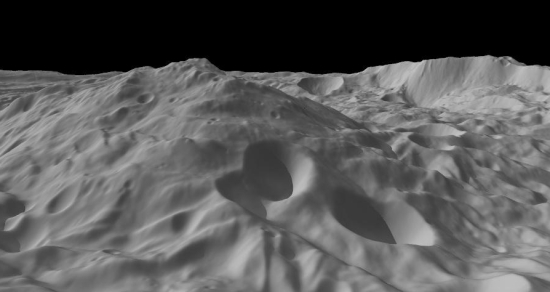
It appears the light gravity on Vesta allows for the formation of extreme topology.
Dawn begins close-up orbit observations of Vesta. More new results here.
In this orbit, the average distance from the spacecraft to the Vesta surface is 420 miles (680 kilometers), which is four times closer than the previous survey orbit.
Data from the infrared telescope WISE has now identified ninety percent of the largest near-Earth asteroids.
NASA researchers also downgraded their estimate of the number of medium-sized asteroids, saying there are 44 percent fewer than previously believed. The downside is that scientists have yet to find many of these mid-sized asteroids, which could destroy a metropolitan city.
The WISE space telescope has raised questions about source of the asteroid believed to have killed the dinosaurs.
NASA has released an update summarizing what scientists have found since Dawn went into orbit around Vesta in July. The video below, compiled from images Dawn has taken, gives a nice visual overview. The most interesting big feature, understated by the video, is the series of grooves that appear to encircle the asteroid’s equator. To my eye it almost looks like Vesta was once two asteroids that got merged into one, with these grooves indicating the weld point.
The direct link to the video can be found here.
Embedded video from
NASA Jet Propulsion Laboratory California Institute of Technology