Astronomers take one last close look at 1999 RQ36 before sending mission there

Astronomers plan one last close look at 1,900-foot-wide asteroid before sending a space probe there to collect samples.

Discovered in 1999, the OSIRIS-REx target asteroid, designated 1999 RQ36, nears Earth once every six years. During the 2011 closest approach in early September, it will be 10.9 million miles (17.5 million kilometers) away. In 1999, closest approach was 1.4 million miles (2.3 million kilometers).

Strangely, the article above never mentions the fact that 1999 RQ36 has 1 in a 1000 chance of hitting the Earth in 2182, which to my mind is the primary reason for studying it.
0 comments

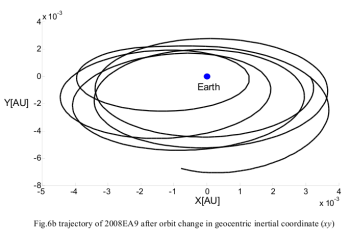
Capturing an asteroid into Earth orbit

orbital path after asteroid capture

Want to mine an asteroid? Rather than travel to it with all their mining equipment, three Chinese scientists have proposed a better way. In a paper published today on the Los Alamos astro-ph preprint website, they have calculated the energy required to shift the orbits of the six thousand near-Earth asteroids and place them in Earth orbit for later mining. Of these, they found 46 asteroids that had the potential for such an operation, and two likely candidates for a space mission. One 30-foot-wide asteroid, 2008EA9, will actually be in the right place for this technique in 2049. As they write,

It can be seen that the velocity increment of the 2008EA9 is relatively small (-1.00km/s) and it will very close approach [approximately 645,000 miles] to the Earth in [February] 2049. Moreover the size of the NEO 2008EA9 is very small so that the capturing of it is relatively easy.

The real problem, of course, is adding that small “velocity increment” to the asteroid.
» Read more

4 comments

Craters, craters, everywhere

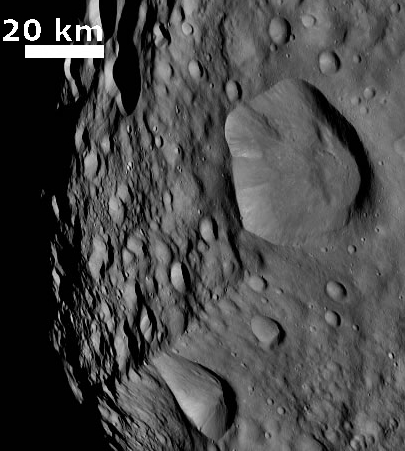
Below the fold are two images released today, one from Dawn at Vesta and the other from Messenger at Mercury. What makes them interesting to me is that, though the surfaces of both Vesta and Mercury are crater-packed, there are definitely distinct differences between them that one can spot if you look closely, all highlighting the fundamentally different environments of both worlds.

First, the Vesta photograph. The image looks out past the asteroid’s horizon, showing clearly that this dwarf planet is not spherical, with the south pole depression that puzzles scientists just on the planet’s limb. The parallel long deep grooves that are associated with this depression can be seen on the right. Notice also that the inside walls of all the craters slope downward in a very shallow manner. This gives the impression that the impacts that formed these craters smashed into an almost beachlike sandy surface. Note too the that the center of some craters have what appear to be flat small “ponds,” a phenomenon seen by the spacecraft NEAR when it orbited the asteroid Eros. These ponds are not liquid, but are actually made up of fine-grained particles that settle in the hollows of the asteroid.
» Read more

1 comment

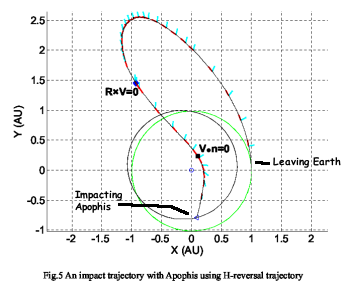
Using a solar sail to deflect an earth-destroying asteroid

solar sail mission to Apophis

In a paper published today on the Los Alamos astro-ph preprint website, two Chinese scientists have proposed using a solar sail for deflecting any asteroid that happens to be aimed at the earth. The diagram to the right is their simulated mission to impact the asteroid Apophis, which will pass close to the earth in 2029 and — depending on whether that flyby puts it through a very small 600 meter-wide mathematical “keyhole” — could then return in 2036 on a collision course.

The idea is to use the sail to slow the spacecraft down enough so that it starts to fall towards the sun. The sail is then used to maneuver it into a retrograde orbit. When it impacts the asteroid the impact will therefore be similar to a head-on collision, thereby imputing the most energy in the least amount of time with the least amount of rocket fuel. In their Apophis simulation, a mission, weighing only 10 kilograms (about 22 pounds), launched around 2025, and hitting the asteroid in this manner in 2026, would deflect its flyby in 2029 enough to guarantee it will not fly through the “keyhole” and therefore eliminate any chance of it hitting the earth in 2036.

Obviously many questions must be answered before such a mission should fly.
» Read more

1 comment

Strange craters on Vesta

strange craters on Vesta

The images from Dawn keep rolling in. The picture on the right, released two days ago, shows the asteroid’s terminator. What makes it intriguing is the weird looking crater near the bottom of the image. It appears to have formed at impact on the wall of a cliff, something that at first glance seems impossible.

This is what I think happened: The impactor sliced down the wall of the cliff, but because of Vesta’s low gravitational field the impact scar never collapsed downward, filling in.

I once wrote an article about asteroids for Astronomy where I described these objects as having the consistency of mashed potatoes and ice cream sundaes. This image illustrates this nicely. The asteroid’s weak gravitational field limits the density of its material, so that puffy strange formations such as this crater can form.

1 comment

Getting closer to Vesta

close-up thumbnail

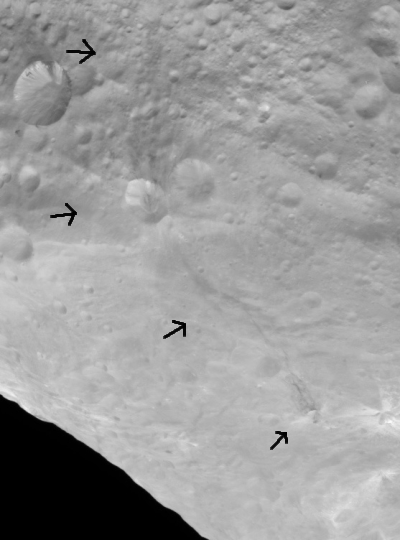
The Dawn mission team released another image today of the giant asteroid Vesta, this time taken from about 2,300 miles away. At this distance the resolution is still somewhat coarse, with the smallest visible detail about 0.43 miles in size.

To the right is a cropped section of the full image, focusing in on what appears to be a very strange geological feature, indicated by the arrows. From what I can tell, the dark meandering streak looks like a rille or flow coming out of the mound or peak near the bottom of the image. Yet, this dark meander continues directly across a crater as if it were a wind-blown dust streak.

I really have no idea what geological process created this. I also suspect that the scientists don’t quite know yet either, though I am sure they have some good theories, mostly based on the very light gravity that should exist on a world only 330 miles in diameter. As I’ve already noted, however, it is going to take them a couple of months to digest the data they are getting and come up with some reasonable conclusions. It will be fun to finally find out what they have learned.

7 comments

Dawn begins science operations in orbit around Vesta

The Dawn science team today released what they are calling “the first full-frame image” of Vesta. The image is shown below the fold.

The picture was taken from 3,200 miles, and shows a pockmarked irregularly shaped world. While many features that resemble the Moon (the craters, the rays radiating out from those craters), that Vesta itself is not spherical makes it very much unlike the Moon. It is probably going to take scientists several months at least to decipher the data they are getting and come up with some concrete conclusions about this strange dwarf planet.
» Read more

1 comment

Astronomers identify Earth’s first Trojan asteroid

Astronomers have spotted the first Trojan asteroid to the Earth.

The asteroid is roughly 1,000 feet (300 meters) in diameter. It has an unusual orbit that traces a complex motion near a stable point in the plane of Earth’s orbit, although the asteroid also moves above and below the plane. The object is about 50 million miles (80 million kilometers) from Earth. The asteroid’s orbit is well-defined and for at least the next 100 years, it will not come closer to Earth than 15 million miles (24 million kilometers).

1 comment
1 67 68 69 70 71 78