
Tag: astronomy
Tycho Brahe’s body exhumed
Scientists have exhumed the body of Danish astronomer Tycho Brahe in order to do a new autopsy.
James Webb Space Telescope in trouble, again
The James Webb Space Telescope is in trouble again, requiring an addition $1.5 billion and an additional year to get finished.
Pluto might be larger than Eris after all
The uncertainty of science! Eris, the distant planet in the Kuiper belt, had been thought to be larger than Pluto. Now astronomers have doubts.
Gliese 581g does exist, according to another scientist
The superEarth orbiting the red dwarf star Gliese 581 in its habitable zone does exist, according to a preprint paper published today on the Los Alamos astro-ph website.
The telescope that ate astronomy
The telescope that ate astronomy. My just finished Sky & Telescope article (expected out early next year) covers some of the same ground, describing how the cost overruns on the James Webb Space Telescope has badly damaged much of NASA’s space astronomy budget, for this and possibly the next two decades.
The most massive neutron star ever discovered
Astronomers have discovered the most massive neutron star ever, twice the mass of the Sun and far heavier than any theory had ever predicted.
Buckyballs discovered in another galaxy
Buckyballs, or carbon molecules called fullerenes, have been discovered all throughout the Milky Way as well as in another galaxy.
New Kepler results!
Scientists released additional Kepler results [pdf] today, this time describing what they are learning about the stars being observed rather than any planets that might be orbiting them. In studying each star’s minute variations of light, the astronomers can track how the star itself is oscillating like a bell ringing. From this they can do a kind of stellar seismology, finding out a great deal about what is going on inside the star. The data has thus:
- produced the most precise measurements of the size and age of another star beside the Sun. KIC 11026764 has a radius 2.05 times the size of the Sun, and is now believed to be 5.94 billion years old, slightly older than the Sun’s 4.57 billion years. Though larger than the Sun, this star is a G-type star like the Sun. So far, Kepler has observed about 1500 solar-type stars. The astronomers are still analyzing this data, with results to follow.
- measured the oscillations of a thousand red giant stars, ranging from slightly larger to dozens of times larger than the Sun. The larger the star, the faster the oscillation and the larger the amplitude, which in turn has confirmed the theories about how the nuclear processes in the core of stars evolve over time, shifting from burning hydrogen to helium. Since these red giants are what our Sun will be like when it reaches old age, we are thus learning something about the Sun’s future.
- and provided the most precise measurements ever of RR Lyrae stars, a class of unusual variable stars that have puzzled astronomers for more than a century. From this data the astronomers hope to find out exactly why these stars fluctuate as they do.
Hubble Data Used to Look 10,000 Years into the Future
Hubble data used to look 10,000 years into the future.
Most distant galaxy ever seen
Using a deep field image taken by the Hubble Space Telescope, astronomers at the European Southern Observatory have identified one galaxy in that image as the most distant ever seen, with a record-setting redshift of 8.6 and thus an rough distance of about 13 billion light years, only about 600 million years after the Big Bang.
Whoops! Last sentence corrected, thanks to my readers.
Hubble marches on: Pinwheel of star formation
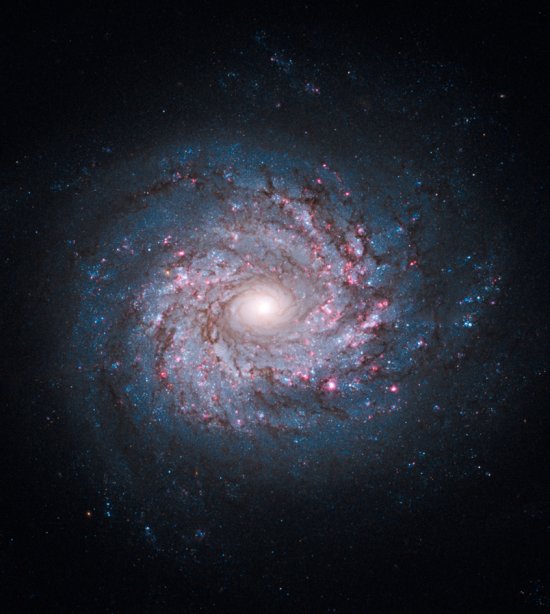
Despite its age (20 plus years), the Hubble Space Telescope continues to produce amazing images. The mosiac below shows the beautiful pinwheel galaxy NGC 3982. From the caption:
NGC 3982 is located about 68 million light-years away in the constellation Ursa Major. The galaxy spans about 30,000 light-years, one-third of the size of our Milky Way galaxy. . . .The arms are lined with pink star-forming regions of glowing hydrogen, newborn blue star clusters, and obscuring dust lanes that provide the raw material for future generations of stars. The bright nucleus is home to an older population of stars, which grow ever more densely packed toward the center.
Hubble tracks the aftermath of a possible asteroid collision
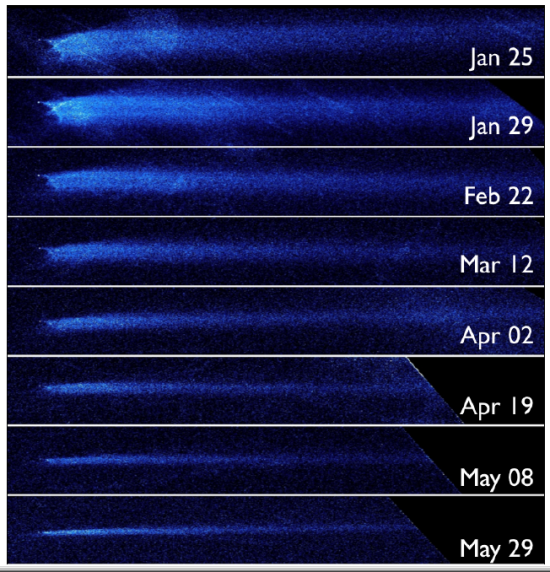
Using the Hubble Space Telescope over the last ten months, astronomers have tracked the decaying aftermath of a possible asteroid collision. Key quote:
Astronomers think a smaller rock, perhaps 10 to 15 feet wide, slammed into the larger one. The pair probably collided at high speed, about 11,000 mph, which smashed and vaporized the small asteroid and stripped material from the larger one. Jewitt estimates that the violent encounter happened in February or March 2009 and was as powerful as the detonation of a small atomic bomb.
The image sequence below, taken from the original paper describing the discovery [pdf], shows the slow changes that have occurred since January. At the moment scientists do not have an satisfactory explanation for the nucleus’s X-shaped pattern in the earliest images.
Habitable exoplanet might not exist
The uncertainty of science: The extrasolar planet discovered orbiting Gliese 581 in its habitable zone might not exist, according to other scientists.
Signals from Gliese 581?
Two years before anyone knew there was a Earthlike planet orbiting Gliese 581 in its habitable zone, an astronomer doing work for SETI detected a single very unusual pulse of energy coming from that area in the sky.
First planet discovered that might harbor life!
Big news! Scientists have discovered the first rocky terrestrial planet orbiting its sun at a distance where life as we know it could form. The planet itself has a mass three to four times Earth, so no matter what, conditions on its surface would be very different than here. Nonetheless, this is a major discovery, and is only the first of many. Key quote:
The discovery suggests habitable planets must be common, with 10 to 20 per cent of red dwarfs and sun-like stars boasting them, the team says. That’s because Gliese 581 is one of just nine stars out to its distance that have been searched with high enough precision to reveal a planet in the habitable zone.
Dangerous asteroid discovered by new telescope
A new survey telescope, designed to scan the entire available sky approximately three times every month, has discovered its first potentially hazardous asteroid (PHO) , 150 feet in diameter and set to speed past the Earth at a distance of 4 million miles in mid-October. Key quote:
Most of the largest PHOs have already been catalogued, but scientists suspect that there are many more under a mile across that have not yet been discovered. These could cause devastation on a regional scale if they ever hit our planet. Such impacts are estimated to occur once every few thousand years.
Birthplace of the Sun?
In a preprint [pdf] posted today on the astro-ph website, astronomers outline the discovery of a star more like a twin of the Sun than any previously discovered. The star is located in the galactic star cluster M67, 3000 light years away. The similarity is so close that the scientists even speculate that the Sun itself might have formed in this same cluster, 4.5 billion years ago. Key quote from paper:
The similarity of the age and overall composition of the Sun with the corresponding data of M67, and in particular the agreement of the detailed chemical composition of the Sun with that of M67-1194, could suggest that the Sun has formed in this very cluster. According to the numerical simulations by Hurley et al. (2005) the cluster has lost more than 80% of its stars by tidal interaction with the Galaxy, in particular when passing the Galactic plane, and the Sun might be one of those. We note that the orbit of the cluster encloses, within its apocentre and pericentre, the solar orbit. However, the cluster has an orbit extending to much higher Galactic latitudes, presently it is close to its vertical apex at z = 0.41 kpc (Davenport & Sandquist 2010), while the Sun does not reach beyond z = 80 pc (Innanen, Patrick & Duley 1978). Thus, in order for this hypothesis of an M67 origin of the Sun to be valid, it must have been dispersed from the cluster into an orbit precisely in the plane of the Galactic disk, which seems improbable.
The last sentences above refer to the different orbital inclinations of the galactic orbits of both the Sun and M67. M67’s orbital inclination is far steeper. While M67 is presently about 1350 light years (410 parsecs) above the galactic plane, the Sun’s orbit never takes it more than 261 light years above the plane.
One more point of interest: M67 is a well known object to amateur astronomers, located in the constellation Cancer.
Too Much Water on the Moon?
Too much water on the Moon?
My Friday night travels
On Friday I drove up to Westfield, New Jersey, to give a public lecture to Amateur Astronomers, Inc. at Union County College in Cranford, New Jersey. On this, my second visit to this amateur astronomy club, my lecture topic was the story behind the Apollo 8 mission to the Moon, the subject of my first book, Genesis: the Story of Apollo 8.
I visit a lot of astronomy clubs, giving talks on space and its history, so it is not a light complement when I say that this particular club is one of the most active, organized, and enthusiastic astronomy clubs I have ever seen. This is not to say that other clubs are not active, organized, or enthusiastic, only that it seems to me that the members of Amateur Astronomers are particularly so.
This fact only makes the decision by Union County College to throw the club and its observatory off campus seem incredibly stupid. Fortunately, the club has managed to negotiate a two year postponement of their eviction. What will happen after that, however, remains unknown.