
Flying on empty to a comet
Flying on empty to a comet.
Flying on empty to a comet.
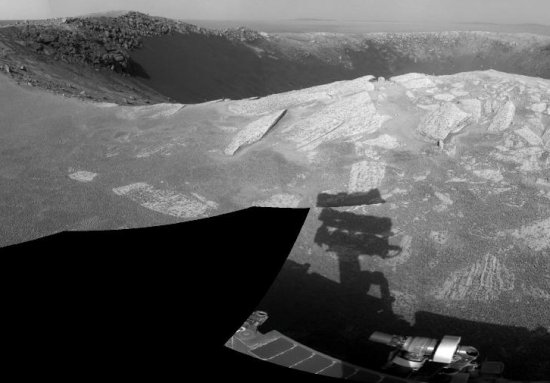
In its 14 mile multi-year trek to Endeavour Crater — now about half completed — the Mars rover Opportunity has stopped to take a short rest stop at a small crater.
The crater, dubbed “Santa Maria Crater” by the scientists who operater Opportunity, is about the size of a football field. What makes it especially interesting are the sharp rocks piled up on its rim, as they are probably debris ejected from the crater at impact. Since this material probably came from deep below the Martian surface, it is also likely to hold information about the Martian geological past, thereby making it a prime research site.
An asteroid discovered more than 100 years ago is actually an extinct comet. And it is coming back to life!
Recent monitoring of the Sun’s brightness as it went from maximum to minimum in its solar cycle has found that, surprisingly, the changes in brightness across different wavelengths do not necessarily vary in lockstep. Key quote:
SIM suggests that ultraviolet irradiance fell far more than expected between 2004 and 2007 — by ten times as much as the total irradiance did — while irradiance in certain visible and infrared wavelengths surprisingly increased, even as solar activity wound down overall. The steep decrease in the ultraviolet, coupled with the increase in the visible and infrared, does even out to about the same total irradiance change as measured by the TIM during that period, according to the SIM measurements.
The stratosphere absorbs most of the shorter wavelengths of ultraviolet light, but some of the longest ultraviolet rays (UV-A), as well as much of the visible and infrared portions of the spectrum, directly heat Earth’s lower atmosphere and can have a significant impact on the climate. [emphasis mine]
The uncertainty of science: Did the Martian methane signal come from Earth?
The hubbub about this week’s lunar solstice eclipse was, from my perspective, mostly manufactured press blather. For those who had never seen a lunar eclipse, it was a spectacular experience, but there really was nothing scientifically or technically unique about the fact that it happened to occur on the solstice.
However, below is an eclipse that is definitely unique both technically and scientifically. Scientists using the Mars rover Opportunity have filmed an eclipse on Mars, showing the Martian moon Phobos crossing in front of the Sun. Consider the engineering accomplishment: not only did they need to be able to calculate exactly when this would happen at a very particular spot on the Martian surface, they had to have a camera there able to take the movie. And they had to operate it from Earth!
Scientists have completed the IceCube neutrino observatory in Antarctica, a cubic kilometer in size and situated a mile deep in the ice.
Another scheme to stop a dangerous asteroid: Use a flotilla of solar sails to divert Apophis.
How close to the Sun could we get?
According to a statistical analysis, scientists predict the discovery of Earth’s twin in 2011.
Note that I reported this story three months ago, on September 13!
Alan Stern, project scientist of NASA’s mission to Pluto, New Horizons, gives his perspective ten years after the start of the project.
Want to discover an exoplanet? A portion of the data being gathered by Kepler is now available online for anyone to peruse.
A scientist has made the first measurements of the strength at the Earth’s core of its magnetic field. What’s most fascinating is that he used the Moon and distant quasars to do it! First he used radio observations of the quasars to get very precise measurements of the Earth’s rotation axis and how the Moon was tugging at that axis and thus affecting its magnetic field. Then,
By calculating the effect of the moon on the spinning inner core, Buffett discovered that the precession makes the slightly out-of-round inner core generate shear waves in the liquid outer core. These waves of molten iron and nickel move within a tight cone only 30 to 40 meters thick, interacting with the magnetic field to produce an electric current that heats the liquid. This serves to damp the precession of the rotation axis. The damping causes the precession to lag behind the moon as it orbits the earth. A measurement of the lag allowed Buffett to calculate the magnitude of the damping and thus of the magnetic field inside the outer core.
Dead alien life arrives on Earth! Not really but still exciting anyway: Scientists have found the remains of space-born amino acids — essential to life — in the meteorite that crashed in the Sudan in 2008. Key quote:
“This meteorite formed when two asteroids collided,” said Daniel Glavin of NASA’s Goddard Space Flight Center in Greenbelt, Md. “The shock of the collision heated it to more than 2,000 degrees Fahrenheit [1,093 degrees Celsius], hot enough that all complex organic molecules like amino acids should have been destroyed, but we found them anyway.”
The discovery is further evidence that the basic elements of life can form in even the most hostile of environments.
A software glitch prevented Kepler from making science observations for 13 hours this week.
A cyclone on Saturn has now lasted more than five years, since scientists started tracking it closely in 2004 with the arrival of Cassini in orbit around Saturn.
Scientists have used data from Cassini to identify what they think are ice volcanoes on Titan. The two volcanoes, each about 3000 feet high, are located near the equator and appear to resemble the volcanoes on Earth, with a central crater on top of cone-like peak and finger-like flows coming down the sides from the crater. The lava here, however, is not molten rock, but water.
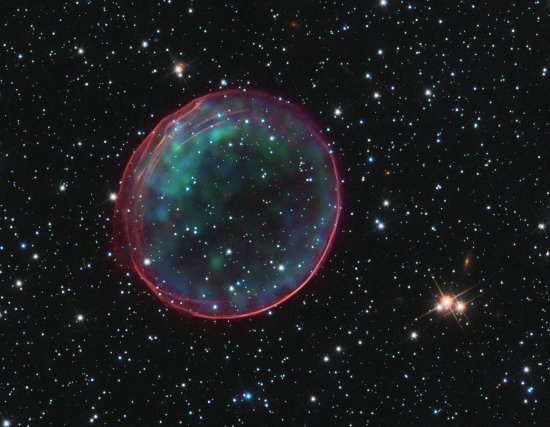
Time for some astronomical sightseeing! This image, produced from data taken by both the Hubble Space Telescope and the Chandra X-ray Observatory, shows what astronomers call a supernova remnant. The bubble, located in the Large Magellanic Cloud 160 thousand light years away, is thought to be 23 light years across and expanding about 11 million miles per hour. It is thought that the supernova itself took place around 1600. That we have no record of it is probably because it was only visible in the southern hemisphere, where few records of such events were being kept at that time. More here, including the image using only Hubble data as well as a video animation that is quite stunning.
After a 33 year journey, Voyager 1 has detected evidence that it is about to enter interstellar space.