Hubble out of safe mode and resumed science observations

According to the Hubble website, engineers have corrected the gyro issue that put the Hubble Space Telescope into safe mode on April 23, 2024.

On April 30, 2024, NASA announced it restored the agency’s Hubble Space Telescope to science operations April 29. The spacecraft is in good health and once again operating using all three of its gyros. All of Hubble’s instruments are online, and the spacecraft has resumed taking science observations.

No other information was released. The safe mode was initiated by faulty readings from one of those gyros. Was the problem in the gyro itself, or were the readings merely incorrect? This matters because when one of those gyros finally fails, the telescope will go to one-gyro mode, saving its second gyro in reserve. At that point Hubble will no longer be able to take sharp images, though it will still be able to some science.

2 comments

Webb maps the global temperature and water vapor of a hot exoplanet

The uncertainty of science: Using detailed infrared data from the Webb Space Telescope, scientists have mapped the temperature swings and atmospheric water vapor across the entire global of a tidally locked “hot Jupiter” exoplanet about 284 light years away that orbits its star every 19.5 hours.

The team used Webb’s MIRI (Mid-Infrared Instrument) to measure light from the WASP-43 system every 10 seconds for more than 24 hours. “By observing over an entire orbit, we were able to calculate the temperature of different sides of the planet as they rotate into view,” explained Bell. “From that, we could construct a rough map of temperature across the planet.”

The measurements show that the dayside has an average temperature of nearly 2,300 degrees Fahrenheit (1,250 degrees Celsius) – hot enough to forge iron. Meanwhile, the nightside is significantly cooler at 1,100 degrees Fahrenheit (600 degrees Celsius). The data also helps locate the hottest spot on the planet (the “hotspot”), which is shifted slightly eastward from the point that receives the most stellar radiation, where the star is highest in the planet’s sky. This shift occurs because of supersonic winds, which move heated air eastward.

…To interpret the map, the team used complex 3D atmospheric models like those used to understand weather and climate on Earth. The analysis shows that the nightside is probably covered in a thick, high layer of clouds that prevent some of the infrared light from escaping to space. As a result, the nightside – while very hot – looks dimmer and cooler than it would if there were no clouds.

The data also found water vapor on both the day and night sides of the exoplanet, but surprisingly no evidence of methane, suggesting that atmosphere has high winds exceeding 5,000 miles per hour that mixes that atmosphere globally. Any methane that was expected to exist on the night side gets blown to the day side where the heat destroys it.

This data, while excellent, is also very coase and even more uncertain. While Webb can get good infrared spectroscopy from almost 300 light years away, we must take the interpretations of that data with great skepticism.

0 comments

Webb takes an infrared look at the mane of the Horsehead Nebula

Context images
Click for original image.

The mane of the Horsehead Nebula, seen in infrared
Click for original image.

The cool infrared image to the right, cropped, reduced, and sharpened to post here, was taken by the Webb Space Telescope and released today. The three pictures above provide the context, with the rectangle inside the rightmost image indicated the area covered by the close-up to the right.

Webb’s new images show part of the sky in the constellation Orion (The Hunter), in the western side of a dense region known as the Orion B molecular cloud. Rising from turbulent waves of dust and gas is the Horsehead Nebula, otherwise known as Barnard 33, which resides roughly 1,300 light-years away.

The nebula formed from a collapsing interstellar cloud of material, and glows because it is illuminated by a nearby hot star. The gas clouds surrounding the Horsehead have already dissipated, but the jutting pillar is made of thick clumps of material and therefore is harder to erode. Astronomers estimate that the Horsehead has about five million years left before it too disintegrates. Webb’s new view focuses on the illuminated edge of the top of the nebula’s distinctive dust and gas structure.

In the close-up, note the many distant tiny galaxies, both above the mane as well as glowing throught it.

2 comments

Movies of two supernovae remnants produced from two decades of Chandra X-ray images

Using more than two decades of data from the Chandra X-ray Observatory, scientists have created two movies of the supernovae remnants the Crab nebula and Cassiopeia A.

I have embedded those movies below. From the press release:

Over 22 years, Chandra has taken many observations of the Crab Nebula. With this long runtime, astronomers see clear changes in both the ring and the jets in the new movie. Previous Chandra movies showed images taken from much shorter time periods — a 5-month period between 2000 and 2001 and over 7 months between 2010 and 2011 for another. The longer timeframe highlights mesmerizing fluctuations, including whip-like variations in the X-ray jet that are only seen in this much longer movie. A new set of Chandra observations will be conducted later this year to follow changes in the jet since the last Chandra data was obtained in early 2022.

…Cassiopeia A (Cas A for short) is the remains of a supernova that is estimated to have exploded about 340 years ago in Earth’s sky. While other Chandra movies of Cas A have previously been released, including one with data extending from 2000 to 2013, this new movie is substantially longer featuring data from 2000 through to 2019.

» Read more

0 comments

Hubble celebrates 34 years in orbit with a new photo of the Little Dumbbell Nebula

The Little Dumbbell Nebula
Click for original image.

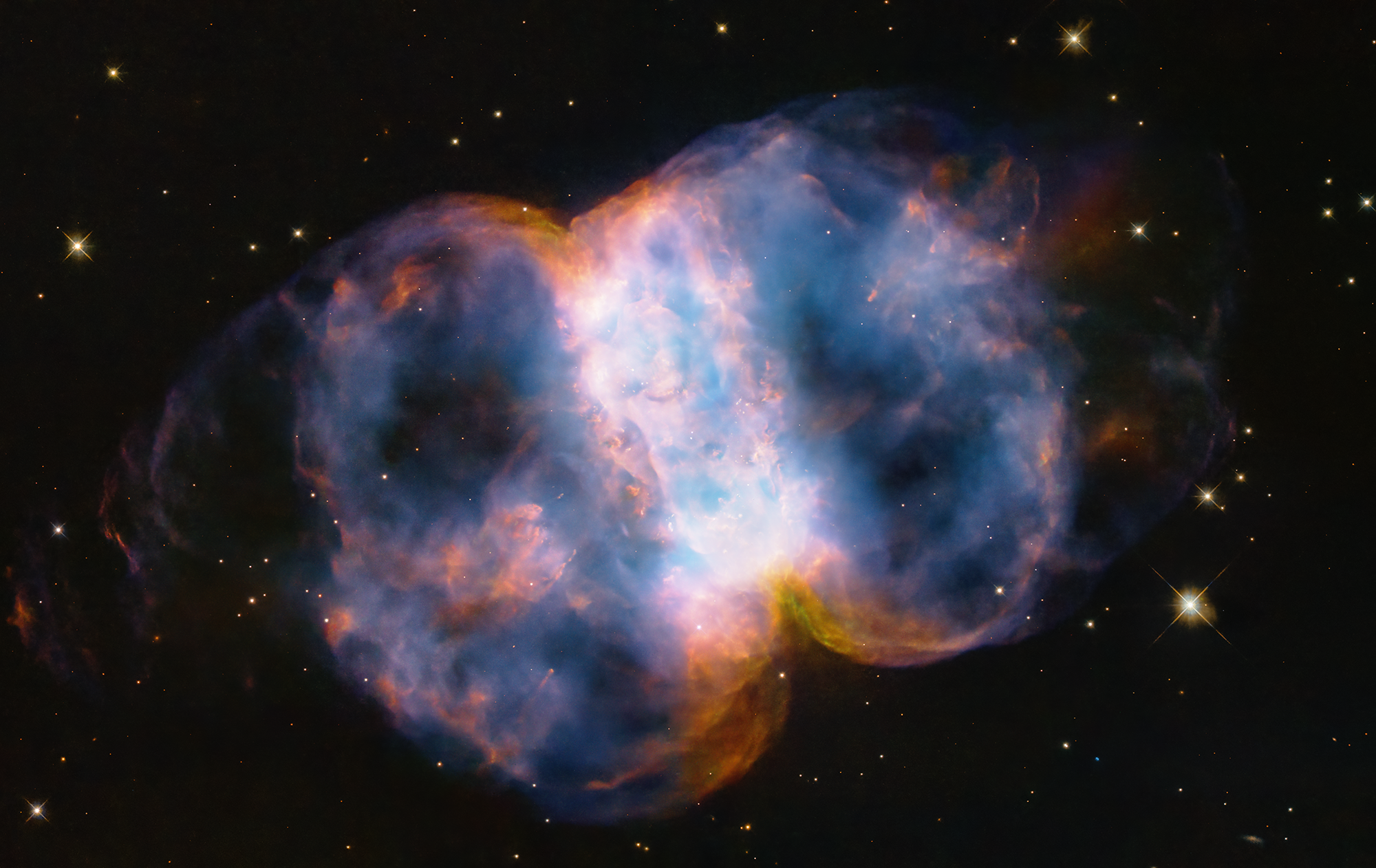
Cool image time! To celebrate the 34th anniversay of its launch in 1990, astronomers have used the Hubble Space Telescope to take a new photo of the Little Dumbbell Nebula (also known as M76), located about 3,400 light years away and one of the most well-known planetary nebulae in the sky.

That picture is to the right, cropped, reduced, and sharpened to post here. From the caption:

M76 is composed of a ring, seen edge-on as the central bar structure, and two lobes on either opening of the ring. Before the star burned out, it ejected the ring of gas and dust. The ring was probably sculpted by the effects of the star that once had a binary companion star. This sloughed off material created a thick disk of dust and gas along the plane of the companion’s orbit. The hypothetical companion star isn’t seen in the Hubble image, and so it could have been later swallowed by the central star. The disk would be forensic evidence for that stellar cannibalism.

The primary star is collapsing to form a white dwarf. It is one of the hottest stellar remnants known at a scorching 250,000 degrees Fahrenheit, 24 times our Sun’s surface temperature. 
The sizzling white dwarf can be seen as a pinpoint in the center of the nebula. A star visible in projection beneath it is not part of the nebula.


Pinched off by the disk, two lobes of hot gas are escaping from the top and bottom of the “belt,” along the star’s rotation axis that is perpendicular to the disk. They are being propelled by the hurricane-like outflow of material from the dying star, tearing across space at two million miles per hour.

Since launch Hubble has made 1.6 million observations of over 53,000 astronomical objects, and continues to be in high demand by astronomers, with only one request in six able to get time on the telescope. Not surprisingly, almost all of Hubble’s biggest discoveries were unexpected. Its future right now rests with its last three working gyroscopes used to orient it precisely. When one more fails, it will go to one-gyro mode, which will limit the precision of that orientation significantly. At that point the sharpness of the telescope’s imagery will sadly decline.

The only comparable orbital optical telescope now planned is China’s Xuntian optical telescope, scheduled for launch next year. It will fly in formation with the Tiangong-3 space station, allowing astronauts to periodically do maintenance missions to it. As I noted many times previously, American astronomers better start learning Chinese, assuming China even allows them access. Nor will these American astronomers have a right to complain, as it was their decision to not build a Hubble replacement, in their 2000, 2010, and 2020 decadal reports.

3 comments

Patchy arms in a nearby spiral galaxy

Patchy arms in spiral galaxy
Click for original image.

Cool image time! The photo to the right, reduced and sharpened to post here, was taken by the Hubble Space Telescope to study this southern hemisphere galaxy in detail. The galaxy, dubbed ESO 422-41, is located about 34 million light years away, and thus is a relatively close neighbor. From the caption:

A spiral galaxy, with a brightly shining core and two large arms. The arms are broad, faint overall and quite patchy, and feature several small bright spots where stars are forming. A few foreground stars with small diffraction spikes can be seen in front of the galaxy.

The patchy nature of the two arms makes each somewhat indistinct, so that at first glance this galaxy looks more like a elliptical blob, until you look close and notice those arms winding around that bright core. And as patchy as those arms are, the patches of blue are regions where new stars are forming.

0 comments

Analysis of Io’s atmosphere suggests it has been volcanically active for its entire 4+ billion year history

By analysizing the isotobes in Io’s atmosphere, scientists now believe that it has been volcanically active since its initial formation at the birth of the solar system 4.5 billion years ago.

de Kleer et al. found that both elements [ sulfer- and chlorine-bearing molecules] are highly enriched in heavy isotopes compared to average Solar System values due to the loss of lighter isotopes from the upper atmosphere as material is continuously recycled between Io’s interior and atmosphere. The findings indicate that Io has lost 94% to 99% of the sulfur that undergoes this outgassing and recycling process. According to the authors, this would require Io to have had its current level of volcanic activity for its entire lifetime.

This data suggests that Io, as well as Jupter’s other three large Galilean moons (Europa, Calisto, and Ganymeded) have been in their present orbits since their formation 4.5 billion years ago. It also means that, while Io’s geological history keeps getting wiped out by its volcanic activity, the other three contain detailed geological records of the solar system’s entire history. Combine that with the geological data we will eventually get from Mars, it appears that we shall someday be able to document that history far beyond anything expected.

1 comment

TESS has resumed science operations

Engineers have successfully returned TESS to full science operations, without providing as yet any explanaton as to why on April 8, 2024 it went into safe mode or what they did to fix the issue.

The Aprill 11 press release announcing the safe mode had only mentioned that the shut down had occurred “during scheduled engineering activities.” The lack of information continues to suggest that someone did an “Oops!” during those activities, and NASA is too embarassed to reveal that fact.

0 comments

Using Gaia data scientists discover the heaviest stellar black hole ever found

In digging into the precise motion data from the Gaia space telescope scientists have discovered the Milky Way’s heaviest stellar-sized black hole, with a mass thirty-three times the mass of our Sun.

Stellar black holes are formed from the collapse of massive stars and the ones previously identified in the Milky Way are on average about 10 times as massive as the Sun. Even the next most massive stellar black hole known in our galaxy, Cygnus X-1, only reaches 21 solar masses, making this new 33-solar-mass observation exceptional.

Remarkably, this black hole is also extremely close to us — at a mere 2000 light-years away in the constellation Aquila, it is the second-closest known black hole to Earth.

The only known black hole inside the Milky Way that is larger is Sagittarius A* (pronounced A-star), the supermassive central black hole at the galaxy’s center and weighing over four million solar masses. That creature is a very different thing, as it involves the long term evolution of the galaxy itself. Stellar-sized black holes only involve the death of a single star, with possible additions from a handful of others.

2 comments

TESS in safe mode

NASA today revealed that on April 8, 2024 its TESS space telescope went into safe mode, for reasons that are not yet understood.

NASA’s TESS (Transiting Exoplanet Survey Satellite) entered into safe mode April 8, temporarily interrupting science observations. The team is investigating the root cause of the safe mode, which occurred during scheduled engineering activities. The satellite itself remains in good health.

The spacecraft itself remains healthy and they expect to resume science operations “in the coming days.”

That safe mode occurred while “scheduled engineering activities” were ongoing suggests that the two are linked. The lack of any details from NASA further suggests that someone did a “oops!” during those activities, and they are now scrambling to fix things.

1 comment

A whirlpool half-hidden by dust

A whirlpool half-hidden by dust
Click for original image.

Cool image time! The picture to the right, reduced and sharpened to post here, was taken by the Hubble Space Telescope and shows us a magnificent spiral galaxy about 100 million light years away that also has very active nucleus at its center as well as many star-forming regions (in blue) in its outer arms.

That we do not see the same blue spiral arms on the right side of the photo is not because they are lacking, but because a very large stream of dust blocks our view.

This dark nebula is part of the Chamaeleon star-forming region, itself located only around 500 light-years from us, in a nearby part of the Milky Way galaxy. The dark clouds in the Chamaeleon region occupy a large area of the southern sky, covering their namesake constellation but also encroaching on nearby constellations, like Apus. The cloud is well-studied for its treasury of young stars, particularly the cloud Cha I, which has been imaged by Hubble and also by the … James Webb Space Telescope.

0 comments

Lunar Reconnaissance Orbiter snaps a smeared image of South Korea’s Danuri lunar obiter

Danuri as seen by LRO
Click for original image.

Cool image time! On March 5 to March 6, 2024, the orbits of NASA’s Lunar Reconnaissance Orbiter (LRO) and South Korea’s Danuri orbiter had three close approaches, during which LRO had a chance to snap pictures of Danuri as it zipped by in the opposite direction.

The first image is to the right, cropped but expanded to post here.

The flight paths of the two vehicles were nearly parallel but in opposite directions, resulting in extreme relative velocity. The LROC NAC exposure time was very short, only 0.338 milliseconds. But still, Danuri was smeared by a factor greater than 10x in the downtrack direction.

…On the first opportunity, LRO was slewed 43 degrees to capture Danuri from a distance of 5.0 kilometers

Of the three pictures taken, this one appears the best. In all three cases, the fast relative speed was too fast for the camera shutter, so that Danuri’s image was smeared as you see.

2 comments

Today’s eclipse

The next eclipses to cross the U.S.
Map by Michael Zeiler (GreatAmericanEclipse.com). Click for original.

Today a solar eclipse will cross some of the most populated areas of Mexixo, the United States, and Canada, as shown on the map to the right.

We shall not see such an event in North America again until 2046, and that will only cover a small part of the Pacific northwest. If you have never seen such an event, get your eclipse glasses (essential if you don’t want to go blind), take some time off of work, and go see it today. This link from Sky & Telescope covers about everything you need to know.

The experience is very hard to describe, though I tried when Diane and I traveled to South Bend, Idaho, in 2017 to experience that eclipse. As I wrote,

Totality was amazing. I was amazed by two things. First, how quiet it became. There were about hundred people scattered about the hotel lawn, with dogs and kids playing around. The hotel manager’s husband set up speakers for music and to make announcements, but when totality arrived he played nothing. People stopped talking. A hush fell over everything. Moreover, I think we somehow imagine a subconscious roar from the full sun. Covered as it was, with its soft corona gleaming gently around it, it suddenly seemed still.

Secondly, the amazing unlikeliness of the Moon being at just the right distance and size to periodically cause this event seemed almost miraculous. Watching it happen drove this point home to me. And since eclipses themselves have been a critical event in the intellectual development of humanity, helping to drive learning and our understanding of the universe, it truly makes me wonder at the majesty of it. I do not believe in any particular religion or their rituals (though I consider the Bible, the Old Testament especially, to be a very good manual for creating a good life and society), but I do not deny the existence of a higher power. Something made this place, and set it up in this wonderous way. Today’s eclipse only served to demonstrate this fact to me again.

I am sure your impressions will be unique to you.

16 comments

Engineers confirm IXPE is fixed and resuming science observations

Engineers have now confirmed the software fix they sent to the IXPE space telescope on March 26, 2024 has worked, and have taken the telescope out of safe mode so that it can resume science observations.

The IXPE mission is now observing a new transient X-ray source – Swift J1727.8–161 – a candidate accreting black hole. The source has recently begun producing jets of material moving at a fraction of the speed of light. The IXPE observations will help to understand accretion onto black holes, including potentially revealing how the relativistic jets are formed.

The telescope observes the universe in X-rays, but does so by observing its polarization. This approach provides information not seen in direct observations.

0 comments

Interacting galaxies

Interacting galaxies
Click for original image.

Cool image time! The picture to the right, reduced and sharpened to post here, was taken by the Hubble Space Telescope as part of a dark energy survey. It shows two galaxies very close together, their perpheries only about 40,000 light years apart, with the larger galaxy about the size of the Milky Way.

For comparison, the Large Magellanic Cloud (LMC) is about 167,000 light years from the Milky Way, more than four times farther that this satellite galaxy. Yet the satellite galaxy here appears much larger than the LMC, having a central core that the LMC lacks. From the caption:

Given this, coupled with the fact that NGC 5996 is roughly comparable in size to the Milky Way, it is not surprising that NGC 5996 and NGC 5994 — apparently separated by only 40 thousand light-years or so — are interacting with one another. In fact, the interaction might be what has caused the spiral shape of NGC 5996 to distort and apparently be drawn in the direction of NGC 5994. It also prompted the formation of the very long and faint tail of stars and gas curving away from NGC 5996, up to the top right of the image. This ‘tidal tail’ is a common phenomenon that appears when galaxies get in close together, as can be seen in several Hubble images.

In this single picture we are witnessing evidence of a process that has been going on for likely many millions of years.

2 comments

The remnant of the supernova from 1181, as seen in multiple wavelengths

Supernova remnant as seen in multiple wavelengths
Click for original image.

Using a number of different telescopes and observing in many wavelengths outside the visible spectrum, astronomers have produced a new composite image of the remnant of a supernova that was detected in the year 1181 and remained visible to the naked eye for about six months.

That composite picture is to the right, cropped and reduced to post here. From the press release:

X-ray observations by ESA’s XMM-Newton (blue) show the full extent of the nebula and NASA’s Chandra X-ray Observatory (cyan) pinpoints its central source. The nebula is barely visible in optical light but shines bright in infrared light, collected by NASA’s Wide-field Infrared Space Explorer (red and pink). Interestingly, the radial structure in the image consists of heated sulfur that glows in visible light, observed with the ground-based Hiltner 2.4 m telescope at the MDM Observatory (green) in Arizona, USA, as do the stars in the background by Pan-STARRS (white) in Hawaii, USA.

Because the remnant is so dim in visible light, it has taken years of searching to locate it.

2 comments

The spiraling magnetic field surrounding the Milky Way’s central supermassive black hole

The magnetic field lines surrounding Sagittarius A*
Click for original image.

Astronomers have now produced the first detailed image of polarized light surrounding the Milky Way’s central supermassive black hole, dubbed Sagittarius A* (pronounced “Sagittarius A-star”) which in turn maps out the spiraling field lines of that black hole’s magnetic field.

The image to the right, reduced to post here, shows that image. From the press release:

“What we’re seeing now is that there are strong, twisted, and organized magnetic fields near the black hole at the center of the Milky Way galaxy,” said Sara Issaoun, CfA NASA Hubble Fellowship Program Einstein Fellow, Smithsonian Astrophysical Observatory (SAO) astrophysicist, and co-lead of the project. “Along with Sgr A* having a strikingly similar polarization structure to that seen in the much larger and more powerful M87* black hole, we’ve learned that strong and ordered magnetic fields are critical to how black holes interact with the gas and matter around them.”

Light is an oscillating, or moving, electromagnetic wave that allows us to see objects. Sometimes, light oscillates in a preferred orientation, and we call it “polarized.” Although polarized light surrounds us, to human eyes it is indistinguishable from “normal” light. In the plasma around these black holes, particles whirling around magnetic field lines impart a polarization pattern perpendicular to the field. This allows astronomers to see in increasingly vivid detail what’s happening in black hole regions and map their magnetic field lines.

Despite this similarlity, it still remains a mystery why the much larger M87 black hole is very active while Sagittarius A’ remains generally quiet.

0 comments

Engineers resolve issue on IXPE space telescope

Engineers have resolved the issue on the IXPE (Imaging X-ray Polarimetry Explorer) space telescope that was jumbling the data it was sending to Earth, and expect to return it to full science operations shortly.

On March 26, using procedures developed following that previous interruption, the team initiated a spacecraft avionics reset to address the issue, which put IXPE into a planned safe mode. The team has confirmed that IXPE is once again transmitting valid telemetry data and is now working to resume science operations, in as rapid and safe a manner as possible. The spacecraft is in good health.

The “previous interruption” was in 2023. In both cases it appears that simply rebooting the telescope’s software fixed the problem.

1 comment

The tangled view of astronomers

A protostar in formation
Click for original image.

The uncertainty of science: The picture to the right, cropped, reduced, and sharpened to post here, was taken by the Hubble Space Telescope as part of a survey of young stars surrounded by an edge-on dust disk. From the caption:

FS Tau is a multi-star system made up of FS Tau A, the bright star-like object near the middle of the image, and FS Tau B (Haro 6-5B), the bright object to the far right that is partially obscured by a dark, vertical lane of dust. The young objects are surrounded by softly illuminated gas and dust of this stellar nursery. The system is only about 2.8 million years old, very young for a star system. Our Sun, by contrast, is about 4.6 billion years old.

The blue lines on either side of that vertical dust lane are jets moving out from FS Tau B. The caption says their asymetrical lengths are likely due to ” mass is being expelled from the object at different rates,” but it just as easily be caused by the angle in which we see this object, making the nearer jet seem longer than the one behind.

That astronomers cannot move around such an object and see it from many angles explains the headline of this post. We can only see astronomical objects from one angle, and when they are complex objects such as this one, a large part of the research problem is disentangling the shapes we see into a coherent picture. Spectroscopy helps a lot, as it provides information about the speed and direction of different parts of the object, but even this can be enormously complicated and difficult to interpret.

Remember these facts when you read news reports about astronomical research. No matter how certain the press release sounds, its certainty is always tempered by many unknowns, some very pedestrian but fundamental.

0 comments

Citizen scientist project discovers 16 active asteroids

A project that has enlisted approximately 8,300 ordinary citizens to review more than 430,000 photos taken by a telescope in Chile has discovered sixteen asteroids that produce comae and tails like comets.

Identifying and tracking active asteroids whose activity specifically appears to be due to the sublimation of ice – known as main-belt comets – is a particular interest of the project team, as it is an essential part of understanding the abundance and distribution of volatile material like ice in the Solar System.

…The project, utilizing publicly available Dark Energy Camera (DECam) data from the Victor M. Blanco telescope in Chile, involved the examination of more than 430,000 images of known minor planets by 8,300 volunteers, where images identified by citizen scientists as being likely to contain active asteroids were then passed on to the science team for confirmation and additional analysis.

You can read the research paper here. If you want to participate, the Active Asteroids project is still on-going, and can be accessed here.

0 comments
1 13 14 15 16 17 113