The closest supernovae in almost 25 years

Astronomers have spotted the closest supernovae in almost 25 years, only 21 million light years away.

The supernova, dubbed PTF 11kly, occurred in the Pinwheel Galaxy, located in the “Big Dipper,” otherwise known as the Ursa Major constellation. It was discovered by the Palomar Transient Factory (PTF) survey, which is designed to observe and uncover astronomical events as they happen. “We caught this supernova very soon after explosion. PTF 11kly is getting brighter by the minute. It’s already 20 times brighter than it was yesterday,” said Peter Nugent, the senior scientist at Berkeley Lab who first spotted the supernova. Nugent is also an adjunct professor of astronomy at UC Berkeley. “Observing PTF 11kly unfold should be a wild ride. It is an instant cosmic classic.”

Astronomers expect the supernova to continue to brighten over the next two weeks, when it should be visible to anyone using binoculars.
1 comment

When dust, pebbles, rocks, and boulders act like liquid

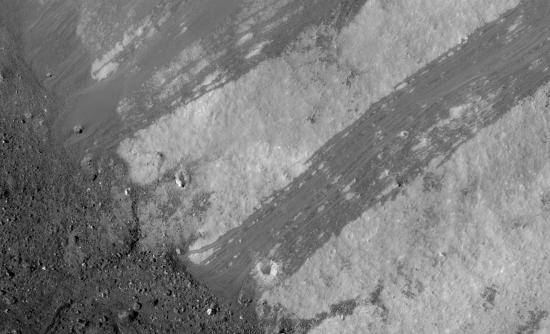
The science team of Lunar Reconnaissance Orbiter released an intriguing picture yesterday of what scientists call a granular flow down the side of a five mile wide crater on the far side of the moon. Looking at the image, one would swear that the darker material flowing down the slope of the crater rim is a lava flow frozen in place.

lunar granular flow

However, according to the scientists, that is not what it is. Instead, this is merely debris left behind from an avalanche.
» Read more

0 comments

The American Eclipse of 2017

2017 Eclipse map

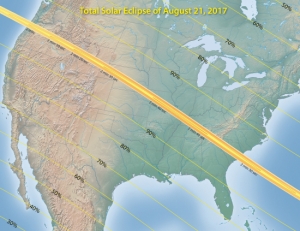
Time to start making your vacation plans. On August 21, 2017 a total eclipse of the sun is going to traverse the entire length of the continental United States, from Oregon to South Carolina. Kentucky will have the longest view, with totality as long as three minutes.

And astronomers are already thinking of ways to harness the help of the American people in observing this event. In a paper published today on the Los Alamos astro-ph website, a team of astronomers are proposing organizing something they have dubbed the U.S. Eclipse MegaMovie, whereby they gather together as many images of the totality as possible and assemble them into a single film, showing the evolution of the sun’s corona as it crosses the continent.
» Read more

0 comments

Hubble captures a necklace in space

necklace in space

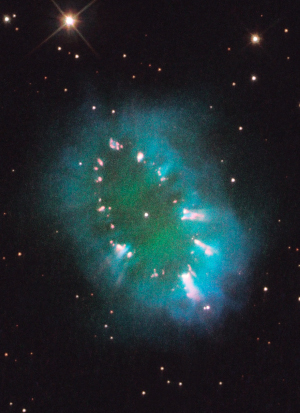
Who needs aliens and imagined cities on the moon when you have a reality that produces such strange and beautiful things as the image on the right?

On July 2, the Hubble Space Telescope took this image of a planetary nebula, aptly dubbed the Necklace Nebula. As the caption explains,

A pair of stars orbiting close together produced the nebula, also called PN G054.2-03.4. About 10,000 years ago one of the aging stars ballooned to the point where it engulfed its companion star. The smaller star continued orbiting inside its larger companion, increasing the giant’s rotation rate.

The bloated companion star spun so fast that a large part of its gaseous envelope expanded into space. Due to centrifugal force, most of the gas escaped along the star’s equator, producing a ring. The embedded bright knots are dense gas clumps in the ring.

The binary still exists, and can be seen as the star in the center of the necklace. The two stars are now only a few million miles apart and complete an orbit around each other in about a day.

0 comments
1 165 166 167 168 169 188