Two years from today a total eclipse will cross the U.S.

Start making your plans! The Great American solar eclipse will take place two years from today.

Aug. 21, 2017, will mark the first time this century, and the first time since 1979, that a total solar eclipse will cross the contiguous (lower 48) United States (Alaska had its turn in 1990; Hawaii in 1991). And for the very first time, the shadow track — better known as the “path of totality” — will sweep only over the United States and no other country, leading some people to refer to this upcoming event as “The Great American Eclipse.”

Many Americans taking full advantage of this event’s close proximity to their homes will have a golden opportunity to witness firsthand one of the most beautiful and most exciting of nature’s sky events. The total eclipse will be seen by an estimated 12 million people who fortuitously live within the totality path.  However, the number of people who are within just one day’s drive of the totality zone is probably around 200 million.

5 comments

Eight telescope protesters arrested on road to summit of Haleakala on Maui

Police arrested 8 protesters on Thursday attempting to block trucks delivering construction materials for the new Daniel K. Inouye Solar Telescope (DKIST) under construction since 2012 on the summit of Haleakala on the island of Maui in Hawaii.

One of those arrested has been a leader of the protests at Mauna Kea against the Thirty Meter Telescope.

The Hawaii state government continues to waffle on what it is going to do. Either they will make sure that construction of these telescopes can proceed, as per the agreements made after years of negotiation, or they are going to bow to a handful of protesters. Right now it appears that it can’t seem to make up its mind.

Meanwhile, if these protesters really have the support of a majority of Hawaiians, then astronomy in Hawaii is doomed.

0 comments

Astronomers photograph an exoplanet

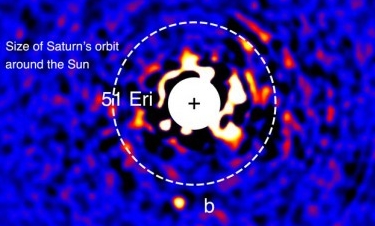
51 Eridani b

Cool image time! Astronomers have used the Gemini Telescope on Mauna Kea to take the clearest image yet of a Jupiter-sized gas giant orbiting another star 96 light years away.

Once the astronomers zeroed in on the star, they blocked its light and spotted 51 Eri b orbiting a little farther away from its parent star than Saturn does from the sun. The light from the planet is very faint — more than one million times fainter than its star – but GPI can see it clearly. Observations revealed that it is roughly twice the mass of Jupiter. Other directly imaged planets are five times the mass of Jupiter or more. In addition to being the lowest-mass planet ever imaged, it’s also the coldest — about 800 degrees Fahrenheit — and features the strongest atmospheric methane signal on record. Previous Jupiter-like exoplanets have shown only faint traces of methane, far different from the heavy methane atmospheres of the gas giants in our solar system.

All of these characteristics, the researchers say, point to a planet that is very much what models suggest Jupiter was like in its infancy.

The exoplanet is the bright spot near the bottom of the image.

3 comments

Astronomers chart the universe’s slow death

Using data gathered from more than 200,000 galaxies, astronomers have been able to measure the slow decline in the universe’s energy output since the Big Bang.

The fact that the Universe is slowly fading has been known since the late 1990s, but this work shows that it is happening across all wavelengths from the ultraviolet to the infrared, representing the most comprehensive assessment of the energy output of the nearby Universe. “The Universe will decline from here on in, sliding gently into old age. The Universe has basically sat down on the sofa, pulled up a blanket and is about to nod off for an eternal doze,” concludes Simon Driver.

I wish to note the significant uncertainty of this result. While this result is important and does strongly suggest that the universe is dying, 200,000 galaxies is hardly a significant representation of the universe’s galaxy population.

3 comments

Mauna Kea visitor center reopens

The visitor center on Mauna Kea was reopened this weekend after a month closure that supposedly forbid access by the public.

And yet, for that entire month, the state has allowed the protesters opposing construction of the Thirty Meter Telescope (TMT) to remain camped across the street.

To me, this illustrates where the state’s loyalties lie. They might talk a tough game, but they are really doing nothing to enforce the law and the legally negotiated agreements between the astronomical community and the various Hawaiian cultural institutions that had agreed on the conditions for building TMT. By allowing the protesters to continue to break the law and set up house on the mountain, the state is saying they really want construction to cease.

I say, maybe the time has come for astronomers to agree, and move lock, stock, and barrel south to Chile. In addition, maybe tourists should consider other places to visit, rather than a place that exhibits such hostility to outsiders.

8 comments

TMT protesters gather outside IAU conference in Hawaii

Two quotes from the article I think clarify what is going on here. First, one of the protester signs illustrated very clearly the level of ignorance and foolishness of the protesters;

“We don’t want your big toy telescopes on our sacred mountain.”

Then there was this significant point noted in the article:

The demonstrators are a diverse group but are generally led by men and women in their twenties who were educated in modern Hawaiian-language immersion schools. Decades ago, children were beaten for speaking the language; today it is a source of cultural pride and a touchstone for Hawaii’s burgeoning sovereignty movement.

In other words, for the past few decades the public schools in Hawaii have been focused on teaching young Hawaiians to hate American culture and whites. Instead, race and ethnicity come before concepts of freedom and individual rights. How nice. (If you don’t believe me spend just a little time studying what these native peoples courses teach. I’ve seen it here in Arizona as well as in New York. They really do teach anti-Americanism and a hatred of whites.)

However, considering that Hawaii has been controlled exclusively by leftwing Democrats for decades, no one should be surprised.

0 comments

Twenty arrested for blocking trucks to different mountain telescope in Hawaii

Twenty protesters were arrested on Friday trying to block trucks leaving for the summit of Haleakala on the island of Maui, as part of the work building the new Daniel K. Inouye Solar Telescope there.

This protest did not involve Mauna Kea. It suggests that the hostility to astronomy and outsiders on Hawaii is growing. It also suggests to me that maybe astronomers and outsiders should consider going somewhere else for their research and tourism. Let’s find out how happy these Hawaiian protesters will be if the money these industries bring to their island disappears.

Another article notes that seven others were arrested on Mauna Kea as well. It thus appears that the Hawaiian government is finally moving to enforce the law there.

9 comments

The supernova of 1987 finally begins to fade

Almost thirty years after Supernova 1987a became the first naked eye supernova since the invention of the telescope, the necklace ring of spots that the explosion’s shockwave ignited in the late 1990s are finally beginning to fade.

But now the hotspots have slowly begun to fade, Claes Fransson (Stockholm University, Sweden) and colleagues report in the June 10th Astrophysical Journal Letters. The team studied images taken by the Hubble Space Telescope from 1994 to 2014, and spectra from the Very Large Telescope spanning 2000 to 2013. Based on the rate at which the hotspots are fading, the researchers predict the glittering necklace will fade away sometime between 2020 and 2030, with the calculations favoring closer to 2020. The clumps of gas in the central ring are likely dissolving, thanks to a combination of instabilities and conduction in the hot gas surrounding the clumps. In other words, the central ring is being destroyed.

The show really isn’t over. The aftermath of a star exploding goes on for thousands of years. So to will SN1987a’s show.

0 comments

Astronomers confirm existence of Earthlike exoplanet 21 light years away

Worlds without end: Astronomers have confirmed the existence of a rocky Earthlike exoplanet only 21 light years away.

HD 219134b is also the closest exoplanet to Earth to be detected transiting, or crossing in front of, its star and, therefore, perfect for extensive research. “Transiting exoplanets are worth their weight in gold because they can be extensively characterized,” said Michael Werner, the project scientist for the Spitzer mission at NASA’s Jet Propulsion Laboratory in Pasadena, California. “This exoplanet will be one of the most studied for decades to come.”

The planet has a mass 4.5 times that of Earth, and orbits its sun every three days, which means it is not likely to harbor life. Its sun also harbors three other small exoplanets, but little is known of them.

Expect a lot more news coming from HD 219134b, however. With transits every three days, astronomers are going to have a lot of opportunities to study its atmosphere and make-up.

1 comment

Hawaii government not enforcing Mauna Kea emergency rule

Surprise, surprise! The emergency rule imposed by the Democratic governor of Hawaii at Mauna Kea, restricting access and forbidding camping, is not being enforced.

A week after Governor David Ige signed the rule into effect on July 14, signs informing the public were posted on along the Mauna Kea summit access road. Days later on Thursday, July 23, DLNR Conservation and Resource Enforcement officers started distributing what officials are calling educational handouts.

Cell-phone video taken by protesters, who say they’re standing in protection of the mountain as a sacred Native Hawaiian place, captured the first exchange. “We’re here just to serve you these papers, okay? And basically what you need to do is just to read them and understand that this is the emergency proclamation that went through,” a DOCARE officer explained.


DLNR officers have been back five times since then, but no citations or arrests have been made.

This is typical behavior when faced with liberal illegal protesters for most modern political leaders, especially Democrats. Even when they talk a good game, when it comes time to actually enforce the law, they chicken out. And until Governor Ige enforces the law, I do not see how construction of the Thirty Meter Telescope can resume.

3 comments

Astronomers confirm Kepler discovery of near twin of Earth

Worlds without end! In the release today of another set of Kepler data, astronomers have announced the discovery in that dataset of a new twin of Earth.

The newly discovered Kepler-452b is the smallest planet to date discovered orbiting in the habitable zone — the area around a star where liquid water could pool on the surface of an orbiting planet — of a G2-type star, like our sun. The confirmation of Kepler-452b brings the total number of confirmed planets to 1,030. …

Kepler-452b is 60 percent larger in diameter than Earth and is considered a super-Earth-size planet. While its mass and composition are not yet determined, previous research suggests that planets the size of Kepler-452b have a good chance of being rocky. While Kepler-452b is larger than Earth, its 385-day orbit is only 5 percent longer. The planet is 5 percent farther from its parent star Kepler-452 than Earth is from the Sun. Kepler-452 is 6 billion years old, 1.5 billion years older than our sun, has the same temperature, and is 20 percent brighter and has a diameter 10 percent larger.

While this exoplanet is certainly not identical to Earth, it is close enough that the possibility of alien life — really alien life — could very likely exist upon it.

The dataset also included 11 other Earth twin candidate exoplanets that still need to be confirmed.

0 comments

Internet tycoon commits $100 million to alien life search

Russian internet entrepreneur Yuri Milner has given SETI $100 million for a ten year project to accelerate their effort to search for evidence of extraterrestrial life.

Understanding why SETI needs private funding is important:

SETI has been going on since 1960, when radio telescopes became sensitive enough to detect signals from another planet if it was broadcasting signals similar to those which our civilization does. Researchers developed devices that could monitor millions of frequencies at once for any signal that looked at all different from that produced by astronomical objects or the natural background. At first funded by universities and NASA, public funding for SETI was axed by Congress in the early 1990s. Since then, the nonprofit SETI League has received funding of a few million dollars a year from private donors.

Congress correctly cut the funds because it isn’t really the business of the federal government to search for alien life. Some taxpayers really don’t want their money used for that purpose, and they should have the right to say no. Instead, Congress essentially told SETI to do it right: Get private funding from people who want the research done. The work will be done more efficiently for less, and no one will be required to contribute who doesn’t want to.

Milner’s contribution now is the biggest donation yet, and suggests that interest in this research is building culturally.

7 comments

Astronomers find exoplanet twin of Jupiter

Worlds without end: Astronomers have discovered an exoplanet with the same mass as Jupiter orbiting its star in a very similar orbit.

Not only that, but:

The planet’s host, the solar twin HIP 11915, is not only similar in mass to the Sun, but is also about the same age. To further strengthen the similarities, the composition of the star is similar to the Sun’s. The chemical signature of our Sun may be partly marked by the presence of rocky planets in the Solar System, hinting at the possibility of rocky planets also around HIP 11915.

I immediately wonder if this star also has rocky inner planets.

2 comments

Road to Mauna Kea opened, with restrictions

The University of Hawaii has reopened the road to the summit of Mauna Kea, subject to the emergency restrictions imposed by Hawaii’s Board of Land and Natural Resources.

The visitors center remains closed, and access by the public is much more limited. However, with the road open to employees it means astronomy can resume on the mountain as well as construction of the Thirty Meter Telescope.

I fully expect some of the protesters to defy these restrictions and get arrested. Based on their behavior these past four months, they don’t have much respect either for the law, or for the sacredness of the mountain.

0 comments

Hawaii officials vote to limit access to Mauna Kea

Hawaii’s Board of Land and Natural Resources voted 5 to 2 on Friday to restrict access to Mauna Kea.

The rule restricts being within a mile (1.6 kilometres) of the mountain’s access road during certain nighttime hours, unless in a moving vehicle, and prohibits camping gear. It would allow construction to resume on the $1.4 billion Thirty Meter Telescope, the subject of months of protests. Many Native Hawaiians consider the mountain sacred. Camping was already prohibited on the mountain. “We need the tools to keep order on the mountain,” said board member Chris Yuen. “It’s sad that it has come to this point.”

Not surprisingly, the leader of the protesters said they would ignore the rule and continue their overnight protests.

0 comments

The incivility and hostility of the Mauna Kea protesters

The management of Mauna Kea has released event logs by both their rangers [pdf] and the visitor center [pdf], outlining the generally hostile and illegal behavior of the TMT protesters during the past four months, including threats of violence against visiters and workers to the mountain.

The news story above does not really give the full flavor of the protesters’ generally rude and hostile behavior. They repeatedly threatened workers and visitors, damaged both existing facilities as well as the natural environment on which they camped illegally, and interfered with others who had come to the mountain to star-gaze or work. The logs also include numerous examples of the protesters exhibiting incredible ignorance about the astronomy on the mountain as well as the Thirty Meter Telescope itself. If you get the chance, read these logs yourself. They clarify for everyone which side stands on the side of civilization and which does not.

Finally there is this important tidbit:

From March 24, 2015 through present, groups of protesters, some up to nearly 200 persons, have sporadically been onsite on the University of Hawaii management lands and DLNR lands on Maunakea. A group of about 10 protesters has maintained a continuous presence day and night. [emphasis mine]

As is usual for protests like this, the actual numbers are miniscule, and are magnified by a press that wants to promote the protesters’ agenda, even though a very large majority does not agree with that agenda.

6 comments

A bullseye in space

Cool image time! The science team of the Swift space telescope has released a movie compiled from X-ray images taken of the first outburst from black hole V404 Cygni in 26 years. [link fixed!]

Astronomers say the rings result from an “echo” of X-ray light. The black hole’s flares emit X-rays in all directions. Dust layers reflect some of these X-rays back to us, but the light travels a longer distance and reaches us slightly later than light traveling a more direct path. The time delay creates the light echo, forming rings that expand with time.

Detailed analysis of the expanding rings shows that they all originate from a large flare that occurred on June 26 at 1:40 p.m. EDT. There are multiple rings because there are multiple reflecting dust layers between 4,000 and 7,000 light-years away from us. Regular monitoring of the rings and how they change as the eruption continues will allow astronomers to better understand their nature.

V404 Cygni is located about 8,000 light-years away. Every couple of decades the black hole fires up in an outburst of high-energy light. Its previous eruption ended in 1989.

The animation below the fold is a smaller resolution version of the movie, showing the rings as they expand outward.
» Read more

0 comments

Dance of the stars

Astronomers have found a stellar system made up of five stars, two binary systems orbiting each other, with a fifth star orbiting one of the stars in one of the binaries.

Co-author Dr Markus Lohr, from the Open University, told BBC News that these contact binaries were stars that orbit so closely they share an outer atmosphere. The other star pair – a detached binary – has a separation distance of some three million km. The two binaries orbit in the same plane at a distance of 21 billion km.

Follow-up observations of different wavelengths of light coming from the star system uncovered a fifth star, which is linked to the detached binary star. “This is a truly exotic star system. In principle there’s no reason why it couldn’t have planets in orbit around each of the pairs of stars. Any inhabitants would have a sky that would put the makers of Star Wars to shame,” Dr. Lohr said. “There could sometimes be no fewer than five Suns of different brightnesses lighting up the landscape.”

Dr. Lohr is being a bit extravagant. Though planets are a possibility here, I suspect it very unlikely that they are habitable.

0 comments

Astronomers propose giant super Hubble replacement

A major university consortium that manages many ground- and space-based telescopes has proposed that a new giant optical space telescope be built to replace Hubble.

A report published today by the Association of Universities for Research in Astronomy in Washington, D.C., lays out the rationale for another orbiting observatory. It will have a mirror as big as 12 meters across, to both look for habitable planets around other stars and peer deep into the early aeons of the universe.

Hubble has a mirror 2.4 meters across, so this would be significantly larger. In fact, if built this new space telescope would make it bigger than any ground-based telescope that exists today.

As the article notes, the cost over-runs and delays of the infrared James Webb Space Telescope — which went from a $1 billion budget to $8 billion — will likely make Congress reluctant to fund a new giant project like this. Nonetheless, this report gives us a hint of where the astronomy community wants to head in future decades. For the past two decades they have poo-pooed the construction of a new and larger optical space telescope. It appears from this report that this culture is now changing.

0 comments

TMT protesters complain about road closure

The leader of the protest that is opposing the construction of the Thirty Meter Telescope (TMT) is now complaining about the road closure imposed by Hawaii’s government that is preventing him and his followers from returning to the mountain.

“The telescope employees have been able to access the mountain every single day to go up and come back down and even we as protectors of the mountain have been given daily access to conduct pule and religious practices on the mountain,” said Kahookahi Kanuha, a member of Ku Kia’i Mauna, which hopes to keep the telescope from being built. “So, if they do deem it unsafe, it is quite irresponsible of them to allow other individuals up the mountain.”

So let me get this straight: He thinks it is wrong for the people who own or lease the mountain — who have legal right to control access — to block the protesters, but he sees nothing wrong with him going there — trespassing — and blocking access to others. What a hypocrite.

This article proves that my analysis from Tuesday is correct. The government has shut the road mainly to quietly get the protesters out of the way and let things cool down. When construction resumes, I guarantee that road access will restricted to prevent the protesters from returning and blocking the road. (Update: The quotes here from the state’s attorney general provide even further confirmation that the state will not allow protests to obstruct future access to construction crews.)

One other note: The author of the first article above uses the typical dishonest mainstream media technique of only quoting one protester, the activist leader, while claiming that “protesters” are objecting. The data in the article, however, does not document this spin. As far as I can tell, the only one complaining about the road closure is this one guy.

0 comments
1 66 67 68 69 70 113