Nano Pirate – The butterfly under an electron mircoscope
An evening pause: Life is truly a miracle, in ways that are quite literally beyond belief.
Hat tip Cotour.
An evening pause: Life is truly a miracle, in ways that are quite literally beyond belief.
Hat tip Cotour.
The uncertainty of science: A new study on Earth using an “dry immersion tank” now suggests that weightlessness could increase the chances that female astronauts could get blood clots during long space missions.
First reported in 2020, an International Space Station mission detected an unexpected blood clot in a female astronaut’s jugular vein. To date, space-health research has had more male participants but with the number of female astronauts on the rise, a new SFU–European Space Agency study examined how microgravity affects blood clotting specifically in women. Key findings
- 18 female participants experienced five days of continuous simulated microgravity in a European Space Agency (ESA)-sponsored VIVALDI I dry immersion study.
- Coagulation time (the time it took for blood clots to start forming) was longer.
- Once started, clots formed faster.
- Once formed, the strength and stability of the clots was greater
The dry immersion tank is “a specially designed water bath with a waterproof sheet to keep participants dry while floating, and simulating weightlessness.”
The researchers admit these results are very uncertain. For one, none of the clots that occurred during the study were “clinically concerning,” which means they were the kind of clots that the body deals with normally without threat. The researchers also noted in their paper’s abstract that “current published research on this topic is male-centered,” which explains the female focus of this particular research.
This research suggests that blood clots could be an issue on long missions in weightlessness, but the data is sparse and very incomplete. Moreover, based on more than a quarter century of missions longer than six months in space, it appears the one blood clot cited above might have been the only incident so far recorded. And any results using immersion tanks on Earth is questionable, as they are a poor substitute for actual weightlessness in space.
Nonetheless, these results add weight to the need for developing interplanetary spaceships with some sort of artificial gravity. Without it, the health of any passengers going on long missions to other planets like Mars is certainly at risk, not simply from blood clots but from bone loss, vision damage, spinal deformities, and overall loss of cardio-vascular and muscular strength, all issues that have been documented well in space.

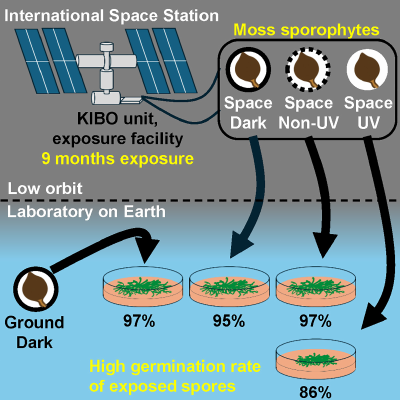
Graphic from paper.
Scientists have now demonstrated that moss, a bryophyte, can still reproduce despite spending nine months exposed to the harsh vacuum and radiation environment of space on the outside of ISS.
In fact, the researchers found that more than 80% of the spores survived and were able to germinate. You can read their peer-reviewed paper here [pdf].
That the moss could survive is in itself not as surprising as you might think. When the Apollo 12 astronauts brought back pieces from the unmanned Surveyor-3 lander scientists found a single bacterium that survived in space for more than two years. What makes this new result more significant is that moss isn’t simply bacteria, but plant life far more complex. More important, the results found that the moss was far more tolerant of that harsh environment than other lifeforms. From the paper:
In contrast, desiccation-tolerant animals such as tardigrades (Hypsibius dujardini and Ramazzottius varieornatus) and UV-resistant insects’ hydrated larvae undergoing anhydrobiosis (Polypedilum vanderplanki) failed to match the UVC tolerance observed in P. patens spores. Similarly, spores of bacteria and fungi, such as Bacillus subtilis and Aspergillus niger, showed only limited UVC resistance. Thus, these patterns highlight that certain plant structures, namely spores and seeds, tend to exhibit superior UV resistance, likely due to the presence of specialized UV-screening pigments such as flavonoids and carotenoids, which help protect DNA and cellular structures from UV-induced damage.
As the paper notes in its conclusion:
As pioneer plants, bryophytes have the potential to transform regolith into fertile soil, facilitating ecosystem development on other planets, similar to peat moss improving soil fertility on Earth.
That moss isn’t bother significantly by radiation means any greenhouse on Mars need not be shielded as aggressively as previously thought, at least in the initial stages.

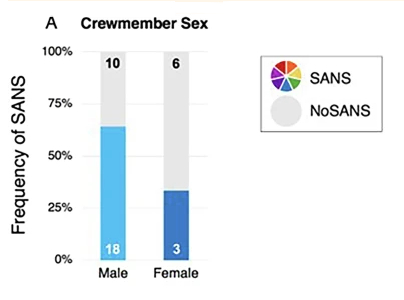
Astronauts who experienced changes in their
eyes (SANS) while on long missions in space
The uncertainty of science: A recent study of 30 astronauts during long term stays on ISS suggests that weightlessness impacts the shape of the eyes more in men than in women.
You can read the paper here.
In addition to changes in fluid around the brain, the team also found that a form of eye compression, a hallmark of Spaceflight Associated Neuro-ocular Syndrome known as globe flattening, was the most consistent eye change among crew members. “By far the most prevalent sign of eye changes that we observed was globe flattening, suggesting that this should be the primary monitoring target for ocular health,” Seidler said. “Interestingly, eye changes were more prevalent in males than females.”
Globe flattening, when the back of the eyeball becomes slightly indented or pushed inward, might sound minor, but it can have significant effects on vision and raise concerns for long-duration space missions.
Surprisingly, there was no strong link between brain structural changes and eye changes, suggesting that the effects on the eyes and brain may arise from distinct mechanisms rather than shared physiological cause
For the eye research, the sample was so small, 28 individuals of which only 9 were females, the researchers readily admit in their abstract that and “interpretation of these findings should be tempered by the fact that our sample included a relatively small number of females.” Nonetheless, the research did suggest that, regardless of sex, about half of all humans will experience these eye issues during long missions in weightlessness.
The results underscore the need to do artificial gravity experiments in orbit, to find out the minimum amount of gravity needed to mitigate or even eliminate these health issues. Otherwise, interplanetary travel is going to be seriously hampered, if not impossible.
The uncertainty of science: Using new data from the Webb Space Telescope, scientists now conclude that the identification on an exoplanet in April 2025 of the molecules dimethyl sulfide (DMS) and/or dimethyl disulfide (DMDS) — both of which on Earth are only associated with the presence of life — is now uncertain and that these molecules likely aren’t there.
The new work uses [Webb] data to better qualify what is going on. The work confirms the presence of an ocean on this peculiar exoplanet, although it can’t confirm if there is a thick or thin atmosphere. They couldn’t find water vapor in the atmosphere, suggesting that there is an efficient cold trap, keeping evaporation to a minimum on this temperate sub-Neptune world.
Those potential biosignatures were all below the threshold for an undeniable detection, and their model suggests that a possible presence of DMS could be explained by sources unrelated to life. They advise considering more and different molecules to use as biosignatures. Astronomers are studying worlds that are very different from our own, and the chemical signatures that seem obvious here on Earth might not fit well with those exoplanets.
In other words, they simply don’t have enough data to know, one way or the other. No surprise, The science of studying exoplanets is in its infancy, and right now can only tease out the smallest of details based on our limited technology and the distances involved.
You can read the new paper here [pdf]. It notes further that using these molecules as a sign of life is also a mistake, as they can be created in other ways having nothing to do with biology.
Link here. The NASA update provides a nice overview of the research, beginning with this overview:
When astronauts began spending six months and more aboard the International Space Station, they started to notice changes in their vision. For example, many found that, as their mission progressed, they needed stronger reading glasses. Researchers studying this phenomenon identified swelling in the optic disc, which is where the optic nerve enters the retina, and flattening of the eye shape. These symptoms became known as Space-Associated Neuro-Ocular Syndrome (SANS).
The research suspects the changes are due to the fluid shifts in the body that take place due to weightlessness, with blood shifting from the legs to the head. Various projects have studied a number of solutions, including wearing leg cuffs, administering vitamin B, and possibly using centrifuge-created artificial gravity to mitigate the condition. The problem has also generated new work in developing better equipment for to studying the eye, including improved imaging and techniques for measuring the eye’s stiffness.
China’s state-run press yesterday announced the discovery of a new microbe on its Tiangong-3 space station that appears designed to survive in the harsh environment of space.
In May 2023, the Shenzhou-15 crew collected surface microbial samples using sterile wipes, preserving them at low temperatures in orbit. Subsequent ground analysis revealed the novel Niallia tiangongensis species, confirmed through multidisciplinary methods including morphological analysis, genome sequencing, phylogenetic studies and metabolic profiling, the CMSA said.
…Niallia tiangongensis demonstrates exceptional stress resistance, maintaining cellular redox balance and ensuring robust growth in extreme conditions by regulating bacillithiol (BSH) biosynthesis to counteract space-induced oxidative stress, according to the CMSA. It exhibits distinctive capabilities in biofilm formation and radiation damage repair, making it a highly adaptable “all-rounder” for space environments.
More information here. This new microbe has characteristics both different and similar to microbes found on ISS. Its discovery is also not that unique, a it appears such unusual and new biology has been found in other space-related environments, such as the clean rooms on Earth used to build spacecraft. For example, dozens were found in clean room for the Phoenix Mars lander in the early 2000s.
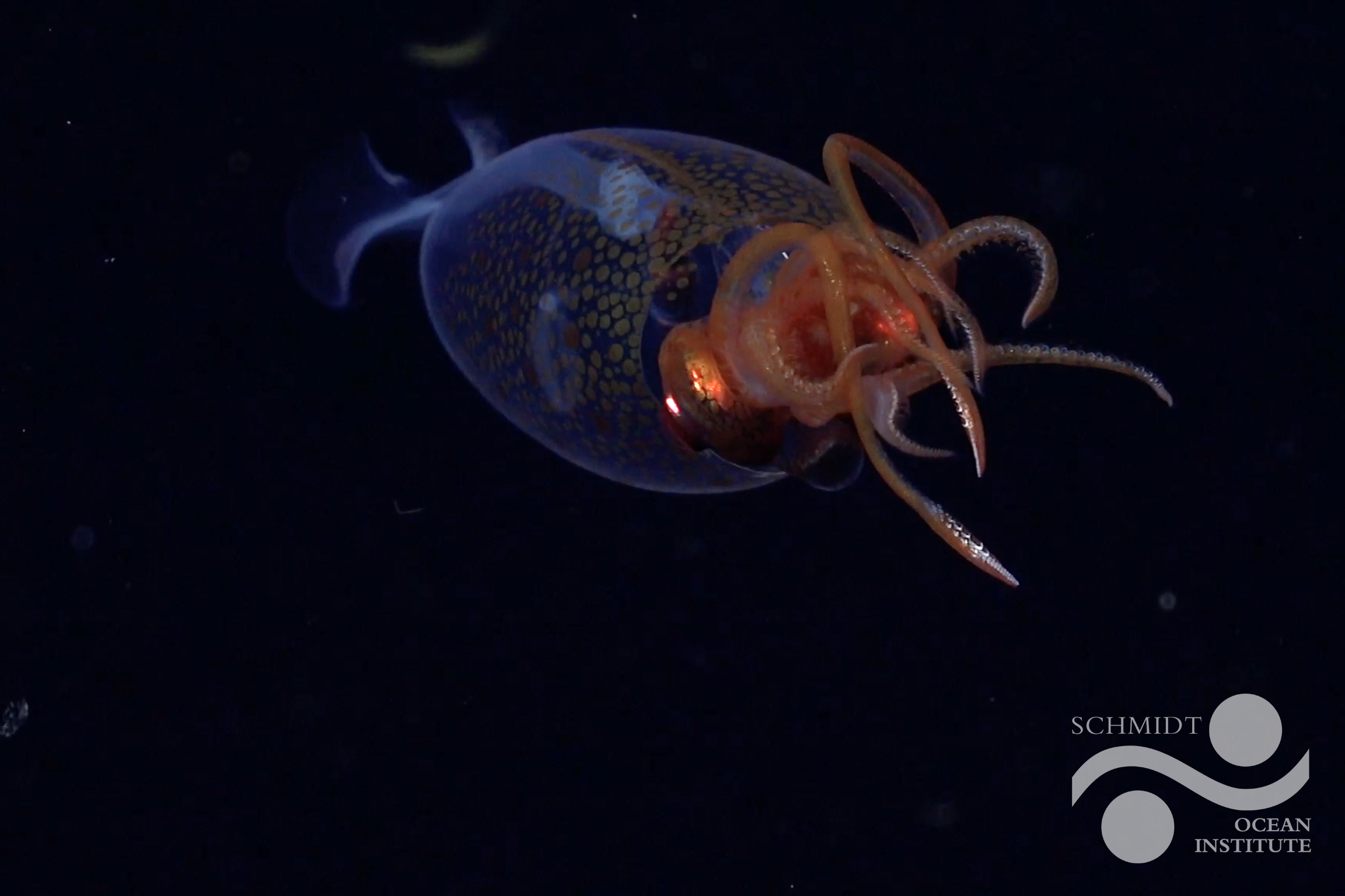
Using an autonomous submersible, scientists have captured the first pictures and video ever of a live transparent colossal squid in its natural habitat.
This one was captured on film using a remotely operated vehicle at a depth of 1,968 feet (600 m) during the team’s 35-day expedition to uncover new marine life. It’s a juvenile squid, about 0.98 ft (30 cm) long, with a transparent body, iridescent eyes, trademark hooks on the middle of each of its eight arms, and clubs on its two long tentacles.
…If you’re looking at this and wondering why this colossal squid doesn’t resemble the hefty red one you saw being pulled aboard a fishing boat back in 2007, good eye! That’s because this species starts out transparent, and loses its see-through appearance as it ages. Dr Kat Bolstad, associate professor at the Auckland University of Technology Lab, noted that the red coloration seen in the arms suggests this creature could switch between looking transparent to opaque.
I have embedded the video below.
» Read more
Researchers have discovered that by blocking the increase of a certain protein within the body, they can not only extend the lives of rats by about 25%, the rats overall health in old age was improved significantly.
You can read the original paper here and the press release from the researchers here. From that press release:
After establishing IL11’s role in aging, the team demonstrated that by applying this anti-IL11 therapy in the same preclinical model, metabolism was improved. The mice shifted from generating white fat to beneficial brown fat. Brown fat breaks down blood sugar and fat molecules to help maintain body temperature and burn calories. The researchers also observed improved muscle function and overall better health in their study, as well as an increased lifespan by up to 5 per cent in both sexes.
Unlike other drugs known to inhibit specific pathways involved in aging, such as metformin and rapamycin, anti-IL11 therapy blocks multiple major signaling mechanisms that become dysfunctional with age, offering protection against cardio-metabolic diseases, age-related loss of muscle mass and strength as well as frailty. In addition to these externally observable changes, anti-IL11 therapy also reduced the rate of telomere shortening and preserved mitochondria’s health and ability to generate energy.
According the paper, this drug is now in early-stage clinical trials for fibrotic lung disease, but its benefits — as seen in these rat experiments — could turn out to be far greater, across the board.
New research now suggests strongly that the exposure to cosmic rays during a three-year-long mission to Mars would cause permanent damage to a person’s kidneys.
The results indicated that both human and animal kidneys are ‘remodelled’ by the conditions in space, with specific kidney tubules responsible for fine tuning calcium and salt balance showing signs of shrinkage after less than a month in space. Researchers say the likely cause of this is microgravity rather than GCR [galactic cosmic rays], though further research is required to determine if the interaction of microgravity and GCR can accelerate or worsen these structural changes.
The primary reason that kidney stones develop during space missions had previously been assumed to be solely due to microgravity-induced bone loss that leads to a build-up of calcium in the urine. Rather, the UCL team’s findings indicated that the way the kidneys process salts is fundamentally altered by space flight and likely a primary contributor to kidney stone formation.
Perhaps the most alarming finding, at least for any astronaut considering a three-year round trip to Mars, is that the kidneys of mice exposed to radiation simulating GCR for 2.5 years experienced permanent damage and loss of function. [emphasis mine]
The study used samples “from over 40 Low Earth orbit space missions involving humans and mice, most of which were to the International Space Station, as well as 11 space simulations involving mice and rats.”
If these results are confirmed, it means that any interplanetary spaceship is going to require significant shielding. Having a safe haven they can go to during high energy solar events will not work, as cosmic rays arrive randomly at all times. This research thus tells us that we can’t simply add engines to the space station designs presently being built to send them to Mars. Instead, we need a heavy-lifte capability (such as Starship) to get the much heavier, well-shielded habitable modules into orbit.
In what might be the most sophisticated medical treatement yet seen by a wild animal, scientists in 2022 observed an orangutan named Rakus treat a face wound with a poultice it made from a plant known by locals to have medicinal value.
Rakus was observed eating the stems and leaves of the creeper akar kuning (Fibraurea tinctoria), which local people use to treat diabetes, dysentery and malaria, among other conditions. Orangutans in the area rarely eat this plant.
In addition to eating the leaves, Rakus chewed them without swallowing and used his fingers to smear the juice on his facial wound over seven minutes. Some flies settled on the wound, whereupon Rakus spread a poultice of leaf-mash on the wound. He ate the plant again the next day. Eight days after his injury, his wound was fully closed.
Other animals have been seen using plants or insects for medicinal reasons, but none had done anything as complicated as Rakus. Nor have researchers of orangetans ever seen another do anything similar in more than two decades of research. It is thus unclear how Rakus knew what to do. Did he figure it out on the spot, or had he seen it done in the past by others when unobserved?
Scientists studying the brains of 30 astronauts who spent from two weeks to one year on ISS have found that the longer a person stayed in weightlessness the greater the changes caused in the brain, and the longer it takes to recover.
Their findings, reported today in Scientific Reports, reveal that the brain’s ventricles expand significantly in those who completed longer missions of at least six months, and that less than three years may not provide enough time for the ventricles to fully recover.
Ventricles are cavities in the brain filled with cerebrospinal fluid, which provides protection, nourishment and waste removal to the brain. Mechanisms in the human body effectively distribute fluids throughout the body, but in the absence of gravity, the fluid shifts upward, pushing the brain higher within the skull and causing the ventricles to expand.
“We found that the more time people spent in space, the larger their ventricles became,” said Rachael Seidler, a professor of applied physiology and kinesiology at the University of Florida and an author of the study. “Many astronauts travel to space more than one time, and our study shows it takes about three years between flights for the ventricles to fully recover.”
You can read the paper here. The expansion of ventricles is a normal process due to aging, but I could not find any description in the paper noting its impact, for good or ill. Long periods of weightlessness brings it about quickly, but only temporarily.
According to a study comparing the changes in the brain experienced during long term missions on ISS, it appears that the Russians have developed better protocols for preparing themselves for return to Earth that prevents the enlargement in one part of the brain seen in American astronauts.
From the link:
The study focused on 24 Americans, 13 Russians, and a small, unspecified number of astronauts from the ESA. The researchers collected MRI scans of the astronauts’ brains before and after they spent six months on the ISS (only 256 individuals have visited the space station).
After being in space, all the space travelers exhibited similar brain changes: cerebrospinal fluid buildup and reduced space between the brain and the surrounding membrane at the top of the head. The Americans, however, also had more enlargement in the regions of the brain that serve as a cleaning system during sleep, e.g. the perivascular space (PVS).
…The Russian astronauts did not exhibit enlarged PVS, suggesting there might be differences in protocol that are neuro-protective.
From the paper itself:
[Russian C]osmonauts undergo six lower body negative pressure (LBNP) sessions starting two weeks prior to landing, while NASA and ESA astronauts do not typically do it. LBNP induces caudal displacement of fluids from the upper body by placing the legs and pelvis in a semiairtight chamber with negative pressure.
An advanced resistive exercise device (ARED) is regularly used by space flyers to perform free weight exercises on the ISS, but the load and frequency of use are lower for [Russian] cosmonauts compared with NASA and ESA astronauts. Lifting heavy loads during resistive exercise is often accompanied by a brief Valsalva maneuver, inducing increased ICP and decreased cerebral blood flow and cerebrovascular transmural pressure, which can result in PVS fluid accumulation. Although the effects of LBNP and ARED on the brain during spaceflight are unknown, they could partly explain the different WM-PVS changes detected in astronauts and cosmonauts. We cannot exclude that other factors (e.g., diet) might play a role in this difference. Further studies are required to confirm these hypotheses.
Apparently two protocols are different that seem to help the Russians. First, the LBNP, developed by the Russians on their earlier space stations, is essentially a pair of pants that sucks fluids down to the legs, simulating the situation normally found on Earth, and thus reduces the fluids in the upper body sooner than landing. Second, doing exercises simulating lower weight loads apparently helps the Russians as well.
After studying more than 200 samples from ISS brought back to Russia, researchers have identified more than 20 types of microorganisms that make their home on ISS, including some pathogens and fungi.
The habitat of the module and the entire Russian segment of the ISS is an environmental niche home to bacteria and microscopic fungi, the materials suggest. “These microorganisms use the station’s decorative-finishing and design materials as their basic habitat,” according to the materials.
The experiment aboard the ISS involved taking samples and delivering them to Earth in descent modules. In the course of three years, over 200 samples were taken, with bacteria discovered in 34% and fungi in 3% of them. “In 5% of the samples with the presence of bacterial microflora and in 100% of the samples with the presence of fungal microflora, the standard indicator regulated by SSP 50260 NORD was exceeded,” the materials say.
The fungi indicate mold, a long known problem on manned space stations first identified by the Russians on their Salyut stations in the ’70s and ’80s. The pathogens do not appear to be harmful, or else the astronauts would have experienced sicknesses. No such sicknesses have been reported, though they might have occurred but have not been released publicly due to medical privacy concerns.
The uncertainty of science: A study of fourteen astronauts who spent six months on ISS has found that weightlessness appears to increase the loss of red blood cells, and that the continuing loss extends well past their return to Earth.
Before this study, space anemia was thought to be a quick adaptation to fluids shifting into the astronaut’s upper body when they first arrived in space. Astronauts lose 10 percent of the liquid in their blood vessels this way. It was thought astronauts rapidly destroyed 10 percent of their red blood cells to restore the balance, and that red blood cell control was back to normal after 10 days in space.
Instead, Dr. Trudel’s team found that the red blood cell destruction was a primary effect of being in space, not just caused by fluid shifts. They demonstrated this by directly measuring red blood cell destruction in 14 astronauts during their six-month space missions.
On Earth, our bodies create and destroy 2 million red blood cells every second. The researchers found that astronauts were destroying 54 percent more red blood cells during the six months they were in space, or 3 million every second. These results were the same for both female and male astronauts.
The study also found that for as much as a year afterward the astronauts continued to lose red blood cells at a rate 30% greater than normal.
The researchers immediately suggested further invasive monitoring of anyone who wants to go to space. From their paper:
Space tourism will considerably expand the number of space travelers. Medical screening of future astronauts and space tourists might benefit from a preflight profiling of globin gene and modifiers. Postlanding monitoring should cover conditions affected by anemia and hemolysis. Monitoring individual astronaut’s levels of hemolysis during mission may be indicated to reduce health risks.
Without question, this data strongly suggests that it would be wise for anyone who wants to go into space for long periods have themselves checked for anemia, and have it treated prior to going, or if they still have it at launch time to decide not to go. However, the choice should belong to the individual, not bureaucrats imposing regulations or legislators passing laws.
Unfortunately, our modern leftist society now assumes such decisions no longer belong to the individual, but must be made by their betters in Washington. Provisions in the 2004 Space Amendments act allows the FAA to impose such invasive medical testing on future space tourists. Its bureaucrats have not yet done so, but the recent history with government mandates over the COVID shots suggests strongly that they will not hesitate to do so when they think they can get away with it.
New research comparing blood samples taken from five Russian astronauts before and after long term missions to ISS suggests that weightlessness can cause brain damage.
Published in JAMA Neurology, the new research looked at five male Russian cosmonauts. Each spent an average of 169 days in space. Blood samples were taken from each subject before leaving Earth, and then at three points after returning.
Five different blood-based biomarkers were measured, each known to correlate with some kind of brain damage. Three biomarkers in particular were found to be significantly elevated after the cosmonauts returned to Earth – neurofilament light (NfL), glial fibrillary acidic protein (GFAP), and a specific type of amyloid beta protein.
The researchers hypothesize the increases in NfL and GFAP levels may indicate a type of neurodegeneration called axonal disintegration. Elevated NfL levels are currently being investigated as a way of detecting the earliest stages of brain damage associated with Alzheimer’s disease.
It must be emphasized that the research did not find brain damage, only data within the blood samples that is often associated with brain damage. More research is required to determine if these biomarkers indicate the same thing in space as they do on Earth.
The uncertainty of science: According to a new study by researchers at Ben-Gurion University in Israel of mortality rates across the entire United States, people that live in regions of higher background radiation have lifespans on average 2.5 years longer.
Background radiation is an ionizing radiation that exists in the environment because of natural sources. In their study, BGU researchers show that life expectancy is approximately 2.5 years longer among people living in areas with a relatively high vs. low background radiation. Background radiation includes radiation emanating from space, and radiation from terrestrial sources. Since the 1960s, there has been a linear no-threshold hypothesis guiding policy that any radiation level carries some risk. Hundreds of billions of dollars are spent around the world to reduce radiation levels as much as possible.
…According to BGU Professors Vadim Fraifeld and Marina Wolfson, along with Dr. Elroei David of the Nuclear Research Center Negev, lower levels of several types of cancers were found when the radiation levels were on the higher end of the spectrum rather than on the lower end. Among both men and women, there was a significant decrease in lung, pancreatic, colon and rectal cancers. Among men, there were additional decreases in brain and bladder cancers. There was no decrease in cervix, breast or prostate cancers or leukemia.
Their data “covered the entire US population of the 3139 US counties, encompassing over 320 million people,” according to their paper’s abstract.
Up until now the assumption has been that any radiation is bad, based not on research but on assumptions gained by the negative consequence of exposure to high radiation. There has been no good data on the consequences of low level background radiation, because it is so hard to gather. The time frames are long and the numbers small, all of which causes the impact of background radiation to be overwhelmed by other factors. This study’s statistical use of the entire U.S. population is an attempt to overcome these obstacles.
This study is statistical, which means it found a correlation between higher radiation and longer lifespans. Correlation however does not prove causation. The study found no direct evidence that humans health benefits from background radiation. We should therefore take these results with a large grain of salt.
At the same time, their extremely large database is quite telling, and adds some weight to their conclusion.
Scientists have discovered a “significant increase” in the brain’s white matter that occurs after astronauts have completed long missions in weightlessness.
The team conducted brain MRIs of 11 astronauts before they traveled to the ISS, and then again one day after they returned. Scans were then performed at several interval across the following year. “What we identified that no one has really identified before is that there is a significant increase of volume in the brain’s white matter from preflight to postflight,” Kramer says. “White matter expansion in fact is responsible for the largest increase in combined brain and cerebrospinal fluid volumes postflight.”
These changes remained visible one year after spaceflight, which the researchers say indicates they could be permanent alterations. Past research has suggested that changes in the volume of cerebrospinal fluid (CSF) specifically could be a key driver of Visual Impairment Intracranial Pressure in astronauts. The authors of the new study also observed an increase in the velocity of CSF through the cerebral aqueduct, along with deformation of the pituitary gland, which they believe is related to higher intracranial pressure in microgravity.
The uncertainties for this work remain very large. For one thing, the sample (11 astronauts) is very small. For another, the permanence of this change is only suggested and remains unproven.
Nonetheless, this research adds to the growing body of research that suggests that long term weightlessness is generally not good for the human body. It also reinforces the desperate need for research into the effects of even a small amount of artificial gravity. To most efficiently design spacecraft that provide some form of centrifugal force as artificial gravity, we need to find out the minimum required. It could be providing only 10% or 30% Earth gravity could be sufficient. Or not. We just don’t know.
The engineering challenges however go up significantly the more gravity you need to create. For future interplanetary travel this information is critical.
It isn’t a vaccine that will prevent infection, but tests in France and in the U.S. now show that a drug normally used to treat malaria is very effective in reducing the symptoms of the Wuhan virus.
He said that the first Covid-19 patients he had treated with the drug chloroquine had seen a rapid and effective speeding up of their healing process, and a sharp decrease in the amount of time they remained contagious.
Chloroquine – which is normally used mainly to prevent and treat malaria – was administered via the named drug, Plaquenil.
The drug is readily available and can be prescribed to anyone who is considered threatened by the virus to help them get better why reducing the chances of them giving it to others.
Link here. In the past five days the number of people known to be infected has grown from about 450 to now more than 1,400, with deaths rising to 41 total. (The rate of deaths to those infected however has dropped, from 5% to less than 1%.) Also, a very small number of cases have been found in other countries throughout the world, limited so far to people who had recently been in the region of China with the most infections.
How serious is this epidemic? The rise in cases in only a week is concerning for sure, as very quickly the numbers are beginning to match the SARS epidemic in 2002-2003, which took a year to get to 8,000 infected. The so-far low death rate however suggests the disease is manageable.
The situation in China however is very serious. They have locked down regions with populations in the multi-millions, and the number of cases might soon strain their health system. Worse, we do not know if the numbers the non-transparent communist government is posting are accurate. There have been numerous rumors all week that the infection count is far higher than what has been publicly revealed. This could be true, or not. The rumors exist because no one trusts the communists to allow the truth to be published.
At the moment it still appears to me that, at least outside of China, the situation is under control. Whether it remains that way we can only wait and see.