
California – the Coming Collapse
Another government budget disaster: California – the coming collapse.
Another government budget disaster: California – the coming collapse.
The former CEO of one of the nation’s largest banks says that unless the federal government gets its budget under control, bankruptcy is a “mathematical certainty.” I especially like this quote from the CEO, John Allison, in describing the past history of Fannie Mae and Freddie Mack:
“I was on a committee, a Financial Services Roundtable, for nine years trying to do something about Freddie Mac and Fannie Mae,” said Allison. “You couldn’t help but see it coming,” he said. “You ran the numbers, particularly the last several years, and it was mathematically certain Freddie and Fannie were going bankrupt.”
“We met with Congress. We met with [House Financial Services Chairman] Barney Frank and [Senate Banking Chairman] Chris Dodd and they absolutely wouldn’t see it,” said Allison.
Let’s take a trip into the future, looking past Tuesday’s midterm election.
For the sake of argument, let’s assume that, come Tuesday, the Republicans take both houses, in a stunning landslide not seen in more than a century. Let’s also assume that the changes in Congress are going to point decidedly away from the recent liberal policies of large government (by both parties). Instead, every indication suggests that the new Congress will lean heavily towards a return to the principles of small government, low taxes, and less regulation.
These assumptions are not unreasonable. Not only do the polls indicate that one or both of the houses of Congress will switch from Democratic to Republican control, the numerous and unexpected primary upsets of established incumbents from both parties — as well the many protests over the past year by large numbers of ordinary citizens — make it clear that the public is not interested in half measures. Come January, the tone and direction of Congress is going to undergo a shocking change.
Anyway, based on these assumptions, we should then expect next year’s Congress to propose unprecedented cuts to the federal budget, including the elimination of many hallowed programs. The recent calls to defund NPR and the Corporation for Public Broadcastings are only one example.
When Congress attempts this, however, the vested interests that have depended on this funding for decades are not going to take the cuts lightly. Or to put it more bluntly, they are going to squeal like pigs, throwing temper tantrums so loud and insane that they will make the complaints of a typical three-year-old seem truly statesman-like. And they will do so in the hope that they will garner sympathy and support from the general voting public, thereby making the cuts difficult to carry out.
The real question then is not whether the new Congress will propose the cuts required to bring the federal government under control, but whether they, as well as the public, will have the courage to follow through, to defy the howls from these spoiled brats, and do what must be done. » Read more
According to the Orlando Sentinel, the likely budget cuts expected from the next Congress are almost certainly going to threaten the extra shuttle flight that Congress authorized several weeks ago.
If victorious on November 2, will the Republicans actually cut spending? This article outlines the issues.
Steny Hoyer must be in trouble. At the Charles County Candidate Forum on Wednesday, he lowered himself to actually debate his opponents for the upcoming Congressional election, the first time I have seen this happen since I moved to his district in 1999. However, his Republican opponent, Charles Lollar, got the last word, and made Hoyer look bad.
The bad economy since 2008 was only worsened by the Obama stimulus, according to one economist. Key quote:
“Today there is a dependency on people who have never been able to forecast anything,” Taleb said. “What kind of system is insulated from forecasting errors?
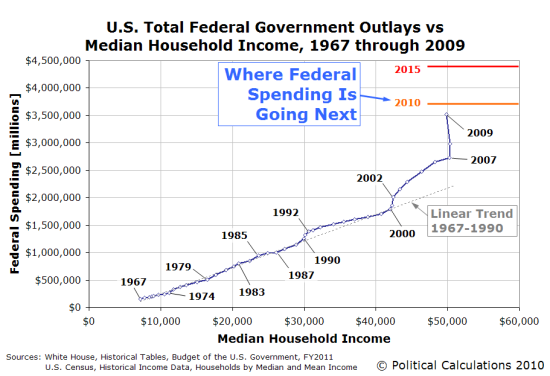
You think NASA’s going get money this year or next? Or ever? In one graph (see below), this article shows how completely out of control federal spending has become, beginning in 2007, with no end in sight. Key quote:
Until this skyrocketing spending growth is arrested and reversed, we suspect that government spending has become disconnected from the ability of any American household to support it.
The great disconnect, part 2,345: In July, the first month of California’s fiscal year, the state spent $1 billion dollars more than had been forecast. Meanwhile, the state legislature has not yet passed a budget.
But will we do anything about it? In 2009 Social Security will be in the red for the first time since the last legislative overhaul in 1983.
Decline and fall? Out of cash, Camden, New Jersey, is going to close all three of its public libraries on December 31.
The space war continues. Congressman Frank Wolf (R-Va) of the House Appropriations committee says that there is little chance the NASA budget will be approved until January.
All the discussion about the future of NASA must be put in some fiscal context, and here it is: the Debt and Deficit Commission that the Obama administration created to review the spending problems of the federal government has some bad news: there literally is no money for anything but Social Security, Medicare, and Medicaid. Key quote from the Washington Post article:
The commission leaders said that, at present, federal revenue is fully consumed by three programs: Social Security, Medicare and Medicaid. “The rest of the federal government, including fighting two wars, homeland security, education, art, culture, you name it, veterans — the whole rest of the discretionary budget is being financed by China and other countries,” Simpson said.
The space war continues. This article by Lee Roop of the Huntsville Times gives an excellent summary of the precarious political position of NASA’s manned space program.