NASA/NSF express collision concerns for SpaceX’s Starlink constellation

Capitalism in space: In a February 8th letter to the FCC, the National Science Foundation (NSF) and NASA expressed their concerns about the collision possibilities of SpaceX’s full 30,000 satellite Starlink constellation with other spacecraft.

The letter raised several issues about the proposed constellation, primarily because it would increase the number of tracked objects in low Earth orbit by more than a factor of five. “An increase of this magnitude into these confined altitude bands inherently brings additional risk of debris-generating collision events based on the number of objects alone,” the agency stated. “NASA anticipates current and planned science missions, as well as human space flight operations will see an increase in conjunctions.”

The letter did not oppose the constellation, but simply outlined issues that the agencies thought SpaceX needed to address before the constellation’s full deployment. It also noted that these concerns apply to other planned large satellite constellations.

0 comments

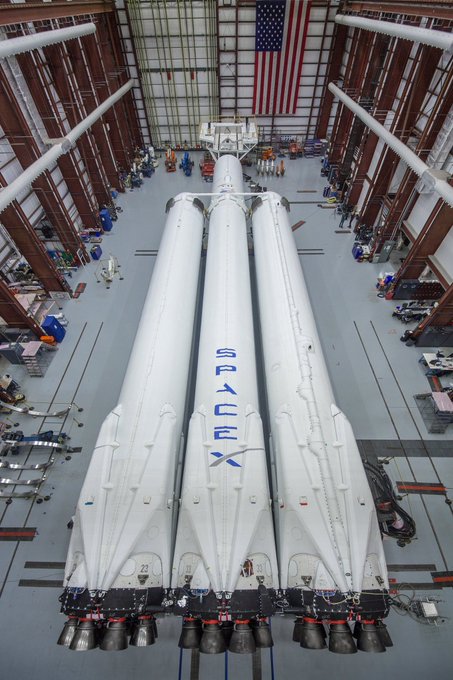
SpaceX stacks Starship on Superheavy on orbital launchpad

Starship mounted by tower on Superheavy

Capitalism in space: SpaceX for the first time used the giant arms on the launch tower at its Boca Chica orbital launchpad to stack Starship on top of Superheavy, with the fully stacked giant rocket to act as a backdrop to Elon Musk’s update on the project scheduled for airing tonight at 8 pm (Central).

You can see a time lapse of the several hour process here.

The use of a launch tower to stack a rocket is apparently a first, and provides solid evidence that SpaceX’s plan to catch Superheavy with that tower and put it on the ground has a chance of success.

SpaceX has not yet announced how Musk’s presentation will be aired, but when this information is available I will embed it on Behind the Black.

8 comments

Forty just-launched Starlink satellites lost because of geomagnetic storm

SpaceX revealed today that because of the unexpected and ill-timed arrival of a geomagnetic storm from the Sun, 40 of the 49 Starlink satellites launched on February 3rd were lost and will quickly burn up in the atmosphere. As noted at Teslarati:

SpaceX says it “commanded the satellites into a safe-mode where they would fly edge-on (like a sheet of paper) to minimize drag” as soon as it was aware of the issue but that “the increased drag…prevented the satellites from leaving safe-mode to begin orbit raising maneuvers.” Based on that phrasing, the most obvious explanation is that the added drag caused up to 40 of the satellites to fall far enough into the atmosphere that their ion thrusters would no longer be able to raise their orbits faster than the drag was lowering them. Raising their solar arrays into the position needed for maximum power generation (and thus maximum sustained thrust) would also drastically accelerate reentry.

A lot of the press and those who love to attack SpaceX have made a big deal about this, but the real news of this story is the unprecedented impact of a geomagnetic storm on some newly launched satellites. Such a thing has never happened before, and only happened now because SpaceX does not raise the orbits of any Starlink into a more stable orbit before making sure the satellite is functioning properly. If it is not, the company leaves it in a low orbit so it quickly burns up and does not add to the amount of space junk in orbit. This approach is also somewhat unprecedented, but it also demonstrates SpaceX’s generally rational and responsible approach to what it does in commercial space.

Because of this approach, however, these satellites were vulnerable to this storm. The timing had to be just perfect to destroy them, and sadly for SpaceX it was. I fully expect SpaceX to add solar activity as a factor in timing future Starlink launches.

Note: I didn’t initially comment because I don’t see this as that big a deal. The effort to slander SpaceX by some (see the quotes for example near the end of this article) however changed my mind.

15 comments

Swiss startup raises $29 million to build a hypersonic commercial plane

Capitalism in space: Destinus, a new Swiss startup, has successfully raised $29 million in seed money to begin development of a hypersonic commercial plane.

Destinus is developing a vehicle that takes off and lands horizontally under the power of airbreathing jet engines. Once out of controlled airspace, Destinus’ hyperplane is designed to accelerate to hypersonic speeds with the help of a cryogenic hydrogen-fueled rocket engine, according to the company’s Feb. 8 news release.

Destinus has been testing airbreathing engines during flight tests of an unpiloted prototype. By the end of the year, the company aims to show its prototype can break the sound barrier

This company’s founding has an interesting backstory. Its founder, Mikhail Kokorich, was a major investor in the American space tug company Momentus. When the Defense Department forced him to sell his share in that company last year because he was not an American, he moved to Switzerland to form Destinus instead. Nor is this Kokorich’s only endeavors in commercial space. He has started a number of other small companies previously.

Don’t expect Destinus’s plane to fly in the near future. Though it has already flown a small scale prototype, the company only started to hire engineers in the past few months.

1 comment

Pioneer game update: Full demo of game released

Though no launch date for the Kickstarter campaign for funding the creation of a videogame based on my science fiction book Pioneer has been announced, the producer, Aaron Jenkin, early this week released the full demo of the game. You can download a version for either Windows, Mac, or Linux here.

I’ve played the Linux version and had a great time. While this is only a demo, Aaron has captured the feel of my book, while adapting it to the needs of a video game. I really hope when the Kickstarter campaign starts, it quickly raises enough to produce the game. It will be a blast for players.

For those who want to get the game’s newsletter updates, published about once per week, you can subscribe at PioneerSpaceGame.com. If you are definitely interested in donating to the game, you should also subscribe as it gives Aaron a sense of the amount of interest (the numbers have been rising quickly in the past month, a very good sign!).

For those who want to get a sense of of what the game itself will be like now, below the fold is the game’s trailer.
» Read more

13 comments

Space tug company picks Falcon 9 for test flights

Capitalism in space: Launcher, one of several space tug startups, has awarded SpaceX the contract to launch its first four test flights of its Orbiter tug.

Launcher announced Feb. 7 it signed a multi-launch contract with SpaceX for three additional missions of its Orbiter tug. Those tugs will fly on Falcon 9 rideshare missions in January, April and October of 2023.

Launcher’s first Orbiter tug will launch on SpaceX’s Transporter-6 rideshare mission in October 2022 under a contract announced last June when the company revealed its plans to develop Orbiter. The vehicle is designed to deploy cubesats and other smallsats in their desired orbits as well as host payloads for missions lasting up to two years.

Launcher — along with Momentus, Spaceflight, Astroscale, and several others — are all rushing to build and launch the first tugs for transporting satellites from orbit to orbit, or to remove space junk. Launcher’s deal with SpaceX suggests it is tailoring its system for satellites launched from the Falcon 9.

2 comments

Lockheed Martin wins NASA contract to build Mars rocket

Capitalism in space: NASA yesterday awarded Lockheed Martin a $194 million contract to build the Mars rocket that will lift Perseverance’s samples into orbit for return to Earth.

Set to become the first rocket fired off another planet, the MAV [Mars Ascent Vehicle] is a crucial part of a campaign to retrieve samples collected by NASA’s Perseverance rover and deliver them to Earth for advanced study. NASA’s Sample Retrieval Lander, another important part of the campaign, would carry the MAV to Mars’ surface, landing near or in Jezero Crater to gather the samples cached by Perseverance. The samples would be returned to the lander, which would serve as the launch platform for the MAV. With the sample container secured, the MAV would then launch.

Once it reaches Mars orbit, the container would be captured by an ESA (European Space Agency) Earth Return Orbiter spacecraft outfitted with NASA’s Capture, Containment, and Return System payload. The spacecraft would bring the samples to Earth safely and securely in the early- to mid-2030s.

According to this project’s webpage, the European Space Agency (ESA) is building that they call a “fetch rover” which will be deployed from the rover to get the samples and bring them back to the MAV.

There are a lot of uncertainties in this scenario. It has been decades since Lockheed Martin built rockets. ESA has not yet built an operational Mars rover. It is also unclear who will build NASA’s lander and capture/return payload. Thus, do not expect this mission to launch “as early as ’26,” as the press release says. I predict it will launch at least five, maybe ever ten years, later.

4 comments

Astra launch aborts at T-0

UPDATE: The launch has been scrubbed for the day. No word on when they will reschedule, nor has Astra released any information as to what caused the launch abort, other than a “telemetry issue.”.

Capitalism in space: The second attempt by Astra to launch its first commercial satellites on its second orbital launch from Cape Canaveral aborted at T-0.

The launch on February 5th was scrubbed when some radar equipment used by the range failed.

The launch team is presently reviewing the data to see if they can recycle and attempt another launch today. This would be the second recycle today, as the first launch attempt was held about a minute before launch and then recycled, leading to the launch abort at T-0. The launch window still has about 100 minutes left.

The rocket is carrying four cubesats, three built by students at three different universities, with the fourth built by engineers at NASA’s Johnson Space Center in their effort to learn how to build cubesats for themselves.

I have embedded Astra’s live stream below the fold, for those who wish to watch.
» Read more

1 comment

Iceye raises $136 million in private investment capital

Capitalism in space: Iceye, which launches commercial Earth observation satellites, has successfully raised another $136 million in private investment capital, bringing its total cash raised to $304 million.

With the latest cash infusion announced Feb. 3, Iceye is expanding manufacturing capacity and upping its launch tempo. Iceye plans to loft 11 satellites in 2022, after launching seven in 2021. Iceye also will devote additional resources toward natural catastrophe monitoring. In 2021, Iceye began working with insurance industry partners including Zurich-based Swiss Re and Tokyo-based Tokio Marine.

With the climate changing and natural catastrophes becoming more frequent, Iceye executives see increasing demand for updated information. SAR satellites are particularly useful for observing floods and other disasters because unlike optical sensors, they gather data at night and through clouds.

Essentially, commercial satellites like Iceye’s are replacing the government satellites that NASA and NOAA have been launching, but with far less frequency and far more cost in the last two decades. In fact, the inability of these agencies to get many new Earth observation satellites launched on time and cheaply has fueled this new private industry.

Like NASA’s manned program, the government will soon depend entirely on privately-built satellites for its climate and Earth resource research. And it will get more for its money and get it faster.

0 comments

Former NASA insiders form commercial company to launch satellites to lunar orbit

Capitalism in space: Two former NASA managers have teamed up with two commercial businessman to form a startup, dubbed Quantum Space, to launch an unmanned platform to lunar space to provide support for NASA’s Artemis program.

The team includes Steve Jurczyk, who spent thirty years at NASA and finished his career there before retiring serving as acting NASA administrator for the first three months of the Biden administration.

Jurczyk is one of the three co-founders of Quantum Space. Another is Ben Reed, former division chief of exploration and in-space services at NASA’s Goddard Space Flight Center and who worked on satellite servicing projects there. He is the chief technology officer of Quantum Space. The third co-founder is Kam Ghaffarian, who also helped start commercial space station company Axiom Space and lunar lander developer Intuitive Machines after selling Stinger Ghaffarian Technologies. They’re joined by Kerry Wisnosky, the co-founder and former principal owner of Millennium Engineering and Integration, who is the chief operating officer of Quantum Space.

Their plan is to launch their platform and robots to the Earth-Moon L1 point, the spot where the gravitational spheres of influence of the Earth and Moon meet, about 40,000 miles from the Moon.

The outpost … would consist of two components. One is a spacecraft bus that serves as a platform for hosting payloads, using modular “plug-and-play” interfaces. The other is a spacecraft that would deliver payloads to the platform and install them using robotic manipulators.

Those payloads could include communications, navigation, remote sensing, space domain awareness and space weather sensors, Jurczyk said. Those payloads would primarily come from customers, but he said the company is looking at developing its own payloads, particularly for imaging of the Earth and moon.

They hope to launch their first satellite by ’25.

Like the insiders who run Axiom, these guys are taking advantage of their experience at NASA to build a private space company that will serve NASA’s needs. They are also recognizing that in the coming years, everything NASA “does” will be done by private companies. This company is their effort to jump on that bandwagon.

2 comments

SpaceX successfully launches another 49 Starlink satellites

Capitalism in space: SpaceX successfully completed its third launch in four days today, launching 49 Starlink satellites into orbit on its Falcon 9 rocket.

At the time of writing, the satellites themselves have not yet deployed. The first stage, flying its sixth mission, landed successfully. The two fairing halves were flying their sixth and fourth flights.

The 2022 launch race:

6 SpaceX
2 China
1 Virgin Orbit
1 ULA

11 comments

NASA outlines plans for ISS deorbit and the transition to commercial stations

Capitalism in space: NASA on January 31st released its updated plan for transitioning all government manned orbital operations to commercial private space stations in the next eight years in preparation for the deorbiting of ISS in early 2031.

You can read the report here [pdf]. The key paragraph however is this:

NASA has … signed agreements with three U.S. companies (Blue Origin of Kent, Washington; Nanoracks LLC of Houston, Texas; and Northrop Grumman Systems Corporation of Dulles, Virginia) to develop commercial destinations in space that go directly to orbit, i.e., free-flyers. The awards, along with the Axiom concept [where the private station starts as part of ISS and then later separates], are the first part of a two-phase approach to ensure a seamless transition of activity from the ISS to commercial destinations. During this first phase, private industry, in coordination with NASA, will formulate and design [commercial space stations] capabilities suitable for potential Government and private sector needs. The first phase is expected to continue through 2025.

For the second phase of NASA’s approach to a transition toward [commercial space stations], the Agency intends to certify for NASA crew member use [commercial space stations] from these and potential other entrants, and ultimately, purchase services from destination providers for crew to use when available.

It is NASA’s goal to be one of many customers of commercial LEO destination services, purchasing only the goods and services the Agency needs. [Commercial space stations], along with commercial crew and cargo transportation, will provide the backbone of the human LEO ecosystem after the ISS retires. [emphasis mine]

The report predicts that, by using private stations instead of building its own, the agency will save up to two billion dollars per year, money it can than use of planetary missions. This of course is assuming NASA cancels SLS. If not, I predict that overpriced cumbersome rocket will quickly absorb all this money saved.

The highlighted sentence indicates that NASA continues to accept entirely the recommendations I made in my 2017 policy paper, Capitalism in Space [a free pdf download]. In fact, that sentence is almost an exact quote from one of most important recommendations.

3 comments
1 257 258 259 260 261 677