A tour of Stoke Space

Nova upper stage static fire test

Tim Dodd of Everyday Astronaut yesterday released a long video in which he got a new tour the Stoke Space facility, led by the company’s CEO and founder, Andy Lapsa.

I have embedded that video below. The image to the right is a screen capture of a static fire test of the company’s Nova rocket’s upper stage engine that was done at the end of the tour. The engine uses a radical design of a ring of small nozzles, with a heat shield in the middle. The design aims to allow that upper stage to return to Earth for reuse, after it has deployed its payload. Nova’s first stage will also be reusable, landing vertically like the Falcon 9.

Though as usual Lapsa said nothing about schedule, it appears that the company is getting very close to its first launch. It appears the company’s launchpad in Florida will be ready for launch early in 2026. It also appears that all the rocket’s components are falling into place.

Lapsa noted that though both stages are designed to land and be reused, the goal for that first launch is simply to demonstrate they can get the rocket into orbit. Neither stage will attempt a landing. Once they’ve got that success under their belt, they will then go for other milestones.

Right now only SpaceX and Stoke Space are working to build a completely reusable rocket. SpaceX is going very big, with Starship. Stoke is aiming for the Falcon 9 market. If successful, it will be able to beat that rocket in price.
» Read more

4 comments

Eutelsat/OneWeb to launch new 340 satellites by 2027

More business for rockets! The internet satellite company Eutelsat/OneWeb now has plans to launch another 340 satellites by 2027, partly to replace aging satellites but also to upgrade its constellation.

Eutelsat OneWeb plans to deploy a constellation of over 340 satellites for its second-generation (Gen-2) low-earth orbit (LEO) network by 2027, as it looks to strengthen its business-to-business (B2B) and business-to-government (B2G) offerings globally. Neha Idnani, Regional Vice President for Asia Pacific at Eutelsat OneWeb, told Business Today in an exclusive interaction that the company is gearing up for the next phase of its orbital expansion to boost network capacity, resilience and coverage worldwide.

OneWeb began deploying its Gen-1 satellites in 2019 and operates a constellation of around 640 satellites as of 2025. While the network is fully operational, close to 100 satellites from the initial fleet are due for replenishment. The Gen-2 rollout will mark a shift to a more advanced and flexible network architecture.

The article at the link touts India’s space agency ISRO as a likely launch provider for those missions, which isn’t surprising as a substantial percentage of Eutelsat/OneWeb is owned by an Indian investor. It is also likely however that other companies, including SpaceX, Blue Origin, and Rocket Lab, will be considered also.

7 comments

Rocket Lab completes its 7th launch for Japanese company iQPS

Rocket Lab this evening successfully completed its 7th launch of a radar satellite for Japanese company Q-Shu Pioneers (iQPS), its Electron rocket lifting off from one of the two launchpads in New Zealand.

Q-Shu has signed Rocket Lab to do eleven launches total, so expect four more launches next year.

In 2025 Rocket Lab also completed three launches of its HASTE version of Election, which is designed to do suborbital hypersonic tests for the Pentagon. If we count these, the company has completed 21 launches in 2025. And even if we don’t count these suborbital launches, Rocket Lab has now launched more times than any other private company, except for SpaceX.

The leaders in the 2025 launch race:

168 SpaceX
85 China
18 Rocket Lab (a new record)
15 Russia

SpaceX still leads the rest of the world in successful launches, 168 to 142.

2 comments

Axiom gets $100 million of investment capital from Hungarian company

Axiom's new module assembly sequence
Axiom’s assembly sequence for its planned station, initially attached to ISS but subsequently detached

The space station startup Axiom has now obtained a $100 million investment by the Hungarian communications provider 4iG.

The company said Dec. 19 it has committed to invest $30 million in Axiom by the end of 2025, followed by an additional $70 million by March 31, 2026.

In October, 4iG announced a non-binding commitment letter to evaluate a potential $100 million investment in Axiom Space. The agreement outlined a separate $100 million framework for cooperation on the development of orbital data center systems over the next five years. 4iG said in a news release that the Axiom investment would provide Hungary with an opportunity to secure a long-term role in orbital data centre programs and space-based data processing and storage, but did not provide details.

In 2024 there were rumors the company had a serious cash shortage, though since then construction of its first two modules has proceeded as planned, with a launch of the first module still set for sometime in 2026. This new infusion of cash should shore up Axiom’s station construction considerably.

My rankings of the commercial space stations now under development:

» Read more

36 comments

A new commercial smallsat space telescope is now operational and offering its data to scientists

Mauve space telescope
Mauve space telescope. Click for source.

Capitalism in space: A new commercial optical space telescope with a 5-inch-wide mirror and dubbed the Mauve Telescope is now operational in orbit, with its private owner, UK startup Blue Skies, offering its data to scientists for an annual subscription fee.

Blue Skies is in the process of commissioning the Mauve and plans to start delivering data to scientists in early 2026. Customers include Boston University, Columbia University, INAF’s Osservatorio Astrofisico di Arcetri, Konkoly Observatory, Kyoto University, Maynooth University, the National Astronomical Observatory of Japan, Rice University, Vanderbilt University, and Western University.

The spacecraft’s three-year mission is to study flares from stars and their impact on the habitability of planets around them. From low Earth orbit, it hosts a telescope that can collect data in the ultraviolet to visual light range (200-700 nm spectrum).

With such a small mirror Mauve is not going to be able to do a lot of ground-breaking work, though there are definitely observations of value it can accomplish, such as those listed above. Its main purpose is as a demonstration project to attract a bigger round of new investment capital, from universities like the ones listed above, for launching a larger private telescope with greater capabilities.

This is how all telescopes were funded in the U.S. until World War II, through private funds privately built. Blue Skies effort here suggests we are heading back to that model, with government budgets increasingly constrained. The company is already working on a second and larger space telescope, dubbed Twinkle with a 18-inch primary mirror. It hopes over time to continue to scale up its orbital telescopes until it is matching Hubble and Webb, and doing so faster and at far less cost.

And for profit no less!

5 comments

Something caused a Starlink satellite to tumble and its fuel tank to vent

According to an update yesterday by SpaceX on X, one of its many Starlink satellites is now tumbling with its fuel tank venting, and is thus losing altitude.

On December 17, Starlink experienced an anomaly on satellite 35956, resulting in loss of communications with the vehicle at 418 km. The anomaly led to venting of the propulsion tank, a rapid decay in semi-major axis by about 4 km, and the release of a small number of trackable low relative velocity objects. SpaceX is coordinating with the @USSpaceForce and @NASA to monitor the objects.

The satellite is largely intact, tumbling, and will reenter the Earth’s atmosphere and fully demise within weeks. The satellite’s current trajectory will place it below the @Space_Station, posing no risk to the orbiting lab or its crew.

Either the tank burst, or got hit with something causing it to burst.

The media reports I’ve seen have tried to make this event more significant than it is. First, it is remarkable how few of SpaceX’s thousands of Starlink satellites have failed in this manner. These low numbers show how this incident is rare and not very concerning. Second, the spacecraft’s orbit is decaying, and will soon burn up harmlessly in the atmosphere. It will not add any space junk to low Earth orbit.

In fact, that this event illustrates more than anything how well SpaceX manages its Starlink constellation. Thousands of satellites launched, and only a handful have failed like this.

7 comments

New Trump executive order today guarantees major changes coming to NASA’s Moon program

Change is coming to Artemis!

The White House today released a new executive order that has the typically grand title these type of orders usually have: “Ensuring American Space Superiority”. That it was released one day after Jared Isaacman was confirmed as NASA administrator by the Senate was no accident, as this executive order demands a lot of action by him, with a clear focus on reshaping and better structuring the entire manned exploration program of the space agency.

The order begins about outlining some basic goals. It demands that the U.S. return to the Moon by 2028, establish the “initial elements” a base there by 2030, and do so by “enhancing sustainability and cost-effectiveness of launch and exploration architectures, including enabling commercial launch services and prioritizing lunar exploration.” It also demands this commercial civilian exploration occur in the context of American security concerns.

Above all, the order demands that these goals focus on “growing a vibrant commercial space economy through the power of American free enterprise,” in order to attract “at least $50 billion of additional investment in American space markets by 2028, and increasing launch and reentry cadence through new and upgraded facilities, improved efficiency, and policy reforms.”

To achieve these goals, the order then outlines a number of actions required by the NASA administrator, the secretaries of Commerce, War, and State, as well as the Director of the Office of Management and Budget (OMB) and the Assistant to the President for Domestic Policy (APDP), all coordinated by the assistant to the President for Science and Technology (APST).

All of this is unsurprising. Much of it is not much different than the basic general space goals that every administration has touted for decades. Among this generality however was one very specific item, a demand to complete within 90 days the following review:
» Read more

29 comments

Kenya to build its own spaceport

Kenya spaceports
Kenya spaceports

The Kenyan government has now initiated a project to establish a second commercial spaceport on the country’s coast, located near the town of Kipini.

As stated in the document made public on December 16, 2025, the government is looking to recruit a skilled transaction advisor who is capable of analyzing the technical, financial, legal, environmental, and social feasibility of the construction of the spaceport based on a PPP model. The strategy utilizes Kenya’s location on the equator, which provides some benefits in satellite launches, among them lower fuel consumption, lower launch costs, and easier satellite placement in low-inclined orbits around the earth’s equatorial region.

…Under the plan, the transaction advisor will prepare a detailed feasibility study in line with the PPP Act, 2021. The study will include concept designs, launch vehicle options, infrastructure requirements, lifecycle cost estimates, and a phased implementation plan for the facility.

As shown on the map to the right, this new facility would be to the north of the San Marco offshore platform that had been used for eight launches by Italy from the ’60s to the ’80s and that the Italian rocket company Avio is now planning to re-open.

The Kenyan government apparently wants to build its own a launch site that it can offer to others to use.

5 comments

Station module builder Max Space announces new Thunderbird inflatable module

Thunderbird, with cut-out showing interior and person for scale
Thunderbird, with cut-out showing interior and person
for scale. Click for original images.

The startup Max Space yesterday unveiled a new larger and upgraded inflatable module, dubbed Thunderbird, that it proposes to sell to the various space stations being built in the U.S. and globally.

Thunderbird Station is built to support 4 or more crew members continuously, with an incredible 350m³ of pressurized volume, more than triple that of a standard ISS module. Launched on a single standard Falcon 9 rocket, the full expandable habitat launches compactly and expands 20x once deployed in orbit, requiring no in-orbit assembly. The interior features a novel reconfigurable architecture, morphic interior structure,that allows astronauts to dynamically adapt the space for research, manufacturing, or living during a mission. The design was developed in collaboration with veteran astronauts to take full advantage of three-dimensional volume in microgravity, not just traditional floor and wall space, to create the most spacious and functional habitable volume ever built. [emphasis in original]

The company also announced that it plans to fly a much smaller demonstration mission of this inflatable module design in the first quarter of 2027, launching on a Falcon 9 rocket and dubbed Mission Evolution.

The primary objective is to test and verify the on-orbit deployment of the expandable module with its exceptional micrometeoroid protection layers. After many years of successful ground testing and development, the flight unit is in full production and is scheduled for launch Q1 2027 onboard a scheduled SpaceX launch.

Max Space first appeared in 2024 when it announced its intention to fly an inflatable demo mission by 2025. Obviously that schedule has undergone some significant delays, though it appears the company used the time to refine its designs considerably. Its management includes one former NASA astronaut and one former member of the Bigelow space station team that built the first private orbiting inflatable modules, Genesis-1, Genesis-2, and BEAM (still operating on ISS).

The company is not trying to build its own space stations. Instead, it is marketing its inflatable modules to all the other space station startups as a quick way to get an additional large module added to their stations.

Hat tip to BtB’s stringer Jay.

2 comments

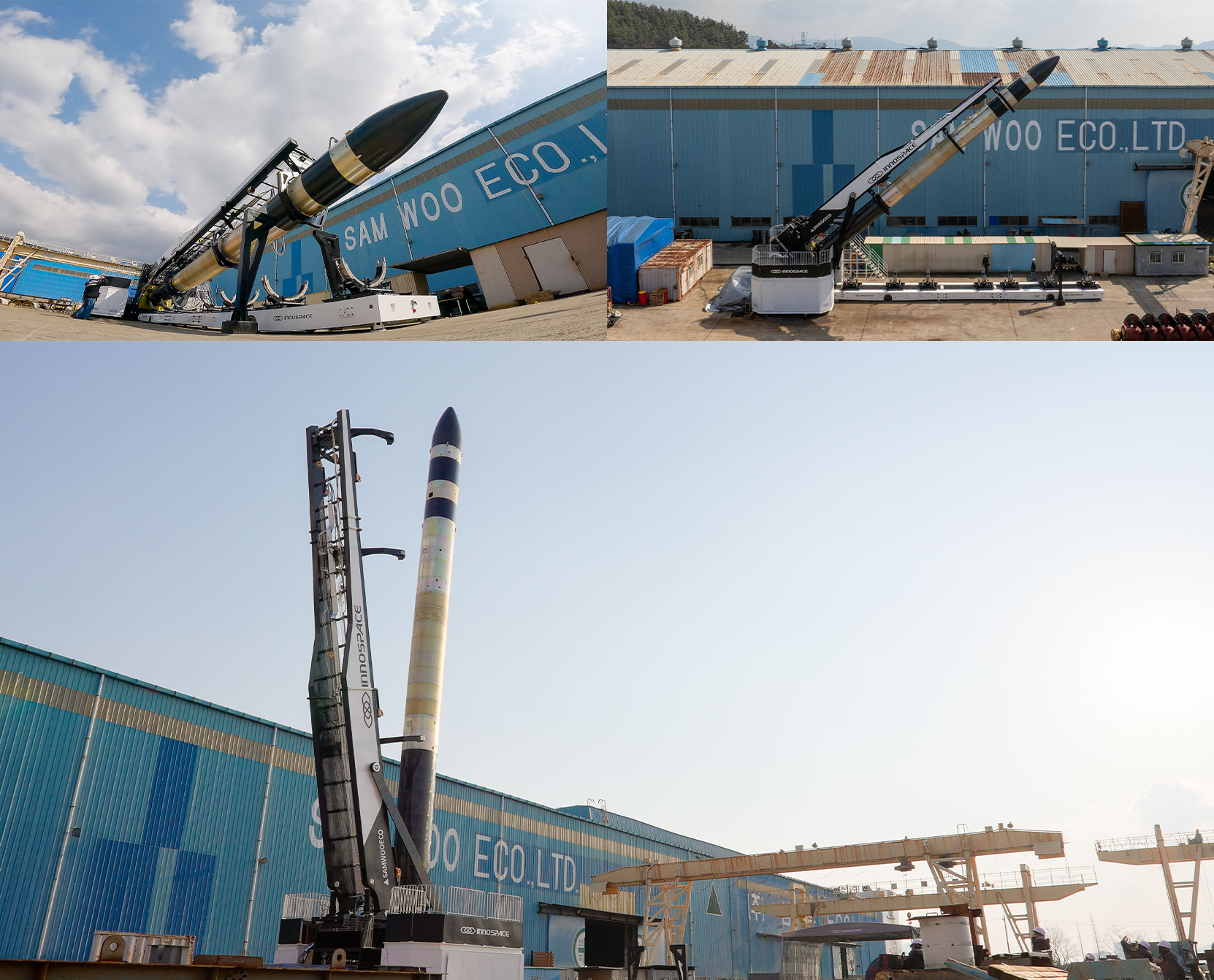
South Korean rocket startup Innospace signs deal to launch from Australia

Proposed Australian spaceports
Australian spaceports: operating (red dot) and proposed (red “X”)
Click for original image.

The South Korean rocket startup Innospace — about to attempt its first orbital launch from Brazil on December 19, 2025, earlier this week signed an agreement with Australia’s Southern Launch spaceport to launch its rockets from there.

Leading space mission service provider Southern Launch has signed South Korean launch service provider Innospace to conduct space missions from the Whalers Way Orbital Launch Complex and the Koonibba Test Range. This strategic partnership enables Innospce to conduct a diverse range of missions from Southern Launch sites, including orbital satellite launches and suborbital technology demonstrations.

Beginning in 2026 and continuing for at least the next decade, this agreement strengthens South Australia’s position as an emerging global hub for space innovation.

Whether or not its launch from Brazil’s long unused Alcantera spaceport is a success, it appears Innospace was looking for another spaceport option closer to South Korea. Moreover, Southern Launch has been an on-going active launch site for suborbital launches as well as a landing zone for spacecraft, unlike Alcantera which has sat unused for decades. That activity probably makes it a more viable place to operate.

Hat tip to BtB’s stringer Jay.

0 comments

Rocket Lab launches a set of technology test satellites for Space Force

Rocket Lab tonight successfully placed into orbit a set of Space Force technology test satellites dubbed DISKSat, its Electron rocket lifting off from Wallops Island in Virginia.

DISKSat is a new standard satellite design, shaped like a flat disk about a yard across and developed by the Aerospace Corporation. The idea is that these disk-shaped satellites will more efficiently fit payload into the standard cylindrical fairings used by rockets. This mission includes four that will be deployed in low Earth orbit, but during the mission will also test operation in much lower orbits than satellites normally fly. I suspect the flat design reduces the atmospheric drag at those low orbits, thus allowing the satellite to remain in orbit for longer time periods.

The leaders in the 2025 launch race:

168 SpaceX
84 China
17 Rocket Lab (a new record)
15 Russia

SpaceX still leads the rest of the world in successful launches, 168 to 140.

12 comments

Three launches and one scrub overnight

Falcon 9 1st stage after landing for 30th time

In the past twelve hours there was one launch abort at T-0 and three successful launches.

First, Japan’s space agency JAXA attempted to launch a GPS-type satellite using its H3 rocket, built by Mitsubishi. The countdown reached T-0 but then nothing happened. The launch was then scrubbed because of an issue in the ground systems. No new date was announced.

Next, Arianespace, the commercial division of the European Space Agency (ESA), launched two European Union GPS-type satellites, Galileos 33 and 34, its Ariane-6 rocket lifting off from French Guiana.

This was Arianespace’s seventh launch in 2025, the most it has achieved since 2021, though still about 20-30% lower than the numbers it generally managed in the 2010s.

Finally, SpaceX followed with two launches on opposite coasts. First, its Falcon 9 rocket launched 29 Starlink satellites from the Kennedy Space Center in Florida, the first stage completing its sixth flight by landing on a drone ship in the Atlantic.

Shortly thereafter the company launched another 27 Starlink satellites, its Falcon 9 rocket lifting off from Vandenberg Space Force Base in California. The first stage (B1063) completed its 30th flight, landing on a drone ship in the Pacific. This stage is now the third Falcon 9 booster to reach 30 reuses:
» Read more

11 comments
1 28 29 30 31 32 677