French startup The Exploration Company now building an in-orbit servicing spacecraft

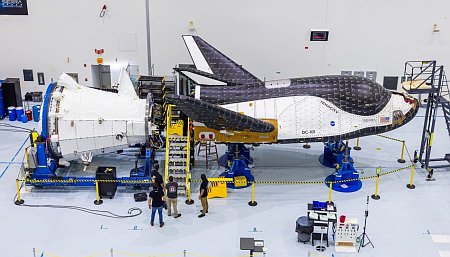
The French startup The Exploration Company, which has been developing an unmanned cargo spacecraft called Nyx to supply the commercial space stations under development, has now also gotten funds from the European Space Agency (ESA) to build an in-orbit spacecraft designed to provide refueling and servicing capabilities as well.

More information here.

In a 25 November update on its progress with an ESA-funded project, the company revealed that it is also working on a spacecraft called Oura, designed to refuel satellites in orbit, thereby extending their operational lifespan.

…As part of the 25 November update, the company announced that it had been awarded a Phase B2 contract for the InSPoC-1 programme. The Phase B2 development of the project will include activities up to Technology Readiness Level 6, which represents the development of a prototype and its demonstration in a relevant environment.

Once again, this contract from ESA is radically different than its past policy of building and owning everything itself. Instead, it is hiring this French company to develop this capability, which this French company will then own and be able to sell for profits to others.

2 comments

Pentagon decides New Glenn must fly four times before its certifies it for military launches

Pentagon officials yesterday announced that before it will certify Blue Origin’s New Glenn rocket for commercial military payloads, it must complete two more successful orbital launches, for a total of four flights.

Blue Origin’s New Glenn rocket will have to complete four successful orbital flights as its pathway to certification under the U.S. Space Force’s National Security Space Launch (NSSL) program, Lt. Gen. Philip Garrant said Dec. 10 at the Spacepower conference. Garrant, who leads the Space Systems Command, said Blue Origin selected the four-flight benchmark and the government agreed. “The government is supporting a four-flight certification for New Glenn,” he told reporters. The rocket has logged two successful missions so far, and Garrant said a third launch is expected “earlier in the new year than later.” If upcoming flights stay on track, he added, “I think they’re going to be in a fantastic place to become our third certified provider and compete for missions.”

If certified, Blue Origin would join SpaceX and United Launch Alliance as the Space Force’s third heavy-lift launch provider.

It is surprising that the military is requiring four successful flights from Blue Origin, but required only two from ULA’s new Vulcan rocket, and certified that even though there were problems on Vulcan’s second flight.

These extra flights should not cause a significant delay, since Blue Origin is expecting to complete a number of launches in 2026 to meet its obligations under its Amazon Leo contract

7 comments

Unconfirmed anonymous sources at Reuters and Bloomberg claim SpaceX is planning a public stock offering

Two stories from Reuters and Bloomberg yesterday suggest Elon Musk is considering making SpaceX a publicly traded company, with an initial stock offering sometime in 2026. From the Reuters’ report:

Elon Musk’s SpaceX is looking to raise more than $25 billion through an initial public offering in 2026, a move that could boost the rocket-maker’s valuation to over $1 trillion, a person familiar with the matter told Reuters on Tuesday. The company’s move towards a public listing, which could rank among the largest global IPOs, has been largely driven by the rapid expansion of its Starlink satellite internet business, including plans for direct-to-mobile service and progress in its Starship rocket program for moon and Mars missions.

SpaceX has started discussions with banks about launching the offering around June or July, the person said, requesting anonymity to discuss confidential information.

Since both stories rely entirely on anonymous sources, we should not take either very seriously. I only post this now merely to put it on the record. And though Elon Musk has since hinted there might be some truth to both, he has also been very vague about his plans. While a public offering would garner him a lot of cash, it would bring with it a lot of regulatory headaches that would seriously interfere with what he wants to do. In the end I think (and hope) he will decide it ain’t worth it. Starlink right now is bringing in enough money to allow him to accomplish everything, and more.

If anything, these stories illustrate again the corruption in our modern propaganda press. Such stories would have been considered junk four decades ago. Then it was traditional practice that a story needed at least two independent sources, one of which was not anonymous. No longer. Anyone can push any lie, and these news outlets will publicize it, for the sake of clicks.

NOTE: This is a recreation of a post published on December 10, 2025 that was lost during this morning’s server outage.

7 comments

SpaceX completes its 11th launch this year for the National Reconnaissance Office

SpaceX today successfully placed its 11th payload into orbit this year for the National Reconnaissance Office, its Falcon 9 rocket lifting off from Cape Canaveral in Florida.

The first stage completed its fourth flight, landing back at Cape Canaveral. The rocket’s two fairings were both new, flying their first mission.

The leaders in the 2025 launch race:

162 SpaceX (a new record)
79 China
15 Rocket Lab
15 Russia

SpaceX now leads the rest of the world in successful launches, 162 to 131.

4 comments

Academia makes its first comprehensive attempt to plan science missions to Mars using Starship

Figure 2-2 from the NAS report
Figure 2-2 from the National Academies
of Science report

A new report released today by the National Academies of Science, entitled “Highest Priority Science for the First Human Missions to Mars,” is essentially the first attempt by the planetary science community to plan its future science missions to Mars using the gigantic capabilities that SpaceX’s Starship is expected to provide them.

You can download the report here.

Even though the report made the search for life on Mars its big priority — a bugaboo that NASA and the science community trots out repeatedly to garner clicks from the ignorant propaganda press — this report is radically different then all previous similar NASA studies proposing future Mars exploration, as indicated by the graphics from figure 2-2 of the report to the right. Unlike those past studies, which were badly limited by the inadequate capabilities of any spacecraft NASA could send to Mars, this new report recognizes how much the game is changed by SpaceX’s Starship.

First, the new panel did not attempt to place any limit on any landing zones. Earlier reports had forbidden landings in the high latitudes or high altitudes because of the risks to NASA’s proposed landers. Starship overcomes much of those risks, giving researchers much greater flexibility.

Second, the focus of the missions will not be solely devoted to scientific or geological research, as had been the case for all previous similar reports by NASA and the academic community. Instead, the proposed research goals includes important engineering and human exploration requirements outside of science, including efforts to use the resources on Mars itself as well as find locations better suited for human habitation. Once again, the vastly greater capabilities of Starship influenced this change.

Even more important, the study doesn’t assume the future missions will be unmanned, as all previous NASA reports have done. In fact, it does the opposite, proposing multiple 30-day manned missions, as shown in the graphic. One set of three missions would go to three different locations, while another set of three missions would focus on one place in particular.

Much of this shift towards manned flight I think stemmed from the presence on the panel of representatives from the private companies SpaceX and The Exploration Company (a French startup), as well as an engineer from the National Academy of Engineering. Previously studies were almost always entirely dominated by planetary scientists, so the goals outlined were always focused on their interests. Now the idea of human exploration has become prevalent.

The panel’s work was clearly also influenced by the realization that SpaceX’s Starship is not only far more capable, its first flights are just around the corner. SpaceX plans sending it numerous times to Mars in the very near future, as shown in the graphic below that Elon Musk released during a presentation in May 2025.
» Read more

22 comments

SpaceX launches 29 more Starlink satellites, sets new record for Falcon 9 reuse, dominates the world in rocketry

First stage after landing for the 32nd time

SpaceX today launched another 29 Starlink satellites, its Falcon 9 rocket lifting off from the Kennedy Space Center in Florida.

The first stage of its Falcon 9 rocket (B1067) flew for its 32nd time, a new record for a Falcon 9 first stage. As shown in the rankings below of the most reused launch vehicles, this stage is now just one flight from tying the space shuttle Atlantis:

39 Discovery space shuttle
33 Atlantis space shuttle
32 Falcon 9 booster B1067
30 Falcon 9 booster B1071
29 Falcon 9 booster B1063
28 Falcon 9 booster B1069
28 Columbia space shuttle

Sources here and here.

Nor will it be long before SpaceX’s fleet surpasses all the shuttles.

Meanwhile in the 2025 launch race SpaceX’s dominance is overwhelming, as shown by the leader board:
» Read more

23 comments

More than 300 companies in discussions in connection Space Force’s “Golden Dome” project

According to guarded remarks by the head of Trump’s “Golden Dome” project, he has been in negotiations with more than 300 aerospace companies as the Space Force begins preliminary design work on this missile defense system.

President Trump’s Golden Dome czar says he has held “one-vs.-one” talks with more than 300 private companies in recent months to hash out the secretive architecture of the futuristic missile defense shield that the administration is determined to put into operation over the entire U.S. homeland by mid-2028.

In his first public remarks since being named to the position in June, Gen. Michael A. Guetlein, vice chief of space operations at the U.S. Space Force, told an audience at the annual Reagan National Defense Forum that although the layered design of the Golden Dome remains classified, he is confident that “our industry partners have a pretty good insight into what we’re doing.”

The project, which remains mostly cloaked in secrecy, received $24.5 billion in funding this year from Congress, with that number expected to rise considerably in later years.

My sense from Guetlein’s remarks is that right now the project is simply gathering already existing missile defense assets under one roof in order to get something operational by 2028 as ordered by Trump. Guetlein is also getting the enthusiastic support of the industry — which sees big bucks flowing their way from Golden Dome in the coming years. Many of the new space startups have been shifting operations from civilian space to this military project in anticipation of this funding.

While the concept is not unreasonable, considering the success seen with the Pentagon’s Patriot system and Israel’s Iron Dome, the secret structure so far of Golden Dome is almost guaranteed to lend itself to corruption and wasteful spending, a systemic problem within our present federal government.

4 comments

Korean Air and Hyundai Rotem sign deal to develop methane-fueled rocket engine

Two South Korean companies, the airline company Korean Air and the railroad company Hyundai Rotem, have signed a partnership agreement to develop a methane-fueled rocket engine by 2030, funded by the government’s Korea Research Institute for Defense Technology Planning and Advancement (KRIT).

Korean Air will lead the development of the engine’s turbopump, a core component often described as the heart of the propulsion system. The turbopump compresses liquid methane and oxidizer at extremely high pressures and speeds. Its development requires advanced engineering capable of handling cryogenic temperatures of -180°C to several hundred degrees, while rotating tens of thousands of times per minute.

Hyundai Rotem is a division of the automobile company Hyundai, but its focus is building railroads. The press release does not say what it will do as part of this partnership.

It is also unclear from the press release whether these companies will be own this engine for sale to others, or are developing it for the government. If the latter, the project will have a much more limited potential.

1 comment

Japanese startup Ispace expands deal with Japan Airlines

The Japanese lunar lander startup Ispace has now expanded its partnership deal with Japan Airlines (JAL) and two other associated JAL companies aimed at building transportation infrastructure to, from, and on the Moon.

The new agreement outlines the co-creation of systems and infrastructure supporting future lunar bases with high-frequency transportation to the lunar surface. Leveraging maintenance technology, air traffic control, and operations management expertise developed by JAL and JALEC in the aviation field, the two companies will aim to advance a sustainable presence on the Moon.

With the addition of JALUX to the partnership, the companies will explore new collaborations regarding space-related services for the public within the JAL Group. Consideration will also be given to sales cooperation for payloads sales utilizing ispace’s lunar transportation service. By combining ispace’s lunar transportation via its lander with the JAL Group’s aviation expertise and customer network, the partnership is expected to provide lunar transportation opportunities to diverse stakeholders.

A lot of vague PR language, but it does appear the goal is to develop lunar transportation products for what the companies expect to be a growing industry on the Moon.

1 comment

SpaceX launches 28 Starlink satellites

SpaceX today successfully launched another 28 Starlink satellites, its Falcon 9 rocket lifting off from Vandenberg Space Force Base in California.

The first stage completed its 12th flight, landing on a drone ship in the Pacific.

The leader board in the 2025 launch race.

160 SpaceX (a new record)
77 China
15 Rocket Lab
15 Russia

SpaceX now leads the rest of the world in successful launches, 160 to 129.

0 comments

SpaceX to launch another secondary private stock sale, hints at going public

UPDATE: Elon Musk has posted on X that this story is “not accurate.”

According to reports yesterday, SpaceX is about to launch another secondary private stock sale that double the value of the company.

Elon Musk’s SpaceX, is initiating a secondary share sale that would give the company a valuation of up to $800 billion, The Wall Street Journal reported Friday.

SpaceX is also telling some investors it will consider going public possibly around the end of next year, the report said.

At the elevated price, Musk’s aerospace and defense contractor would be valued above ChatGPT maker OpenAI, which wrapped up a share sale at a $500 billion valuation in October.

At $800 billion, SpaceX would be the world’s most valuable private company.

As for going public, nothing is confirmed. Musk has made some comments suggesting he is considering the idea, but at the same time has noted the problems such a act would cause him.

Musk recently discussed whether SpaceX would go public during Tesla’s annual shareholders meeting last month. Musk, who is the CEO of both companies, said he doesn’t love running publicly traded businesses, in part because they draw “spurious lawsuits,” and can “make it very difficult to operate effectively.”

It seems to me it would be a big mistake for Musk to do this. As a public stock-trading company, Musk would lose the freedom he presently has with SpaceX.

Meanwhile, this new private stock offering has done wonders for the value of Echostar’s stock, now that the company’s own stake in SpaceX after selling it some of its FCC licensed spectrum.

24 comments

House hearing on Artemis yesterday signals strong doubts about the program in Congress

Artemis logo

The space subcommittee of the House Science, Space, and Technology Committee yesterday held a hearing on space, one day after the Senate held its own hearing on the nomination of Jared Isaacman as NASA administrator.

The House hearing however was not about Isaacman, but was apparently staged to highlight what appears to be strong reservations within Congress about NASA’s Artemis program, as presently structured. Its timing, just after the Isaacman hearing, was clearly aimed at garnering as much publicity as possible.

Video of the hearing can be seen here.

The focus of the hearing was also on China, and how there is real fear in Congress that its space program is outstripping NASA’s. Both the Republican committee chairman and the ranking Democrat stressed these concerns, and the need to beat China to the Moon and beyond.

More important, all four witnesses pushed the same point.

The rallying cry at this hearing as well as yesterday’s is the “race” with China.

…Foushee asked each of the witnesses for one-word answers to the question: is NASA on track to get back to the Moon before Chinese taikonauts arrive?

Not all succeeded with one word, but their sentiment was similar. Cheng replied “no, I am very pessimistic.” Swope: “worried.” Besha: “maybe.” Griffin: “no possible way…with the present plan.”

Former NASA administrator Mike Griffin was the most blunt in his criticism of NASA.
» Read more

21 comments
1 30 31 32 33 34 677