Airbus signs China’s Qianfan or Spacesail constellation to provide internet on its airplanes

In what is a major coup for one of China’s planned large constellations, Airbus yesterday agreed to use the Qianfan or Spacesail constellation to provide Wi-Fi service on its airplanes.

At a satellite internet industry ecology conference in east China’s Shanghai on Thursday, Airbus signed a market cooperation agreement on the satellite internet service with Shanghai Spacesail Technologies Co., Ltd. The Spacesail Constellation will provide high-speed, low-latency broadband satellite services via the high-speed connectivity system on aircraft, enhancing the in-flight experience for passengers.

The two parties will also work together to meet the needs of airlines, and promote the development of intelligent, personalized services based on low-orbit broadband communication technology.

Starsail is a direct competitor to Starlink. China has so far launched 119 satellites out of a planned first phase constellation of 648. Later phases could increase the constellation to as many as 10,000 satellites.

It seems puzzling why Airbus went with this Chinese constellation, rather than either Starlink or Amazon’s Leo (formerly Kuiper). Starlink is far more developed, while Leo has more satellites in orbit (154 to 119) than Spacesail. And both are private companies from the capitalistic west, not pseudo-companies controlled by the Chinese communists.

Maybe this deal is preliminary to a major purchase of Airbus airplanes by China. China wanted its system on those planes, and so Airbus agreed to go along.

Regardless, this deal tells us that this Chinese internet constellation is going to be a major competitor to both Starlink and Leo.

10 comments

SpaceX launches 28 Starlink satellites

SpaceX today successfully launched another 28 Starlink satellites, its Falcon 9 rocket lifting off from Vandenberg Space Force Base in California.

The first stage completed its 4th flight, landing on a drone ship in the Pacific.

The leaders in the 2025 launch race:

159 SpaceX (a new record)
75 China
15 Rocket Lab
15 Russia

SpaceX now leads the rest of the world in successful launches, 159 to 127.

2 comments

Boeing is still not off the hook for its malfeasance behind the two 737-Max crashes that killed 346

Boeing Logo

It turns out that one week after a judge approved a plea deal in early November between Boeing and the Justice Department that would allows the company to avoid a criminal prosecution for its malfeasance and fraud that led to two 737-Max airplane crashes that killed a total of 346 people — thus dismissing the pending criminal charges — the families of the victims filed an appeal, asking a higher court to overturn that deal.

The families had argued before U.S. District Court Judge Reed O’Connor that the Department of Justice’s (DOJ) non-prosecution agreement violated the judicial review provisions, which was reached behind closed doors without the families’ statutory right to confer. The writ of mandamus argues that no substantive proceedings before Judge O’Connor were held before he made his decision in favor of Boeing.

…DOJ initially presented Judge O’Connor with a non-prosecution agreement (NPA) that he rejected. Instead of coming back with something more stringent, DOJ presented Boeing with the lesser punishment of an NPA in which Boeing would merely pay a $243.6 million penalty, give $444.5 million to be divided amongst the 346 families, and make additional investments in its safety and compliance. In exchange, the DOJ agreed to dismiss the criminal charge against Boeing. On November 6, Judge O’Connor approved this revised NPA and granted the government’s motion to dismiss.

The families now look forward to the Fifth Circuit Court of Appeals to reverse this decision through its writ of mandamus. In the writ, Paul Cassell, pro bono, attorneys for the families and professor of the S.J. Quinney College of Law at the University of Utah, argued on behalf of the families’ that the government’s NPA with Boeing would not provide sufficient oversight of Boeing and failed to account for the fact that Boeing’s criminal behavior was found to have caused the deaths of 346 crash victims. Boeing’s CEO and its lawyers had admitted to the fraud in a guilty plea issued four years ago.

In 2021 Boeing itself pleaded guilty to malfeasance and corruption charges, and was given three years to clean up its act or face criminal prosecution. When after three years Justice found Boeing had instead lied to it while doing little to fix things, it first proceeded with prosecution, only to suddenly back off and make this plea deal.

Thus, the families’ case is strong. Boeing is an admitted criminal and has also done nothing to change its behavior. Whether the families can get the plea deal overturned, however, remains unknown. The legal system no longer can be trusted when it comes to big government contractors like Boeing. The government acts routinely to protect them (as Justice is doing here), and thus there will be heavy political pressure on the courts to turn down this appeal.

3 comments

France’s space agency CNES found liable for environmental damage at French Guiana spaceport

French Guiana spaceport
The French Guiana spaceport. The Diamant launchsite is labeled “B.”
Click for full resolution image. (Note: The Ariane-5 pad is now the
Ariane-6 pad.)

France’s space agency CNES, which has taken back management from Arianespace of the French Guiana spaceport it owns, has now been found liable for destroying a protected habitat as it began construction to upgrade the old abandoned Diamant rocket launch site into a pad for several of Europe’s new commercial rocket startups.

In March 2022, the regional environmental authority of French Guiana (DGTM) formally informed CNES that it could not begin demolition or earthworks at the Diamant site without first securing the legally required species and water-law authorisations. Despite this, the agency leveled the area in the preceding weeks, with the environmental NGO CERATO discovering the destruction in April 2022.

In August 2022, the DGTM carried out an unannounced inspection of the Diamant site and found further destruction of protected habitats linked to the agency’s PV2 solar farm project. In October 2022, the PV2 project manager informed DGTM that CNES had known about the presence of protected species on the PV2 site since 1 July 2022, yet began earthworks anyway.

In response to repeated flouting of DGTM procedures, the Prefect of French Guiana, the top regional authority, issued a stop-work order requiring CNES to halt all works at both sites.

It appears this stop-work order has contributed to delays in construction. The news now is that the case appears to have been settled.

The agency has been ordered to repair the damage within three years or face a fine of €50,000. It will also be required to finance ecological compensation actions elsewhere on the grounds of the Guiana Space Centre. The conclusion of the lawsuit will allow the agency to fully resume construction at the site, which it had been ordered to stop in late 2022.

In other words, CNES has been told to spend money elsewhere at the spaceport to make the local environmental authorities happy. It remains unclear how these delays have or even will impact the plans of the Spanish rocket startup PLD, which hopes to do the first orbital launch of its Miura-5 rocket from this site in 2026. PLD expects the first flight-worthy Miura-5 to be delivered to French Guiana early next year, so the delays in French Guiana have not yet effected its plans. That might now change if the site won’t be ready as planned.

This whole story however does indicate a fundamental problem within all of Europe’s space regulatory infrastructure that in the future is likely to hinder the development of its new commercial space industry. Europe’s leadership likes its red tape, and has done nothing to reduce it as it has shifted from the government-run model (where it controls and owns everything) to the capitalism model (where it buys what it needs from an independent competing private sector).

2 comments

SpaceX launches 29 more Starlink satellites

SpaceX today successfully launched another 29 Starlink satellites, its Falcon 9 rocket lifting off from Cape Canaveral in Florida.

The first stage completed its 25th flight, landing on a drone ship in the Atlantic. With this flight, this booster, B1077, has now tied the space shuttle Endeavour in reuses, and is only three behind the Columbia shuttle.

The leaders in the 2025 launch race:

158 SpaceX (a new record)
74 China
15 Rocket Lab
15 Russia

SpaceX now leads the rest of the world in successful launches, 158 to 126.

3 comments

All eight ports on ISS occupied for the first time; Longest manned mission about to start?

ISS as presently configured
ISS as presently configured. Click for original.

For the first time in its more than quarter century history, all eight docking ports on ISS are occupied, as shown in the graphic to the right.

For the first time in International Space Station history, all eight docking ports aboard the orbital outpost are occupied following the reinstallation of Northrop Grumman’s Cygnus XL cargo spacecraft to the Earth-facing port of the station’s Unity module. The eight spacecraft attached to the complex are: two SpaceX Dragons, Cygnus XL, JAXA’s (Japan Aerospace Exploration Agency) HTV-X1, two Roscosmos Soyuz crew spacecraft, and two Progress cargo ships.

This milestone follows the reattachment of the Cygnus XL spacecraft, supporting the Northrop Grumman-23 commercial resupply services mission for NASA, which was removed last week by the robotics officer at the agency’s Mission Control Center in Houston using the space station’s Canadarm2 robotic arm. The Cygnus XL movement was coordinated between NASA, Northrop Grumman, and Roscosmos to provide appropriate clearance for the arriving crewed Soyuz MS-28 spacecraft on Nov. 27.

Cygnus will remain attached to the orbiting laboratory until no earlier than March 2026, when it is scheduled to safely depart and dispose of up to 11,000 pounds of trash and unneeded cargo when it harmlessly burns up in Earth’s atmosphere.

This situation will not last of course, and in fact it may never happen again before the station is retired around 2030. First, Cygnus will leave in March. Second, one Russian Soyuz capsule will leave shortly, as the presence of two simply indicates a crew rotation is underway.

Third, it is presently unclear when the Russians will be able to launch further Soyuz or Progress capsules. » Read more

11 comments

German rocket startup Isar gets launch contract from ESA

The German rocket startup Isar Aerospace yesterday announced it has won a launch contract from the European Space Agency (ESA) to place a satellite carrying a number of experimental payloads into orbit before the end of 2026.

Satellite launch service company Isar Aerospace has signed a contract with the European Space Agency (ESA) to launch the ΣYNDEO-3 mission under the European Union’s In-Orbit Demonstration and In-Orbit Validation Programme (IOD/IOV). The launch will be carried out from Isar Aerospace’s dedicated launch complex at Andøya Space in Norway from Q4 2026.

…Redwire is the prime contractor for the ΣYNDEO-3 mission and will be delivering its Hammerhead spacecraft for a launch onboard Isar Aerospace’s launch vehicle Spectrum to a low Earth orbit (LEO). The spacecraft was built and integrated at Redwire’s state-of-the-art satellite processing facility in Belgium. The spacecraft aggregates 10 innovative payloads from six countries and institutions: Spain, France, Germany, Italy, Luxembourg and the EC.

Isar has yet to reach orbit with its Spectrum rocket. The first launch failed in March only seconds after launch. A second attempt is presently scheduled for sometime prior to December 21, 2025, lifting off from Andoya.

This is the second new launch contract Isar has announced in the past two weeks, and the third since September. At the moment it appears it is gaining momentum pending that first launch later this month, especially because a successful December launch would make it the first European rocket startup to successfully reach orbit.

0 comments

SpaceX gets Air Force approval to launch and land Starship/Superheavy at Cape Canaveral

Cape Canaveral

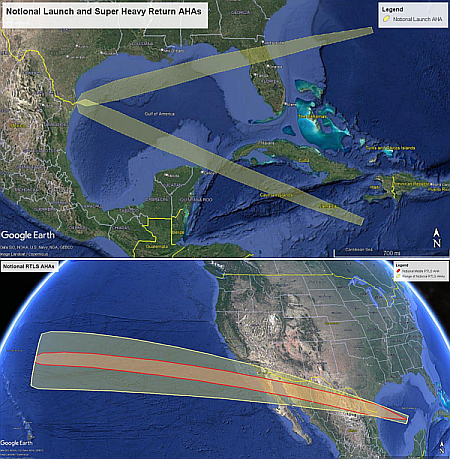
The Air Force announced late yesterday [pdf] that it will now allow SpaceX to launch its Starship/Superheavy rocket at Space Launch Complex 37 (SLC-37) at Cape Canaveral in Florida (as shown on the map to the right) as many as 76 times per year, with twice that number of landings.

The DAF [Department of Air Force] decision authorizes SpaceX to use SLC-37 at CCSFS [Cape Canaveral Space Force Station] to support Starship-Super Heavy launch and landing operations, including the redevelopment of SLC-37 and the other infrastructure improvements required and analyzed in the FEIS [Final Environmental Impact Statement]. Under this ROD [record of decision], upon execution of the real property agreement and associated documentation, and as analyzed in the FEIS while adhering to the mitigation measures specified in Appendix A to this ROD, SpaceX is authorized to: (1) undertake construction activities necessary to re-develop SLC-37 and associated infrastructure for Starship Super Heavy operations; (2) conduct prelaunch operations, including the transportation of launch vehicle components and static fire tests; and (3) conduct up to 76 launches and 152 landings annually once a supplemental analysis of airspace impacts by the Federal Aviation Administration (FAA) is completed. [emphasi mine]

The deal also requires SpaceX to do some road upgrades in order to transport the rocket from its Gigabay to the launch tower. The company immediately announced on X yesterday that it has already begun construction, and expects to have three pads in Florida before all is done.

The final environmental impact statement [pdf] was released on November 20, 2025, and concluded in more than 200 pages that there will be no significant impact from these launch operations, something that should be self-evident after more than three-quarters of century of rocketry at the Cape. The existence of the spaceport acts to protect wildlife, because it limits development across a wide area.

The report suggested that some turtle species and one mouse specie might “affected adversely”, but it it also appears that risk was considered minor and not enough to block development. To deal with this however the impact statement requires SpaceX to do a number of mitigation actions, similar to what it is required to do at Boca Chica.

One fact must be recognized, based on the red tape and delays experienced by SpaceX during the Biden administration. Had Kamala Harris and the cadre that ran the White House under Biden had been in office now, this approval would almost certainly have not happened, or if it did, it would have likely been delayed for a considerable amount of time, into next year at the earliest. It is certain that Trump is clearing the path to prevent red tape and the administrative state from slowing things down unnecessarily.

This announcement also strengthens the likelihood that SpaceX will do at least one launch of Starship/Superheavy from Florida in 2026. And if not then, by 2027 for sure.

10 comments

Two launches today, by Arianespace and SpaceX

Today there were two launches worldwide, one from South America and the second from the U.S.

First, Arianespace launched a South Korea imaging satellite from French Guiana, using the Vega-C rocket built and owned by the Italian rocket company Avio. Based on the July 2024 agreement, this is the next-to-last Vega-C flight that Arianespace will manage. After the next flight, Avio will take over management of its own rocket, cutting out this government middle man, though that agreement also allowed customers who had previously signed with Arianespace for later flights to stay with it as the managing organization.

Either way, Arianespace’s responsibilities will soon be limited solely to the Ariane-6 rocket, which itself has a limited future, being expendable and too expensive to compete in the present launch market.

Next SpaceX launched another 27 Starlink satellites into orbit, its Falcon 9 lifting off from Vandenberg Space Force Base in California. The first stage completed its 20th flight, landing on a drone ship in the Pacific.

As the Vega-C launch was only the sixth for Europe in 2025, it remains off the leader board for the 2025 launch race:

157 SpaceX (a new record)
74 China
15 Rocket Lab
15 Russia

SpaceX now leads the rest of the world in successful launches, 157 to 126.

0 comments

A detailed look at Europe’s $1 billion commitment to its nascent commercial rocket industry

The European Space Agency

Link here. In announcing last week the European Space Agency’s (ESA) budget for the next three years, along with its general overall goals, the European council (dubbed CM-25) also apparently committed about $1.45 billion to its “European Launcher Challenge”, a program created in 2023 and designed to encourage the development of new European rockets, owned and operated by independent competing startups.

The article at the link provides a good overall summary of major increase in funding for this program, including which ESA countries are contributing the most and why. The key quote however is this:

In July 2025, ESA shortlisted Isar Aerospace, Rocket Factory Augsburg, PLD Space, MaiaSpace, and Orbex to proceed to the initiative’s next phase. It then began discussions with the host country of each company to assess its willingness to contribute to that company’s participation in the European Launcher Challenge.

During his post-CM25 address, ESA Director General Josef Aschbacher revealed that Member States had committed double the anticipated amount for the European Launcher Challenge, with the final figure exceeding €900 million. While the funding model’s structure suggests that only the UK, Spain, France, and Germany contributed, post-CM25 disclosures have indicated that a few additional countries also committed funds to the programme.

Germany appears to be the biggest contributor, supplying more than a third of the total fund ($422 million). This isn’t surprising, since Germany also has the most rocket startups, three, two of which are on that shortlist (Rocket Factory and Isar). Spain is next with a contribution of $196 million, aimed helping the rocket startup PLD. The UK is next, also contributing $196 million, likely to be used to support its Orbex startup that wants to launch from its Saxavord spaceport in the Shetland Islands.

A variety of other ESA nations, the Czech Republic, the Netherlands, and Norway, have also outlined their contributions, for a variety of space-related startups unrelated to rockets.

France also appears to have donated a significant amount, but has not made that number public. Its MaiaSpace startup is one on that shortlist above, but France also has one or two other rocket startups that might eventually qualify for aid.

The bottom line is that ESA here is committing funding to aid the development of rockets and space infrastructure that it won’t own or control, a major shift from its past policy of owning and controlling everything through its Arianespace pseudo-commercial company, what I call the Soviet- or government-run model. Instead, these ESA nations are going to help fund a range of competing private rockets, which will own the rockets and operate them for profit. ESA will simply become one of their customers, following the capitalism model that the U.S. switched to in the previous decade.

This increased commitment to capitalism in the ESA suggests that we should see some real progress by these startups in the next three years.

If you think the launch records being set this year are breath-taking, you ain’t seen nothin’ yet.

3 comments

SpaceX launches another 29 Starlink satellites

SpaceX in the early morning hours today successfully launched 29 more Starlink satellites, its Falcon 9 rocket lifting off from the Kennedy Space Center in Florida.

The first stage completed its fourth flight, landing on a drone ship in the Atlantic.

The leaders in the 2025 launch race:

156 SpaceX (a new record)
74 China
15 Rocket Lab
15 Russia

SpaceX now leads the rest of the world in successful launches, 156 to 125.

1 comment

South Korean rocket startup Innospace announces date for inaugural launch

The South Korean rocket startup Innospace late last week announced that it has delayed the date for the first launch of its Hanbit-Nano rocket a few days in order to correct a “minor anomaly” during testing in Brazil.

During the avionics integration test, INNOSPACE performed a detailed analysis of a minor signal anomaly observed in a specific segment of the test and confirmed the tolerance range of the integration profile affected by flight-environment variations. To further validate the findings, the company carried out a second test using a Brazilian Air Force aircraft under conditions closely replicating the actual flight environment, allowing for a comprehensive review of response characteristics and signal stability across all integration items.

The launch was previously scheduled for a launch window from November 22nd to December 17th, taking place from Brazil’s long unused Alcantara spaceport on its northeast coast. The new window now runs from
December 16th to December 22nd. The launch itself is now scheduled for December 17th.

If this launch is successful, South Korea will have leapfrogged past India, Japan, and Australia to be the first Asian country to have a private company successfully launch a rocket.

2 comments
1 31 32 33 34 35 677