The causes behind the launch failure of Firefly’s Alpha rocket in April

In late August the FAA and Firefly completed the investigation into the launch failure of Firefly’s Alpha rocket in April, clearing the way for the company to resume launches.

At the time however this approval was reported here merely as a quick link on X. The company however also published its conclusions at that time which explained the cause of the failure. For completeness I post that now, describing what happened just after the first stage separated from the second stage.

Alpha’s first stage then experienced a rupture milliseconds after stage separation. The pressure wave hit Alpha’s second stage, leading to the loss of the engine’s nozzle extension and substantially reducing stage two thrust. The second stage was able to recover attitude control and continued to ascend to an altitude of 320 km until running out of propellant. The vehicle was three seconds short of achieving orbital velocity and five seconds short of the target payload deployment orbit.

The ground-based video, onboard telemetry, post-flight empirical testing and Computational Fluid Dynamics analysis corroborated excessive heat from Plume Induced Flow Separation as the most probable root cause of the mishap. Alpha Flight 6 flew a higher angle of attack than prior missions. Plume-induced flow separation intensified heat on the leeward side reducing structural margins, causing the booster to rupture from stage separation induced loads.

Fortunately, the corrective actions are straight forward: increase thermal protection system thickness on Stage 1 and reduce angle of attack during key phases of the flight. Corrective actions have already been implemented.

The company expects to resume flights in the very near future, probably before the end of 2025.

0 comments

Spanish rocket startup PLD completes test of prototype first stage

The Spanish rocket startup PLD has successfully conducted a short “burst test” of a full scale prototype of the first stage of its proposed Miura-5 rocket as it prepares for a first launch.

The test subjected the stage to pressures beyond its intended operating limits to determine the point of structural failure. According to the PLD Space update, the test validated the structural performance of the tank under cryogenic temperatures and extreme pressure conditions. The company will now proceed with a fully integrated qualification model of the stage that includes all the elements required for flight.

The company had hoped to launch the rocket for the first time from its French Guiana launchpad before the end of this year, but that schedule has slipped to 2026. At the same time, it clearly is making real progress, having also tested the engines of the rocket’s second stage in August.

0 comments

Court throws out environmental lawsuit against SpaceX, FAA, and Starship/Superheavy

The federal district court judge for the District of Columbia yesterday dismissed entirely the environmental lawsuit that had been filed against SpaceX and the FAA by anti-Musk activists following the first orbital test launch of Starship/Superheavy.

More details here. The lawsuit itself [pdf] was filed in 2023, claiming that the FAA’s environmental assessment of SpaceX’s activities at Boca Chica would do no harm to the environment were wrong.

SpaceX activities authorized in the FONSI/ROD [the environmental reassessment issued last year] have and will adversely affect the surrounding wildlife habitat and communities. In addition to harm from construction activities and increased vehicle traffic, rocket launches result in intense heat, noise, and light pollution. Furthermore, the rocket launches and testing result in explosions which spread debris across surrounding habitat and cause brush/forest fires — including one that recently burned 68 acres of adjacent National Wildlife Refuge. The FAA calls these explosions “anomalies,” but in fact they occur frequently, with at least 8 over the past 5 years. FAA acknowledged that many more such “anomalies” are expected over the next 5 years. The U.S. Fish and Wildlife Service has found that prior SpaceX rocket explosions harmed protected wildlife and designated habitat in violation of the Endangered Species Act (ESA).

At the time I noted this:

In other words, rockets and launch sites should never be placed inside wildlife refuges, because such activity is detrimental to wildlife.

A more false statement cannot be made. Under this conclusion the launch facilities at Cape Canaveral, which have been operating in the middle of a wildlife refuge now for more than six decades, should be shut down immediately. All the wildlife there must certainly be dead!

We have almost three-quarters of a century of empirical data in both Florida and California that spaceports are clearly beneficial to wildlife, because they actually create the refuge by reserving large areas where development cannot occur. This court decision merely confirms reality, something it appears increasingly the left doesn’t have much grasp of.

6 comments

Starlink down for about an hour last night

According to several major news sources, Starlink was down for about an hour last night globally, impacting several tens of thousands in the U.S. alone.

More than 37,000 US users were reporting issues with the internet service Monday at 12:30 a.m. ET, according to the website Downdetector.com. By 1:30 a.m., that number had fallen into the hundreds. The internet service owned by Musk’s SpaceX stopped working on “the entire frontline in Ukraine” around 7:30 a.m. Kyiv time (12.30 a.m. ET), said Maj. Robert “Magyar” Brovdi, the commander of Ukraine’s unmanned systems force, on Telegram. As of 8:00 a.m., service was gradually being restored, he said.

I link to CNN, but numerous other outlets thought this story significant enough to give it front page coverage. That this is considered news, however, illustrates perfectly how well Starlink functions normally. A brief outage lasting less than an hour makes the cover of every news outlet in the world, because normally Starlink works without problems for its more than six million subscribers.

SpaceX has not as yet provided any information about the cause of the outage. I suspect we are seeing the result of a hacker attack, possibly by Russia, but that is pure speculation. Even if not, it is in SpaceX’s interest to outline in detail what happened. This has been its policy in the past, but in the previous outage in July the company was not forthcoming. That lack of transparency has not served the company well.

0 comments

Space station startup Vast endorses NASA’s new strategy that no longer requires a continuous human presence in space

The American space stations under construction
The American space stations under development

Officials from the space station startup Vast revealed at a conference last week that they endorse NASA’s new strategy that, not only no longer requires the commercial stations to immediately establish a continuous human presence in space, will also award multiple development contracts to the commercial stations.

Speaking Sept. 11 at the Global Aerospace Summit, Max Haot [chief executive of Vast] endorsed NASA’s new strategy, announced more than a month ago, that calls for multiple Space Act Agreements to support development leading to a four-person, 30-day demonstration mission. “We think it’s really the right direction,” he said, noting it accelerates the award timeline. NASA said in a draft solicitation this month it expects to award multiple funded agreements by April 2026, months sooner than under earlier plans.

The original plan had been to choose at most two, but likely only one of the four consortiums/companies that are developing station proposals. The winner would have gotten a big contract that would have also required it to push hard for continuous full time occupation, from day one.

The new plan will instead award smaller development contracts to as many as three of the four station projects, aimed at getting them off the ground and operating, even if astronauts only fly in them intermittently. Eventually the hope is that their capabilities will expand quickly to permanent occupation, especially if they start earning revenue from the private sector, outside NASA. In fact, the smaller government contracts will force them to seek investment and profits elsewhere.

The four commercial stations under development, ranked by me based on their present level of progress:
» Read more

0 comments

SpaceX launches Northrop Grumman’s Cygnus freighter to ISS

SpaceX today successfully launched Northrop Grumman’s Cygnus freighter with more than five tons of cargo, its Falcon 9 rocket lifting off from Cape Canaveral in Florida.

The first stage completed its fourth flight, landing back at Cape Canaveral. The two fairing halves completed their 3rd and 6th flights respectively. Cygnus is expected to be berthed to ISS using the robot arm on September 24, 2025. This is also the first flight of the stretched version of Cygnus, capable of carrying more cargo.

The leaders in the 2025 launch race:

118 SpaceX
53 China
13 Russia
12 Rocket Lab

SpaceX now leads the rest of the world in successful launches, 118 to 92. China also had its own launch scheduled for this evening, but no information about it has yet been released.

2 comments

Two launches in the past day

The beat goes on. Since yesterday afternoon there have been two more global rocket launches, by Russia and SpaceX.

First, Russia launched the sixth GPS-type satellite as part of its next generation Glonass constellation, its Soyuz-2 rocket lifting off from its Plesetsk spaceport in northeast Russia. The rocket’s lower stage fell several different drop zones in Russia. No word if they landed near any habitable areas.

Next, SpaceX this morning launched another 24 Starlink satellites into orbit, its Falcon 9 rocket lifting off from Vandenberg in California. The first stage completed its 28th flight, landing on a drone ship in the Pacific.

The leaders in the 2025 launch race:

117 SpaceX
53 China
13 Russia
12 Rocket Lab

SpaceX now leads the rest of the world in successful launches, 117 to 92.

As for the rankings for the most reuse by a rocket, this is the present leader board:

39 Discovery space shuttle
33 Atlantis space shuttle
30 Falcon 9 booster B1067
28 Columbia space shuttle
28 Falcon 9 booster B1071
27 Falcon 9 booster B1069
27 Falcon 9 booster B1063

Sources here and here.

8 comments

Italian rocket company Avio commits $469 million to expand operations

The Italian rocket company Avio, which owns the Vega-C rocket, today announced that is has approved a $469 million fund to expand its manufacturing capabilities, including building a production facility in the United States.

Announced on 12 September, the capital raise is part of a new ten-year business plan targeting an average annual growth rate of about 10% in turnover and more than 15% in core profit (EBITDA). This growth will be driven by a higher Vega C launch cadence, the introduction of Vega E, continued participation in the Ariane 6 programme, and the construction of a new defence production facility in the United States, which is expected to be completed by 2028.

The management of Vega-C had previously been controlled by the European Space Agency’s (ESA) commercial arm, Arianespace, which had owned and operated all of Europe’s rockets. ESA however is eliminating that commercial arm, shifting from the government-run model to the capitalism model, whereby it simply acts as a customer buying services from the private sector.

As part of that shift, Avio is in the process of taking back its Vega-C from Arianespace. Beginning next year it will be marketing the rocket directly to customers. This major investment reflects this change. The company is now free to pursue profits wherever it can find them, and it appears it wishes to market itself aggressively to American satellite companies as well as its defense industry.

0 comments

SpaceX launches Indonesian commercial communications/broadband satellite

SpaceX tonight successfully launched an Indonesian commercial communications/broadband satellite, its Falcon 9 rocket lifting off from Cape Canaveral in Florida.

The first stage completed its 23rd flight, landing on a drone ship in the Atlantic. The two fairings completed their 16th and 24th flights respectively.

The leaders in the 2025 launch race:

116 SpaceX
53 China
12 Rocket Lab
12 Russia

SpaceX now leads the rest of the world in successful launches, 116 to 91.

0 comments

SpaceX launches military payload for the Pentagon’s Space Development Agency

SpaceX early today successfully launched a classified military payload for the Pentagon’s Space Development Agency, its Falcon 9 rocket lifting off from Vandenberg Space Force Base in California.

The first stage completed its sixth flight, landing on a drone ship in the Pacific.

I did not post this in the morning because there was a second SpaceX launch scheduled for the afternoon, and I planned on posting both launches in one post. That launch however was scrubbed and rescheduled for tomorrow.

The leaders in the 2025 launch race:

115 SpaceX
53 China
12 Rocket Lab
11 Russia

SpaceX now leads the rest of the world in successful launches, 115 to 90.

4 comments

Update on what SpaceX learned about Starship’s tiles during the 10th test flight

Superheavy after its flight safely captured at Boca Chica
Superheavy after the October 2024 flight,
safely captured during the very first attempt

Link here. The update comes from a presentation given this week by Bill Gerstenmaier, SpaceX’s executive in charge of build and flight reliability, at the American Astronautical Society’s Glenn Space Technology Symposium in Cleveland.

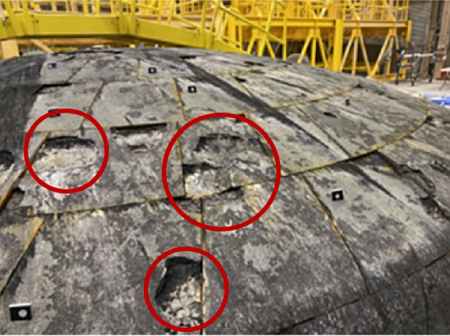
Lots of new details. First, almost no tiles fell off during this flight. More significant, they found that the use of metal tiles won’t work. They tested three, and found that “The metal tiles… didn’t work so well.”

Gestenmaier also outlined how the flight provided the necessary data for sealing the gaps between the tiles better.

Gerstenmaier pointed to a patch of white near the top of Starship’s heat shield. This, he said, was caused by heat seeping between gaps in the tiles and eroding the underlying material, a thermal barrier derived from the heat shield on SpaceX’s Dragon spacecraft. Technicians also intentionally removed some tiles near Starship’s nose to test the vehicle’s response.

“It’s essentially a white material that sits on Dragon and it ablates away, and when it ablates, it creates this white residue,” Gerstenmaier said. “So, what that’s showing us is that we’re having heat essentially get into that region between the tiles, go underneath the tiles, and this ablative structure is then ablating underneath. So, we learned that we need to seal the tiles.”

They hope to do the 11th test flight in October, repeating the same suborbital configuration of previous flights, using the same version 2 of Starship. The plan will then be to follow up with a first suborbital flight of version 3 in 2026, followed quickly by orbital flights. During one of those orbital flights they will also try to do a chopstick catch of Starship. They also hope to do the first refueling tests next year.

All in all, it appears the test program is proceeding as hoped, and is about to accelerate significantly.

1 comment

Croatian startup moves up the launch date for two subscale returnable capsules

The Croatian startup Genesis Space Flight Laboratories (Genesis SFL) has now accelerated the development of its orbital returnable capsule for manufacturing in space, moving up the launch date for its first two subscale demonstrator capsules from 2027 to 2026.

Initially planned for 2027, the missions were moved forward after Genesis SFL announced on 9 September that it had secured earlier slots with an as-yet-undisclosed launch provider.

Speaking to European Spaceflight, Genesis SFL CEO Bence Mátyás explained that the company’s GEN-1 and GEN-2 demonstrators will likely be the smallest reentry capsules ever flown, comparable in size to picosatellites. Despite their diminutive size, the capsules will be capable of remaining in orbit for approximately six months before performing reentry procedures, a capability made possible by the use of a host satellite [essentially the service module] also under development by the company. Once on a reentry trajectory, the capsule will separate from its host satellite and deploy a mini-parachute and antenna to enable recovery following a splashdown.

If these demonstrators succeed, the company plans to scale up later GEN capsules step-by-step, eventually matching and even exceeding those of companies like Varda.

The returnable capsule industry appears at the moment to be bursting with new companies. In the U.S. we have Varda, Inversion Space, Sierra Space, and even SpaceX using Starship. In Europe — in addition to Genesis in Croatia, we have The Exploration Company in France, Atmos in Germany, PLD in Spain, and Space Cargo in Luxembourg. And I am certain there are others that I am missing.

Very clearly the investment community sees big profits in using orbital capsules to manufacture products for later sale on Earth.

0 comments
1 46 47 48 49 50 677