Overview of China’s lunar sample return mission

Chang'e-5 landing site on Moon

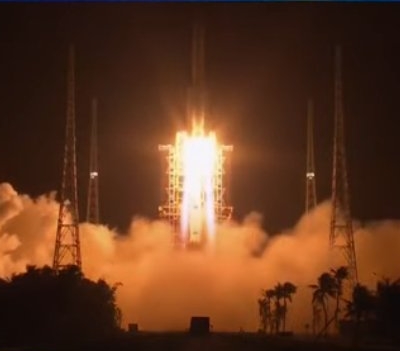
Link here. The Chinese mission, the first to bring back lunar samples since the 1970s, is now set for launch on November 24, 2020.

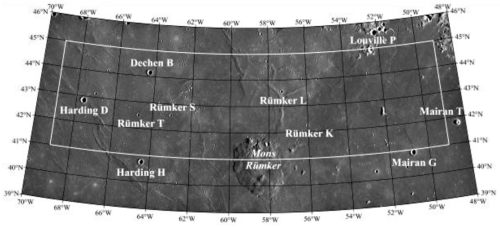
Chang’e-5 includes a lander, ascender, orbiter and returner. After the spacecraft enters the Moon’s orbit, the lander-and-ascender pair will split off and descend close to Mons Rümker, a 1,300-metre-high volcanic complex in the northern region of Oceanus Procellarum — the vast, dark lava plains visible from Earth. Once the craft has touched down, it will drill up to 2 metres into the ground and extend a robotic arm to scoop up about 2 kilograms of surface material. The material will be stored in the ascender for lift-off.

The descent and ascent will take place over one lunar day, which is equivalent to around 14 Earth days, to avoid the extreme overnight temperatures that could damage electronics, says Clive Neal, a geoscientist at the University of Notre Dame in Indiana.

…Once the ascender is back in lunar orbit, the samples will be transferred to the returner. This in-flight rendezvous will be complex and “a good rehearsal for future human exploration”, says James Carpenter, a research coordinator for human and robotic exploration at the European Space Agency in Noordwijk, the Netherlands. China plans to send people to the Moon from around 2030.

The Chang’e-5 spacecraft will then journey back to Earth, with the lander parachuting toward Siziwang Banner in Inner Mongolia, northern China, probably sometime in early December.

The location, as shown in the image above, is in the northern mid-latitudes of the Moon’s nearside, and is a place where some relatively recent volcanic activity might have occurred, though still in the far past.

0 comments

Is this the planned landing site of China’s Mars rover?

The prime landing site for China's Mars rover?

According to this Space News article, a report in the Chinese press, since revised to remove the information, had provided precise coordinates on Mars for the prime candidate landing site for China’s Tianwen-1 rover.

[I]nformation published in an article (in Chinese) in the official China Space News publication following launch in July provides a specific primary landing site. The article reported landing coordinates of 110.318 degrees east longitude and 24.748 degrees north latitude, within the southern portion of Utopia Planitia. Online versions of the article have since been edited to remove the coordinates; however, these remain published by sources citing the article.

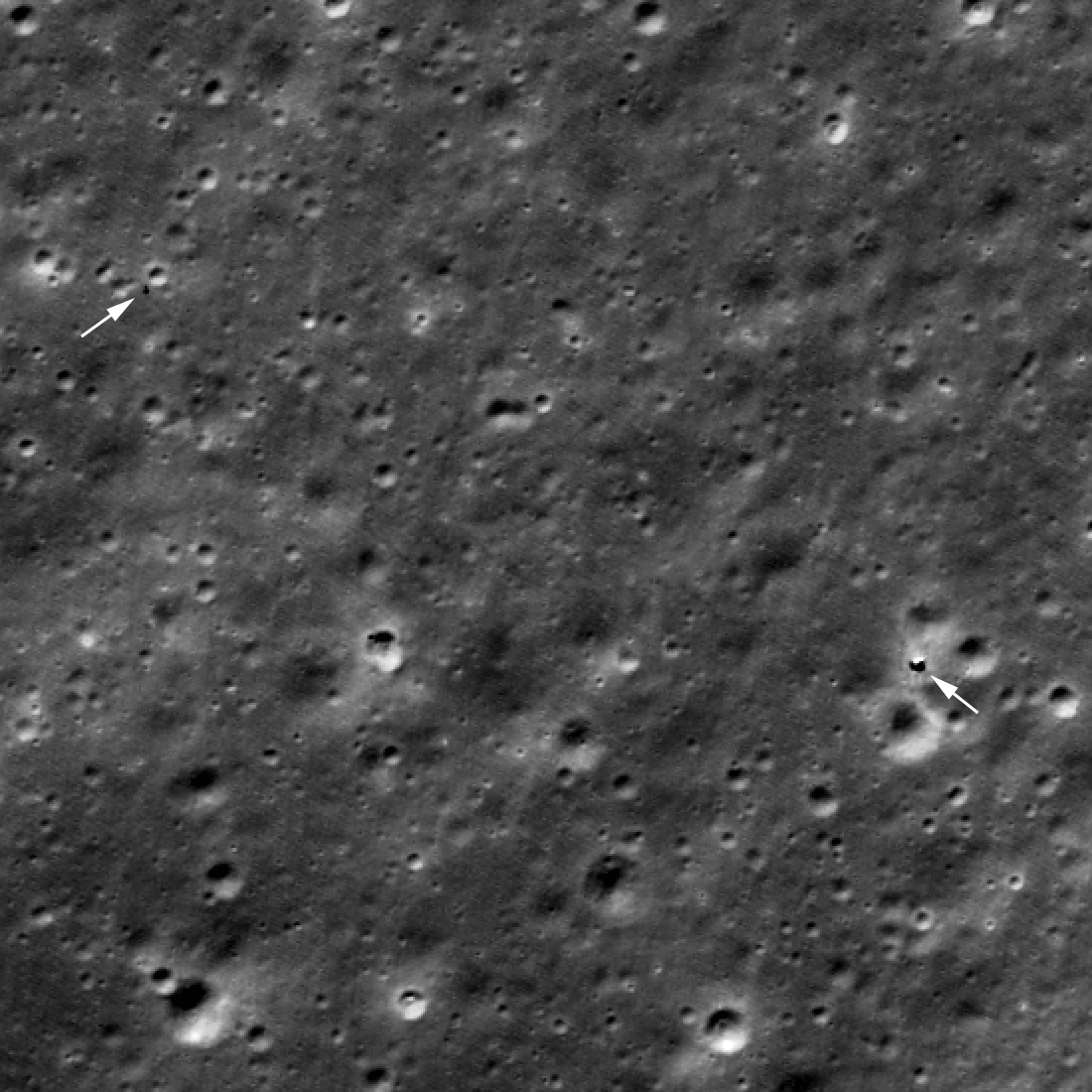
The mosaic on the right, made up of two images taken by Mars Reconnaissance Orbiter’s (MRO) context camera (found here and here) shows this location with the white cross. The white box is the area covered by the only image taken of this area by MRO’s high resolution camera.

As these photos show, this location, in a part of Mars’ northern lowland plains dubbed Utopia Planitia, is generally smooth and flat, making for a relatively safe landing site. At the same time, it has craters and some ridges and hills that could pose issues.

That the coordinates were removed from the Chinese press story suggests that this might be the prime site, but until Tianwen-1 gets into Mars orbit and begins scouting the site with its own high resolution images, they want to reserve judgement. The spacecraft arrives in orbit in February ’21, and they presently plan to land the rover in May. That gives them three months to scout this location as well as a secondary landing site on the other side of Mars, in the Chryse Planitia northern lowlands [pdf], the same region where Viking 1 and Mars Pathfinder landed.

Once they have done this they will be able to refine the location more precisely.

0 comments

“That is a blatant lie.”

In a long fifty minute public interview tonight on the Tucker Carlson Show, embedded below the fold, a businessman outlined in great documented detail how Joe Biden, the Democratic Party’s presidential candidate, was lying when he said he had no knowledge and never participated the business dealings of his son Hunter Biden, including a partnership with a Chinese company connected to the Chinese Communist Party.

More details here. The businessman, Tony Bobulinski, was quite clear and convincing. Bobulinski outlined in detail two meetings he had with Joe Biden in connection with those Chinese business dealings.

[Carlson]: The former vice-president has said that he was not involved in his son’s business dealings and had no knowledge of them at all. But this sounds like direct involvement in them.

[Bobulinski]: That is a blatant lie. When he states that, that is a blatant lie.

Apparently this man has come forward because he knows Biden is lying, and in the process is smearing his name by accusing him of being a party to Russian disinformation. Bobulinski however is a Navy veteran who had top secret clearance. To be accused of literally being a traitor was too much for him to take, which is why he has gone public with his knowledge.

Watch the interview below. It is worth your time, especially now only a week before election day. Joe Biden is not only a liar, he has been willing to make deals with Chinese businesses that work for the Chinese Communist Party, and as Bobulinski notes, is very seriously compromised by all standards of national security. As president it will be very difficult for him to defend the nation’s interests, exposed as he is now as someone with deep financial ties to Chinese government interests.

Even worse, the willingness of almost every major news organization to bury this story condemns them forever as true partisan hacks with zero loyalty to the United States itself. They deserve nothing but of utter contempt and disgust from every American.

» Read more

29 comments

China outlines its updated space ambitions for the 2020s

The new colonial movement: China this week outlined some of its space ambitions for the 2020s, updating its planned lunar unmanned program as well as developments in its rocket industry.

For the Moon they plan the following:

Chang’e 6, a backup mission for this year’s sample-return launch, is scheduled to head to the moon in 2023 or 2024; Chang’e 7 is planned to launch around 2024 with the dual aims of landing on the south pole of the moon and closely studying the region from orbit. An eighth mission is also in the works for later this decade.

As for their rocket industry, CASIC, the government entity that supervises China’s commercial space activities (including a number of private companies operating independently but supervised closely by it) announced plans for a reusable two-stage reusable spaceplane, a new constellation of satellites, and a number of new quick-launch solid rockets aimed at doubling their launch rate.

1 comment

Chang’e-4 and Yutu-2 awake for 23rd lunar day on far side of the Moon

The new colonial movement: China’s Chang’e-4 lander and Yutu-2 rover have both been reactivated for their 23rd lunar day on far side of the Moon.

Yutu 2 is set to continue its journey northwest from the landing site and will target a roughly 12-inch (30 centimeters) rock on the rim of a nearby crater for analysis with a spectrometer. The rover has used that instrument to analyze a range of specimens in Von Kármán crater, notably causing a stir when it discovered an impact melt breccia initially described as “gel-like.”

It is the hope of the Chinese scientists that this rock will be ejected material from that crater and will have come from the lunar interior.

Also, though you need to read Chinese to understand how to access it, the project has released to the public another batch of data from both spacecraft.

0 comments

Possible collision today of two big pieces of space junk

A space junk tracking company is predicting a “more than 10%” chance that two large pieces of space junk with a combined mass of more than 6,000 pounds might collide tonight over the south Atlantic just before 9 pm (eastern).

The two pieces, one a defunct Russian satellite and the other a Chinese upper rocket stage, will be moving at more than 32,000 miles per hour relative to each other at the moment when impact might occur.

If they do hit, the collision will break both pieces into many new smaller pieces of space junk. Not a good thing.

5 comments

Seven countries join the U.S. in signing the Artemis Accords

NASA announced yesterday that seven countries — the United Kingdom, Australia, Canada, Japan, Luxembourg, the United Arab Emirates and Italy — have now signed the Artemis Accords, the Trump administration’s effort to create a legal framework that will protect property rights in space and get around the legal limitations imposed by the Outer Space Treaty.

I suspect this announcement was in response to statements earlier this week by Dmitry Rogozin, the head of Russia’s space agency, that they will not partner with the U.S. in its Lunar Gateway space station project. Though Rogozin cited other issues for the decision, such at the fact that they would not be treated as an equal partner in Gateway, I suspect the decision was also made because Russia’s government opposes the Artemis Accords and does not wish to sign it. China has said the same.

Since those accords are designed to shift power and control from governments to private enterprise, it is not surprising that Russia and China oppose them. Both are authoritarian top-down societies whose government reflects their culture. To sign an agreement that would take power from the state and give it to their citizens is unacceptable.

So be it. Of the countries that have signed, I expect in future years they will all prosper in space, and eventually force others to accept the ideas of freedom, private property, and capitalism that inspire the accords. Luxombourg is committed to pushing private enterprise and investment in commercial space. The UK, Australia, Canada, and Japan all follow the same principles, and all have robust space industries that should only get stronger.

And the UAE, the new baby on the block, wants to make commercial space a big part of its future. Signing these accords — along with their peace deal with Israel — indicates strongly that they mean business, and that they are trying heartily to separate themselves from the radical Islamic movements that have been poisoning the Arab Middle East for decades.

Moreover, the U.S. is requiring any nation that wishes to participate in its effort to return to the Moon to sign these accords. These nations, and their citizens, will therefore have a chance to contribute to that effort, and likely make a lot of money in the process.

Posting is late today because Diane and I went on an 8-mile hike. My gym now idiotically requires masks while you work out, and I am certainly not going to do that. Therefore, to maintain our cardiovascular systems while strengthening our immune systems (the best defense against all flulike diseases, including the Wuhan virus), we have been doing 6 to 10 mile hikes now twice a week. It means one day a week I need to schedule some posts early, and catch up when I get home. I hope my readers understand.

3 comments

China’s Long March 3B launches another remote sensing satellite

China today (October 11) successfully used its Long March 3B rocket to place another remote sensing satelle into orbit.

No word on whether the first stage and its strap-on boosters landed on any homes, or if they were equipped with fins to guide their re-entry.

The leaders in the 2020 launch race:

26 China
16 SpaceX
10 Russia
4 ULA
4 Europe (Arianespace)

With this launch China moves back into a tie with the U.S., 26-26, in the national rankings.

6 comments

China releases images of Tianwen-1 on way to Mars

Tianwen-1 on its way to Mars

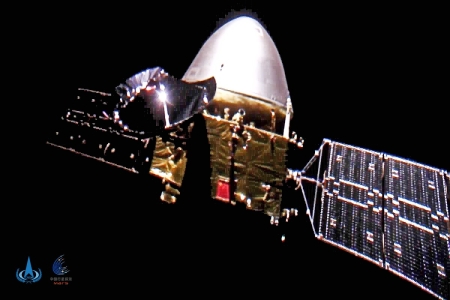
China has released several images taken of its Tianwen-1 orbiter/lander/rover by a camera ejected by the spacecraft on its way to Mars.

The images released by the China National Space Administration on Oct. 1 show the Tianwen 1 spacecraft traveling through the blackness of space. Tianwen deployed a small camera to take the self-portrait as it tumbled away from the mothership.

Two wide-angle lenses on the deployable camera were programmed to one image every second. The images were transmitted back to Tianwen via a wireless radio link, then downlinked back to ground teams in China.

In the images, Tianwen 1’s solar array wings and dish-shaped high-gain communications antenna are prominently visible. The white section of the spacecraft is the mission’s entry module and heat shield, which contains a Chinese rover designed to land on Mars and explore the surface.

The spacecraft is about halfway to Mars, and will arrive in Mars orbit in February. It will then spend several months surveying its candidate landing sites, of which there appear to be two, before releasing the lander/rover to the surface.

5 comments

China and Russia launch a bunch of satellites

Russia today used its Soyuz-2 rocket to launch three communication satellites plus 19 commercial smallsats.

This was the first time Russia used the Soyuz-2 for these particular small communications satellites, as previously they had been launched by a variety of smaller rockets.

China in turn today used its Long March 4B to place two Earth resource satellites into orbit.

The leaders in the 2020 launch race:

25 China
15 SpaceX
10 Russia
4 ULA
4 Europe (Arianespace)

China has moved ahead of the U.S. 25 to 24 in the national rankings.

These numbers should change again in the next few days. The U.S. has had a number of scrubs and launch delays in the past few days. ULA has been repeatedly pushing back the previously delayed launch of a National Security Agency reconnaissance satellite due to a variety of problems related to its Delta 4 Heavy rocket. The launch is now set for just after midnight tonight (Monday night). [UPDATE: Launch scrubbed due to lightning and poor weather. Tentatively rescheduled for 11:58 pm (Eastern) on September 29.]

SpaceX meanwhile had to scrub a launch this morning (September 28) of another 60 Starlink satellites due to weather. No new launch date has yet been announced.

Northrop Grumman also has had to scrub tomorrow’s Antares launch of a Cygnus cargo freighter because of poor weather at Wallops Island. It is now set for the evening of October 1st.

SpaceX also has a scheduled launch tomorrow morning of a GPS satellite on its Falcon 9 rocket. This is also threatened by weather. There is also no word whether the ULA launch scrub will cause this launch to be delayed.

0 comments

German instrument on Chang’e-4 documents dangerous radiation levels

This result is not a surprise: A German instrument on China’s Chang’e-4 lander, located now on the Moon’s far side, has measured the radiation levels there, and found them to be much worse than found on Earth.

DLR radiation physicist Thomas Berger from the DLR Institute of Aerospace Medicine, who participated in the publication explains: “The radiation exposure we measured is a good indication of the radiation inside a spacesuit. The measurements give us an equivalent dose rate – the biologically weighted radiation dose per unit of time – of around 60 microsieverts per hour. For comparison, during a long-haul flight from Frankfurt to New York, the dose rate is five to 10 times lower than this. On Earth’s surface, it is some 200 times lower. In other words, a long-term stay on the Moon will expose astronauts’ bodies to high doses of radiation.”

“Human bodies are simply not made to be exposed to space radiation,” adds Robert Wimmer-Schweingruber of the Christian-Albrecht University (CAU) in Kiel, whose team developed and built the LND instrument . “On longer missions to the Moon, astronauts will have to protect themselves from it – by covering their habitat with a thick layer of lunar rock, for example. This could reduce the risk of cancer and other illnesses caused by long periods of time spent on the Moon.”

Previous instruments had only measured the cumulative radiation for the entire mission. This instrument took multiple readings lasting one, ten, or sixty minutes, which gives a more realistic measure of what an astronaut would actually experience, once there.

13 comments

ULA reveals Chinese-owned company attempted to steal rocket data

In an interview yesterday ULA’s CEO Tory Bruno revealed that a Chinese-owned software company tried to infiltrate the supply chain being set up to build their next generation Vulcan rocket.

Bruno said the Chinese-owned vendor identified in ULA’s supply chain was a provider of software for tools used to manufacture the company’s next-generation rocket Vulcan Centaur. Because the issue was detected quickly, no sensitive information was extracted by that supplier, Bruno said.

The company flagged as a risk was a tool supplier working with KUKA Robotics. According to ULA, KUKA had no access to ULA’s intellectual property. “ULA envisions no further future work involving KUKA or KUKA products,” the spokesperson said. “There was no evidence they attempted to obtain data, however, we have an obligation to our customers as well as our company to ensure we have taken all necessary steps to protect our IP as well as information the government has entrusted us with.”

The Pentagon has shown growing concern about Chinese ownership of U.S. suppliers and continues to impose cybersecurity requirements on contractors. “But I have to tell you this is just shocking in terms of the scale and ubiquity of this threat and this effort on the part of China to not only gain access to intellectual property through traditional means — hacking or espionage — but through infiltration of the supply chain,” Bruno said.

The article also notes that while the top tier subcontractors ULA might hire are almost all American owned, foreign companies own 70% of the smaller subvendors, and the number of Chinese-owned subvendors has grown 420% since 2010.

China’s effort to steal American technology has been a serious problem that has been ignored for too long.

5 comments

Empty Chinese apartment complex overrun with plants and mosquitoes

The coming dark age: A Chinese apartment complex, designed to be an “eco-paradise,” has instead become an empty jungle overrun with plants and mosquitoes.

An experimental green housing project in a Chinese megacity promised prospective residents life in a “vertical forest,” with manicured gardens on every balcony. All 826 apartments were sold out by April this year, according to the project’s estate agent, but instead of a modern eco-paradise, the towers look like the set of a desolate, post-apocalyptic film.

The problem? The mosquitoes love the plants too. Only a handful of families have moved into Chengdu’s Qiyi City Forest Garden because of an infestation, state media reported.

The pictures at the link are quite incredible. Imagine being surrounded by neighbors who allow their property to fall apart and you have a sense of what these buildings look like.

4 comments

China launches rocket from ocean launch platform

The new colonial movement: China today successfully put nine Earth observation smallsats into orbit using its Long March 11 rocket, and it did it by launching from a floating launch platform.

I have embedded video of the launch below the fold. Notice that the rocket appears to ignite its first stage engines after it is flung upward from the platform, similar to the launch of an ICBM from a submarine. This is not surprising, as the Long March 11 solid fueled rocket is based on ICBM technology.

The leaders in the 2020 launch race:

23 China
15 SpaceX
9 Russia
4 ULA
4 Europe (Arianespace)

The U.S. still leads China 24 to 23 in the national rankings.

» Read more

1 comment

China’s Kuaizhou-1A rocket fails at launch

China’s Kuaizhou-1A rocket yesterday failed during launch, though no details have been released.

Kuaizhou 1A and Kuauzhou 11 are rapid response rockets derived from intercontinental ballistic missiles that are capable of placing satellites into orbit on short notice. Launches are managed by ExPace, a commercial subsidiary of the state-owned China Aerospace Science and Industry Corporation.

The Kuaizhou-1A is the smaller of the two rockets. This was its first failure after ten successful launches.

4 comments

China launches another remote sensing satellite; crashes 1st stage near homes

The new colonial movement: China today used its Long March 4D rocket to launch another remote sensing satellite.

UPDATE: It appears the first stage booster crashed near a populated area. Footage of the crash can be seen here. Note that the red smoke indicates very toxic materials. Anyone who goes close risks serious health problems.

The leaders in the 2020 launch race:

22 China
15 SpaceX
9 Russia
4 ULA
4 Europe (Arianespace)

In the national rankings the U.S. still leads China 24 to 22.

5 comments

China successfully lands its reusable version of the X-37B

The new colonial movement: After only two days in space, China today successfully landed what appears to be its reusable version of the X-37B.

No photos of this spacecraft have been released, nor has China provided any specific information about its shape or design. What we know however suggests it is similar in concept to the unmanned, pick-up-truck-sized X-37B.

Apparently this short flight was to test its ability to reach orbit and then return autonomously. According to the state-controlled Chinese press, it did so.

10 comments

China launches its version of X-37B

The new colonial movement: It appears that China has launched its version of a reusable X-37B mini-shuttle, or at least, that is most likely first guess, based on the meager data available.

China launched a new experimental reusable space vehicle on Thursday from the Jiuquan Satellite Launch Center using a Long March-2F/T – Chang Zheng-2F/T – launch vehicle. Launch from the LC43/91 launch complex, under a veil of secrecy with no official launch photos or even a launch time disclosed.

Chinese media emitted a laconic report referring, that “the test spacecraft will be in orbit for a period of time before returning to the domestic scheduled landing site. During this period, it will carry out reusable technology verification as planned to provide technical support for the peaceful use of space.”

More at the link, though the lack of information, especially the refusal to even give a launch time, strongly indicates China wants to limit knowledge of this spacecraft’s position in space, thus limiting the ability of others to photograph it. What is known however does point to this being a variation of a small reusable unmanned shuttle, like the X-37B.

While once again China has not come up with something new, copying (or stealing) the idea from someone else, having such a vehicle gives them a significant capability. They can now test many different technologies in orbit for long periods, and get them back to Earth for study afterward.

The leaders in the 2020 launch race:

21 China
15 SpaceX
9 Russia
4 ULA
4 Europe (Arianespace)

The U.S. continues to lead China 24 to 21 in the national rankings.

2 comments
1 37 38 39 40 41 72