Another Al Gore doomsday prediction bites the dust

In a new paper published yesterday, climate scientists described a newly discovered deep, cold current flowing off Iceland’s coast that appears to make the ocean conveyor belt that warms the northern Atlantic less sensitive to climate change than previously thought.

In other words, another one of Al Gore’s doomsday predictions has proven false.

More significantly, scientists now have no understanding why the ocean conveyor belt shut down during past ice ages, as their most favored theory now appears insufficient.
» Read more

1 comment

The very slow ramp up to maximum

an active sun

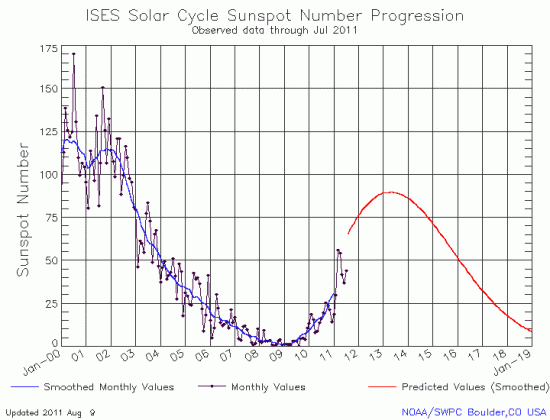
As it does every month, NOAA’s Space Weather Prediction Center released today its monthly updated graph of the Sun’s solar cycle sunspot activity. I have posted the July graph below.

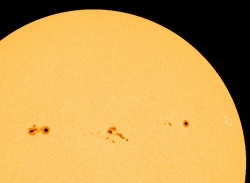
For the first time in four months there was a increase in sunspot activity, albeit small. The sun has been even more active in August, as shown by the flurry of sunspots on its face from August 1 (shown on the left) and the August 8 solar flare, the most powerful produced in four years.

This monthly graph, however, continues to suggest that the next solar maximum will be very very weak, even weaker than the most up-to-date predictions for the next solar maximum.

The sunspot graph for July 2011

0 comments

It’s the coverup, not the crime

A new Rasmussen poll finds that 69% of the public now believe that climate scientists falsified data to support their own theories about global warming. Moreover, these numbers are up ten points since December 2009, which happens to be just after the climategate emails were released.

These terrible numbers are further evidence that the willingness of the scientific community to whitewash their investigations of the climategate scientists, what I consider to be the equivalent of a community-wide cover-up, has done serious harm to science and its reputation.
» Read more

4 comments

New NASA Data Blow Gaping Hole In Global Warming Alarmism

The headline says it all: New NASA data blow gaping hole in global warming alarmism.

Scientists on all sides of the global warming debate are in general agreement about how much heat is being directly trapped by human emissions of carbon dioxide (the answer is “not much”). However, the single most important issue in the global warming debate is whether carbon dioxide emissions will indirectly trap far more heat by causing large increases in atmospheric humidity and cirrus clouds. Alarmist computer models assume human carbon dioxide emissions indirectly cause substantial increases in atmospheric humidity and cirrus clouds (each of which are very effective at trapping heat), but real-world data have long shown that carbon dioxide emissions are not causing as much atmospheric humidity and cirrus clouds as the alarmist computer models have predicted.

The new NASA Terra satellite data are consistent with long-term NOAA and NASA data indicating atmospheric humidity and cirrus clouds are not increasing in the manner predicted by alarmist computer models. The Terra satellite data also support data collected by NASA’s ERBS satellite showing far more longwave radiation (and thus, heat) escaped into space between 1985 and 1999 than alarmist computer models had predicted. Together, the NASA ERBS and Terra satellite data show that for 25 years and counting, carbon dioxide emissions have directly and indirectly trapped far less heat than alarmist computer models have predicted. [emphasis mine]

2 comments

Thank the Gods for Climategate

Thank the gods for climategate.

We are certainly in a far different world vis-a-vis global warming than 21 months ago. The [global warming] climatologists are, to a very large extent, being ignored. Yes, there is an IPCC coming up, and perhaps we should wait until that is over. But I will predict that no matter what hoohah comes out of it, it will not have 50% of the energy of the previous IPCCs, because governments just arenโ€™t listening with baited breath anymore. If there is any place where the mojo counted, it was with governments. But it ainโ€™t there any more.

0 comments

The journal Science finally admits things have not gotten warmer in the past decade

The journal Science finally admits things have not gotten warmer in the past decade.

The explanation provided, that recent volcanic eruptions cooled a warming earth, might be true, though the conclusions are based not so much on data but on climate computer models, a fact that leaves me somewhat skeptical. Nonetheless, what is significant to me about this article is that Science — which has been decidedly in the global warming political camp for years and has frequently lambasted scientists who suggested the climate’s warming has slowed or even stopped in the past decade — has now been forced to admit that the warming has stopped. That they feel compelled to push the global warming threat in the same sentence only reveals their continuing scientific bias.

0 comments

The sun, climate change, and censorship

The chief of CERN has prohibited its scientists from drawing any conclusions from a major experiment that appears to prove that solar activity and the resulting ebb and flow of cosmic rays has a direct effect on the climate.

Two points:

First, the results described provide strong evidence that the sun is a much more important component in climate change than any climate model has previously predicted. These results could help explain the Little Ice Age, which took place around 1700 at exactly the same time the sun became very quiet and stopped producing sunspots for decades. They could explain the Medieval Warm Period around 1000 AD, when cosmic ray activity declined (which also suggests the sun become more active) and the earth apparently warmed. And they might very well even explain the recent cooling during the past decade, which also took place during a period of solar inactivity and a comparable increase in cosmic ray activity.
» Read more

1 comment

Wither the Arctic Icecap?

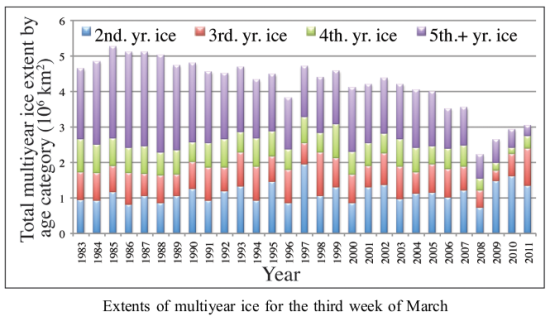
In a paper published today in Geophysical Research Letters, climate scientists have estimated the distribution and trends for the Arctic icecap from 1980 through March 2011. What they have found is a significant decline in older ice on top of an overall declining trend that showed a strong but partial recovery since 2008. The graph below, from the paper, illustrates clearly these trends.

Arctic Ice, 1980 - 2011

What this means for the icecap itself remains unclear. As the scientists themselves note in their conclusion:
» Read more

0 comments

Bad news for climate modelers

A new analysis of the orbits of Ceres and Vesta says that in a surprisingly short time those orbits become chaotic and therefore unpredictable. More significantly, those orbits interact with the Earth’s and also make its long term orbit chaotic and unpredictable. From the abstract:

Although small, Ceres and Vesta gravitationally interact together and with the other planets of the Solar System. Because of these interactions, they are continuously pulled or pushed slightly out of their initial orbit. Calculations show that, after some time, these effects do not average out. Consequently, the bodies leave their initial orbits and, more importantly, their orbits are chaotic, meaning that we cannot predict their positions. The two bodies also have a significant probability of impacting each other, estimated at 0.2% per billion year. Last but not least, Ceres and Vesta gravitationally interact with the Earth, whose orbit also becomes unpredictable after only 60 million years. This means that the Earth’s eccentricity, which affects the large climatic variations on its surface, cannot be traced back more than 60 million years ago. This is indeed bad news for Paleoclimate studies. [emphasis mine]

The scientists found that it became impossible to calculate the orbits of the two largest asteroids after only several ten thousand years. They also found that “numerous asteroids in the main belt will behave in the same way with . . . much more chaotic behavior than previously thought.” Worse, the possibility of collisions was far higher than ever thought. Ceres and Vesta have a 1 in 500 chance of colliding with each other every billion years, while other asteroids have chances as low as 1 in 1000.

The importance of this discovery, which still needs to be confirmed by other researchers, cannot be understated.
» Read more

1 comment
1 64 65 66 67 68 84