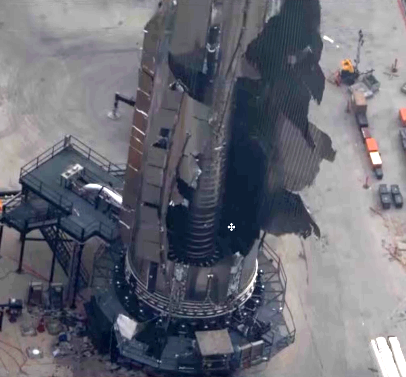
A small European prototype re-entry capsule survived PSLV launch failure

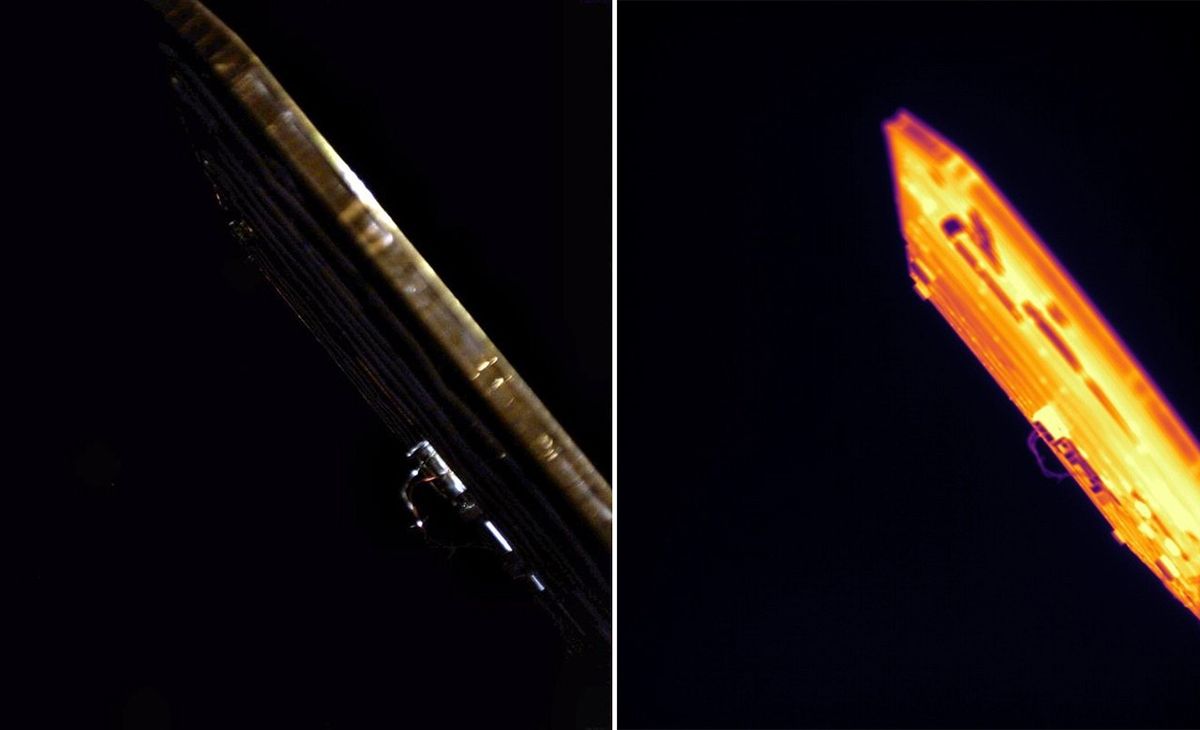
A small prototype re-entry demonstration capsule, built by the Spanish startup Orbital Paradigm and dubbed the Kestrel Initial Demonstrator (KID), apparently survived for a short period the failure of the third stage of India’s PSLV rocket early this week.

According to an Orbital Paradigm press release, the survival of its little demonstrator came as a surprise. “When we understood that the launch was non-nominal it was a bit of a hit for us,” explained Orbital Paradigm CEO Francesco Cacciatore. … “I think the launch livestream was still ongoing when the team saw that we had 190 seconds of flight data transmitted and received. We needed a few minutes to realize it was real data and not a glitch.”

…“KID was tested beyond its design envelope, and it worked. Separation, power-on, and data transmission, even after reentry, all performed well despite degraded conditions,” explained the company in a 13 January update. “Based on initial analysis, it seems that we achieved 4 out of 5 launch milestones, albeit through an off-nominal profile. The failure to deliver customers’ data prevents us from declaring the mission a success.”

The company considers the mission a failure because it did not get the re-entry data back that it really needed. It says however it is moving forward on a more advanced demonstrator it hopes to launch in 2027. I suspect it will not hire India’s space agency ISRO to launch it.

1 comment

ULA loses another launch contract to SpaceX

The Space Force yesterday announced it has switched rocket companies for its next GPS satellite launch, taking the launch away from ULA and its Vulcan rocket and giving it to SpaceX.

SpaceX could launch the GPS III Space Vehicle 09 (SV09) within the next few weeks, as the satellite was entering the final stages of pre-flight preparations. As part of the swap, United Launch Alliance (ULA) will instead launch the third of the next generation of Global Positioning System satellites. The GPS III Follow-on (GPS IIIF) SV13 satellite was originally scheduled to launch on a Falcon Heavy, but will now fly on Vulcan.

“SV09 and SV13 were traded between ULA and SpaceX to get capability to orbit as soon as possible, for the same reason as the prior swap, which resulted in the last GPS launch in May 2025,” the spokesperson said in a statement. “The trade results in an overall net cost savings to the government and again demonstrates our sustained commitment to moving at speed to deliver combat-credible capabilities on orbit to meet warfighter needs.”

While at first glance it appears ULA has lost nothing, the military’s decision here bodes ill for the company. First, it indicates ULA has been unable to get Vulcan ready on time, forcing the Space Force to look to someone who could.

Second, this is the second time the Pentagon has taken a launch from ULA for these reasons. Increasingly it appears the military is losing patience with ULA’s inability to launch on time. For example, in awarding its most recent set of nine launches, it gave them all to SpaceX, bypassing ULA entirely.

In the past the Space Force tolerated ULA’s delays and high launch cost in order to guarantee the military had more than one launch provider. It now appears it is placing more importance on reliability and cost savings. And as I say, this bodes ill for ULA, which has not done a good job of providing either.

5 comments

Mitsubishi buys space on proposed Starlab space station

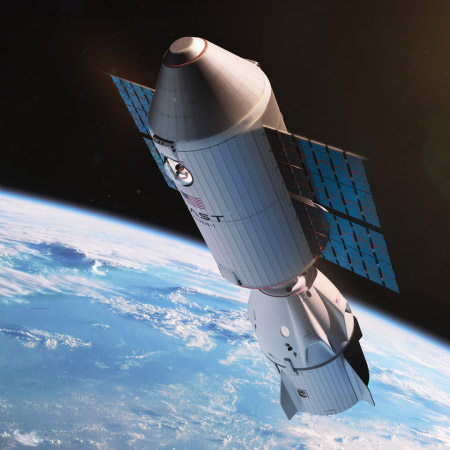
Starlab design in 2025
The Starlab design in 2025. Click
for original image.

The Japanese company Mitsubishi has now signed an agreement with the consortium building the large single module Starlab space station that will launch on Starship, reserving part of that station for the company’s own use while also increasing its financial investment in the project.

Starlab Space LLC today announced that Mitsubishi Corporation has reserved and pre-purchased capacity on Starlab’s commercial space station, becoming a foundational customer while simultaneously increasing their investment in the company and joining Starlab’s Board of Directors through representative Issei Shinohara.

The expanded partnership includes acquisition of usage rights for designated payload volume and utilization of on orbit laboratory facilities on Starlab, positioning Mitsubishi to accelerate space-based research opportunities for Japanese institutions. This customer commitment is accompanied by an expanded equity partnership that brings additional investment to support Starlab’s development.

Mitsubishi had in April 2024 already joined the Starlab partnership, though almost no details were announced at that time. Today’s announcement provides those details. It also appears Mitsubishi is bypassing Japan’s space agency JAXA, which in the past always ran such international projects. Instead Mitsubishi will directly “support Japanese space development objectives while contributing to advancements in areas such as life sciences research, advanced materials development, and next-generation manufacturing technologies.” In other words, it is telling JAXA to jump in the lake. It can do this better without that government third party, which by the way has not been very effective in recent years.

This deal continues Starlab’s aggressive momentum in recent months. Though Axiom is still listed above it in my rankings below of all the American space stations under development, I now consider the two essentially tied for second.
» Read more

0 comments

SpaceX launches another 29 Starlink satellites

SpaceX today completed its fifth launch in 2026, placing 29 Starlink satellites into orbit, its Falcon 9 rocket lifting off from Cape Canaveral in Florida.

The first stage competed its 25th flight, landing on a drone ship in the Atlantic.

At this moment the entire 2026 launch race is SpaceX, and SpaceX only. The only other entity to attempt a launch so far in 2026 has been India’s space agency ISRO, and that launch was a failure last night.

0 comments

Space station Starlab gets major new investor

Starlab design in 2025
The Starlab design in 2025. Click
for original image.

The consortium led by Voyager Technologies that is building the Starlab space station announced last week that it has obtained a major new investor with more than a billion dollars in assets.

The investor, Seven Grand Managers, is based in New York. The announcement did not specify how much the firm had committed to the Starlab project, but it was clear from this statement that involved significant funds.

Starlab is being built to be commercially viable from Day One,” said Chris Fahy, founder and chief investment officer, Seven Grand. “Our investment recognizes that commercial infrastructure in the post-ISS era is not speculative, but tangible, bankable and poised for growth. Starlab’s world-class management team and strategic partners are unlocking the beginning of this enormous opportunity.” [emphasis ine]

The highlighted quote suggest Seven Grand was impressed with the Starlab concept, a single very large ready-to-go station launched on Starship. Most of the other stations will involve assembly of multiple modules on multiple launches before they are “ready-to-go.” The only other station launching as a single module, Max Space’s Thunderbird, has only recently entered the race, and is thus far behind.

Starlab had previously raised $383 million in a public stock offering, in addition to the $217.5 million provided by NASA. This new private investment capital further strengthens its future, and suggests the station could get built and launched, even if it fails to win a major station construction contract from NASA.

Below are my rankings of the five American space station projects:
» Read more

1 comment

SpaceX launches NASA’s Pandora exoplanet space telescope

SpaceX today successfully launched a new NASA space telescope, Pandora, its Falcon 9 rocket lifting off from Vandenberg in California.

Pandora is a smallsat focused on studying 20 stars known to have transiting exoplanets. It will look at each repeatedly to draw as much information about the star and the exoplanet as possible. Also deployed were two other NASA smaller astronomy cubesats.

The Falcon 9 first stage completed its 5th flight, landing back at Vandenberg. The two fairing halves completed their first and seventh flights respectively.

At this moment, SpaceX is the only entity to have launched in 2026. This was its fourth launch.

5 comments

Space Force awards nine launch contracts to SpaceX

In announcing its next round of satellite launch awards, the Space Force’s Space Systems Command (SSC) has awarded all nine launches (valued at $739 millon total) to SpaceX, bypassing both Blue Origin and ULA.

SSC awarded the [three] SDA-2 missions to SpaceX for launches projected to begin in [the fourth quarter of fiscal year ’26], and awarded the [two] SDA-3 missions to SpaceX for launches to begin in [the third quarter of fiscal year ’27]. SSC also awarded the [four] NTO-5 launches to SpaceX projected to occur in [the first quarter of fiscal year ’27 and the second quarter of fiscal year ’28]. The total value of these awards is $739M.

It is surprising that SpaceX got all nine contracts. Even though SpaceX charges less than ULA, and Blue Origin’s New Glenn rocket is not yet certified by the Pentagon for operational launches, it has been military policy in recent years to distribute this work to more than one launch provider so as to guarantee a redundancy. ULA exists today for expressly that reason. In the past it would have certainly gotten at least one of these launches.

As for Blue Origin, the Space Force could have awarded it at least one of the later launches in ’27 and ’28, contingent on getting New Glenn certified.

That the Space Force bypassed both companies entirely speaks volumes. It appears it has decided to simply go with the best product now available, and to heck with redundancy.

20 comments

French rocket startup MaiaSpace announces its launch schedule

The French rocket startup MaiaSpace is now planning to launch a suborbital test rocket in 2026 to be followed by its first orbital flight in 2027.

As the company works toward the commencement of commercial operations in 2027, it is planning to launch an initial suborbital demonstration flight in late 2026 to validate key elements of the Maia launch system. The rocket will be launched in its full two-stage configuration and will carry a reduced propellant load, with MaiaSpace aiming for a minimum altitude of 100 kilometres. … “For what concerns our first flight, we will deploy a minimum viable product designed to test critical phases (lift-off, stages separation, engine ignition of the second stage, …) and to validate the key features required for our first orbital flight.”

Maiaspace is a wholly owned subsidiary of ArianeGroup, the Airbus-Safran partnership that builds the Ariane-6 rocket for Arianespace. Its goal with Maiaspace is to quickly develop a small reusable rocket that can compete with the other new European startups in Germany (Isar and Rocket Factory Augsburg) and Spain (PLD).

1 comment

FCC approves SpaceX request to expand Starlink by 7,500 satellites

The Federal Communications Commission (FCC) yesterday approved SpaceX’s request to both expand its Starlink constellation by 7,500 satellites as well as use additional bands of spectrum.

The Federal Communications Commission on Friday approved SpaceX’s request to launch an additional 7,500 of its Starlink Gen2 satellites, bringing the total allowed Gen2 constellation to 15,000. The agency also granted the company’s request to operate in additional spectrum bands and to operate at higher power in other bands between 10.7-30 GigaHertz (GHz), pending the completion of an existing FCC rulemaking where the question is being considered.

…The order also allows SpaceX satellites to use lower orbits, down to 340 kilometers, and provide direct-to-cell service. The company is seeking approval for a separate 15,000-satellite constellation that would provide upgraded direct-to-cell service using spectrum it’s purchasing from EchoStar.

The article notes that under the Trump administration has also revamped the FCC’s grant program, that under Biden canceled an $886 million grant, claiming absurdly that Starlink did not provide service to rural areas. Under the new program “SpaceX is set to serve the most locations of any ISP under the $42.45 billion Broadband Equity, Access, and Deployment program after new Trump administration rules that made it easier for satellite providers to compete for funding.”

Not that SpaceX or any of the other constellations need this government grant. Trump would serve the country better to shut the program down.

9 comments

SpaceX launches 29 Starlink satellites

The beat goes on: SpaceX today successfully launched another 29 Starlink satellites into orbit, its Falcon 9 rocket lifting off from Cape Canaveral in Florida.

This was SpaceX’s third launch in 2026. It remains the only entity globally to complete a launch so far this year.

The first stage of its Falcon 9 rocket (B1069) flew for its 29th time, passing the space shuttle Columbia in the rankings of the most reused launch vehicles:

39 Discovery space shuttle
33 Atlantis space shuttle
32 Falcon 9 booster B1067
30 Falcon 9 booster B1071
30 Falcon 9 booster B1063
29 Falcon 9 booster B1069
28 Columbia space shuttle

Sources here and here.

0 comments
1 31 32 33 34 35 897