
Dan Fogelberg – Same Old Lang Syne
An evening pause: A good way to end the year.
An evening pause: A good way to end the year.
Capitalism in space: SpaceX has finally rolled the first Falcon Heavy rocket out to its launchpad in preparation for at least one static fire engine test prior to is first launch.
SpaceX engineers are expected to conduct a fit check and complete other tests at pad 39A this week, followed by a hold-down firing of all 27 first stage engines some time after New Year’s Day. The company has not set a target date for the Falcon Heavy’s first liftoff, but officials say the launch is targeted in January, some time after the hold-down hotfire test.
Should it launch successfully, the Falcon Heavy will be the most powerful rocket in the world.
Update: They have now lowered the Falcon Heavy to a horizontal position. I suspect that the raising and lowering were both part of the fit check tests, and that they will soon raise the rocket up again.
An evening pause: Hat tip Wayne DeVette.
Russian engineers have successfully restored communications with Angola’s first communications satellite, AngoSat 1.
It appears the problem was in connection with the satellite’s solar panels. The link suggests that as the panels unfolded there was a loss of power, which got restored over time once the panels were extended and were charging the batteries.
Link here. Some are amusing. Some are ridiculous. One or two might actually be useful.
According to a NASA presentation last month, it appears that both SpaceX and Boeing are aiming to complete both their first unmanned and manned flights this coming year.
The schedules remain tight, but SpaceX plans to do its first unmanned demo mission in April, followed by a manned flight in August, while Boeing’s first unmanned flight is set for August, with the first manned flight in November. If these schedules happen 2018 should be quite an exciting year.
A Ukrainian Zenit rocket with a Russian Fregat upper stage successfully launched Angola’s first communications satellite into orbit today. [Update: While the rocket succeeded, it appears there is a problem with the satellite, which Russia built for Angola. Engineers have lost contact with it.]
The launch occurred earlier today, but it took nine hours for the Fregat upper stage to complete several engine burns and maneuvers to place the satellite in the correct orbit. Considering that it was a Fregat upper stage that caused the launch failure of a Soyuz rocket last month, it seemed wise to wait for these maneuvers to complete successfully before announcing this launch a success.
That Russia and Ukraine worked together to make this happen is quite amazing, considering that the two countries are essentially still fighting a war against each other. It also indicates, as noted by this article, that the future of Zenit and the Ukrainian rocket industy might not be dead.
Angosat 1 was originally supposed to blast off on a Zenit rocket from Sea Launch’s commercial ocean-going platform in the Pacific Ocean. But Sea Launch flight operations ceased in 2014, and Russian officials considered launching Angosat 1 on the heavy-lift Angara 5 rocket before deciding last year to put the satellite on a fully-assembled Zenit booster already in storage at the Baikonur Cosmodrome.
At the time of the last Zenit launch in December 2015, there were no more missions on the Ukrainian-made rocket’s manifest, leaving the Zenit program’s future in question.
But with the switch of Angosat 1’s launch to a Zenit rocket, and the purchase of Sea Launch infrastructure mothballed in Long Beach, California, by a commercial Russian airline company, there are plans for the resumption of Zenit missions in the future. The new Sea Launch company, called S7 Sea Launch, ordered a dozen new Zenit launch vehicles from Yuzhmash in April for ocean-based missions and flights staged from the Baikonur Cosmodrome. Another Zenit rocket is slated to launch a long-delayed Ukrainian telecom satellite from the Baikonur Cosmodrome next year.
This launch also probably closes out the launch schedule for 2018, with the standings as follows:
29 United States (including all companies)
20 Russia
18 SpaceX
17 China
Russia, China, and SpaceX have all indicated that they are aiming for a launch rate of about 30 launches per year. If that happens in 2018, we could see the most rocket launches next year since the late 1980s.
An evening pause: A nice way to close this year’s Christmas season. Hat tip Wayne DeVette, who notes this performance’s “unique arrangement.” Quite refreshing.
An evening pause: Most people in the secular world today know this version of the hymn, but this performance of the original is so magnificent I think all should see it, whether you are Christian or not. And for those who are Christian, what better day but today to hear it.
To me, it was this performance from 1987 by Jean Redpath that is most meaningful, but in good will I — a secular humanist born a Jew — post the gospel version now.
An daytime pause: For me, this version, starring Alastair Sim, remains the best of all the many adaptions of Charles Dickens classic short novel. Always worth seeing during the holiday season. As I wrote last year when I posted it, “I watched this again and felt like weeping, not because of the sentimentality of the story itself but because it is so seeped in a civilized world that increasingly no longer exists. There was a time when this was our culture. I fear it is no longer so. As noted by the Spirit of Christmas Present, ‘This boy is ignorance, this girl is want. Beware them both, but most of all beware this boy.’”
May all my readers have a wonderful Christmas, and a Happy New Year.
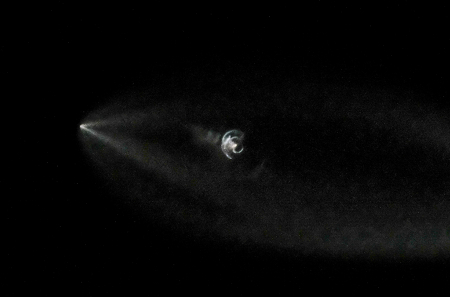
Numerous news articles today have noted that last night’s launch by SpaceX of ten Iridium satellites produced a somewhat unusual light show for Californians. Reader Frank Kelly sent me some images he took, noting,
I was able to catch the booster ascent, stage separation, second stage burn and what looks like the booster spinning with at least one engine firing. The spinning went on for a while so it must have had some fuel left.
I read SpaceX said they would not land this booster so maybe they had some fun with it for us folks in LA. It spun around for a minute like a pinwheel. A great show.

The image above right is one of his images, reduced in resolution to post here. Below that is a cropped section of the full resolution image, showing the “pinwheel” being performed by the first stage. And as other readers of BtB have also noted, the launch crew was clearly performing engine tests and maneuvers with this first stage, all the way down to the ocean.
As is typical of SpaceX, they waste no opportunity to test their equipment and find out what it can do, on the extreme. I suspect these maneuvers were designed to push the first stage’s ability to recover from an out-of-control spin. From the call-outs by engineers during the launch, it appears that this test was a success, as it appears from those call outs that the first stage “landed” properly upright in the ocean.
Let me add that in reviewing some of the youtube videos posted by my readers in the comments below, I also think these first stage maneuvers might be tests in preparation for the first Falcon Heavy launch, which will involve landing three first stages at the same time, two landing very close together at Kennedy. The flight tests yesterday could be an effort to demonstrate how well they can program those first stages for their return.
Capitalism in space: SpaceX today successfully launched ten 10 Iridium satellites.
This launch for Iridium reused a first stage from a previous Iridium launch. This was the first time Iridium launched with a used first stage. SpaceX did not try to recover the stage, which could be for several reasons, including the possible desire by the customer that they devote their entire effort to getting the satellites in orbit.
This was also SpaceX’s last launch for the year. The launch standings for the year now are thus:
29 United States
19 Russia
18 SpaceX
15 China
Sometime in the first week of 2018 I will post a full table showing this year’s launches plus the launch totals going back to the early 1980s. It reveals a great deal about the history of the launch industry for the past half century, as well as where that launch industry is likely heading in the coming half century.
An evening pause: And yes, that’s Ian Anderson of Jethro Tull on the flute.
Hat tip Wayne DeVette.
Capitalism in space: Roscosmos is considering a plan to launch a hotel module to ISS where it could house tourists for profit.
According to a detailed proposal seen by Popular Mechanics, the 20-ton, 15.5-meter-long module would provide 92 cubic meters of pressurized space. It would accommodate four sleeping quarters sized around two cubic meters each and two “hygiene and medical” stations of the same volume. Each private room would also have a porthole with a diameter of 228 millimeters (9 inches), while the lounge area of the module would have a giant 426-millimeter (16-inch) window.
The external structure of the tourist module looks like the Science and Power Module, NEM-1, which Russia is currently building for the International Space Station. The second NEM module had originally been on the books in the station’s assembly scenario, but the Russian government funded only one module. It will serve primarily as a science laboratory and a power-supply station for the ISS.
Now, Russia’s prime space station contractor, RKK Energia, came up with a scheme to pay for the second NEM module through a mix of private and state investments. To make profit, the NEM-2 would be customized for paid visitors.
Makes sense to me. Russia doesn’t really have the money right now to fund a big deep space exploration program. Better they aim for profits in space, as that will keep them in the black and provide them the capital they presently lack.
Capitalism in space: The rover being built by the Japanese team competing for the Google Lunar X-Prize has arrived in India for installation on the PSLV rocket that will launch it into space.
The Sorato rover which is flight ready will be mounted on Team Indus lander at its facility in Jakkur. HAKUTO, one of the five teams competing for the Google Lunar XPRIZE, has signed a ride share agreement with Team Indus (India’s first private aerospace startup) for launching the Sorato along with the Indian rover.
Team Indus’s spacecraft, along with the two rovers, will also carry a few payloads and will be launched onboard ISRO’s workhorse, the PSLV-XL. The launch is expected to take place early next year (before March 8, 2018, the date set by Google to the five privately funded teams to launch the landers and the rovers on the Moon surface).
Several important details here. First, though the Japanese team appears to have all the necessary funds to pay for their flight, Team Indus is still searching for investment, and might not have the money to pay for its share of the flight. What will happen in that case is unclear.
Second, the word Hakuto in Japan means “white rabbit.” This name was chosen because Japanese folklore says a rabbit can be seen in the dark areas of the Moon’s face. This makes Japan’s rover the second rabbit to fly to the moon, after China’s Yutu rover, which in English means “jade rabbit” a name also based on Chinese folklore.
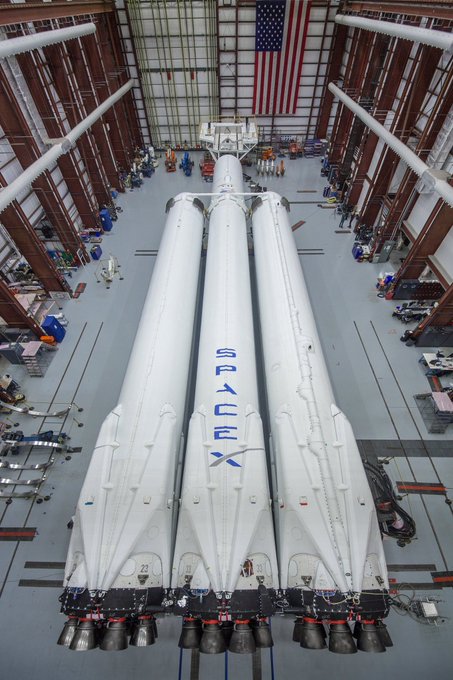
Capitalism in space: Elon Musk today tweeted several pictures of the Falcon Heavy rocket, assembled in its hanger at Cape Canaveral and awaiting roll out for its first static fire tests on the launchpad.
As I will have nothing to do with Twitter, I must thank reader Michael Phillips for emailing me the photos. The one of the right I think shows the most detail. Note that the two side stages are previously flown Falcon 9 first stages. Only the central core has not flown before. According to previous reports, it required significant redesign to work in this configuration.
There is as yet no word on exactly when the roll out and launchpad static fire tests will take place, but all indications suggest it will be very soon. Whether the launch itself will follow several weeks later, as the link above says and has been stated many times by SpaceX, is more questionable. Remember, they have never fired all 27 engines of the threefold first stage at the same time. I am expecting that they will need time to review the data from that static fire test. I would be very surprised if their analysis and any changes it calls for will be doable in only a few weeks.
An evening pause: I think this song is fitting for the last night of Hanukkah. For Jews, this verse well describes perfectly what it is like when they try to express their point of view in a harsh and hostile world:
“Fools” said I, “You do not know
Silence like a cancer grows
Hear my words that I might teach you
Take my arms that I might reach you”
But my words like silent raindrops fell
And echoed in the wells of silence
The two singers are brothers and rabbis, and are performing here for an Israeli television show modeled after American Idol called Rising Star.
Hat tip Jim Mallamace.
Local county officials in Florida are involved in a court fight over the decision by the county to borrow $8 million in order to pay a grant to Blue Origin for locating its factory there.
Brevard County commissioners narrowly approved a plan that would allow the county to borrow money to pay for an $8 million economic incentive to rocket manufacturer Blue Origin. The vote was 3-2, with Chair Rita Prichett and Commissioners Jim Barfield and Curt Smith supporting the proposal. Vice Chair Kristine Isnardi and Commissioner John Tobia voted against the plan.
Brevard County Clerk of Courts Scott Ellis told commissioners he plans to go to court to challenge the legality of the county borrowing money to pay for the grant to Blue Origin.
Isnardi is quoted in the article as saying “I don’t think it’s a great policy to give $8 million to a billionaire.” The opposition to this grant also questions the legality of borrowing money to pay it.
Capitalism in space: A World View balloon exploded at its launch facility in Tucson yesterday.
No injuries were caused when a large, tethered test balloon ruptured as crews deconstructed it after a successful ground test to fill the balloon, World View spokesman Andrew Antonio said. The rupture resulted in a loud sound heard in the area, and a small fire on the balloon, he said. “We have reached out to reassure our immediate neighbors,” Antonio said. “There were no injuries and only superficial facility damage at the site.”
World View says it can use either helium or hydrogen gas to fill its stratospheric balloons but has initially been using hydrogen, which company officials have said is safe when handled properly.
World View also released its first images from a Stratollite balloon flight yesterday.
I think the second link demonstrates clearly that Stratollite is a good concept for high altitude reconnaissance. I think the first link demonstrates that hydrogen is still problematic for high altitude balloons.
An evening pause: This is the second Christmas song I’ve posted by Daniela Andrade, and this is the third version I’ve posted of this particular song, one by Katie Melua and the second the original by Judy Garland.
No matter. This version is as good as the others.
Hat tip Edward Thelen.