Orbital ATK prepares Cape Canaveral launchpad for July Minotaur launch

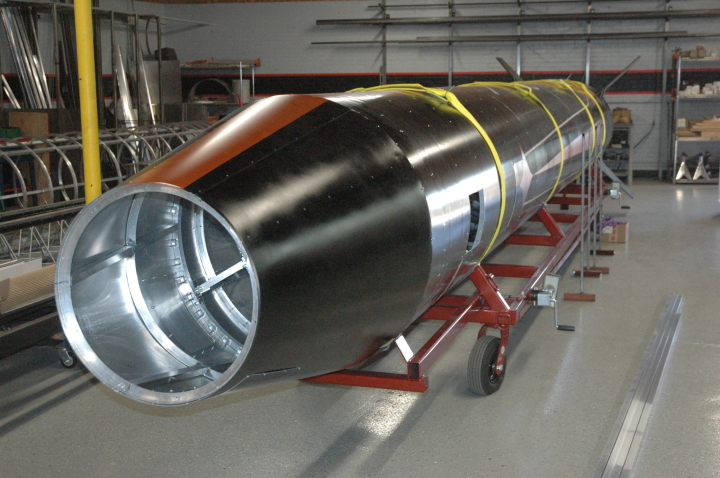
The competition heats up: Orbital ATK crews on Sunday practiced stacking stages on a Cape Canaveral launchpad in preparation for a July Minotaur 4 launch of an Air Force surveillance satellite.

Teams this weekend stacked three inert Peacekeeper missiles stages on a launch stand similar to those that will make up the Minotaur IV rocket’s first three stages. Two more Orion 38 stages will fill out the rocket. On Sunday, the first three stages standing more than 50 feet tall were surrounded by puffy white covers that will keep the right temperature during the launch campaign’s summer heat.

Plans called for the mobile gantry to be rolled back on rails to its launch position before the stages are taken down on Monday.

Orbital ATK has been prevented from expanding its Minotaur 4 market beyond military launches because the rocket uses these available but now unused Peacekeeper missiles and is thus very inexpensive. Their competitors have been their influence in Congress to forbid their use commercially.

2 comments

SpaceX successfully completes Falcon 9 static fire test

SpaceX on Sunday successfully completed the launch dress rehearsal countdown and static fire test for its next Falcon 9 launch, which will loft a Dragon capsule to ISS and is set now for February 18.

The article at the link as well as a lot of other news organizations are making a big deal about the fact that this launch is taking place at the LC-39A launchpad, used during the Apollo program as well as by the shuttle. While the historic background is interesting, of more significance to me is that this test brings SpaceX closer to having two operational pads in Florida, one of which (LC-39A) is configured for Falcon Heavy launches.

1 comment

UK commits £10 million to space development

The competition heats up: The United Kingdom’s space agency yesterday announced that it is making available £10 million in grants for projects that develop and improve the country’s launch capabilities.

Organisations expected to bid for a share of the funding are likely to be joint enterprises of launch vehicle operators and potential launch sites. The funding must be used to develop spaceflight capabilities, such as building spaceport infrastructure or adapting launch vehicle technology for use in the UK. The aim is to establish a commercial spaceflight market to capture a share of the emerging global market from 2020.

The government also announced today that it is preparing legislation to develop a safe and competitive regulatory environment for spaceflight. This work goes hand-in-hand with government’s work internationally to achieve the technical, trade and policy agreements necessary for UK based launch services and developing interest from launch customers and operators from around the world.

It is interesting to me that the UK’s effort to prepare a better regulatory environment for private space is happening parallel to the similar recently-announced regulartory efforts in Luxembourg, the United States, and the United Arab Emirates, just to name a few. It seems that the nations that wish to compete in the new colonial movement in space are all discovering that the Outer Space Treaty is a problem, and they are all searching for ways to legally bypass it, without abandoning it.

5 comments

Trump to the Moon!

Two stories in the past two days strongly suggest that the Trump administration is planning a two-pronged space policy approach, with the long-term goal of shifting most of space to private operations.

From the first link:

The more ambitious administration vision could include new moon landings that “see private American astronauts, on private space ships, circling the Moon by 2020; and private lunar landers staking out de facto ‘property rights’ for American on the Moon, by 2020 as well,” according to a summary of an “agency action plan” that the transition drew up for NASA late last month. Such missions would be selected through an “internal competition” between what the summary calls Old Space, or NASA’s traditional contractors, and New Space characterized by SpaceX and Blue Origin. But the summary also suggests a strong predilection toward New Space. “We have to be seen giving ‘Old Space’ a fair and balanced shot at proving they are better and cheaper than commercial,” it says.

Another thrust of the new space effort would be to privatize low-Earth orbit, where most satellites and the International Space Station operate — or a “seamless low-risk transition from government-owned and operated stations to privately-owned and operated stations.” “This may be the biggest and most public privatization effort America has ever conducted,” it says.

Essentially, they are going to do exactly what I suggested back in late December, give SLS/Orion a short-term realistic goal of going to the Moon. This is what it was originally designed for, and it is the only technology presently available that has even the slightest chance of meeting the three year deadline outlined above. More important, this will give Congress something in the negotiations, as SLS/Orion has been Congress’s baby — pushed and funded by Congress over the objections of the previous administration and without a clear mission to go anywhere — in order to keep the money stream flowing to the big “Old Space” companies like Boeing and Lockheed Martin. Obama tried to simply cancel its predecessor, Constellation, and that did not sit well with Congress. Trump however understands negotiation and how to play the game. In order to eventually eliminate SLS Trump is going to provide Congress some short term excitement and some viable long term alternatives.

The long term alternatives will be private enterprise. Even as they send SLS/Orion on its grand finale to the Moon, the Trump administration will accelerate the restructuring of NASA to make the agency less of a design and construction operation and more a mere customer of private space. All non-military Earth orbital operations will be shifted to the private sector over time, so that once SLS/Orion has achieved that goal of completing a lunar mission there will be a strong enough private space sector to replace it, allowing Congress to let it go the way of Apollo and the space shuttle.

9 comments

Orbital ATK sues DARPA over its satellite repair program

Orbital ATK has filed a lawsuit against the Defense Department’s DARPA division over its satellite repair program that is apparently going to award a contract to a Canadian company to develop a system for using robots to repair orbiting satellites.

Orbital argues that the federal program, called the Robotic Servicing of Geosynchronous Satellites, would unfairly compete with its own privately funded effort, a system called the Mission Extension Vehicle 1, backed by at least $200 million from investors. The company has set up at a production facility in Northern Virginia, with a launch planned for next year.

DARPA wants to build out a government-funded program of its own, and is close to awarding a contract to a company that Orbital views as a competitor. In a contract announcement briefly posted on the agency’s website, DARPA said it is awarding a $15 million contract to Space Systems/Loral (SSL), a U.S. subsidiary of Canadian aerospace firm MacDonald, Dettwiler and Associates. DARPA spokesman Jared B. Adams said the contract award was posted in error and elements of the deal are still being worked on.

In its lawsuit, Orbital alleges that the contract violates federal policy against creating government space programs that compete with existing commercial ones. “The U.S. National Space Policy explicitly directs government agencies to avoid funding activities that are already in development in the commercial marketplace,” the company said in a statement. “Orbital ATK will continue to pursue all available options to oppose DARPA from moving forward with this illegal and wasteful use of U.S. taxpayer dollars.”

DARPA normally pushes projects that no one is doing, either because the work is too experimental or can’t yet make a profit. In this case however it appears that this is not the case. Worse (from a political perspective), they are awarding the contract to a non-American company. I would not be surprised if Congress soon steps in and shuts this particular DARPA project down.

0 comments

Democrats in Pima County vote to appeal World View court decision

The Pima County Board of Supervisors in Arizona has voted 3-2 on a party-line vote to appeal a judge’s decision that canceled the county’s deal with the space tourism balloon company World View because it violated state law.

The Pima County Board of Supervisors voted 3-2 to appeal a Superior Court decision which concluded the county violated state law when it signed an agreement and lease with World View, a space exploration company located near the Tucson International Airport.

The vote was along party lines, with the three Democrats voting for the appeal and the two Republicans voting against it.

The court ruled the county did not comply with a law which requires the county to appraise the property, hold a public auction, and negotiate a fair rental price before it agreed to build a $15 million complex for the company.

It seems to me that — rather than fight this in court — the smart thing to do here is to work out a new agreement that does not violate the law, something that the county was able to do with its lease agreements with Vector Space Systems. This apparently was what the Republicans on the board were proposing. Instead, the Democrats have chosen to fight, even though that will delay things further and is likely to fail in court anyway.

0 comments

Educated Fish

An evening pause: I especially like the worm’s imitation of Mae West.

On a more serious note, these old animated films provide a very real window into the culture that existed in America in the 1930s. If you want to know where we are going, compare this to today’s art.

Hat tip James Mallamace.

2 comments

NanoRacks and Boeing to build private airlock on ISS

The competition heats up: NASA has signed an agreement with NanoRacks and Boeing to build private commercial airlock to attach to ISS in 2019 and be used for commercial operations.

Commercial opportunities through Airlock begin with cubesat and small satellite deployment from station and include a full range of additional services to meet customer needs from NASA and the growing commercial sector. Currently, cubesats and small satellites are deployed through the government-operated Japanese Kibo Airlock. Additionally, the crew on board may now assemble payloads typically flown in soft-stowage ISS Cargo Transfer Bags into larger items that currently cannot be handled by the existing Kibo Airlock. “We are very pleased to have Boeing joining with us to develop the Airlock Module,” says NanoRacks CEO Jeffrey Manber. “This is a huge step for NASA and the U.S. space program, to leverage the commercial marketplace for low-Earth orbit, on Space Station and beyond, and NanoRacks is proud to be taking the lead in this prestigious venture.”

Beyond station, the Airlock could at some future time, be detached and placed onto another on-orbit platform.

This is part of the overall transition at NASA from government-built and -run to privately-built and -run.

1 comment

Jean Redpath – How Can I Keep from Singing

A evening pause: Performed live June 13, 1987. I think of these words whenever I am in a truly glorious place underground:

My life goes on in endless song
Above earth’s lamentations,
I hear the real, though far-off hymn
That hails a new creation.

Through all the tumult and the strife
I hear it’s music ringing,
It sounds an echo in my soul.
How can I keep from singing?

While though the tempest loudly roars,
I hear the truth, it liveth.
And though the darkness ’round me close,
Songs in the night it giveth.

No storm can shake my inmost calm,
While to that rock I’m clinging.
Since love is lord of heaven and earth
How can I keep from singing?

3 comments

ULA to trim workforce again

The competition heats up: In another effort to cut costs, ULA is planning to trim its workforce again in 2017.

In 2016 they cut 350 jobs. They haven’t specified a number this time, as they hope to initially eliminate jobs through voluntary buyouts and layoffs. Regardless, this is a good sign, as it indicates that the company remains serious about being competitive in the launch market.

0 comments

Judge strikes down Tucson/Worldview spaceport deal

A deal between Pima County in Tucson Arizona and the space tourism balloon company World View has been struck down.

The Tucson judge sided with the libertarian Goldwater group, which argued Pima County ran afoul of state rules governing subsidies and incentives to businesses. “Judge Woods’ ruling protects Pima County taxpayers from having to foot the bill for World View’s untested business model,” said Jim Manley, senior attorney at the Goldwater Institute. “Instead of relying on a sweetheart deal from taxpayers, World View will need to pay market rates to lease its building, just like every other business in Pima County.”

Goldwater attorneys didn’t like that Pima County approved the deal without a popular ballot measure and that the deal was done without an appraisal. Goldwater also argued the lease deal was for less than market rates for a custom building. “The county is free to renegotiate the lease,” said Manley, “but only after they appraise the building, hold a public auction, and lease the building to the highest bidder. All of that will protect taxpayers from illegally subsidizing a private business.”

As much as I want this business to thrive, I think the Goldwater Institute was right. Pima County violated numerous laws and even some parts of the state constitution putting together this deal. Even if there was no corruption here, it opened the door to future backroom corruption if the deal was allowed. Now, I expect World View and the county will have to renegotiate.

0 comments

Congressional report worries over Falcon 9 engine cracks

A forthcoming congressional report, reported by the Wall Street Journal, reveals that NASA is concerned about cracks that occur in the turbopumps of SpaceX’s Merlin engines.

The newspaper says the report has found a “pattern of problems” with the turbine blades within the turbopumps, which deliver rocket fuel into the combustion chamber of the Merlin rocket engine. Some of the components used in the turbopumps are prone to cracks, the government investigators say, and may require a redesign before NASA allows the Falcon 9 booster to be used for crewed flights. NASA has been briefed on the report’s findings, and the agency’s acting administrator, Robert Lightfoot, told the newspaper that he thinks “we know how to fix them.”

A spokesman for SpaceX, John Taylor, said the company already has a plan in place to fix the potential cracking issue. “We have qualified our engines to be robust to turbine wheel cracks,” Taylor said. “However, we are modifying the design to avoid them altogether. This will be part of the final design iteration on Falcon 9.” This final variant of the Falcon 9 booster, named Block 5, is being designed for optimal safety and easier return for potential reuse. According to company founder Elon Musk, it could fly by the end of this year.

Here’s the real scoop: SpaceX initially built the engines to fly once, just as every single rocket company has done in the entire history of space, excluding the space shuttle. Under these conditions, the cracks could be considered an acceptable issue, which is what they mean when they say “We have qualified our engines to be robust to turbine wheel cracks.” My guess is that they tested the engines, found that the cracks were not a significant problem for a single flight, especially because the Falcon 9 rocket uses nine Merlin engines on the first stage and thus has some redundancy should one fail. And based on SpaceX’s flight record — no launch failures due to failed engines — that conclusion seems reasonable.

SpaceX is now redesigning to eliminate the cracks, however, because such cracks are not acceptable for engines that will fly multiple times on reused first stages.

Thus, this story, as leaked, appears to me to be a hit job by powers in Congress who dislike the competition that SpaceX poses to big government rockets like SLS. SLS will use salvaged shuttle engines, designed initially for many reuses, and thus are superior in this manner to SpaceX’s Merlin engines. The shuttle engines however were also built by the government, which didn’t care very much about the cost of development, or making any profits. The comparison thus is somewhat bogus. Moreover, I suspect these cracks were only discovered after SpaceX successfully landed and recovered some first stages. To put them on trial in the press now for doing good engineering research and redevelopment seems somewhat inappropriate.

The report itself has not yet been released, though it does also note lingering issues with the parachutes being developed for Boeing’s Starliner capsule.

Overall, both companies are struggling to start their operational flights by 2019. For Congress or NASA to try to put more roadblocks up in that development seems most counterproductive.

9 comments

More new robots from Boston Dynamics

The video at the link shows off SpotMini, of video of which I posted previously. However, the first robot shown is one they have named Handle and is something they admit could be “nightmare-inducing.” It walks upright on two legs, but instead of feetpods it has wheels, giving it the ability to move very fast. And for some reason, they put its arms on backwards so that the elbows bend inward instead of outward.

Watch the video. The robot design work here is truly breath-taking.

5 comments

The ships of Hanjin six months after it went bankrupt

Real news: Six months ago the shipping company Hanjin went bankrupt, stranding its 96 container ships worldwide. This article takes a detailed look not only on what happened to those ships since, but also at the state of the entire shipping industry.

There was a time when Hanjin’s collapse in August and this follow-up story would have been major news stories, covered by all the leading mainstream press outlets. No more. Even though it indicates significant financial and economic trends that should concern anyone who is serious about being an educated citizen, the press doesn’t cover it, and the public today really doesn’t care.

Just another indicator that a new dark age is looming.

6 comments

ESA commits $91 million to reusable rocket engine development

The competition heats up? Despite a general lack of interest in reusability, the ESA has now committed $91 million to develop a new low cost prototype reusable rocket engine.

In an interview with SpaceNews, Airbus Safran Launchers CEO Alain Charmeau said FLPP is allocating 85 million euros ($91 million) to Prometheus to fund research and development leading to a 2020 test firing. Now that Prometheus is an ESA program, Charmeau expects more countries will get involved. “ESA will pay the contract to Airbus Safran Launchers and then Airbus Safran Launchers will cooperate with European industry, of course France and Germany, but we will have also contributions from Italy, Belgium, Sweden and probably a couple of others to a smaller extent,” Charmeau said.

This project reminds me of many NASA development projects. The agency spends the money to do a test firing, but the prototype is never used and gets abandoned as soon as the test is completed.

Things might change, however, come the 2020s. By then I think American companies will be quite successful in their effort to create reusable rockets, and that will leave Europe in the lurch competitively. Their solution at this time for combating that future competition however is not getting more competitive. Instead, as noted in the article at the link, Airbus Safran, the company building Ariane 6, wants the ESA to compel its members to use their rocket, regardless of cost.

0 comments
1 383 384 385 386 387 542