SpaceX launches Indonesian commercial communications/broadband satellite

SpaceX tonight successfully launched an Indonesian commercial communications/broadband satellite, its Falcon 9 rocket lifting off from Cape Canaveral in Florida.

The first stage completed its 23rd flight, landing on a drone ship in the Atlantic. The two fairings completed their 16th and 24th flights respectively.

The leaders in the 2025 launch race:

116 SpaceX
53 China
12 Rocket Lab
12 Russia

SpaceX now leads the rest of the world in successful launches, 116 to 91.

0 comments

Dennis James – Mozart’s Adagio for Glass Harmonica

An evening pause: Performed live 2017. And yes, that is a real instrument, using “a series of glass bowls or goblets graduated in size to produce musical tones by means of friction.” What is even more interesting is that it was invented by Benjamin Franklin in 1761.

Hat tip Judd Clark.

0 comments

SpaceX launches military payload for the Pentagon’s Space Development Agency

SpaceX early today successfully launched a classified military payload for the Pentagon’s Space Development Agency, its Falcon 9 rocket lifting off from Vandenberg Space Force Base in California.

The first stage completed its sixth flight, landing on a drone ship in the Pacific.

I did not post this in the morning because there was a second SpaceX launch scheduled for the afternoon, and I planned on posting both launches in one post. That launch however was scrubbed and rescheduled for tomorrow.

The leaders in the 2025 launch race:

115 SpaceX
53 China
12 Rocket Lab
11 Russia

SpaceX now leads the rest of the world in successful launches, 115 to 90.

4 comments

Update on what SpaceX learned about Starship’s tiles during the 10th test flight

Superheavy after its flight safely captured at Boca Chica
Superheavy after the October 2024 flight,
safely captured during the very first attempt

Link here. The update comes from a presentation given this week by Bill Gerstenmaier, SpaceX’s executive in charge of build and flight reliability, at the American Astronautical Society’s Glenn Space Technology Symposium in Cleveland.

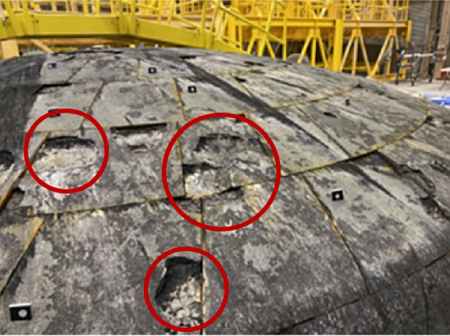
Lots of new details. First, almost no tiles fell off during this flight. More significant, they found that the use of metal tiles won’t work. They tested three, and found that “The metal tiles… didn’t work so well.”

Gestenmaier also outlined how the flight provided the necessary data for sealing the gaps between the tiles better.

Gerstenmaier pointed to a patch of white near the top of Starship’s heat shield. This, he said, was caused by heat seeping between gaps in the tiles and eroding the underlying material, a thermal barrier derived from the heat shield on SpaceX’s Dragon spacecraft. Technicians also intentionally removed some tiles near Starship’s nose to test the vehicle’s response.

“It’s essentially a white material that sits on Dragon and it ablates away, and when it ablates, it creates this white residue,” Gerstenmaier said. “So, what that’s showing us is that we’re having heat essentially get into that region between the tiles, go underneath the tiles, and this ablative structure is then ablating underneath. So, we learned that we need to seal the tiles.”

They hope to do the 11th test flight in October, repeating the same suborbital configuration of previous flights, using the same version 2 of Starship. The plan will then be to follow up with a first suborbital flight of version 3 in 2026, followed quickly by orbital flights. During one of those orbital flights they will also try to do a chopstick catch of Starship. They also hope to do the first refueling tests next year.

All in all, it appears the test program is proceeding as hoped, and is about to accelerate significantly.

1 comment

Croatian startup moves up the launch date for two subscale returnable capsules

The Croatian startup Genesis Space Flight Laboratories (Genesis SFL) has now accelerated the development of its orbital returnable capsule for manufacturing in space, moving up the launch date for its first two subscale demonstrator capsules from 2027 to 2026.

Initially planned for 2027, the missions were moved forward after Genesis SFL announced on 9 September that it had secured earlier slots with an as-yet-undisclosed launch provider.

Speaking to European Spaceflight, Genesis SFL CEO Bence Mátyás explained that the company’s GEN-1 and GEN-2 demonstrators will likely be the smallest reentry capsules ever flown, comparable in size to picosatellites. Despite their diminutive size, the capsules will be capable of remaining in orbit for approximately six months before performing reentry procedures, a capability made possible by the use of a host satellite [essentially the service module] also under development by the company. Once on a reentry trajectory, the capsule will separate from its host satellite and deploy a mini-parachute and antenna to enable recovery following a splashdown.

If these demonstrators succeed, the company plans to scale up later GEN capsules step-by-step, eventually matching and even exceeding those of companies like Varda.

The returnable capsule industry appears at the moment to be bursting with new companies. In the U.S. we have Varda, Inversion Space, Sierra Space, and even SpaceX using Starship. In Europe — in addition to Genesis in Croatia, we have The Exploration Company in France, Atmos in Germany, PLD in Spain, and Space Cargo in Luxembourg. And I am certain there are others that I am missing.

Very clearly the investment community sees big profits in using orbital capsules to manufacture products for later sale on Earth.

0 comments

Rather than streamline red tape, a UK government committee proposes it should fund its space industry directly

Proposed spaceports surrounding Norwegian Sea

In a move that will do nothing to solve the red tape that has stymied the spaceports in Scotland as well as the launch industry in the United Kingdom, a Scottish government committee has concluded that the solution is for the UK government to become a direct investor in its space industry, increasing funding to both its spaceports and any launch companies that wish to use them.

The Scottish Affairs Committee heard from a number of experts and figures involved in the space industry. Professor Malcolm Macdonald, of Strathclyde University, said the UK had not always sustained its “first-mover” advantage in the space launch sector.

The report’s conclusion stated: “It is clear that the UK is falling behind its European counterparts in terms of public investment, leaving Scottish spaceports at a competitive disadvantage in a fast-moving global market. Without sustained backing from the Government – particularly in infrastructure – Scotland risks missing a generational opportunity to lead in space launch. To fully realise this potential, the UK Government needs to go further and faster.”

The MPs called for sustained Government investment in infrastructure.

The report also noted that despite a half-decade head start in establishing its spaceports in Scotland, the Andoya spaceport in Norway is now winning the race to become Europe’s prime spaceport.

Talk about not seeing the forest for the trees. The reason the UK’s spaceports have fallen behind is because its regulatory framework is impossible to navigate, taking years to get any approvals. But rather than fix this, this committee proposes throwing taxpayer money at the problem.

My prediction: It won’t work. Outside rocket companies will continue to move away from the UK, while any that get government investment to stay will find it difficult to get business, because it will still be impossible to get launch licenses when needed.

14 comments

India’s government finalizes deal to transfer operation of its SSLV rocket to a private company

India’s government and its various space agencies yesterday finalized its deal with the Indian company Hindustan Aeronautics Limited (HAL) to take over the manufacture and operation of its government-designed SSLV rocket (Small Satellite Launch Vehicle) for the next decade.

Under the technology transfer contract that HAL signed with ISRO, Indian National Space Promotion and Authorisation Centre (IN-SPACe) and NewSpace India Limited (NSIL), the aviation major will absorb the technology in the first two years, which will be followed by a 10-year production phase. The agreement grants HAL a non-exclusive, non-transferable license to the SSLV technology, which includes comprehensive design, manufacturing, quality control, integration, launch operations, and post-flight analysis documentation, as well as training and support. HAL will be responsible for the mass production of SSLV to meet Indian and global demands,” the company says in a statement.

Initially the Modi government had implied the transfer would involve ownership of the rocket by the private company, so that it could market the rocket for profit. The actual deal does not do this. Instead, it gives HAL the responsibility to manufacture and operate the rocket, but it appears sales and ownership will still be under the control of India’s space agency ISRO. If this is correct, the deal accomplishes less than nothing, and in fact simply adds another player in the game, making the SSLV rocket less competitive in the international market.

Then again, the Modi government might see this deal as just a first step in the transition from a government-run space program to a competitive independent space industry. It needs to wrest control from ISRO, and this can’t be done politically in one fell swoop.

To me however this deal for HAL is a bad one. It now has the responsibility for making and launching the rocket, but none of the benefits.

1 comment

South Korea military begins project to develop a methane-fueled rocket engine

The South Korean defense department has awarded a consortium of Korean aerospace companies a contract to develop a methane-fueled engine that can be used in reusable rockets.

According to the space industry, a consortium led by Hyundai Rotem and Korean Air was selected on the 9th as the preferred negotiator for a 35-ton methane engine technology development project overseen by the Agency for Defense Development (ADD) under the Defense Acquisition Program Administration (DAPA). A formal agreement will be signed in November, initiating full-scale research and development (R&D). The project, budgeted at approximately 49.1 billion Korean won [$35 million], will run until 2030.

It appears there has been a turf war between the military and South Korea’s newly formed space agency, KASA. Originally KASA had planned to develop this engine, but apparently the military’s proposal won out. KASA now says it will collaborate with the ADD, but the project’s budget now goes to the military.

0 comments

EchoStar sells spectrum licenses to SpaceX for $17 billion while buying into Starlink

EchoStar today announced it has sold two of its spectrum licenses to SpaceX for $17 billion, in a deal that will also allow EchoStar’s customers to access Starlink.

EchoStar has entered into a definitive agreement with SpaceX to sell the company’s AWS-4 and H-block spectrum licenses for approximately $17 billion, consisting of up to $8.5 billion in cash and up to $8.5 billion in SpaceX stock valued as of the entry into the definitive agreement. Additionally, the definitive agreement provides for SpaceX to fund an aggregate of approximately $2 billion of cash interest payments payable on EchoStar debt through November of 2027.

In connection with the transaction, SpaceX and EchoStar will enter into a long-term commercial agreement, which will enable EchoStar’s Boost Mobile subscribers – through its cloud-native 5G core – to access SpaceX’s next generation Starlink Direct to Cell service.

Essentially, in exchange for the spectrum EchoStar is investing in SpaceX.

EchoStar also today canceled a contract it had signed in early August with the satellite company MDA to build its own 100 satellite constellation designed to provide direct-to-cellphone service, competing with Starlink and AST SpaceMobile. EchoStar will no longer build a rival constellation.

Wall Street apparently liked this deal, as EchoStar’s stock value quickly rose about 19%. It also appears the deal resolves questions the FCC had raised about EchoStar recent activities.

13 comments
1 60 61 62 63 64 897