Blue Origin wins contract to bring NASA’s Viper rover to the Moon

NASA yesterday awarded Blue Origin a contract to use its Blue Moon lunar lander to transport the agency’s troubled Viper rover to the Moon’s south pole region.

The CLPS task order has a total potential value of $190 million. This is the second CLPS lunar delivery awarded to Blue Origin. Their first delivery – using their Blue Moon Mark 1 (MK1) robotic lander – is targeted for launch later this year to deliver NASA’s Stereo Cameras for Lunar-Plume Surface Studies and Laser Retroreflective Array payloads to the Moon’s South Pole region.

With this new award, Blue Origin will deliver VIPER to the lunar surface in late 2027, using a second Blue Moon MK1 lander, which is in production. NASA previously canceled the VIPER project and has since explored alternative approaches to achieve the agency’s goals of mapping potential off-planet resources, like water.

The contract does not guarantee this mission. NASA has several options along the way to shut things down, depending on the milestones Blue Origin achieves. The first of course is the success of that first lunar lander.

The announcement does not make clear how NASA is going to pay for the work needed to finish Viper. VIPER was originally budgeted at $250 million. When cancelled in 2024 its budget had ballooned to over $600 million, and that wasn’t enough to complete the rover for launch. Moreover, after getting eleven proposals from the private sector companies to finish and launch Viper, in May 2025 NASA canceled that solicitation.

It is very likely Blue Origin is picking up the tab, but if so the press release does not say so.

10 comments

FAA releases proposed revisions to environmental assessment at Boca Chica to accomodate full orbital testing and return of both Superheavy and Starship

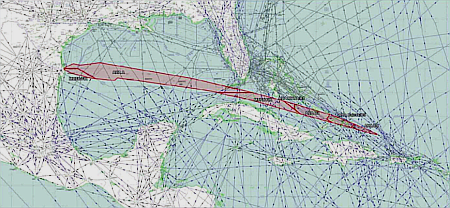
The planned return trajectories for both Superheavy and Starship
The planned return trajectories for both
Superheavy and Starship

The FAA today released [pdf] a new draft of the environmental assessment of SpaceX’s Superheavy/Starship operations at Boca Chica that will allow for full orbital flights as well as for both to return to that launchpad.

The two maps to the right show the two planned return paths for Superheavy (top) and Starship (bottom) as it comes back from orbit. In both cases the ships will return to Boca Chica to be caught by tower chopsticks. The reassessment analyzed the impacts of these trajectories, including its impact on aviation traffic, and concluded the proposal was acceptable. From its conclusion:

The 2022 PEA [Programmatic Environmental Assessment] and April 2025 Tiered EA [environmental assessment] examined the potential for significant environmental impacts from Starship-Super Heavy launch operations at the Boca Chica Launch Site and defined the regulatory setting for impacts associated with Starship-Super Heavy. The areas evaluated for environmental impacts in this Tiered EA include aviation emissions and air quality; noise and noise-compatible land use; hazardous materials; and socioeconomics. In each of these areas, the FAA has concluded that no significant impacts would occur as a result of the Proposed Action. [emphasis mine]

This approval is still only a draft. It must go through a public comment period, ending October 20, 2025. There will also be a virtual public meeting on October 7, 2025. Information about submitting comments or participating in that virtual meeting can be found here.

Such meetings are likely to see the leftist anti-Musk crowd come out in droves, screeching how we are all gonna die if these launches are allowed. The FAA will nod its head, and then ignore the Chicken Littles and approve this plan.

The plan itself tells us that SpaceX is definitely gearing up the first orbital flights of Starship next year, along with the first attempts to catch it with the tower chopsticks.

2 comments

Luxembourg cargo capsule startup Space Cargo raises $32 million in private investment capital

The Luxembourg cargo capsule startup Space Cargo has now raised $32 million in private investment capital in a new funding round focused on developing its BentoBox platform for in-space manufacturing and experimentation.

On 15 September, the company announced that it had closed a €27.5 million Series A funding round led by Expansion Ventures and supported by Eurazeo. The round included participation from the European Innovation Council, the European Investment Bank, and the Luxembourg Future Fund II, which is managed by Société Nationale de Crédit et d’Investissement and the European Investment Fund. It also included contributions from numerous private investors who participated through the crowd-equity platform Tudigo.

Unlike Varda’s returnable capsule, BentoBox is smaller and not designed to return to Earth. Instead it gets launched incorporated on orbital spacecraft built by others, such as Thales Alenia’s REV-1 tug and Atmos’s Phoenix returnable capsule.

0 comments

Astra is now targeting mid-’26 for first launch of its new Rocket-4 rocket

According to a presentation by Astra officials this week, the company now plans the first launch of its larger Rocket-4 rocket in the summer of 2026, followed by a second launch in the fall for the Pentagon.

The summer 2026 inaugural launch will be a test flight, Kemp said, followed by one in October or November for the Defense Department’s Space Test Program. Astra plans quarterly launches of Rocket 4 in 2027, with long-term goals for much higher launch rates. Astra has maintained plans to make Rocket 4 a transportable launch system using standard shipping containers, allowing it to operate from sites with little more than a concrete pad.

This company has had a checkered history. It built and launched its smaller Rocket-3 rocket several times back in 2021 and 2022, with mixed results. After those launch failures it then decided to retire that smaller rocket for Rocket-4, only to run out of cash in 2023-2024. In 2024 its founders put together the cash to buy up the company’s stock to go private, and since then it has made most of its money from that one military test contract as well as selling its electrical propulsion systems to satellite companies.

If it gets Rocket-4 off the ground and begins regularly launches it will be an amazing recovery.

1 comment

SpaceX launches 28 Starlink satellites

SpaceX very early this morning successfully launched another 28 Starlink satellites, its Falcon 9 rocket lifting off from Cape Canaveral in Florida.

The first stage completed its seventh flight, landing on a drone ship in the Atlantic.

The leaders in the 2025 launch race:

119 SpaceX
54 China
13 Russia
12 Rocket Lab

SpaceX now leads the rest of the world in successful launches, 119 to 93.

0 comments

NASA and Northrop Grumman work out rendezvous plan to get Cygnus to ISS

UPDATE: The plan worked and Cygnus is safely berthed at ISS.

According to a press release tonight, NASA and Northrop Grumman have figured out a new rendezvous plan to get Cygnus to ISS after its previous engine burns yesterday cut off prematurely and left it in the wrong orbit.

NASA and Northrop Grumman are targeting the safe arrival of the company’s Cygnus XL at approximately 7:18 a.m. EDT Thursday, Sept. 18, to the International Space Station. The Cygnus XL now will conduct a series of burns to bring the spacecraft to the space station for its robotic capture and installation.

NASA astronaut Jonny Kim is scheduled to capture Cygnus XL using the station’s Canadarm2 robotic arm with backup support from NASA astronaut Zena Cardman. After capture, the spacecraft will be installed on the Unity module’s Earth-facing port and will remain at the space station until March 2026.

The release also added this detail about why that engine burn ended too soon:

Data shared by the spacecraft confirmed that Cygnus XL operated as intended during two planned maneuvers when an early warning system initiated a shutdown command and ended the main engine burn because of a conservative safeguard in the software settings.

Apparently this cause has reassured them that the engine is in good shape for the final rendezvous burns.

4 comments

Premature engine cutoff forces postponement of Cygnus berthing to ISS

During the second of two engine burns today, designed to raise the orbit of Northrop Grumman’s Cygnus freighter to match ISS’s, the burn ended prematurely, placing the capsule in the wrong orbit.

Early Tuesday morning, Cygnus XL’s main engine stopped earlier than planned during two burns designed to raise the orbit of the spacecraft for rendezvous with the space station, where it will deliver 11,000 pounds of scientific investigations and cargo to the orbiting laboratory for NASA. All other Cygnus XL systems are performing normally.

The berthing, using one of the robot arms on ISS, had been planned for early tomorrow, Wednesday, but will not occur until both NASA and Northrop Grumman engineers have analyzed the issues and come up with “an alternate burn plan”.

0 comments
1 58 59 60 61 62 897