
Johannes Brahms – Hungarian Dance #5
An evening pause: Performed live 2012 by the Hungarian Symphony Orchestra.
Hat tip Judd Clark.
An evening pause: Performed live 2012 by the Hungarian Symphony Orchestra.
Hat tip Judd Clark.
CORRECTION: Reader BobT in the comments below noted that this launch is actually nothing more than a duplicate posting of the launch I counted yesterday. Thus, it doesn’t exist, and I have deleted it from my annual count.
As I note below in thanking BobT for noting the error, “This does illustrate something profound. Their launches are now so routine and frequent that it is possible to not realize you are rewatching one you viewed a day earlier. They all sound the same!”
The 2024 launch race thus remains unchanged:
3 SpaceX
1 China
In a tweet yesterday, SpaceX announced that it now intends to fly the seventh test orbital launch of Starship/Superheavy no earlier than January 13, 2025, with a launch window opening at 4 pm (Central).
The launch will test numerous new systems. Superheavy will test the reuse of one of the engines used on the fifth flight, brought back successfully when the booster was successfully caught by the tower chopsticks. It will also test improvements to the launch tower as another chopstick catch will be attempted. As for this Starship prototype, which the company calls Version 2, the upgrades and tests are extensive:
The last test is critical for future orbital test flights. On this test Starship will follow the same orbital flight path as the previous flights, low enough that the atmosphere will force it down without action over the Indian Ocean. SpaceX needs to prove that Starship’s Raptor-2 engines can reliably be restarted before it can go to full orbits that will require such a relight to accurately bring the spacecraft down at the right place.
At an event yesterday Florida governor Ron DeSantis proposed moving NASA headquarters to Florida, saving the half a billion dollars NASA now wants to spend to build a brand new gold-plated new headquarters building in Washington.
[DeSantis:] “They have this massive building in Washington, D.C., and like nobody goes to it. So why not just shutter it and move everybody down here? I think they’re planning on spending like a half a billion to build a new building up in D.C. that no one will ever go to either. So hopefully with the new administration coming in, they’ll see a great opportunity to just headquarter NASA here on the Space Coast of Florida. I think that’d be very, very fitting.”
The NASA transition team for the Trump administration is already sent out a trial balloon about cutting the size of NASA headquarters considerably. That team has also proposed eliminating NASA centers in California and Maryland and consolidating their work into the Marshall Center in Alabama.
Note the trend: All these moves shifts money from decidedly Democratic states to Republican ones. The announced goal would be to reduce NASA’s overhead, but at the same time the moves would take money and power away from Democrat strongholds.
In a continuation of the recent trend to go their own way in space, most of the largest partners in the European Space Agency (ESA) have decided to cut back their annual contributions this year to the agency.
The European Space Agency’s 2025 budget has dropped below its 2024 level after Germany, Italy, and the United Kingdom collectively cut their contributions by €430 million.
During his annual press briefing on 9 January, ESA Director General Josef Aschbacher revealed that the ESA budget for 2025 would be €7.68 billion, down from €7.79 billion in 2024. The reduction in the agency’s budget could have been far worse, as all of the ‘big four’ countries, apart from France, significantly reduced their contributions.
Germany, Italy, the United Kingdom, Belgium, and Spain all reduced their contributions. Except for Belgium, all have instead been recently diverting such funds directly either to space startups in their own country (see here and here), or forgoing contributing to large ESA projects and instead buying the services from other private sources (see here).
In general, it appears the bigger nations in Europe have realized that ESA has not been providing them a good deal. It takes their money, but doesn’t deliver competitive goods. Consider the Ariane-6 rocket. Conceived by ESA and ArianeGroup in 2015, it was five years late in launching. Worse, it was conceived as an entirely expendable rocket — even though SpaceX had just proven in ’15 that re-usability was possible — so that it is now too expensive to compete in today’s rocket market.
ESA also requires its projects to distribute contracts among all the partners, which increases costs and slows development.
In the past five years these countries have been increasingly bypassing ESA, especially when it comes to rocketry. Instead of having all European rockets built and managed by ESA’s commercial arm, Arianespace, these nations are switching to the capitalism model, whereby they each purchase launches from independent competing rocket companies.
The ESA budget cuts reflect this continuing trend. No point in giving cash to this moribund bureaucracy when the money can be better spent elsewhere.
An evening pause: Performed live 2012, but this was not before an audience but was simply their sound check performance beforehand to make sure the microphones were all at the right level to mix properly.
Hat tip to Ferris Akel, who adds “by a band that always took soundchecks very seriously.”

The Middle East, showing the location of
Oman’s proposed spaceport at Duqm.
Oman is now planning three more suborbital launches from its proposed spaceport site at Duqm on the coast of the Indian Ocean, intended to further sell the location as a viable spaceport for use by others.
The first launch, of which little was revealed, took place in early December. What Oman’s state-run has revealed about the rocket is this:
Measuring 6.72m in length and weighing 123kg when fuelled, the rocket was developed with strict adherence to environmental and safety standards. … The Duqm-1 project involved 15 Omani engineers and technicians, who gained valuable experience in the space industry. While the rocket components were manufactured abroad, assembly took place locally, reflecting Oman’s efforts to transfer and localise advanced technologies.
I suspect the planned launches in 2025 will involve a similar-sized rocket. Though I know through various sources that Oman has been trying to encourage American rocket startups to consider this location, no deals have been made because of the State Department’s strict ITAR rules that are designed to prevent hostile nations from stealing American technology. The location however is a good one, and other Middle Eastern Arab nations might begin to consider it for their own rocket programs.
Because it conducted a static fire test using its launchpad deluge system in September 2024, before the Florida Department of Environmental Protection (FDEP) had issued it a permit, the department has now fined Blue Origin $3,250.
The actual permit was subsequently approved in November 2024.
The story is very reminiscent of the red tape treatment SpaceX has been getting at Boca Chica. I am certain Blue Origin’s deluge system uses potable water (confirmed in the comments below), which will do no harm to the environment — proven by decades of government launches at both Cape Canaveral and the Kennedy Space Center. Yet, FDEP accuses the company of dumping “untreated industrial wastewater [in]to the environment.”
This story kind of proves that leftist politicians and activists can never stay bribed. Bezos for years has cozied up to the left with major donations to leftist organizations, including many many environmental groups. But when he finally gets ready to launch they are still ready and willing to make his life difficult.
It seems to me that Governor Ron DeSantis of Florida should have a conversation with the officials at FDEP that issued this fine, explaining to them that the real problem was likely that permitting was taking longer than it should, especially when everyone knows such deluge systems cause no harm. The permit should have been approved instantly.
Early today SpaceX successfully launched another 21 Starlink satellites, including 13 with direct-to-cell capabilities, its Falcon 9 rocket lifting off from Kennedy in Florida.
The first stage completed its 3rd flight, landing on a drone ship in the Atlantic.
Elon Musk also indicated around the same time that the initially scheduled 7th Starship/Superheavy launch on January 10th has been delayed a few days into next week.
The 2024 launch race:
3 SpaceX
1 China
An evening pause: A bit of contrast from yesterday’s pause. Performed live 2022 by the Symphony Orchestra & Grand Choir of the Collegium Musicum Berlin, Donka Miteva conducting.
Hat tip Judd Clark.
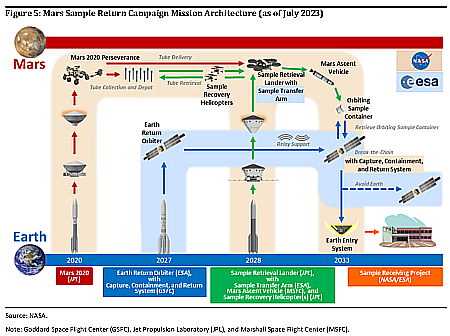
The previous plan for Mars Sample Return
In a press briefing today, NASA officials announced it is considering two options for getting Perseverance’s Mars samples to Earth sooner and what it hopes will for less money.
In the first option, NASA would use already available and operational rockets to launch a larger rover to Mars, landing using a sky crane similar but larger than the one used successfully by both Curiosity and Perseverance. This rover would also have nuclear power system used by those rovers, as well as an arm similar to theirs, simplifying the design process. Under this option it appears NASA is abandoning the use of a helicopter for retrieval, as had previous been considered.
In the second option, NASA would rely on what administrator Bill Nelson called “the heavy-lifte capability of the commercial sector.” He specifically mentions SpaceX’s Starship/Superheavy and Blue Origin’s New Glenn, but added that they are looking at the capabilities of the entire private sector right now.
In both operations, the retrieval rover would clean on Mars the outside of the cores to prevent them from contaminating Earth with Martian particles. Previously that cleaning process was to take place in space on the way back. They claim this change also simplifies things.
The final decision on which option to choose is now scheduled for 2026. NASA likely wishes to see more progress with getting Starship/Superheavy as well as New Glenn operational before deciding.
Note that at this press conference very little was said about the Mars ascent rocket, presently supposedly being built by Lockheed Martin. This is essentially building a full scale rocket only slightly less powerful that Earth-based rockets by a company that has never done it before. It seems the second option is likely going to include other options and other rocket companies for this task. The lack of mention suggests NASA was uncomfortable with mentioning this possibility.
In general, this project still feels incomplete and poorly thought out. Major components — such as the ascent vehicle — have not been worked out properly. The officials claimed these changes would make it possible to bring the samples back in the ’35-’39 time frame but I don’t believe it. What it does do is guarantee a large cash influx to NASA, something administrator Bill Nelson lobbied for during the conference, for the next decade-plus. And I think that was the real goal.
In a positive sign that Japan’s rocket industry is beginning to join the private sector, Toyota yesterday announced that it is investing $44 million in the rocket startup Interstellar Technologies.
Interstellar had been more visible about five years ago, and then disappeared. I figured it had died having run out of cash. It appears it is coming back now in Japan.
We now have the names of the individuals that are reviewing NASA’s future under the Trump administration:
All appear to have deep roots in either Washington or academic, but all also appear to have deep roots in the conservative side of the political spectrum. Several have even moved from NASA positions to the private sector. That latter fact explains the radical changes at NASA that this team has been considering, including canceling SLS and Orion and re-orienting the entire Artemis program using the private sector. In addition they are considering consolidating several NASA centers as well shrink staffing at NASA headquarters.
The CEO of Sierra Space, Tom Vice, revealed yesterday his decision to retire at the end of 2024, providing no reasons for the decision.
Vice had not previously announced any plans to retire from Sierra Space, where he had been chief executive since mid-2021. When the company issued the statement about his retirement, Vice was still listed on Sierra Space’s website in his roles as chief executive and a member of the company’s board of directors.
Sierra Space said that the chairman of the board of Sierra Space, Fatih Ozmen, would serve as interim chief executive while the company looks for a permanent replacement. He is chief executive and co-owner of Sierra Nevada Corporation (SNC), the company from which Sierra Space was spun out in 2021.
The coming year is going to be critical for Sierra, as it will finally launch Tenacity to ISS after years of delays. Should it fail, the company will face huge hurtles to survive. Maybe Vice, who is 61, decided it was time to actually retire. He also likely didn’t want take on that risk.
Overall Vice’s leadership had been good for Sierra. The company’s work accelerated significantly after it was spun off from Sierra Nevada.
An evening pause: If you haven’t yet got up from your weekend partying, this will do it. Performed live sometime in the early 1970s.
Hat tip Alec Gimarc.
SpaceX today completed its second launch in 2025, its Falcon 9 rocket lifting off from Cape Canaveral carrying 24 Starlink satellites.
The first stage completed its seventeenth flight, landing on a drone ship in the Atlantic.
At the moment SpaceX is the only one to complete any launches in 2025, two, though China was supposed to launch its Long March 3B rocket today as well.
I must add that I am very much under the weather today, which explains the limited posting.
According to a report two weeks ago by Eric Berger at Ars Technica and reviewed today by Mark Whittington at The Hill, the transition team for the Trump administration is reviewing a number of very major positive changes at NASA. The transition team has set up a five-person committee to review the following:
The first two recommendations would be doing what I have been recommending since 2011. SLS is an over-priced boondoggle that is too cumbersome and expensive. It can never do the job of establishing a lunar base, NASA’s prime goal. The same applies to Orion, which NASA for years touted as an interplanetary spaceship, an utter lie. It is merely an overweight ascent/descent capsule, nothing more.
The third recommendation is mostly for photo op purposes, since it is unlikely a manned landing can occur that quick, especially if the entire Artemis program is redesigned, replacing NASA’s the SLS rocket with SpaceX’s Starship/Superheavy. At the same time, if Trump shuts down the FAA’s red tape, we might be seeing many test flights of this rocket in the next two years, accelerating its development considerably.
The last two recommendations match the only recommendation from my 2017 policy paper, Capitalism in Space [free pdf here] that NASA has not yet embraced. I had recommended NASA reduce its overhead and bureaucracy, since it widely known in the business that its many agencies do relatively little for their cost. The rumored proposal under consideration is to consolidate the Goddard center in Maryland, the Ames center in California with the Marshall center in Alabama, with the new combined center in Alabama.
Getting this done however remains difficult. The centers exist because elected officials want them in their states and congressional districts. Expect strong resistance in Congress.
That the Trump administration is considering it anyway suggests these big changes are coming, regardless. And if so, I say Hallelujah!
In what would be a five year deal costing $1.56 billion, Italy’s military is presently negotiating with SpaceX to use its Starlink constellation for communications, rather than wait for the European Space Agency’s (ESA) IRIS2 constellation, which is years from launch and likely to experience delays, as do all of ESA’s projects.
By negotiating a five-year deal with SpaceX, Italy may be aiming to bridge the gap until Europe’s IRIS2 system becomes operational. With the ongoing war in Eastern Europe, the country’s Armed Forces likely view secure military communications as an urgent priority. However, critics may argue that the €1.5 billion price tag represents 14.15% of the total IRIS2 budget for just five years of service. For context, Italy is the third-largest contributor to the European Union, with its €18.6 billion contribution in 2023 accounting for roughly 10% of the EU’s total budget.
This story illustrates the good business sense of Elon Musk. He moved to get Starlink in orbit ahead of anyone else, and now is reaping the cash awards because he can provide services while others cannot.
SpaceX tonight successfully launched a commercial communications satellite for the United Arab Emirates (UAE), its Falcon 9 rocket lifting off from Cape Canaveral in Florida.
The first stage completed its 20th flight, landing on a drone ship in the Atlantic. The two fairings completed their 16th and 19th flights respectively.
As this was the first launch in 2025, SpaceX is the only rocket company or nation on the leader board. This will not last long, as there are a lot of launches coming in the next few weeks, including the first launch attempt of Blue Origin’s New Glenn rocket, the seventh test orbital launch of SpaceX’s Starship/Superheavy, the first launch of China’s Long March 8 rocket, a launch of India’s GSLV rocket, and a number of SpaceX Falcon 9 launches, including one that will send Firefly’s Blue Ghost lunar lander on its way to the Moon.
The FAA today announced that it has canceled one of three meetings that it plans to hold in the Brownsville region next week to obtain public feedback on SpaceX’s request to increase its Starship/Superheavy launch rate at Boca Chica to 25 launches per year.
The FAA was scheduled to hold in-person public meetings on January 7th and 9th, 2025. However, due to the designation of January 9, 2025 as a National Day of Mourning to honor the late former President Jimmy Carter, the January 9th meetings are now cancelled.
The meeting schedule is now as follows:
As I noted in November when the new environmental reassessment and these meetings were announced, it is practically certain that the fringe anti-Musk activists groups SaveRGV, Sierra Club, the Friends of Wildlife Corridor, and the fake Indian Carrizo/Comecrudo Nation of Texas (which never existed in Texas) are organizing to be there in force, demanding SpaceX’s Boca Chica operations be shut down.
If the rest of the public, which is the vast majority of the Brownsville community, does not show up to counter these fringe activists, it will make it much easier for the bureaucrats who hate Musk at the FAA to take action against SpaceX. It is essential that the business community at least make an appearance, as the arrival of SpaceX has brought billions of dollars and tens of thousands of jobs to Brownsville.