FCC chairman blasts Amazon and its Leo satellite constellation

FCC logo

Brendan Carr, the chairman of the Federal Communications Commission, yesterday harshly criticized Amazon for filing papers opposing SpaceX’s application to place a million new satellites into orbit while failing to meet its own FCC license requirement to get 1,600 Amazon Leo satellites in orbit by July 2026.

Amazon should focus on the fact that it will fall roughly 1,000 satellites short of meeting its upcoming deployment milestone, rather than spending their time and resources filing petitions against companies that are putting thousands of satellites in orbit.

To put it mildly, Carr’s point is well taken. In legally protesting SpaceX’s proposed constellation while failing to launch on time as promised, Amazon is following what appears to be standard Jeff Bezos’ practice, epitomized by his rocket company Blue Origin. When customers begin favoring others because the Bezos company either submits a poor bid or fails to meet schedules, the Bezos companies routinely go to court in an attempt to squelch that better competition.

Carr is demanding Amazon stop this, and focus instead on getting its own job done for once. Carr is also signaling the FCC’s position on both SpaceX and Amazon. It is likely going to reject Amazon’s filing and give its okay to SpaceX’s million-satellite constellation, in one form or another.

Carr is also telling Amazon that it faces some push back for failing to launch the required number of Amazon Leo satellites on time. Though it is extremely unlikely the FCC will cancel Amazon’s Leo license, the FCC might fine it heavily. Or it could impose new limits on the constellation. Carr is also indicating the FCC will treat future Amazon license applications much more stringently.

7 comments

NASA’s Van Allen Probe A burns up over the Pacific

We didn’t all die! Van Allen Probe A, one of two NASA spacecraft launched in 2012 to study the Van Allen radiation belts that circle the Earth, yesterday burned up harmlessly over the Pacific ocean as expected.

Both Van Allen probes have been defunct since around 2019, when they ran out of fuel. Van Allen Probe B weighed about 1,300 pounds, so some pieces probably reached the ocean. Had it returned over land it did carry the small risk of doing harm.

The orbit of the other probe, Van Allen Probe B, is expected to decay sometime around 2030. Like its twin, it is heavy enough that some parts will survive re-entry. It is therefore a prime target for a demonstration mission proving the technology for removing space junk safely and under control. NASA should put out a request for bids to the many orbital tug companies that now exist to do exactly that, as it is NASA’s responsibility to make sure this spacecraft re-enters the atmosphere safely.

0 comments

Firefly launches its Alpha rocket, almost a year after previous launch failure

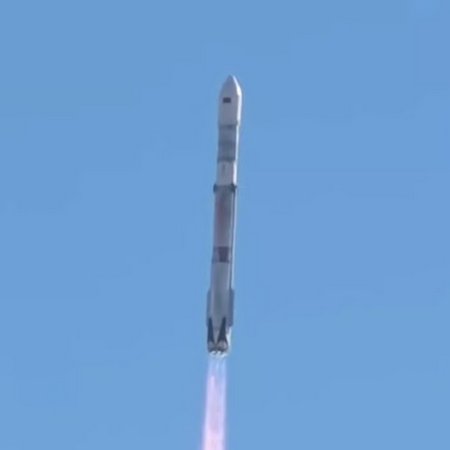
Firefly today successfully launched its Alpha rocket, almost a year after a launch failure in April 2025.

This launch, from Firefly’s launchpad at Vandenberg Space Force Base in California, was the last for this version of Alpha, and was designed as a test flight, both to check out the fixes to correct last year’s failure as well as to prove out some of the technology that will be used on the upgraded Alpha to be used on all future flights.

The 2026 launch race:

30 SpaceX
8 China
3 Rocket Lab
2 Russia
1 ULA
1 Europe (Arianespace)
1 Firefly

SpaceX continues to lead the entire world combined in total launches — as it did in both ’24 and ’25 — and is doing almost twice as many launches as everyone else.

3 comments

Fourteen-year-old NASA satellite about to burn up uncontrolled in the atmosphere

Chicken LIttle rules again.

Chicken Little rules again! After fourteen years, the orbit of one of NASA’s two Van Allen Probe satellites is about to decay, causing the 1,323 pound satellite to burn up uncontrolled in the atmosphere.

As of March 9, 2026, the U.S. Space Force predicted that the roughly 1,323-pound spacecraft will re-enter the atmosphere at approximately 7:45 p.m. EDT on March 10, 2026, with an uncertainty of +/- 24 hours. NASA expects most of the spacecraft to burn up as it travels through the atmosphere, but some components are expected to survive re-entry. The risk of harm coming to anyone on Earth is low — approximately 1 in 4,200.

As today is a very slow news day in space news, a lot of the mainstream press is highlighting this story, with the usual fear-mongering about how it could hit the Earth and cause terrible damage. And while it is certainly true that this satellite appears large enough for some pieces to reach the ground, the chances of those pieces causing any real harm is quite slim. In fact, I think NASA’s estimate of 1 in 4,200 to be far too high.

Mission engineers had initially estimated the orbit would decay in the 2030s, but that estimate was based on a prediction of a weak solar maximum. The Sun however was more active than predicted in the past decade, and that activity caused the Earth’s atmosphere to puff up, which in turn acted to accelerate the satellite’s orbital decay.

This incident once again shows us that there is money to be made in removing defunct satellites from orbit. NASA and ESA have both made it clear each would pay a company to do it. So have some private companies. Some of the orbital tug and robotic servicing companies have here an opportunity they need to grab.

8 comments

SpaceX now targeting early April for next Starship/Superheavy test flight

Based on a tweet posted by Elon Musk on March 7, 2026, SpaceX now targeting early April for next and 12th Starship/Superheavy test orbital flight.

According to this update at nasaspaceflight.com, the Superheavy booster, the 19th prototype and the first version 3 booster, is now on the launchpad for final checks.

On March 8, Booster 19 left Mega Bay 1 and rolled down Highway 4 towards the launch site and Pad 2. This is the start of pad commissioning and booster engine testing for Block 3.

Booster 19 is mounted on Pad 2 to conduct multiple tests over the coming days. This will likely include ambient pressure testing, tanking tests with Liquid Oxygen (LOX) and Liquid Methane (LCH4), spin primes, and eventually a static fire, maybe even a couple of static fires. These tests are not only to help test the booster but also to test all of the pad systems.

While crews have run operations with the Pad 2 tank farm many times, they have never loaded an actual booster with propellant. With a booster finally on the pad, this will help in the final commissioning process.

For these initial pad and booster check-outs, #19 does not have all 33 engines installed. It appears the company wants to test the launchpad fueling system first, with the minimum number of engines needed.

Meanwhile, the Starship prototype that will fly, #39 in the series, is in the assembly building after completing its own series of tanking and launchpad tests.

I want to highlight two numbers — 19 and 39 — in order to illustrate how SpaceX does things versus NASA. Not only has SpaceX already completed eleven test flights of Starship/Superheavy, it has tested or flown 19 and 39 prototypes of each, in one manner or another. The company has a very rich history of hardware and testing as it ramps up towards operational flights. This practically guarantees that those operational flights will not only occur relatively soon, they will be relatively safe and robust.

This was all done in less than a decade, though most of the testing of those prototypes has occurred in the last six years.

NASA meanwhile began work on SLS about fifteen years ago, and has built two rockets total, and so far flown only one. Though the agency did a lot of tests of pieces of the rocket, it flew only one test launch, in 2022. SLS’s design is so cumbersome and expensive, the agency could not afford to fly it multiple times. Thus, much of its testing was done on computer screens, in simulations.

Which rocket would you want to fly on when both are operational?

9 comments

Chinese scientists pinpoint a prime landing site for its manned lunar mission

Potential landing site for China's manned lunar landing

Though no final decision has apparently been made, a just published research paper suggests that China is considering a location almost dead center on the Moon’s near side, on the edge of a mare region dubbed Sinus Aestruum, for its first manned lunar landing, presently targeting a 2030 launch date. From the abstract:

We propose four prospective landing sites in the traversable areas, which provide a range of diverse geological samples, including volcanic debris, mare basalts, Copernicus crater ejecta and high-Th materials. Such a collection may provide insights into the geological evolution of the region and enhance our understanding of the lunar mantle composition and volcanic processes.

The red star on global lunar map to the right, taken from figure 1 of the paper, shows the location of this region. The lower map zooms into the region, with the four stars indicating the four prospective landing sites. The region has several rilles, long meandering channels thought to have formed from lava flow, that could be reached during an EVA.

Though it appears the scientists of this paper are lobbying for this landing region and no final decision has been reached, its location and wide variety of geology strongly suggests this will be the final choice. If so, of the four landing sites outlined two are in the smoother mare regions, and two are off the edge, in rougher terrain. For safety considerations, it is likely the final landing site will be in one of the former.

4 comments

SpaceX launches EchoStar communications satellite

SpaceX early this morning successfully launched an EchoStar communications satellite, its Falcon 9 rocket lifting off from Cape Canaveral in Florida.

The first stage completed its 14th flight, landing on a drone ship in the Atlantic. The rocket’s two fairings completed their 8th and 27th flights respectively.

The 2026 launch race:

30 SpaceX
8 China
3 Rocket Lab
2 Russia
1 ULA
1 Europe (Arianespace)

Not only is SpaceX this year leading the entire world combined in total launches — as it did in both ’24 and ’25 — at the moment its pace is twice that as the rest of the globe.

0 comments

Voyager to make “a multi-million-dollar strategic investment” in Max Space’s inflatable habitats

Voyager-Max lunar habitat
Click for original image.

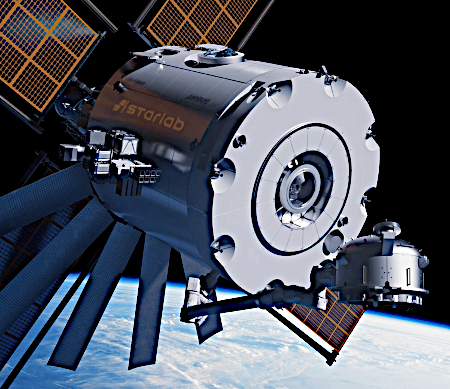
In an expansion of a partnership announced last month, Voyager Technologies — the lead company in the consortium building the Starlab space station — today announced it is now making “a multi-million-dollar strategic investment” in Max Space’s inflatable habitats, aiming at winning contracts both for NASA’s proposed Moon base as well as any other “future deep space missions.”

The actual dollar amount has not yet been released, but my sources say it is in “the low eight figures,” or more than $10 million but probably less than $25 million.

This partnership appears aimed not at NASA’s space station program nor enhancing Starlab. Instead, it is focused on providing NASA (and other commercial operations) inflatable habitats that can be launched and quickly established on the Moon and elsewhere, as shown by the artist’s rendering to the right. It appears Voyager will build the foundation, base, and airlock, while Max will provide the inflatable module above. From the press release:

This initiative directly supports NASA’s historical Artemis Program and aligns precisely with Administrator Isaacman’s announcement to be on the Moon to stay by 2028. Max Space delivers critical enabling infrastructure, maximizing livable volume, enhancing crew safety, and reducing the cost and complexity of surface deployment. It complements Voyager’s broader lunar roadmap, including cislunar mission management, surface logistics, propulsion, power systems, and future surface infrastructure, reinforcing a shared vision of the Moon as an operational domain, not a temporary destination.

In other words, the two companies are aiming to become major suppliers for NASA’s Artemis lunar base, and to do that by offering a way to get it quickly built and operational, at a reasonable cost.

I suspect it will be a few years before NASA issues any such contracts. It will first want to see both companies demonstrate success, both with Voyager’s Starlab and Max Space’s own demo station module scheduled for launch in ’27. Nonetheless, this announcement puts them on the map in the race to get those contracts, and begins to put some commercial reality to the American colonization of the solar system.

4 comments

Italian rocket company Avio wins $65 million War department contract

The Italian rocket company Avio announced last week that it has won a $65 million contract to build a solid-fueled motor for the U.S. Department of War.

Defense Systems and Solutions (DSS), a joint venture between Yulista Integrated Solutions, LLC (YIS) and Science and Engineering Services, LLC (SES), acting as a prime contractor for the US Department of War, selects Avio Group for the development, qualification and initial production of a solid rocket motor for air defense applications.

The contract, amounting approximately to $65 million and covering a three-year period, paves the way for a broader cooperation between the Parties, to exploit respective competences to provide US Government and NATO Allies with critical Defense Systems.

This contract award is significant in several ways. First, it signals the success of Avio’s policy in the past two years to establish itself as a U.S. military contractor, despite being a long-time Italian company. To do this it created a U.S. division, begun construction of a U.S-based manufacturing facility, and committed $500 million to its construction.

Second, Avio’s quick success also illustrates a general weakness in the American solid-rocket industry. It appears the American company that previously dominated this field of military solid-fueled rockets is Northrop Grumman, and its work in recent years has been problematic. Others might also do this work, but it appears no U.S. company has been doing it well enough to satisfy the War Department. The result has been an opportunity for Avio, and it appears it is taking advantage of it.

Finally, this success proves the rightness of the capitalism model. For almost two decades Avio built solid-fueled rockets for the European Space Agency’s commercial division, Arianespace, which controlled the marketing and sale of the rockets. That government control not only created a government middle-man that eat into the profits, it discouraged competition and innovation. Last year ESA completed transfer back to Avio, and the result has been new contracts from many new sources for the company.

0 comments

The Senate cries “Uncle!” on SLS and big goverment with its latest NASA authorization bill

I usually pay relatively little attention to the NASA authorization bills that Congress passes periodically, because these bills are generally nothing more than opportunities for the loudmouths in Congress to use them as a bullhorn to puff themselves up to the public and press. Almost never do such bills really have any real impact on the future, or if they do, that impact is often unintended and negative, as Congress is by and large ignorant about these matters and has priorities counter-productive to getting anything substantive accomplished.

I pay even less attention to authorization bills that have only been approved by a committee, and have not yet been voted on by either house. Such bills are ephemeral and the stuff of fantasy. It is nice to know what’s in them, but until such bills are actually approved by both houses of Congress and signed by the president, their language is even more unworthy of serious attention.

Have the pigs in the Senate learned to stop gorging themselves?

Nonetheless, the NASA authorization bill that was just approved by the Senate Commerce committee is worth reviewing, but not for the reasons that has interested the rest of the mainstream and even the aerospace press.

True, the bill extends ISS until 2032. True, it fully supports the commercial private space stations being built to replace it. True, it endorses NASA administrator Jared Isaacman’s restructuring of the Artemis program. True, it rejects all of Trump’s proposed cuts to NASA’s science programs. And true, it strongly endorses a Moon base as a first step to colonizing Mars.

All of these facts are significant, but to focus on each specifically — as it appears the entire press has done — is to miss the forest for the trees.
» Read more

6 comments

SpaceX launches 25 more Starlink satellites

SpaceX early today successfully placed another 25 Starlink satellites into orbit, its Falcon 9 rocket lifting off from Vandenberg Space Force Base in California.

The first stage completed its 7th flight, landing on a drone ship in the Pacific.

The 2026 launch race:

29 SpaceX
8 China
3 Rocket Lab
2 Russia
1 ULA
1 Europe (Arianespace)

Not only is SpaceX this year leading the entire world combined in total launches — as it did in both ’24 and ’25 — at the moment its pace is about twice that as the rest of the globe.

0 comments

NASA awards ULA’s Centaur-5 upper stage for future SLS launches

NASA yesterday awarded ULA the contract for providing SLS its upper stage after the Artemis-3 mission using the Centaur-5 upper stage that was developed for the company’s Vulcan rocket.

In its procurement statement, NASA said its intention is to issue a sole source contract to ULA, meaning it’s the only upper stage being considered for this new iteration of the SLS rocket. An eight-page supporting document from NASA’s Marshall Space Flight Center (MSFC) in Huntsville, Alabama, was published to document the reasoning for its decision.

Among the stated reasons are the decades-long heritage of the RL10 engine, which has matured over time; the ability of the Centaur 5 to use the interfaces available on the Mobile Launcher 1 (ML1) along with the propulsion commodities of liquid oxygen and liquid hydrogen; and the experience of ULA’s teams working with NASA’s Exploration Ground Systems (EGS) at the Kennedy Space Center and elsewhere in the country.

They also noted that with the Centaur 3 upper stage achieving certification to launch humans as part of the Commercial Crew Program, there are a lot of common features with the Centaur 5.

The decision relieves NASA from wasting more money on the Mobile Launcher-2, which has been a disaster. The contractor Bechtel has gone over budget — from $383 million to $2.7 billion — and is so behind schedule it is still unclear now whether it will be ready by 2029, a decade after the contract was awarded.

It also relieves NASA of spending more money on its own upper stage, which has been as much a disaster, from Boeing.

Instead, this deal is an example of Isaacman doing the right thing. Rather than have NASA design and build its own upper stage, he is buying the product — almost literally off-the-shelf — from a commercial rocket company. He should expand this effort, and consider other private rockets, such as Falcon Heavy, to replace SLS itself.

Now Isaacman should consider suing Bechtel for fraud and incompetence, to try to get back some of the money it wasted.

29 comments
1 17 18 19 20 21 785