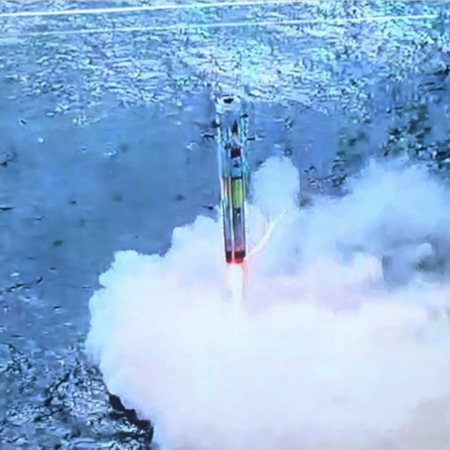
South Korean rocket startup Perigee signs deal to launch from the Philippines

The Philippines

The South Korean rocket startup Perigee yesterday signed an agreement with the government of the Philippines, allowing it to launch its proposed suborbital and orbital Blue Whale rockets from a sea platform within that country’s territorial waters.

The Philippine Space Agency (PhilSA), together with the Department of Information and Communications Technology (DICT), Cagayan Economic Zone Authority (CEZA), Ascend International Gateway, Inc., and … Perigee Aerospace, Inc. signed a Memorandum of Understanding … to collaborate on a framework for rocket development training and experimental rocket launches in the Philippines. These initiatives will demonstrate the viability of the establishment and operation of a Philippine spaceport, with the goal of positioning the country as a gateway to space in the region.

…The agreement builds on the rocket technology know-how transfer and training program undertaken by PhilSA engineers in the Republic of Korea from October to November 2025, in collaboration with Perigee Aerospace. The program equipped the engineers with foundational and applied knowledge in launch vehicle systems through lectures and hands-on experience in rocket assembly and testing. These initiatives lay the groundwork for future activities, including possible localized assembly, testing, and launch operations in the Philippines.

The first four entities listed above are all government agencies in the Philippines. Apparently Perigee is providing training and aid to the Philippines in exchange for the right to launch from within that country. It website states the suborbital version of Blue Whale will launch from a sea platform, but the launch site for the orbital version is unclear.

This deal however sets the stage for possibly developing a land-based spaceport in the Philippines. As shown by the map to the right, the country is well situated for such purposes, with a lot of eastern coastline facing the vast Pacific ocean. A spaceport located on its southernmost island of Mindanao would be especially well placed.

6 comments

Sierra Space raises $550 million in private investment capital

Due to its aggressive shift in the past year away from NASA-based civilian contracts to defense work, Sierra Space announced yesterday that it has successfully raised another $550 million in private investment capital.

That shift occurred because of its failure to deliver its Dream Chaser vehicle to NASA as planned, as well as the apparently lack of progress in its partnership with Blue Origin on the Orbital Reef space station. From the press release:

Sierra Space Corporation, an industry-leading defense-tech space company delivering solutions for the nation’s critical missions, announced today a $550 million equity investment led by LuminArx Capital Management (“LuminArx Capital”), a global alternative investment manager, with participation from existing investors. The financing values the company at $8 billion post-money.

With this new capital, Sierra Space will be able to further focus on its national security space efforts through ongoing expansion of production capacity and continued development of differentiated solutions for its customers. The investment better positions Sierra Space to secure additional contracts, leverage existing technologies, and pursue growth opportunities beyond its current satellite and spacecraft mission programs.

Artist rendering of Orbital Reef design, as of April 2025
Artist rendering of Orbital Reef design, as of April 2025,
the best we can likely ever expect from this dead project.
Click for original image.

The release also mentioned General Atlantic, Coatue, Moore Strategic Ventures, and Andalusian Private Capital as investors.

Though this money should help fuel its work on Dream Chaser and Orbital Reef, I suspect little will go to those two projects. The company is now clearly targeting military and national security work as its prime source of income. There are also indications that there are some technical issues with Dream Chaser that Sierra has not yet revealed.

Meanwhile, the lack of effort from Blue Origin on Orbital Reef likely convinced Sierra it was better to turn its eyes elsewhere. While Sierra spent considerable effort testing its LIFE inflatable module, Blue Origin did practically nothing, and continues to do little. It is unlikely this partnership will win any funding from NASA when the agency awards new space station contracts, expected sometime in six months.

0 comments

Rocket Lab completes another launch yesterday

Rocket Lab yesterday successfully placed a satellite into orbit, its Electron rocket lifting off from one of its two launchpads in New Zealand.

The company did not reveal the name of its customer, though according to this source the satellite was a Blacksky Earth imaging satellite, the fourth launch of a four-launch contract with that satellite company.

The 2026 launch race:

28 SpaceX
8 China
3 Rocket Lab
2 Russia
1 ULA
1 Europe (Arianespace)

Not only is SpaceX this year leading the entire world combined in total launches — as it did in both ’24 and ’25 — at the moment its pace is about twice as much as the rest of the globe.

2 comments

Vast raises $500 million in new private investment capital

Haven-2
Vast’s full Haven-2 station once completed

The space station startup Vast today announced it has raised another $500 million in new private investment capital, bringing the total so far invested in the company’s space station project to more than one billion.

The financing round was led by Balerion Space Ventures with participation from IQT, Qatar Investment Authority (QIA), Mitsui & Co., Ltd, MUFG, Nikon Corporation (Nikon), Stellar Ventures, Space Capital, and Earthrise Ventures. Jed McCaleb, founder and first investor, also participated in the round. As part of the transaction, Balerion Advisor A.C. Charania, former Chief Technologist for NASA, will join the Vast board.

…To date, more than $1 billion has been invested in Vast’s space stations technologies and facilities—resources that NASA and government partners can leverage to ensure readiness to replace the ISS in 2030. The latest financing includes $300 million in Series A equity and $200 million in debt to support the continued development of Vast’s Haven space stations. The funds will be used to expand facilities, grow the team, and advance the company’s proposed successor to the ISS, Haven-2, designed to ensure continuous human presence in low-Earth orbit for the United States and its allies.

Hat tip to reader Richard M for letting me know about this announcement.

In my rankings below of the five American commercial space stations presently in development, I rank Vast #1. This new investment helps solidify its first place standing.
» Read more

2 comments

Third launch attempt by Japanese rocket startup Space One fails

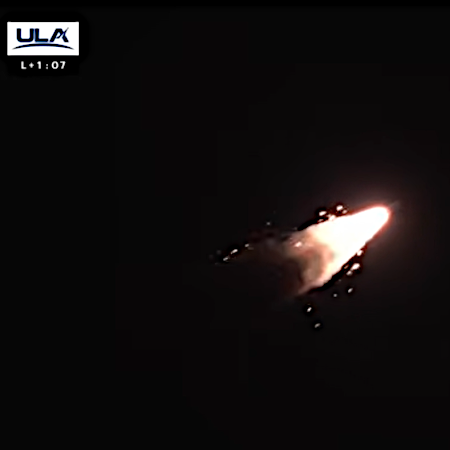
Kairos rocket just after failure

In another attempt to do the maiden launch its orbital Kairos rocket today, the Japanese rocket startup Space One experienced its third launch failure, with the rocket breaking up about a minute after launch.

The screen capture to the right shows the rocket just after failure. The cloud arc in the upper left is the moment some burst occurred. Within seconds it was clear that the rocket was now in several pieces.

The launch attempt, which took place from the company’s own spaceport, Spaceport Kii, on the southern coast of the main island of Japan, was the third failure in a row, all involving failures of the first stage. The first launch in March 2024 blew up mere seconds after launch. The second attempt in December 2024 failed about 90 seconds after launch when the rocket began to spiral out of control.

This third launch appeared more controlled, but it also occurred only a minute after launch.

Whether the company can survive a third straight failure, none of which got even close to main engine cutoff and stage separation, is unknown. The company has some major investors, including Canon, several major Japanese banks, and the government-owned Development Bank of Japan. While they might stick with the company, it would not be surprising if there was a major shake-up in management.

Japan at the moment has no operational launch capability. Space One is its only private rocket startup, while the two rockets belonging to its space agency JAXA, H3 and Epsilon, are both grounded due to launch failures.

4 comments

South Korean rocket startup Innospace signs another spaceport launch deal

Proposed Canadian spaceports

The South Korean rocket startup Innospace, which has attempted one launch of its Hanbit-Nano rocket (a failure), has now signed a launch deal with the proposed Spaceport Nova Scotia, run by Maritime Launch Services.

Maritime Launch Services announced a strategic partnership with South Korean rocket developer Innospace. Under a new Letter of Intent (LOI), the two companies will evaluate hosting the HANBIT launch system at Spaceport Nova Scotia, potentially transforming the Atlantic coast into a primary North American hub for the South Korean firm.

Innospace’s first launch was from Brazil’s long unused Alcantera spaceport on its northeast coast. The company has also signed deals with Portugal’s proposed Santa Maria spaceport, two spaceports in Australia (Southern Launch and Equatorial Launch), and Norway’s Andoya spaceport.

This new deal in Nova Scotia is still preliminary, with the two companies having until the end of the year to finalize the specifics. For Innospace, it appears the company its trying to give itself as many spaceport options as possible. It can also launch from the government spaceport in South Korea, but that provides much more limited orbital flight paths, and presents scheduling difficulties.

For Maritime, this deal might finally get this spaceport off the ground. It was first proposed in 2016, offering satellite companies both a launch site and a Ukrainian-built rocket. That plan fell through when Russia invaded the Ukraine and the rocket became unavailable. Since then Maritime has struggled to convince rocket companies to use the spaceport, all to no avail. It signed some deals, but none has gone anywhere. This deal is its first with a rocket startup that has actually attempted a launch, though that launch was a failure.

1 comment

The first orbiting private space telescope releases “first light” image

Mauve's first light image and data
Click for original image.

The first orbiting private space telescope, owned by Blue Skies Space and dubbed Mauve, has successfully taken its first image and data, a 5 second long exposure of a single star.

That image is to the right, with the spectroscopic data shown by the magenta line. The Hubble Space Telescope’s spectroscopic data is shown in blue and while for comparison.

As part of early commissioning, Mauve was pointed at its first calibration target, eta Ursae Majoris (eta UMa), a bright star in the constellation Ursa Major, approximately 104 light-years from Earth, for a 5-second observation. Eta UMa is a hot, blue-white star, much hotter than our Sun. Eta UMa shines brightly in ultraviolet light, making it an ideal calibration target for a UV observatory like Mauve.

The telescope has a 5-inch mirror, so its resolution is far lower than Hubble’s 94-inch mirror, but because it is above the atmosphere its view is far better than larger ground-based telescopes. Mauve is intended as a three-year-long demonstration project, during which it will study flares from nearby stars that are thought to have exoplanets, as well as binary star systems and variable stars. It is also making this data available to scientists, for a subscription fee. It already has almost a dozen universities signed up.

Blue Skies hopes Mauve’s success will help it raise the capital to build Twinkle, a space telescope with an 18-inch primary mirror. If that succeeds, the company plans to scale up to even bigger orbiting telescopes.

This private sector astronomy model is how the U.S. did things routinely prior to World War II. Then, for many reasons, the government took over for the next three-quarters of a century. It now appears the pendulum is shifting back to the private sector.

1 comment

ESA asks for proposals on building its own space station

ESA logo

The European Space Agency (ESA) last week issued an open call for proposals outlining the construction of its own space station, independent of the five American stations presently in development to replace ISS.

On 27 February, ESA published an intended call for tenders for two Pre-Phase A studies under Scenario 3. According to the call, the studies will consolidate the “feasibility, architecture, utilisation, and technology requirements of a European-led LEO outpost” and propose cooperation with the Canadian Space Agency, Japan’s national space agency JAXA, and “additional partners.” The results of the two parallel studies will be used to enable ESA decision-making for its post-ISS transition by the end of 2026.

Do not expect these “studies” to produce a European-led space station any time soon. It is the ESA way to do lots of studies, and then after reading these to do more detailed follow-up studies outlining what they will do. Then, after years of review, it might finally get started on construction, which always proceeds somewhat slowly.

In the meantime, ESA has signed agreements with three of the five American space station projects (Axiom, Starlab, Vast), with its deal with the Starlab station the most extensive. All three deals leave open the possibility that Europe will rent time at each station to fly experiments and astronauts there.

0 comments

Spanish rocket startup PLD raises $209 million in new investment capital

The Spanish rocket startup PLD, which hopes to launch its orbital Miura-5 rocket this year, has now raised an additional $209 million in new investment capital, bringing the total capital it has raised to more than $400 million.

PLD Space, an international space transportation company, has closed a €180 million Series C equity funding round led by the renowned Japanese manufacturer Mitsubishi Electric Corporation, alongside with other investors.

The Spanish Ministry of Science, Innovation and Universities, through the Centre for the Development of Technology and Innovation (CDTI) and its INNVIERTE fund, and the Spanish public funds management company COFIDES, through its FOCO investment fund, have co-invested in this round. Ultimately, the European renowned Spanish fund Nazca Capital, via Nazca Aeroespacial y Defensa INNIVERTE I FCR Fund, close the round.

The company hopes to ramp up its launch pace to as many as 30 launches per year by 2030, though these numbers are clearly aspirational. It has already won two launch contracts, and it is building its own launchpad in French Guiana, where that first launch will take place, and has also signed a deal with Oman to launch from its proposed spaceport in Duqm. PLD has also said it is in negotiations for a third launch site, not yet named.

0 comments

Varda rents new 200K-square-foot facility in California

Varda's W-5 capsule after landing today
Varda’s fifth capsule after landing on January 29, 2026

The startup Varda, which launches returnable capsules for manufacturing products in space, has now rented a large building in California to build those capsules.

In an expansion of its business of processing pharmaceuticals in Earth’s orbit, Varda Space Industries is renting a large El Segundo plant where toy manufacturer Mattel used to design Hot Wheels and Barbie dolls. The plant in El Segundo’s aerospace corridor will be an extension of Varda Space Industries’ headquarters in a much smaller building on nearby Aviation Boulevard.

Varda will occupy a 205,443-square-foot industrial and office campus at 2031 E. Mariposa Ave., which will give it additional capacity to manufacture spacecraft at scale, the company said

The company will take control of the building in December, and will then need another four to eight months to install its production facilities.

Varda has launched and recovered five capsules so far. Some produced pharmaceuticals for sale on Earth, others other products, while two did hypersonic tests for the Pentagon during re-entry. It has a deal in Australia to land as many as 20 more capsules, and presently has ten more missions scheduled on SpaceX’s Falcon 9 rocket.

1 comment

SpaceX launches 29 more Starlink satellites

SpaceX early this morning successfully placed another 29 Starlink satellites in orbit, its Falcon 9 rocket lifting off from Cape Canaveral Space Force Station in Florida.

The first stage completed its 25th flight, landing on a drone ship in the Atlantic.

The 2026 launch race:

28 SpaceX
8 China
2 Rocket Lab
2 Russia
1 ULA
1 Europe (Arianespace)

Not only is SpaceX this year leading the entire world combined in total launches — as it did in both ’24 and ’25 — at the moment it has launched twice as much as the rest of the globe.

0 comments

Japan to do vertical tests of its own Grasshopper-type demo stage this month

Japan’s space agency is about to attempt two test vertical take-off-and-landing test flights of of its own Grasshopper-type demo stage, dubbed RV-X later this month.

First flight of a small experimental version of a reusable launch vehicle has been scheduled for March 6 by the Japan Aerospace Exploration Agency (JAXA). The 24-ft.-tall vertical-takeoff-and-vertical-landing (VTVL) RV-X is planned to make a short hop at the agency’s Noshiro Rocket Testing Center on the Sea of Japan coast.

RV-X is the first of two flight experiments planned by JAXA on the path to development of a reusable first stage for a next-generation launch vehicle. A second vehicle is planned to fly in 2027 under the multinational Callisto program.

Callisto is being developed jointly with the European Space Agency. Both it and RV-X have been in development for about a decade. Both were initiated in response to SpaceX’s successful reuse of its Falcon 9 first stage. Both projects however appeared stalled until the last two years or so, with little happening.

The JAXA engine on RV-X is apparently the engine it is providing for Callisto. If the flight tests are successful this March, it will be the be transferred to French Guiana for Callisto tests planned no sooner than ’27.

0 comments
1 18 19 20 21 22 785