Two SpaceX launches since yesterday

The beat goes on! Since yesterday SpaceX completed two Starlink launches, placing a total of 54 Starlink satellites in orbit on opposite coasts.

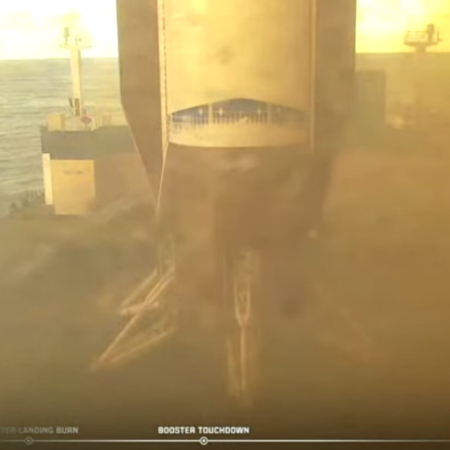
First, the company yesterday afternoon launched 29 Starlink satellites, its Falcon 9 rocket lifting off from Cape Canaveral in Florida. The first stage completed its 10th flight, landing on a drone ship in the Atlantic.

Then early this morning SpaceX placed another 25 Starlink satellites in orbit, its Falcon 9 rocket lifting off from Vandenberg Space Force Base in California. The first stage completed its 11th flight, landing on a drone ship in the Pacific.

The 2026 launch race:

24 SpaceX
8 China
2 Rocket Lab
2 Russia
1 ULA
1 Europe (Arianespace)

As it did in both ’24 and ’25, SpaceX in ’26 so far has more launches than the entire rest of the world combined.

Rocket Lab has a suborbital launch scheduled for later today, lifting off from Wallops Island in Virginia and carrying an Australian hypersonic test vehicle. This won’t count in the totals above, but I will report the results after launch.

6 comments

Medical company making artificial retinas buys payload slots on Starlab

Starlab design as of December 2025

The medical company LambdaVision announced yesterday that has booked payload slots and commercial space on Starlab in order to manufacture “protein-based artificial retinas.”

LambdaVision leverages microgravity to improve the layer-by-layer production process of their artificial retina through alternating layers of the protein bacteriorhodopsin and a polymer, supported by a membrane of a synthetic fiber that has long been used by the medical community. Reduced gravity in an LEO environment improves homogeneity, stability, and performance of thin films like the protein-based artificial retina. By using proteins similar to the visual pigment rhodopsin naturally found in our eyes, LambdaVision’s protein-based artificial retina mimics the light-absorbing properties of human photoreceptors replacing the function of these damaged cells in the retinas of blind patients.

Starlab is the giant single module space station being built by a consortium led by Voyager Technologies that will be placed in orbit by a Superheavy/Starship launch.

While NASA allowed this kind of medical research on ISS, it never allowed the companies to manufacture any products on ISS for later sale on Earth. The new private space stations are decidedly opposed to that government restriction, and thus they are attracting customers like LambdaVision because they will allow it to make money on what it produces. The press release notes that while this first project is aimed at producing artificial retinas to restore vision in patients, the technology will be applicable to “sensitive biosensors, optical systems, tissue engineering, and drug delivery applications.”

In my rankings below of the five commercial American space station projects under development, the first three are basically tied, the fourth is simply late to the game, and the last, Blue Origin’s Orbital Reef, is hardly out of the starting gate.
» Read more

7 comments

Chinese astronauts provide their perspective on the cracked Shenzhou-20 window

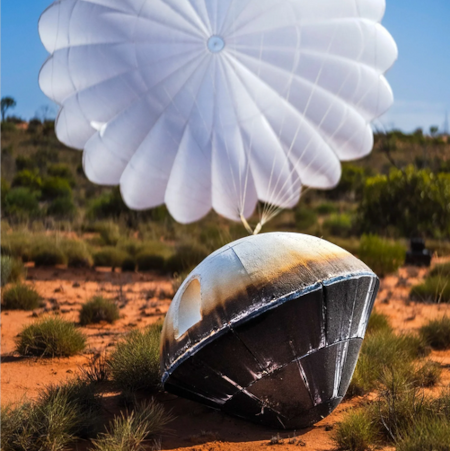
Shenzhou-20 after return
Shenzhou-20 after its return to Earth. The damaged
window can be seen on the right. Click for original image.

The Chinese Shenzhou-20 crew this week gave a detailed interview describing their discovery and inspection of the cracks in the window of their Shenzhou-20 capsule.

Chen Dong, commander of the Shenzhou-20 crew, first noticed the damage to the window while conducting final checks on the return capsule. The believed culprit: space debris striking the window. …As mission commander for Shenzhou-20, Chen said he was the one who went for checking out the return craft. During that work, “I spotted something like a triangular on the viewport,” he said. “My first thought was whether a small leaf had somehow stuck to the outside of the window,” said Chen. “But then I quickly realized that couldn’t happen because we were in space. How could there possibly be a fallen leaf there?”

Chen pointed out the window anomaly to his two other colleagues also in ready mode for the return trek to Earth. Wang, who served as the flight engineer on the Shenzhou-20 mission, had previously worked as an aerospace technician involved in the construction of China’s space station before becoming an astronaut. “I wasn’t really nervous, actually. The outermost layer of the viewport is a protective layer, and inside it there are two pressure-bearing layers, and we are safe as long as the cabin pressure doesn’t change,” said Wang.

Using a 40x microscope, they determined that some of the cracks had penetrated through the window’s outermost layer.

As of today however China has yet to release images of the cracks, or if they have, no western media source has found and released them.

0 comments

Exolaunch integrates five satellites in Isar’s Spectrum rocket

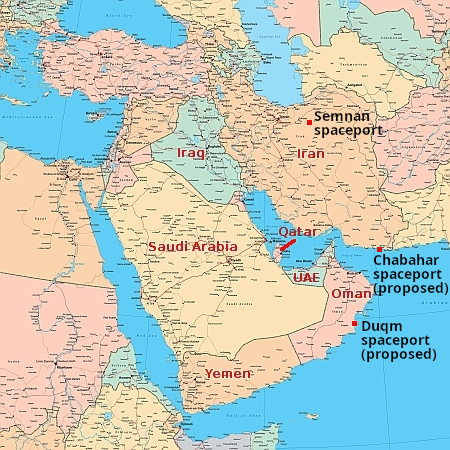
Proposed or active spaceports in North Europe

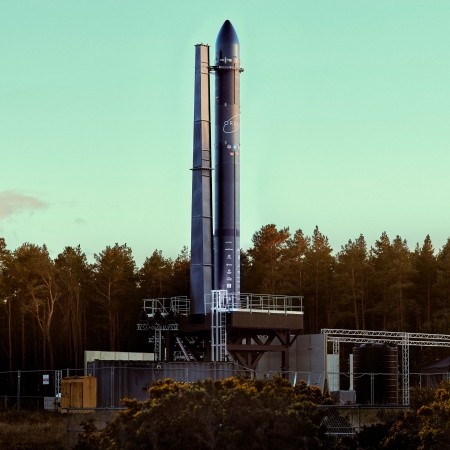
Exolaunch, which specializes in preparing and integrating satellites onto rockets for satellite companies, has now completed the integration of the five satellite payloads that will fly on the second launch attempt of the German startup Isar Aerospace.

The launch is presently scheduled for March 19, 2026, lifting off from Norway’s Andoya spaceport, and is Isar’s second attempt to complete an orbital launch. The first, in March 2025, failed mere seconds after launch due to a loss of attitude control.

The payloads are as follows:

  • CyBEEsat for Technische Universität Berlin (Germany)
  • TRISAT-S for University of Maribor (Slovenia)
  • STS1 for Technische Universität Wien (Austria)
  • Platform 6 6UXL for Endurosat (Bulgaria)
  • FramSat1 for Norwegian University of Science and Technology (Norway).

These are all cubesats and are all likely student projects, willing to risk their launch on an untested rocket because the cost is low.

Of the half dozen or so rocket startups in Europe, Isar appears in the lead. Both PLD and Rocket Factory Augsburg say they will attempt a launch in 2026, but neither has set a date. And both will be trying for their first time, unlike Isar.

It also appears that Andoya is in the lead in the race to be the first European spaceport to complete an orbital launch. The spaceports in the United Kingdom started almost a decade earlier, but have been stymied by government red tape. Norway in turn moved fast to make its regulations simple and fast.

0 comments

SpaceX launches 28 more Starlink satellites on 2nd launch today; sets new 1st stage reuse record

SpaceX this evening completed its second launch today, placing 28 more Starlink satellites in orbit, its Falcon 9 rocket lifting off from Cape Canaveral Space Force Station in Florida.

The first stage (B1067) completed its 33rd flight, landing on a drone ship in the Atlantic. With this flight, B1067 has tied the space shuttle Atlantis for the second most reused launch vehicle on record.

39 Discovery space shuttle
33 Atlantis space shuttle
33 Falcon 9 booster B1067
31 Falcon 9 booster B1071
31 Falcon 9 booster B1063
29 Falcon 9 booster B1069
28 Columbia space shuttle

Sources here and here.

The 2026 launch race:

22 SpaceX
8 China
2 Rocket Lab
2 Russia
1 ULA
1 Europe (Arianespace)

As it did in both ’24 and ’25, SpaceX in ’26 so far has more launches than the entire rest of the world combined.

13 comments

SpaceX launches 25 more Starlink satellites

SpaceX early this morning successfully placed another 25 Starlink satellites into orbit, its Falcon 9 rocket lifting off from Vandenberg Space Force Base in California.f

The first stage (B1063) completed its 31st flight, landing on a drone ship in the Pacific, moving it up in the rankings for the most reused launch vehicles:

39 Discovery space shuttle
33 Atlantis space shuttle
32 Falcon 9 booster B1067
31 Falcon 9 booster B1071
31 Falcon 9 booster B1063
29 Falcon 9 booster B1069
28 Columbia space shuttle

Sources here and here.

The 2026 launch race:

21 SpaceX
8 China
2 Rocket Lab
2 Russia
1 ULA
1 Europe (Arianespace)

As it did in both ’24 and ’25, SpaceX in ’26 so far has more launches than the entire rest of the world combined.

0 comments

India negotiating a possible Gaganyaan docking at ISS

India's Bharatiya Antariksh Station as outlined in 2024
India’s Bharatiya Antariksh Station as outlined in 2024.
Click for original image.

The head of India’s space agency ISRO, it is negotiating with NASA about doing a variety of manned space operations in conjunction with NASA, including a possible Gaganyaan docking to ISS.

According to a presentation by Isro chairman V Narayanan reviewed by TOI [Times of India], the future cooperation areas span three key areas of collaboration between the two nations’ space agencies.

The first involves comprehensive training of ISRO personnel, including astronauts, at NASA facilities across multiple domains, including robotics systems, extravehicular activity (EVA), extravehicular mobility unit (EMU) systems, resource management, space medicine and spaceflight operations, LEO and lunar mission control operations, rendezvous and docking procedures, and payload and science operations.

An important initiative outlined is the uncrewed docking demonstration of India’s Gaganyaan Orbital Module with the US Orbital Segment of the ISS — this would mark a significant technological milestone for India’s human spaceflight programme.

The third area focuses on cooperation in docking, berthing, and inter-operability systems.

It is clear ISRO wishes to get training from NASA for its manned missions. It also makes sense for it to make sure its Gaganyaan’s docking systems are compatible with ISS, Dragon, Starliner, Soyuz, and even China’s station.

Doing a test unmanned docking at ISS would also provide ISRO valuable experience in preparation for its own Bharatiya Antariksh Station (BAS). Its first module is presently scheduled for launch in 2028, with the entire station assembled by 2035.

None of this however has been finalized. If India were to do a docking at ISS, it would like have to wait until 2029, after the two tourist missions assigned to Axiom and Vast. ISS has a limited number of available ports, and I suspect a port really won’t be available until after those missions.

8 comments

Scientists: When a SpaceX upper stage burns up in the atmosphere, it burns up in the atmosphere!

Chicken Little rules!

We’re all gonna die! In making the first direct measurement of the plume caused by the vaporization of the lithium in a SpaceX Falcon 9 upper stage as it burned up in the atmosphere, scientists now claim the pollution for those upper stages as well as the coming launch of tens of thousands of satellites is going to seriously harm the environment.

You can read their paper here. From its conclusion:

Beyond this single event, recurring re-entries may sustain an increased level of anthropogenic flux of metals and metal oxides into the middle atmosphere with cumulative, climate-relevant consequences. After oxidation and heterogeneous uptake on alumina and other metal-oxide particles, aluminium and co-injected species could perturb stratospheric ozone chemistry, modify high-altitude aerosol microphysics through new particle formation, growth, and coagulation, and thereby influence radiative balance. Key unknowns include emission inventories for rockets and satellites, lack of a systematic observational survey of mesospheric metals, altitude-time ablation profiles, chemical lifetimes, particle size-composition distributions, and transport pathways into the lower stratosphere. Addressing these uncertainties will require coordinated, multi-site observations (including resonance-fluorescence and elastic lidars, in situ sampling, and satellites), together with whole-atmosphere chemistry-climate modelling to connect event-scale injections to long-term impacts.

The problems with this study, and its conclusions, are numerous. First of all, this first direct detection of the lithium plume is really no discovery at all. We know the rocket’s upper stage carried lithium. We know it burned up in the atmosphere. It is plainly obvious that lithium would end up as vapor in the upper atmosphere where stage burned up. This detection simply measured what we already knew.

Second, the amount detected is really insignificant. At about 60 miles elevation the numbers rose from 3 lithium atoms per cubic centimeter to 31 during the stage’s burn-up, numbers that will quickly dissipate at these high altitudes. We are not talking big numbers.

Finally, the threat from debris from upper rocket stages is only a temporary problem. As the demand to launch more satellites grows — which it will — the demand to recover and reuse the upper stages will grow as well. Already two American companies, SpaceX and Stoke Space, are developing rockets that will be completely reusable.

The mentality of these scientists is the same “Chicken Little” view of life held by the establishment science community for decades, from climate to industry to Covid to any human endeavor. “Everything humans do is bad! We must ban it now before it destroys us all!” And none of their cries of panic ever carry any larger context or reasonable perspective.

Sadly, this same attitude permeates the mainstream propaganda press. They don’t question such studies, they instead reprint their claims in bold, without any skepticism. We are thus ill-served by our so-called “independent and free” press.

27 comments

First unmanned Gaganyaan mission facing delay

Artist rendering of India's Gaganyaan capsule
Artist rendering of India’s Gaganyaan capsule

Though this is not yet confirmed, sources inside India’s space agency ISRO are saying that the first unmanned Gaganyaan orbital test mission, presently targeting a March launch, is likely to be delayed in order to do additional safety checks, following the two consecutive launch failures of the agency’s PSLV rocket.

After the dual PSLV setbacks, there is zero appetite for risk at Isro. Every component, fitting, system, and subsystem of Gaganyaan is being re-examined in minute detail to ensure mission success.

The PSLV, traditionally regarded as Isro’s workhorse launcher, suffered rare back-to-back failures over the past two years, prompting a comprehensive review of quality assurance and mission readiness protocols across launch vehicles. While Gaganyaan is slated to fly aboard the Human-Rated Launch Vehicle Mark-3 (HLVM3), an upgraded version of the GSLV Mk-III, the recent setbacks have cast a shadow over the broader launch ecosystem.

The actual manned mission is presently scheduled for early next year, after a series of unmanned orbital test flights are completed in ’26. This schedule is significantly later than ISRO’s original schedule. When the program was first proposed in 2018, ISRO said the manned mission would happen in 2022.

1 comment

SpaceX launches 29 Starlink satellites

SpaceX early today successfully launched another 29 Starlink satellites, its Falcon 9 rocket lifting off from Cape Canaveral.

The first stage completed its 26th flight, landing on a drone ship in the Atlantic, within the territorial waters of the Bahamas for the second time.

The 2026 launch race:

20 SpaceX
8 China
2 Rocket Lab
2 Russia
1 ULA
1 Europe (Arianespace)

As it did in both ’24 and ’25, SpaceX in ’26 so far has more launches than the entire rest of the world combined.

0 comments

NASA on Starliner: Too much freedom caused the failure!

Starliner docked to ISS
Starliner docked to ISS in 2024.

NASA today released its final investigation report on the causes behind the Starliner thruster issues during that capsule’s only manned mission in ISS, issues that almost prevented the spacecraft from docking successfully and could have left it manned and out-of-control while still in orbit.

You can read the report here [pdf]. NASA administrator Jared Isaacman made it clear in his own statement that the Starliner incident was far more serious than originally let on.

“To undertake missions that change the world, we must be transparent about both our successes and our shortcomings. We have to own our mistakes and ensure they never happen again. Beyond technical issues, it is clear that NASA permitted overarching programmatic objectives of having two providers capable of transporting astronauts to-and-from orbit, influence engineering and operational decisions, especially during and immediately after the mission. We are correcting those mistakes. Today, we are formally declaring a Type A mishap and ensuring leadership accountability so situations like this never reoccur. We look forward to working with Boeing as both organizations implement corrective actions and return Starliner to flight only when ready.”

A Type A mishap is one in which a spacecraft could become entirely uncontrollable, leading to its loss and the death of all on board. Though Starliner was NOT lost, for a short while as it hung close to ISS that result was definitely possible. Its thrusters were not working. It couldn’t maneuver to dock, nor could it maneuver to do a proper and safe de-orbit. Fortunately, engineers were able to figure out a way to get the thursters operational again so a docking could occur, but until then, it was certainly a Type A situation.

The report outlines in great detail the background behind Starliner’s thruster issues, the management confusion between NASA and Boeing, and the overall confused management at Boeing itself, including its generally lax testing standards.

The report’s recommends that NASA impose greater control over future commercial contracts, noting that under the capitalism model that NASA has been following:
» Read more

50 comments
1 20 21 22 23 24 785