NASA “pauses” Mars Sample Return mission

Perseverance's first set of core samples, placed on the floor of Jezero Crater
Perseverance’s first set of core samples,
placed on the floor of Jezero Crater

Faced with a strong threat of major budget cuts from the Senate, NASA has decided to “pause” the Mars Sample Return mission (MSR) by ramping back some work to consider major changes to the project.

We brought Steve [Thibault] downtown to be the chief engineer in the Headquarters MSR program office … leading a team that consists of all the implementing centers and our European colleagues to stand back and take a look at the architecture with a fresh set of eyes and figure out not only just how to improve our technical margins and make the mission more robust, but also to see if there are ways to implement it in ways to potentially save costs. We’re also going off and listening to industry and seeing what ideas they have.

While the House had approved NASA’s budget request that exceeded $1 billion to complete the mission (more than double its original price tag), the Senate responded by only allocating one quarter of that, demanding NASA come up with a plan that would match its original budget number. This Senate pressure was enhanced by an independent review that harshly criticized the present design of the project, which involves three NASA centers, European participation, and multiple American companies, all building different components that must all interact perfectly.

7 comments

NASA: Budget cuts to Hubble/Chandra under consideration

In what is likely a negotiating ploy with Congress to prevent any budget cuts at all at NASA, the agency revealed late last week that it is considering cutting the budgets to both the Hubble and Chandra space telescopes in order to meet proposed budget limits.

In an Oct. 13 presentation to the National Academies’ Committee on Astronomy and Astrophysics, Mark Clampin, director of NASA’s astrophysics division, said he was studying unspecified cuts in the operating budgets of the Chandra X-Ray Observatory and Hubble Space Telescope to preserve funding for other priorities in the division.

The potential cuts, he said, are driven by the expectation that his division will not receive the full request of nearly $1.56 billion for fiscal year (FY) 2024 because of legislation passed in June that caps non-defense discretionary spending for 2024 at 2023 levels, with only a 1% increase for 2025. “We’re working with the expectation that FY24 budgets stay at the ’23 levels,” he said. “That means that we have decided to reduce the budget for missions in extended operations, and that is Chandra and Hubble.”

That he provided no details suggests this is merely a lobbying tactic. Essentially he is saying to Congress, “If you don’t give me more money I will be forced to shut down our most popular programs. That won’t sit well with your constituents!”

That the House in its appropriations to NASA for 2024 did not cut the agency’s budget significantly also suggests this is mere lobbying. There should be no reason to trim Hubble or Chandra, which are two of the agency’s most successful projects, unless the cost overruns on SLS/Orion and the Mars Sample Return missions are forcing NASA to grab money from other programs. If so, that problem is not Congress’s, but NASA’s. The agency should reconsider those failed projects in order to keep what works working.

6 comments

October 13, 2023 Quick space links

Courtesy of BtB’s stringer Jay.


  • NASA’s inspector general agrees SLS is too costly and it will be impossible to reduce that cost
  • The report is available here [pdf]. Normally I’d highlight each new IG report that notes these plain facts, but I’ve grown bored with doing so. They (as well as I) have been saying the same thing time after time — going back to 2011 — but nothing ever changes. We keep pouring money into an SLS rocket that costs too much, can’t launch frequently, and in the end won’t accomplish much of anything, while other space projects of greater value (for much less) go by the wayside.

    And despite this report we shall continue to do so, because the federal government is broken utterly, from the White House down to the mail rooms in Congress and every agency in the executive branch. It has entirely abandoned its responsibilites to serve the American people. Instead its goal now is simply to funnel money to itself, even if that funnelling will bankrupt the country.

6 comments

Stopgap budget bill includes three-month extension of regulatory “learning-period”

The stopgap 45-day continuing resolution passed by Congress on September 30, 2023 also included a three-month extension of regulatory “learning-period” first established in 2004 and extended several times since then.

Among the provisions in that FAA reauthorization was a three-month extension of the existing restrictions on the FAA’s ability to regulate safety for commercial spaceflight participants. That restriction, often called a “learning period” by the industry, was set to expire Oct. 1 but now runs until Jan. 1.

It must be noted that this so-called limitation on FAA regulation of commercial spaceflight really does not exist any longer, no matter what law Congress passes. The administrative state really runs the show now, and both the FAA and Fish & Wildlife have decided heavy regulations are required, and are imposing such controls over SpaceX’s Superheavy/Starshp test program, while the FAA by itself is imposing strict regulation on Blue Origin’s New Shepard suborbital spacecraft. The result is a slowdown in launches for both, extending months to a year.

It also appears that this heavy regulation is squelching launches of new rockets. Last year four new rocket startups attempted new launches (Astra, ABL, Firefly, Relativity), some making multiple attempts. This year, such test flights have essentially ceased, with only Firefly completing one launch for the military. Worse, two of those companies (Astra and Relativity) have abandoned their rockets entirely, claiming they are building new bigger versions, but one must now wonder.

The long term historical significance of these facts extends far beyond the space industry. Increasingly the unelected bureaucracy in Washington is taking on powers it is not supposed to have, while Congress (which is delegated those powers) increasingly is irrelevant. The shift in power signals a major reshaping of American governance, in a direction that is not good for freedom or the fundamental concepts that established the country and made it a success.

17 comments

Lacking funds to build its spacecraft, the VERITAS project team goes to Iceland

Because NASA has cut almost all funding for the VERITAS mission to Venus in order to fund its overbudget, badly managed, and behind schedule Mars Sample Return mission, the VERITAS science team, held over with only a tiny holding budget for the next seven years, has taken a geology trip to Iceland to study the volcanoes there.

Early last month, one such field campaign took the mission’s science team to a barren and rocky region in Iceland. There, they studied rocks and surfaces near an active volcano named Askja. Such volcanic areas are being used as analogs of Venus to understand the different types of eruptions that may occur on its surface, and to test out various technologies and techniques to prepare for the VERITAS (or Venus Emissivity, Radio Science, InSAR, Topography and Spectroscopy) mission, which is not expected to launch sooner than 2031.

The article at the link focuses on this research, but the real story is this quote:

The VERITAS science team — which is being supported by a shoestring budget of $1.5 million until 2028, after NASA pulled the mission’s funding earlier this year and disbanded its entire engineering wing — collected samples of young rocks and recent lava flows near the Askja volcano that will be analyzed in a lab, according to a NASA statement.

The reason the budget was pulled was to scrap together any funds available from within NASA’s planetary program for that Mars Sample Return Mission, which is doing to the planetary program what the Webb Space Telescope did to NASA’s astronomy program: killing it. As long as NASA and Congress remain committed to that sample return mission, do not expect many new planetary missions to other planets to fly. Its budget has already quadrupled, and its launch is already expected to be delayed. Worse, the mission’s basic design remains tentative, with many major components nothing more than cool graphics on powerpoint presentations, despite having spent gigantic amounts already.

6 comments

House speaker Kevin McCarthy proposes bill to extend “learning period” for rocketry

The speaker of the House, Kevin McCarthy (R- California) today introduced what he calls the STAR act, which would extend the learning period that exempts the new human commercial space industry from heavy regulation from its impended expiration this year for eight more years, to 2031. From his statement:

The STAR Act would extend the learning period by 8 years to provide sufficient time for the FAA and commercial space industry to develop consensus standards for human safety in space flight. The bill’s proposed 8-year extension corresponds with the lengths of the original learning period — from 2004 to 2012—and the extension by Rep. McCarthy’s SPACE Act (P.L. 114-90) — from 2015 to 2023.

More information here. That McCarthy has introduced this bill suggests its chances of passage are high, assuming a very divided and partisan Congress can manage to pass anything in the coming weeks.

8 comments

GAO blasts NASA for purposely failing to control the budget of its SLS rocket

In a new report [pdf] released yesterday, the Government Accountability Office (GAO) strongly blasted NASA’s non-budgeting process for financing the costs for this SLS rocket, which appear specifically designed to allow those costs to rise uncontrollably.

This one sentence from the report says it all:

NASA does not plan to measure production costs to monitor the affordability of the SLS program.

That non-plan is actually in direct defiance of four different reports by both the GAO and NASA’s inspector general over the past decade, all of which found that NASA was not using standard budgeting practices with SLS and which all demanded it do so forthwith. As this new report notes in reviewing this history, in every case NASA failed to follow these recommendations, and instead created budgetary methods designed to instead obscure the program’s cost.

This report notes that NASA continues to do so.
» Read more

7 comments

Unless Congress acts soon, the unelected administrative state will rule unopposed

A dying document
A dying document

While much of the conservative press has been focusing on the illegal abuse of power by security agencies like the FBI, the CIA, and the Department of Justice, in the past week a whole slew of stories having nothing to do with election politics or Donald Trump have even more starkly illustrated the growing power of the many alphabet agencies of the federal government’s executive branch, power that is cancelling the real constitutional power of Congress — even as Congress looks on impotently.

Unlike abusive and illegal indictments of Trump, or evidence that the Justice Department and FBI are acting to protect Joe Biden and his son Hunter, however, these others stories have generally gone unnoticed, except by your intrepid reporter here at Behind the Black.

First, on July 26th we had the Space Force proposing new regulations that would allow it to literally take control over all private space assets in any declared international emergency, without any need to compensate the owners.

The Space Force’s draft framework for how commercial satellite services could be called up in times of crisis or conflict to support military missions would allow the Defense Department to deny participating companies the right to sell their wares to any other client in times of “war, major conflict, national or international emergency.” [emphasis mine]

What is the point of owning anything if the U.S. military has the power to simply steal it from you, without paying you for it, anytime any president or Congress on a whim decides to declare an international emergency? Such declarations were once rare, but now they happen routinely, with dire consequences for private citizens, as we all learned during the COVID panic.

On that same day we also learned that the FAA has refused to allow the private company Varda from bringing back to Earth a capsule it had launched to space several months ago, with the express intent to manufacture needed pharmaceuticals in weightlessness that can’t be made on Earth.
» Read more

15 comments

Senate committee gives NASA and Commerce responsibility for removing space junk

The Senate Commerce committee has now okayed a bill that would require NASA to develop several space junk removal projects while giving the Commerce department the responsibility of identifying what space junk needs to be removed.

The core of the bill would direct NASA to establish an active debris removal program. That would include funding research and development activities “with the intent to close commercial capability gaps and enable potential future remediation missions for such orbital debris,” the bill states. NASA would also fund a demonstration mission for debris removal and allow it and other agencies to procure debris removal services.

The version of the ORBITS Act approved by the committee is different from the version introduced earlier this year. Among the changes is in a section that originally called on NASA to develop a prioritized list of orbital debris to remove. In the new version, that responsibility is given instead to the Commerce Department. The Commerce Department, through its Office of Space Commerce, is developing a space traffic coordination system called the Traffic Coordination System for Space (TraCSS) that will take over civil space traffic management roles currently handled by the Defense Department. That involves taking in data from Defense Department and other sources and using it to provide warnings of potential close approaches to satellite operators.

Though unstated, this bill appears to be a direct slap at the FCC’s effort under the Biden administration to claim the power to regulate space junk, despite its lack of statutory authority to do so.

The bill is of course not yet law, as it still needs to be approved by both the House and Senate. However, some version that stops the FCC now seems very likely, as the House itself has already rejected a bill that would have approved the FCC power grab.

0 comments

Biden reverses late Trump decision to move Space Force headquarters

President Biden yesterday reversed a late Trump decision to move Space Force headquarters from Colorado to Alabama, allowing it to remain in Colorado where most of the former Air Force space operations have been.

Peterson Space Force Base in Colorado Springs has been the preferred choice of the top military space brass ever since the basing process began way back in 2018. Trump’s decision was made over their concerns that moving SPACECOM from its current home (previously the home of Air Force Space Command) would needless delay its full operational capability.

Biden, in the end, shared those concerns. “The most significant factor the President considered was the impact a move would have to operational readiness to confront space-enabled threats during a critical time in this dynamic security environment. U.S Space Command headquarters will achieve ‘full operational capability’ at Colorado Springs later this month. Maintaining the headquarters there maintains operational readiness and ensures no disruption to its mission or to its personnel,” a senior administration official told Breaking Defense in an email. “A move to Alabama, by contrast, would have forced upon that command a transition process between the mid-2020’s and the opening of the new site in the early to mid-2030’s.

Of course, politics was involved as well, with Colorado lawmakers putting great pressure on Biden to make this decision. Alabama lawmakers now say they will fight the decision, but because of the relative speed in which new headquarters can be established, their task is difficult if not impossible.

That difficulty will be reinforced by the proposal of the Senate Appropriations Committee decision to cut the Space Force’s ’24 budget by $1 billion, a 3% reduction. That proposal also has support in the House, which suggests it will become law. Though the cuts are scattered throughout the agency, it will lack the cash necessary to make the expensive shift to Alabama, a fact that will hinder any arguments for making that shift.

1 comment

New Space Force language would give it the power to take over all commercial space assets

A new draft outlining the powers of the Space Force would give it the right to shut down all commercial space activities during any government declared emergency, giving it exclusive control over all space assets, whether built or owned by the government or private companies.

The Space Force’s draft framework for how commercial satellite services could be called up in times of crisis or conflict to support military missions would allow the Defense Department to deny participating companies the right to sell their wares to any other client in times of “war, major conflict, national or international emergency.”

According the draft, the government would also not be required to cover any losses to the companies. In other words, in clear violation of the fifth amendment to the Constitution forbidding the taking of any private property without just compensation, this draft regulation would allow the military to do exactly that. And it won’t require a war, merely a declared emergency, similar to the unjustified emergency declared when COVID arrived.

At this time the draft language has only been issued for industry comment. I suspect the entire space industry will oppose it strenuously. I also expect the government to yield reluctantly, using its financial power to issue major contracts as a wedge to garner some industry compromises.

The result, as with the FCC and the FAA in the two stories below, will be a more powerful administrative state in DC, wielding power the Constitution expressly forbids it to wield.

2 comments

House rejects FCC bill because the bill approved FCC’s recent power grab

The full House yesterday failed to pass an FCC bill designed “to reform satellite spectrum licensing regulations” because of opposition to language that provided a backdoor approval of the FCC’s recent power grab that extended its regulatory power beyond its legal statutory authority.

[T]he leadership of House Science Committee opposed the bill because of provisions regarding regulation of space debris and space traffic management. They pointed to language in the bill that directed the FCC to establish “specific, measurable, and technology-neutral performance objectives for space safety and orbital debris.”

In a “Dear Colleague” letter circulated to House members ahead of the vote, the bipartisan leadership of the full committee and its space subcommittee argued that the FCC would be overstepping its authority by attempting to regulate space safety. “Congress has never explicitly granted FCC authority to regulate in these areas, and doing so now is a significant policy decision,” the letter stated, adding that the FCC also lacked expertise to do so. “Assigning FCC responsibility to both create these rules and assess an applicant’s compliance would divert resources from FCC’s primary mission of assessing the applicant’s spectrum use.”

While this sounds like Congress has actually decided to exercise its Constitution authority and restrict this maverick agency, don’t bet on it. The vote for procedural reasons required a two-thirds majority. 250 House members voted in favor, and 163 voted against, a clear majority in favor that was only 16 votes short of approval.

Moreover, even if Congress removes the language approving the FCC power grab and then passes the bill, it will have done nothing to stop that power grab. Expect FCC officials under Biden to ignore the law and continue to demand the right to regulate how satellites are de-orbited, something it hasn’t the knowledge or authority to do. Satellite companies will have to sue to stop it, an expensive task that will hinder their operations and cost money. Many will simply decide to go along.

The result will be a more powerful unelected administrative state — beholden to no law — and a weaker Congress unwilling to represent the American citizenry by wielding its Constitutional power.

0 comments

House committee imposes major cuts to Justice, FBI, Commerce

As had been suggested by its decision to not impose any cuts (or increases) to the NASA budget, the House appropriation subcommittee in charge of Commerce, Justice, Science-related agencies imposed all of the 28.8% cuts required by the House leadership on the Department of Justice, the FBI, and the Commerce department.

Overall, the bill appropriates $58.4 billion for programs under the jurisdiction of the committee, a $23.8 billion cut compared to the current fiscal year. It eliminates 14 “diversity, equity and inclusion” programs in the covered agencies, cuts spending on “wasteful” climate change programs, and saves more than $50 million by ending the Biden administration’s plan to replace auto fleets at the Department of Commerce and Department of Justice with electric vehicles.

According to the GOP summary, the Commerce Department would see a $1.4 billion cut in discretionary funding, and the Department of Justice would see a $2 billion cut. Federal science agencies together would face a $1.1 billion cut under the bill.

The FBI’s budget is to be cut $1 billion, or 9% (an actual cut, not a reduction in the increase in spending), with $400 million of that coming from salaries and expenses. It also forbids the agency from spending a dime on its planned dream of a new posh and palatial headquarters in the DC suburbs, twice the size of the Pentagon and costing more than $3 billion.

This is exactly what Republicans should have been doing for decades, and were too cowardly to attempt. If an agency of unelected employees in the executive branch abuses its power and causes harm to innocent citizens, something the FBI and the Justice Department have been eagerly doing since Trump became president, then it is the responsibilty and obligation of Congress to use its power of the purse to cut those agencies’ funding.

Even now, however, no one should be confident these cuts will end up in the final bill. This is only the recommendations of one subcommittee. There are still many Republican cowards in the full House, and even more in the full Senate, who will gladly team up with the Democrats (who are all in favor of the abuse of power and the harm to innocent citizens) to reinstate the cuts.

Nonetheless, this is a start. It indicates that we might finally have turned a real political corner towards reform.

8 comments

NASA survives first budget review in Congress

The first 2024 budgets approved by Senate and House appropriation committees for NASA maintain about the same current numbers from NASA’s 2023 budget.

The House committee is recommending $25.367 billion, just shy of the $25.384 billion NASA has now. The Senate committee is proposing $25.000 billion, a greater reduction from current spending. Biden requested a 7.1 percent increase for FY2024, $27.2 billion.

In the House the Republican leadership is requiring this House committee to impose a 28.8% cut in the total money allocated to all the agencies under its control (Justice, Commerce, and Science). It appears the committee members have decided to find the cuts in the other departments, such as the Justice Department. In fact, this first budget review strongly suggests Justice is about to see huge cuts, something that corrupt and partisan agency richly deserves.

As for NASA, the Senate report [pdf] had harsh words for the growing expense of the Mars Sample Return mission, and proposed major cuts, including the possibility of eliminating the project entirely. Instead, the Senate committee preferred wasting that money on Artemis and SLS.

1 comment

Senate committee approves Biden’s FCC nominees

Despite apparent opposition to the Biden nominees by Republicans, the Senate committee involved has approved the three FCC nominees and moved that the process proceed to a vote in the full Senate.

The article also includes these paragraphs, describing absurdities that could only occur in Congress:

[Ted] Cruz [R-Texas] moved that all the nominations, including Damelin and a nominee for the National Transportation Safety Board plus a list of Coast Guard promotions, be favorably reported. There were no objections and the motion was agreed to.

Immediately thereafter, however, Cruz and other Republicans asked to be recorded as no on Gomez and/or Starks and two Democrats as no on Carr. It’s not possible to discern from the webcast who was speaking in all instances, but the bottom line is that all the nominations were approved and now can go to the floor for a vote by the full Senate. The requests to be recorded as no are a signal that the rest of the confirmation process will not be easy.

Cruz moves the nominees should be “favorably” reported, but then announces he and others are against some.

All in all, this appears to be another example of Republican failure theater. Make it sound like you are trying to block Biden’s policies, but then do whatever is necessary to let them to go into effect. Considering that the Democratic Party appointees at the FCC have been pushing for regulatory power beyond the commission’s statutory authority, it seems absurd for any Republican senator (or Democrat senator for that matter) to okay any Biden nominees who would continue that power grab. And yet, the Republicans appear willing to go along.

9 comments

Surprise! The cost for the Mars Sample Return mission is ballooning!

According to NASA, the cost for the Mars Sample Return mission could possibly rise to as high as $8 to $9 billion, more than double the $3.8 billion to $4.4 billion estimated by a 2020 review.

NASA itself has recently become very silent about the project’s expected cost.

NASA officials have been careful not to give any estimates of costs for MSR in recent presentations, stating that it will wait until a formal confirmation review for the program, scheduled for the fall, before providing an official cost and schedule baseline. That will come after a series of preliminary design reviews and a review by a second independent board led by Orlando Figueroa, a former director of NASA’s Mars exploration program.

Those earlier numbers were never realistic, based on NASA’s recent track record. The cost of its big projects — Webb, SLS, Orion, Roman Telescope — always grows exponentially, once the project gets going.

This cost increase however is a serious political problem for NASA and this sample return mission, as the House is demanding major real cuts in the budgets of almost all federal agencies. While I expect NASA to survive these cuts without great harm, a program that shows out-of-control budget growth might become a target by the House, which is likely why NASA scheduled its review of the sample return mission to occur in the fall, after the House approves its next budget. Better to announce bad news as late as possible.

15 comments

Will the wreck of the submersible Titan and the death of its five passengers impact space tourism?

OceanGate's Titan submersible
OceanGate’s Titan submersible

Three articles today all asked the same question as I pose above in the headline, noting the similarity in the business model of the deepsea tourism company OceanGate Expeditions and the burgeoning space tourism business, including both suborbital and orbital flights.

Without question there will be many more such articles in the coming days, as more information is gathered about what caused the failure of the Titan. As these three articles do, all will note the similarities and differences between deep sea tourism and space tourism.

First the differences. » Read more

34 comments

House Democrats propose and Republicans approve Space Force increasing spaceport fees

We’re here to help you! The House Armed Services Committee, controlled by a majority of Republicans, has approved a defense funding bill that includes an amendment, proposed by a Democrat, that would allow the Space Force to charge much larger fees for the use of its spaceports.

Committee members signed off on the legislation June 22, which proposes $874 billion in defense spending. The full House is slated to vote on the bill in July. Included in the bill is an amendment offered by Rep. Salud Carbajal, D-Calif., that would allow the Space Force to collect fees from companies for the indirect costs of using the military’s launch ranges, like overhead infrastructure or other charges that a traditional port authority might impose on its users.

Today, per the Commercial Space Launch Act of 1984, the service is limited to collecting fees for direct costs like electricity at a launch pad. The law also restricts the Space Force from accepting in-kind contributions from commercial companies to upgrade its ranges.

The committee’s bill, if approved, would require commercial launch companies to “reimburse the Department of Defense for such indirect costs as the Secretary concerned considers to be appropriate.”

The bill also includes a Republican amendment that encourages the Space Force to charge other additional fees, or require private companies to do work the Space Force is presently handles.

Though the latter amendment might make sense, both amendments will likely achieve just one thing: making it much more expensive to launch from Cape Canaveral and Vandenberg. Whether those increased costs will be kept as low as possible is entirely unknown. We certainly should not trust officials in the federal government to do so.

7 comments

House proposed cuts pose no threat to NASA, despite the screams of agony

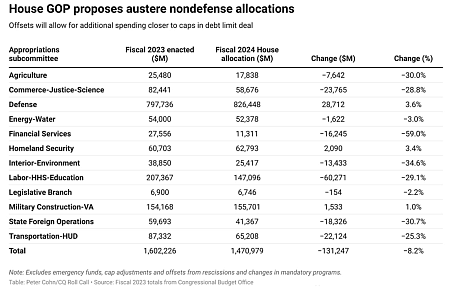
Proposed Republican budget cuts
Proposed Republican budget changes

Before even beginning this story, it is critical for my readers to understand that the worst any of these possible cuts could do to NASA’s budget in 2024 would be to bring it back to budgetary levels from most of the last decade, levels that hardly crippled the agency in the slightest.

The graph to the right, posted initially by Roll Call, outlines in detail the required cuts the Republicans in the House are demanding in the federal budget for the 2024 fiscal year. The percentages in the last column list the amount each of these twelve appropriation subcommittees must cut from their area of focus. NASA is part of the Commerce-Justice-Science category, which requires a total cut of 28.8%.

NASA’s budget in 2023 was $25.4 billion. If the House imposes that percentage cut to NASA, it would lower its 2024 budget to about $18 billion.

O my! We are all going to starve!
» Read more

7 comments

New House bill proposes giving FAA responsibility for monitoring space junk

A just proposed House bill for reauthorizing the Federal Aviation Administration (FAA) also proposes giving that agency the responsibility for monitoring space junk.

The bill instructs the FAA to establish a program to track objects “that are potential sources of covered airborne debris” with a focus on identifying those about to reenter and could pose a risk to aircraft in airspace. That program would coordinate with the FAA’s air traffic control system to identify airspace that needs to be closed for a reentry. It would allow the FAA to establish its own space situational awareness (SSA) facilities and work with other federal agencies, companies or international organizations for data on such objects.

While the focus of the bill is tracking debris to assess airspace risks, the bill does enable additional uses of the data the FAA collects. In particular, it directs the FAA to offer “a basic level of data, information, and services” at no charge. That includes maintaining a public catalog of space objects and “emergency conjunction notifications” of such objects.

The article at the link notes that this new FAA job would also duplicate work of the Space Force, as well as a new Commerce Department office tasked with similar responsibilities. It also duplicates the same responsibilities the FCC has created for itself, outside of its statutory authority.

In other words, there is a factional turf war going on within the swamp, with each faction attempting to establish its territory and control over this work.

The result? Expect Congress to allow this duplication to go forward, funding all three efforts. As we all know, money grows on trees, and hiring as many Washington bureaucrats is the most important thing Congress can do, even if those bureaucrats don’t do anything useful.

5 comments
1 4 5 6 7 8 63