Dawn moving to closest orbit to Ceres
In June the spacecraft Dawn will be lowered to its closest orbit ever to the dwarf planet Ceres, only 30 miles above its surface.
This will be its final orbit, as the spacecraft’s life is approaching its end.
In June the spacecraft Dawn will be lowered to its closest orbit ever to the dwarf planet Ceres, only 30 miles above its surface.
This will be its final orbit, as the spacecraft’s life is approaching its end.
New data from Dawn has found at least one spot on Ceres where recent changes appear to have occurred on the surface.
Observations obtained by the visible and infrared mapping spectrometer (VIR) on the Dawn spacecraft previously found water ice in a dozen sites on Ceres. The new study revealed the abundance of ice on the northern wall of Juling Crater, a crater 12 miles (20 kilometers) in diameter. The new observations, conducted from April through October 2016, show an increase in the amount of ice on the crater wall. “This is the first direct detection of change on the surface of Ceres,” said Andrea Raponi of the Institute of Astrophysics and Planetary Science in Rome.
Raponi led the new study, which found changes in the amount of ice exposed on the dwarf planet. “The combination of Ceres moving closer to the sun in its orbit, along with seasonal change, triggers the release of water vapor from the subsurface, which then condenses on the cold crater wall. This causes an increase in the amount of exposed ice. The warming might also cause landslides on the crater walls that expose fresh ice patches.”
There is a certain irony here. For eons, the only alien body that humans were able to get a good look at, the Moon, was also an object where almost nothing changed. Even today, after humans have visited its surface and numerous orbiting spacecraft have photographed its surface in numbing detail, the Moon has generally been found to be stable and unchanging. Though impacts do occur, and the surface does evolve over time, the Moon is probably one of the most static bodies in the solar system.
The irony is that this lunar stability gave us an incorrect impression of the rest of the solar system. Based on the Moon, it was assumed that airless or almost airless bodies like Mercury, Mars, Pluto, the large moons of Jupiter and Saturn, and asteroids like Ceres would also be stable and unchanging. What we have instead found is that the Moon is the exception that proves the rule. Most of these other worlds are unlike the Moon. They show a lot of surface evolution, over relatively short time scales. They change.
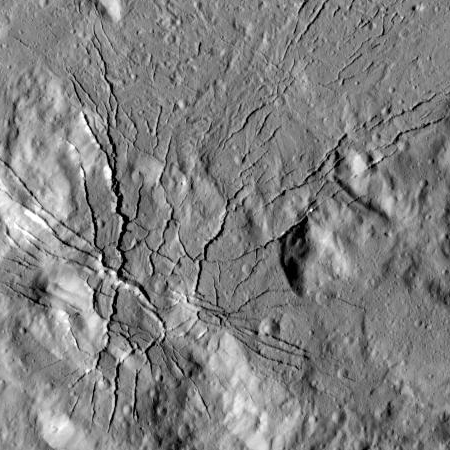
Cool image time! The Dawn science team has released an image of Ceres, cropped to post here in the right, that shows a spiderweb of fractures radiating out from a single point in the floor of Occator Crater.
These fractures have been interpreted as evidence that material came up from below and formed a dome shape, as if a piston was pushing Occator’s floor from beneath the surface. This may be due to the upwelling of material coming from Ceres’ deep interior. An alternative hypothesis is that the deformation is due to volume changes inside a reservoir of icy magma in the shallow subsurface that is in the process of freezing, similar to the change in volume that a bottle of water experiences when put in a freezer.
In the image sunlight is coming from the right. This fractured area can be seen in this earlier simulated oblique image of Occator Crater, in the southwest corner of the crater floor, well away from the crater’s more well known bright areas.
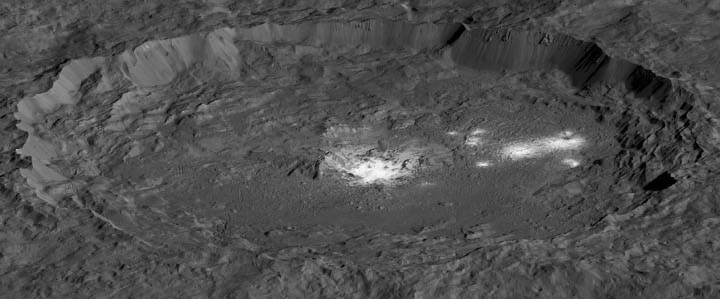
Based on the data obtained of Ceres from Dawn scientists have concluded that a variety of geological activities caused the bright areas on the planet, and that some of those activities could still be happening today.
Since Dawn arrived in orbit at Ceres in March 2015, scientists have located more than 300 bright areas on Ceres. A new study in the journal Icarus, led by Nathan Stein, a doctoral researcher at Caltech in Pasadena, California, divides Ceres’ features into four categories.
The first group of bright spots contains the most reflective material on Ceres, which is found on crater floors. The most iconic examples are in Occator Crater [shown in the image above, reduced and cropped to post here], which hosts two prominent bright areas. Cerealia Facula, in the center of the crater, consists of bright material covering a 6-mile-wide (10-kilometer-wide) pit, within which sits a small dome. East of the center is a collection of slightly less reflective and more diffuse features called Vinalia Faculae. All the bright material in Occator Crater is made of salt-rich material, which was likely once mixed in water. Although Cerealia Facula is the brightest area on all of Ceres, it would resemble dirty snow to the human eye.
More commonly, in the second category, bright material is found on the rims of craters, streaking down toward the floors. Impacting bodies likely exposed bright material that was already in the subsurface or had formed in a previous impact event.
Separately, in the third category, bright material can be found in the material ejected when craters were formed.
The mountain Ahuna Mons gets its own fourth category — the one instance on Ceres where bright material is unaffiliated with any impact crater. This likely cryovolcano, a volcano formed bythe gradual accumulation of thick, slowly flowing icy materials, has prominent bright streaks on its flanks.
The report is somewhat vague about why they think that there might be some geological activity even today.
The image above, released as part of this press release, gives us a simulated oblique look at Occator Crater and its bright areas. It is definitely worth it to look at the full resolution image.
Two studies released today by the Dawn science team suggest that the spacecraft has found evidence that an ancient ocean once existed on Ceres.
In one study, the Dawn team found Ceres’ crust is a mixture of ice, salts and hydrated materials that were subjected to past and possibly recent geologic activity, and this crust represents most of that ancient ocean. The second study builds off the first and suggests there is a softer, easily deformable layer beneath Ceres’ rigid surface crust, which could be the signature of residual liquid left over from the ocean, too.
NASA has decided to extend the Dawn mission again, but have that extension remain in orbit around Ceres.
A priority of the second Ceres mission extension is collecting data with Dawn’s gamma ray and neutron spectrometer, which measures the number and energy of gamma rays and neutrons. This information is important for understanding the composition of Ceres’ uppermost layer and how much ice it contains.
The spacecraft also will take visible-light images of Ceres’ surface geology with its camera, as well as measurements of Ceres’ mineralogy with its visible and infrared mapping spectrometer.
The extended mission at Ceres additionally allows Dawn to be in orbit while the dwarf planet goes through perihelion, its closest approach to the Sun, which will occur in April 2018. At closer proximity to the Sun, more ice on Ceres’ surface may turn to water vapor, which may in turn contribute to the weak transient atmosphere detected by the European Space Agency’s Herschel Space Observatory before Dawn’s arrival. Building on Dawn’s findings, the team has hypothesized that water vapor may be produced in part from energetic particles from the Sun interacting with ice in Ceres’ shallow surface.Scientists will combine data from ground-based observatories with Dawn’s observations to further study these phenomena as Ceres approaches perihelion.
They aim to get as close as 120 miles of the surface during this extension, half as close as the previous closest approach.
NASA is still reviewing the proposal by the Dawn science team that they send the spacecraft to another asteroid in its last years before its fuel runs out.
The spacecraft has continued operations despite problems with its reaction wheels, used for attitude control. After suffering the loss of two of its four reaction wheels earlier in the mission, a third wheel malfunctioned in April. The spacecraft went into safe mode briefly, but controllers resumed operations with hydrazine thrusters taking over for the failed wheel. That failure will eventually lead to the end of the mission when the spacecraft runs out of hydrazine. “It does reduce our lifetime because we have to use hydrazine at a faster rate,” Raymond said at the SBAG meeting in June.
That lifetime, she said, is dependent on the spacecraft’s orbital altitude. Dawn has spiraled out to a higher orbit during its extended mission, which reduces the amount of hydrazine needed for attitude control. “The lifetime is now highly dependent on orbital altitude because we need to use the jets to fight the gravity gradient torques,” she said. In its current high orbit, Raymond said that Dawn had sufficient hydrazine, as well as xenon propellant used for the ion engine, to operate at least through the end of 2018.
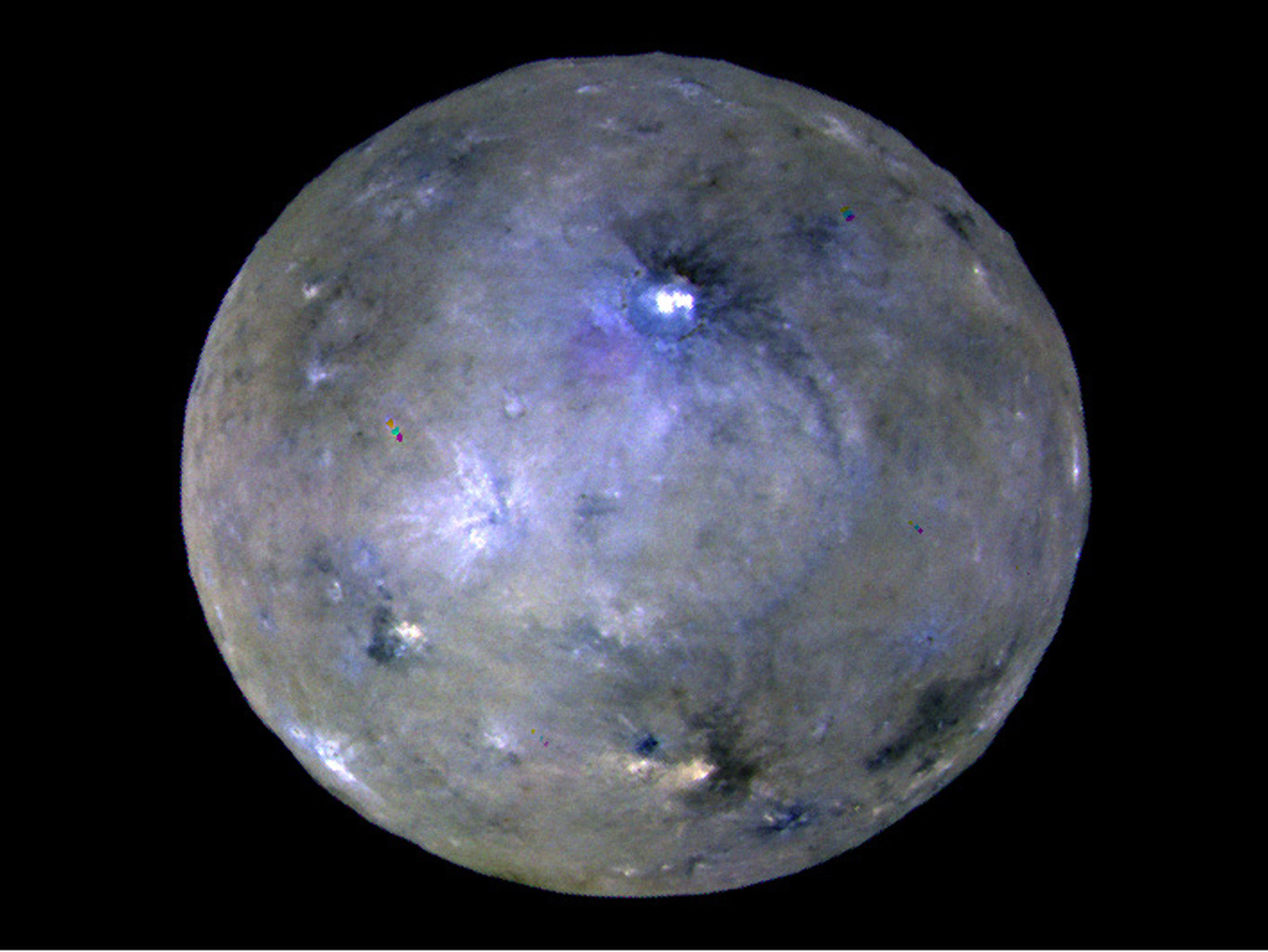
Cool image time! The image on the right, reduced in resolution to show here, was taken by Dawn on April 29, 2017, when the spacecraft had been positioned between the Sun and the dwarf planet at a moment when its entire surface was lit. They have enhanced the colors to bring out the contrasts.
Images combining these different color filter perspectives reveal fine details of Ceres’ surface. For example, they emphasize the distinct compositions and textures of the material ejected from craters. The brightest region on Ceres, called Cerealia Facula, is highlighted in Occator Crater in the center of this image. Vinalia Faculae, the set of secondary bright spots in the same crater, are located to the right of Cerealia Facula.
One of the darkest regions on Ceres is next to Occator, and represents ejected material from the impact that formed the crater. The ejected material forms a large arc that extends over several hundred kilometers, below the center of Ceres in this image. That material’s distribution is partly determined by Ceres’ rotation.
Be sure to take a close look at the full image. It isn’t super high resolution, but it reveals a lot of interesting details
The third of four reaction wheels on Dawn failed on April 23, forcing the spacecraft to use its conventional thrusters to orient itself.
The team discovered the situation during a scheduled communications session on April 24, diagnosed the problem, and returned the spacecraft to its standard flight configuration, still with hydrazine control, on April 25. The failure occurred after Dawn completed its five-hour segment of ion thrusting on April 22 to adjust its orbit, but before the shorter maneuver scheduled for April 23-24. The orbit will still allow Dawn to perform its opposition measurements. The reaction wheel’s malfunctioning will not significantly impact the rest of the extended mission at Ceres.
This might shorten Dawn’s remaining mission, but since it is in its final days anyway, the loss will not be severe.
An analysis of data from Dawn has shown that Ceres’s landslides are distributed in greater numbers towards the poles, which suggests the presence of water ice just below the surface.
Georgia Tech Assistant Professor and Dawn Science Team Associate Britney Schmidt led the study. She believes it provides more proof that the asteroid’s shallow subsurface is a mixture of rock and ice. “Landslides cover more area in the poles than at the equator, but most surface processes generally don’t care about latitude,” said Schmidt, a faculty member in the School of Earth and Atmospheric Sciences. “That’s one reason why we think it’s ice affecting the flow processes. There’s no other good way to explain why the poles have huge, thick landslides; mid-latitudes have a mixture of sheeted and thick landslides; and low latitudes have just a few.”
The data also showed that Ceres has far more landslides than expected, which also supports the idea that the shallow subsurface has a lot of water ice in it, as much as 10% to 50% by volume.
Using crater counts and a careful analysis of features in Occator Crater on Ceres, scientists have estimated that the last major eruption occurred about 4 million years ago.
Nathues and his team interpret the central pit with its rocky, jagged ridge as a remnant of a former central mountain. It formed as a result of the impact that created Occator Crater some 34 million years ago and collapsed later. The dome of bright material is much younger: only approximately four million years. The key to determining these ages was the accurate counting and measuring of smaller craters torn by later impacts. This method’s basic assumption is that surfaces showing many craters are older than those that are less strongly “perforated”. Since even very small craters are visible in highly resolved images, the new study contains the most accurate dating so far.
“The age and appearance of the material surrounding the bright dome indicate that Cerealia Facula was formed by a recurring, eruptive process, which also hurled material into more outward regions of the central pit”, says Nathues. “A single eruptive event is rather unlikely,” he adds. A look into the Jupiter system supports this theory. The moons Callisto and Ganymede show similar domes. Researchers interpret them as volcanic deposits and thus as signs of cryovolcanism.
The volcano itself has slumped away, leaving behind the bright depression. Whether any cryovolcanism is still occurring underground remains unknown.
The spacecraft Dawn has detected evidence of organic molecules in Ceres’ northern hemisphere.
The organic materials on Ceres are mainly located in an area covering approximately 400 square miles (about 1,000 square kilometers). The signature of organics is very clear on the floor of Ernutet Crater, on its southern rim and in an area just outside the crater to the southwest. Another large area with well-defined signatures is found across the northwest part of the crater rim and ejecta. There are other smaller organic-rich areas several miles (kilometers) west and east of the crater. Organics also were found in a very small area in Inamahari Crater, about 250 miles (400 kilometers) away from Ernutet.
This detection does not mean that Dawn has found life on Ceres. It means that the spacecraft has detected molecules that contain carbon, which is the chemical definition of organics. Nor is it unusual for asteroids to have carbon molecules. In fact, there is an entire asteroid class dubbed carbonaceous chondrites that are rich in carbon. In addition, the press release overplays this narrative by making it seem as if the discovery of organics in the solar system is rare and unusual. It is not. Molecules containing carbon have been found in many places, on Mars, on Venus, in asteroids, and elsewhere. All that is happened here is that the scientists have gained more information about the make-up Ceres itself. This is good, but it isn’t what is being sold by the press release.
New research based on Dawn data suggests that volcanoes on Ceres flatten and disappear over time.
NASA’s Dawn spacecraft discovered Ceres’s 4-kilometer (2.5-mile) tall Ahuna Mons cryovolcano in 2015. Other icy worlds in our solar system, like Pluto, Europa, Triton, Charon and Titan, may also have cryovolcanoes, but Ahuna Mons is conspicuously alone on Ceres. The dwarf planet, with an orbit between Mars and Jupiter, also lies far closer to the sun than other planetary bodies where cryovolcanoes have been found.
Now, scientists show there may have been cryovolcanoes other than Ahuna Mons on Ceres millions or billions of years ago, but these cryovolcanoes may have flattened out over time and become indistinguishable from the planet’s surface. They report their findings in a new paper accepted for publication in Geophysical Research Letters, a journal of the American Geophysical Union. “We think we have a very good case that there have been lots of cryovolcanoes on Ceres but they have deformed,” said Michael Sori of the Lunar and Planetary Laboratory at the University of Arizona in Tucson, and lead author of the new paper.
The cause of the flattening?
Viscous relaxation is the idea that just about any solid will flow, given enough time. For example, a cold block of honey appears to be solid. But if given enough time, the block will flatten out until there is no sign left of the original block structure. On Earth, viscous relaxation is what makes glaciers flow, Sori explained. The process doesn’t affect volcanoes on Earth because they are made of rock, but Ceres’s volcanoes contain ice – making viscous relaxation possible.
Cool movie time! Using data from Dawn the German Aerospace Center (DLR) has produced a short animation that gives a 3D flyover of Occator Crater on Ceres.
The animated flyover includes topographic and enhanced-color views of the crater, highlighting the central dome feature. The central area has been named Cerealia Facula. Occator’s secondary group of bright spots is called Vinalia Faculae.
The movie is definitely worth watching, especially the sections that show in close-up the bright areas near the crater’s center.
New data from Dawn now suggests that Ceres contains a large amount of ice on or near its surface.
“On Ceres, ice is not just localized to a few craters. It’s everywhere, and nearer to the surface with higher latitudes,” said Thomas Prettyman, principal investigator of Dawn’s gamma ray and neutron detector (GRaND), based at the Planetary Science Institute, Tucson, Arizona. Researchers used the GRaND instrument to determine the concentrations of hydrogen, iron and potassium in the uppermost yard (or meter) of Ceres. GRaND measures the number and energy of gamma rays and neutrons coming from Ceres. Neutrons are produced as galactic cosmic rays interact with Ceres’ surface. Some neutrons get absorbed into the surface, while others escape. Since hydrogen slows down neutrons, it is associated with a fewer neutrons escaping. On Ceres, hydrogen is likely to be in the form of frozen water (which is made of two hydrogen atoms and one oxygen atom).
Rather than a solid ice layer, there is likely to be a porous mixture of rocky materials in which ice fills the pores, researchers found. The GRaND data show that the mixture is about 10 percent ice by weight.
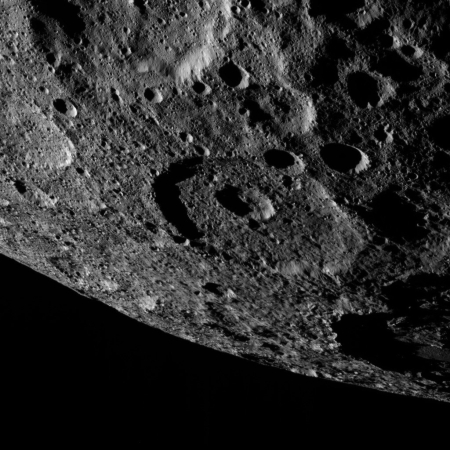
Cool image time! The picture on the right, reduced to show here, was taken on October 17 and was the tenth image taken by Dawn in its new extended mission in orbit around Ceres.
This image of the limb of dwarf planet Ceres shows a section of the northern hemisphere. A shadowy portion of Occator Crater can be seen at the lower right — its bright “spot” areas are outside of the frame of view. Part of Kaikara Crater (45 miles, 72 kilometers in diameter) is visible at top left.
The image was taken from 920 miles away and has a resolution of about 460 feet per pixel.
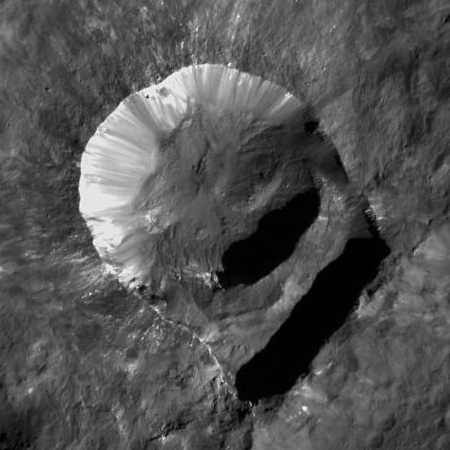
Cool image time! The Dawn image at the right, cropped to show here, was taken on April 19, 2016. It shows the crater Oxo on Ceres and is especially intriguing because it not provides high resolution imagery of the crater’s bright rim, the second brightest feature on Ceres, it also shows how the southeastern part of the crater’s rim has literally slide down into the crater, leaving behind a gaping rombus-shaped pit.
The slumping, combined with the bright material on the rim, is more evidence that at some point in the past Ceres was geologically active.
The uncertainty of science: Despite significant evidence that water ice has helped form specific features on Ceres, other data collected by Dawn suggest that there is not much ice on the surface.
Angular polygonal craters on the surface suggest that Ceres’ crust is fractured, furthering the conclusion that the near-surface crust “must be both brittle enough to fracture and strong enough to retain fractures for long periods of time.”
“Based on our analysis, the crust of Ceres is too strong to be dominated by ice,” said Debra Buczkowski of the Johns Hopkins Applied Physics Laboratory in Laurel, Maryland, the study’s lead author. “While surface features such as the lobate flows show that water ice is present in the dwarf planet’s upper crust and on the surface in some locations, it appears not to be a major factor in creating surface features.”
In addition to studying the surface, researchers drew conclusions about the dwarf planet’s interior makeup. Beneath a strong crust composed of rock, ice and salt hydrates lays a water-rich mantle and a silicate core. Evidence of cryomagmatism is found in the floor-fractured craters, while Ahuna Mons and other domical features have been shown to be cryovolcanic in nature. These surface features suggest that Ceres has been geologically active at some point in its past, perhaps even its recent past.
Note that in just two days, Dawn researchers released two press releases, the first noting that water ice played a significant role in molding major features on Ceres, and the second noting that the surface doesn’t have much water ice. How’s that for a nice demonstration of the uncertainty of science?
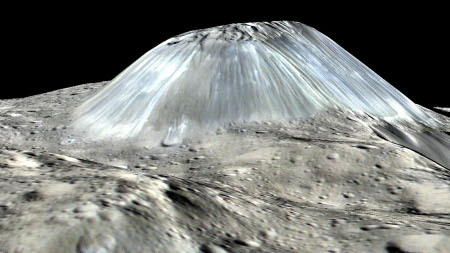
Using data from Dawn scientists have concluded that Ceres’s biggest mountain, Ahuna Mons (shown on the right), was created by water volcanism.
“Ahuna is the one true ‘mountain’ on Ceres,” said David A. Williams, associate research professor in Arizona State University’s School of Earth and Space Exploration. “After studying it closely, we interpret it as a dome raised by cryovolcanism.” This is a form of low-temperature volcanic activity, where molten ice — water, usually mixed with salts or ammonia — replaces the molten silicate rock erupted by terrestrial volcanoes. Giant mountain Ahuna is a volcanic dome built from repeated eruptions of freezing salty water.
The implications of this fact are important, as it suggests that Ceres’s interior was warm enough for long periods, enough to melt ice. Where that heat came from however is a mystery, considering the dwarf planet’s small size.
In order to save fuel as well as obtain a different view of Ceres, engineers are moving Dawn to a higher orbit.
On Sept. 2, Dawn will begin spiraling upward to about 910 miles (1,460 kilometers) from Ceres. The altitude will be close to where Dawn was a year ago, but the orientation of the spacecraft’s orbit — specifically, the angle between the orbit plane and the sun — will be different this time, so the spacecraft will have a different view of the surface.