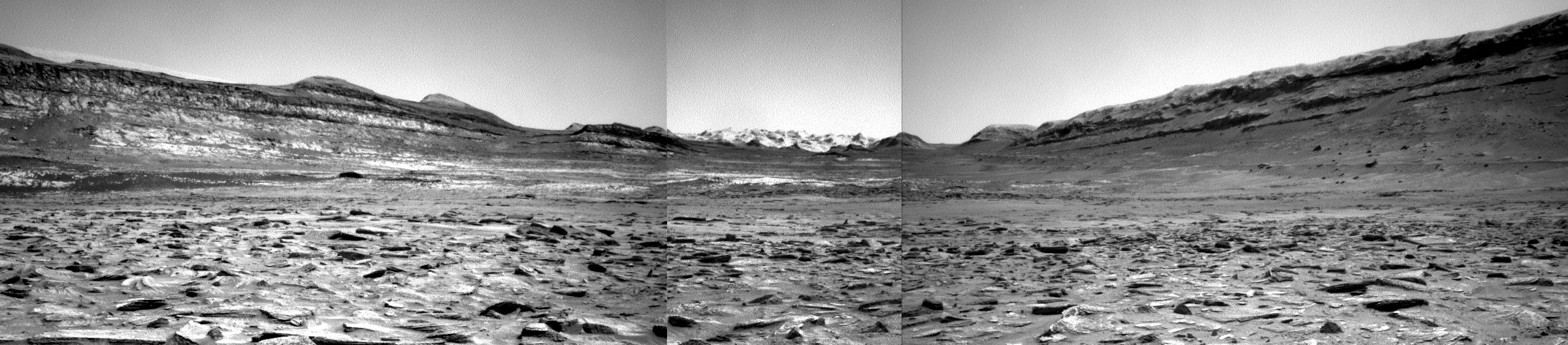
Curiosity unintentionally picks up a rock slab

Sequence showing slab picked up and then dropped
Click for movie. Original images found here, here, here, and here.

In their latest drilling campaign using the drill on the Mars rover Curiosity, the science team picked up a big surprise that could have been a serious problem, but turned out all right in the end. When they tried to extract the drill from the hole, the drill instead stayed stuck to the rock, and picked the whole rock up instead.

The four images to the right show the sequence, sourced from here, here, here, and here.

On April 25, 2026, Curiosity drilled a sample from a rock nicknamed “Atacama,” which is an estimated 1.5 feet in diameter at its base, 6 inches thick and weighs roughly 28.6 pounds (13 kilograms). When the rover retracted its arm, the entire rock lifted out of the ground, suspended by the fixed sleeve that surrounds the rotating drill bit. Drilling has fractured or separated the upper layers of rocks in the past, but a rock has never remained attached to the drill sleeve. The team initially tried vibrating the drill to shake off the rock, but saw no change.

Then, on April 29, they tried reorienting Curiosity’s robotic arm and vibrating the drill again. Imagery in the GIF shows sand falling from Atacama, but the rock stayed attached to the rover.

Finally, on May 1, Curiosity’s team tried again, tilting the drill more, rotating and vibrating the drill, and spinning the drill bit. The team planned to perform these actions multiple times but the rock came off on the first round, fracturing as it hit the ground.

Had they not been able to release the rock it could have seriously impacted the mission, even ended it.

As noted by the science team in their own update today about this situation:

Future activities involve wrapping up the drill campaign on Atacama and, nominally, seeking a more firmly rooted drill target in order to collect drill tailings for analysis, which were lost from Atacama as part of the effort to dislodge the drill bit from the rock.

In other words, they are going to have hunt around for a better drill spot, as they really do want to study some drill samples at this location. They have left the boxwork area and have moved uphill closer to the pure sulfite unit, and want to see how the geology has changed.

5 comments

The UK’s Sutherland spaceport now appears dead

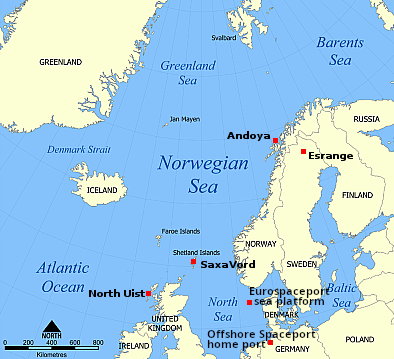
Proposed or active spaceports in North Europe

In a news report yesterday about the failure of the United Kingdom’s rocket startup Orbex in February 2026, the following details about the Sutherland spaceport in Scotland suggests that spaceport is now defunct, with little chance of being revived.

Administrators say that one of Orbex’s key remaining assets is the Sutherland Spaceport site near Melness – although the only construction work undertaken at the site is some 600m of access road. The company responsible for it, Sutherland Spaceport Ltd (SSL), remains financially stable, according to administrators. This means the site could still be sold or potentially restarted, even though no launch activity is currently taking place.

The spaceport sits on land leased from local crofters under a long-term arrangement managed through Highlands and Islands Enterprise. SSL holds a 50-year sublease, with an option to extend for 25 years, and a break clause in 2027.

Orbex had originally intended to launch from Sutherland — close to the rocket factory it had built — but local opposition by billionaire Anders Holch Povlsen (who is a major owner in the competing Saxavord spaceport on the Shetland Islands) as well as endless bureaucratic delays from the UK’s Civil Aviation Authority made that impossible. The company attempted to switch its launches to Saxavord, but the cost and new licensing requirements were too much.

No other launch company has expressed any interest in using Sutherland, and it appears none will be forthcoming in the near future. The red tape in the UK, combined with that powerful local opposition, has made Sutherland a pariah to the smallsat rocket companies looking for launch sites.

Though the spaceport might say it is “financially stable”, without any customers I guarantee it is going to disappear at some point.

2 comments

Former NASA administrator Bridenstine moves from lobbyist to CEO of orbital tug startup

Jim Bridenstine
Jim Bridenstine testifying before Congress
as a big space lobbyist

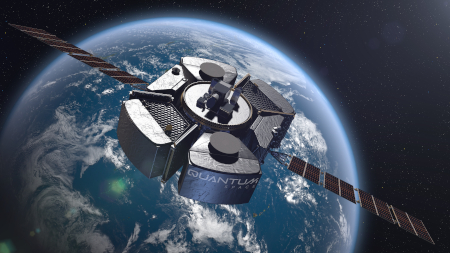
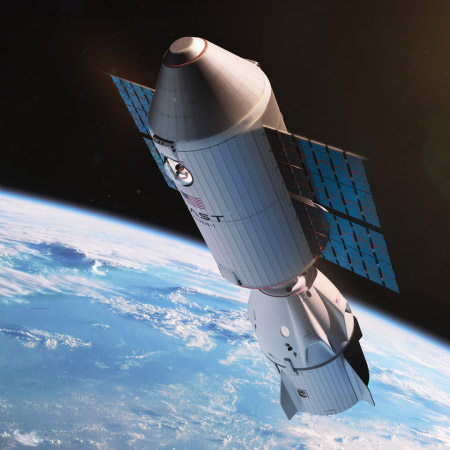
Former NASA administrator Jim Bridenstine has taken the job of CEO for the orbital tug startup Quantum, ending his post-NASA career as a lobbyist for some of the biggest old space companies.

Since his departure from NASA, Bridenstine has worked as a managing partner of The Artemis Group consulting firm, and the appointment to Quantum Space marks the first time he has taken up an official corporate post, he told Breaking Defense.

“I was asked several times” to be a CEO, he said, but “never accepted until now.”

Bridenstine waxed enthusiastic about Quantum Space’s plans for its Ranger spacecraft that is being designed to support “sustained maneuver for dynamic space operations.”

Bridenstine’s lobbying for the Artemis Group was mostly aimed at encouraging a giant NASA space program, comparable to the 1960s Apollo effort, with the main beneficiaries the older established companies like Boeing, Lockheed Martin, and Northrop Grumman, and at the expense of the new space industry led by SpaceX. That effort was largely a failure, as it has become very clear these old companies can’t get the job done, at least not at a price anyone can afford.

At Quantum Bridenstine is back on the side of new space, pushing a new orbital tug company whose Ranger tug can “carry a whopping 4,000 kilograms (8,818.49 pounds) of hydrazine fuel to orbit, Bridenstine explained, and will use that fuel for both chemical propulsion and electric propulsion.” It plans on launching the first Ranger demo mission in early 2027, after which the company hopes to win both commercial and military contracts using Ranger’s tug capabilities.

2 comments

SpaceX launches 24 more Starlink satellites

SpaceX tonight successfully launched another 24 Starlink satellites, its Falcon 9 rocket lifting off from Vandenberg Space Force Base in California.

The first stage completed its 24th flight, landing on a drone ship in the Pacific.

The leaders in the 2026 launch race:

55 SpaceX
23 China
8 Russia
6 Rocket Lab

For the third straight year SpaceX leads the entire world combined in total launches, 55 to 44.

0 comments

Lockheed Martin joins partnership to build off-shore launch platform

Artist's rendering of Seagate platform
Artist’s rendering of Seagate platform. Click for original.

According to a post yesterday by Johnathon Caldwell, a vice president and general manager at Lockheed Martin, the company will be joining the partnership of Seagate and Firefly to build an off-shore launch platform from which Firefly hopes to launch its Alpha rocket.

The three companies will work together on mission‑application concepts and flight‑demonstration projects that leverage Seagate’s Gateway offshore launch platform. This sea‑based launch facility, combined with Firefly’s responsive Alpha launch vehicle, will provide rapid, flexible access to space from diverse locations, an essential capability for tactical payloads and national‑security missions.

Seagate only went public with this project in late March. Firefly signed on in April. Now Lockheed Martin has joined. It appears the concept has great potential for it to attract so much interest so quickly. Nor should this be surprising. The Chinese have been very successful in the past two years with its own sea platform, and the concept was proven years ago with Sea Launch.

Though Firefly presently launches Alpha from Vandenberg, the company also has deals with Sweden’s Esrange spaceport and a lease for a pad at Cape Canaveral. It has also been studying launching from a proposed commercial spaceport in northern Japan. This partnership with Seagate might allow it to abandon all these land-based sites, or supplement them.

Lockheed Martin in the past has invested heavily in new rocket companies, including Rocket Lab, ABL, Orbex, and X-Bow. Of these, only Rocket Lab has succeeded. With this deal Lockheed is looking for another option for getting its commercial and military payloads into orbit, with a much greater launch flexibility.

0 comments

Blue Origin’s 1st unmanned lunar lander completes ground testing

Blue Moon MK-1 in testing chamber
Blue Origin’s unmanned Blue Moon MK-1 lunar lander
in test chamber. Click for original image.

Blue Origin’s 1st unmanned lunar lander, dubbed Blue Moon Mark-1 (MK-1) or “Endurance,” has completed ground testing at the Johnson Space Center in Houston, prior to its planned launch before the end of this year.

The NASA press release however said nothing about the results of that testing.

Testing in NASA Johnson’s Chamber A, one of the world’s largest thermal vacuum test facilities, enabled engineers to model the vacuum of space and the extreme temperature conditions the spacecraft would experience during flight. By recreating these conditions on the ground, teams evaluated system performance and verified structural and thermal integrity prior to launch. NASA and Blue Origin will incorporate lessons learned from MK1’s design, integration, and testing to support NASA’s future Artemis missions that will return American astronauts to the Moon.

Normally when such testing is completed the press release touts their success. The vagueness in the language above is to my instincts somewhat concerning. Did they find something in that testing that needs modification prior to launch? If so, getting this lander off the ground before the end of the year is going to be questionable, as those fixes will have to be incorporated and then tested again.

Any delay such as this would in turn impact the first test in orbit of Blue Origin’s manned Blue Moon MK-2 lunar lander, scheduled for late 2027 during the Artemis-3 manned mission, where NASA wishes to test rendezvous and docking for both Blue Origin’s lander and SpaceX’s Starship.

Some clarity here would be reassuring.

0 comments

Sunspot update: The number of sunspot continues to decline

For only the second time since I started this website in 2010, I forgot last month to do my monthly sunspot update. No matter. The Sun’s behavior in producing sunspots in the past two months was actually amazingly similar, so doing both months at once works.

According to NOAA’s monthly graph of the sunspot activity on the Earth-facing hemisphere, the amount of sunspots in both March and April continued to be low, well below the predictions put forth by NOAA’s panel of scientists in their April 2025 prediction.

That graph is below, annotated with extra information by me to illustrate the larger scientific context.
» Read more

11 comments

Is SpaceX buying a 200-plus square mile patch of Louisiana?

Pecan Island SpaceX facility?

According to a real estate agent in Louisiana, there is credible but unconfirmed evidence that SpaceX is in the process of buying a 136,000 acre plot of land owned by Exxon on the coast of Louisiana west of New Orleans, near the unincorporated town of Pecan Island.

The rumor — repeated in private group chats, in coffee shops in Abbeville, and in hunting camps from Forked Island to Grand Chenier — is that SpaceX has acquired or is in the process of acquiring approximately 136,000 acres of coastal Louisiana marshland straddling Pecan Island and Freshwater City in Vermilion Parish. The footprint reportedly stretches from south of Highway 82 down to the Gulf of America, encompassing some of the most ecologically rich and economically untouched wetlands in North America.

If true, this would be the single largest private land acquisition in the modern history of Vermilion Parish. To put it in perspective: 136,000 acres is roughly 212 square miles — bigger than the entire city of New Orleans. SpaceX’s existing Boca Chica/Starbase facility in South Texas, which has reshaped Brownsville’s economy and real estate market in just five years, is built on a footprint of less than 100 acres. A 136,000-acre Louisiana site would not be a launch pad. It would be an industrial campus on a scale never before seen in American aerospace.

I must emphasize that this agent is speculating, and that there is no confirmed evidence that SpaceX is the rumored buyer. At the same time, the agent has done his homework. This purchase by SpaceX would make sense on multiple levels. It would give it a very large facility smack dab between Boca Chica and Florida, on the Gulf, so that if Starships are manufactured here they could be easily shipped both east and west to those launch sites. This facility would also give SpaceX to option of shifting more of its operations out of unfriendly California and to a more friendly state, something Elon Musk has been doing since the Covid panic.

It would allow for the construction of larger data centers and satellite manufacturing factories, without much opposition from local communities.

Finally, there is the possibility this location could also serve as a spaceport, though it would only work well for polar orbits.

Stay tuned. If this speculation is true we should find out momentarily.

Hat tip reader Steve Golson.

27 comments

SpaceX launches South Korean Earth imaging satellite plus 44 other smallsats

SpaceX at about midnight tonight successfully launched a South Korean Earth imaging satellite as well as 44 other smallsats, its Falcon 9 rocket lifting off from Vandenberg Space Force Base in California. As of posting the satellites had not yet been deployed.

The first stage (B1071) completed its 33rd flight, landing back at Vandenberg, 50 days after its previous flight. With this flight, the booster moves into a third place tie with the Atlantis shuttle shuttle in the rankings of the most reused launch vehicles:

39 Discovery space shuttle
34 Falcon 9 booster B1067
33 Atlantis space shuttle
33 Falcon 9 booster B1071
32 Falcon 9 booster B1063
31 Falcon 9 booster B1069
28 Columbia space shuttle
27 Falcon 9 booster B1077
27 Falcon 9 booster B1078

Sources here and here.

The leaders in the 2026 launch race:

54 SpaceX
23 China
8 Russia
6 Rocket Lab

For the third straight year SpaceX leads the entire world combined in total launches, 54 to 44.

0 comments

$2 bill that Gene Cernan carried on three missions sells for more than $90K

The $2 bill that astronaut Gene Cernan carried on all three of his space missions in 60s and 70s has now sold at auction for $91,519.

Signed and flight-certified by Cernan, the bill is encapsulated and graded by Paper Money Guaranty (PMG) as Choice Fine 15. The holder notes its provenance as having been flown aboard Gemini 9A (1966), Apollo 10 (1969), and Apollo 17 (1972), and traces its origin to Cernan’s personal collection.

A signed letter of provenance from Cernan states that the bill was originally owned by his father and later carried by the astronaut on each of his spaceflights. The letter documents its presence during low Earth orbit on Gemini 9A, lunar orbit on Apollo 10, and on the lunar surface during Apollo 17.

This auction was space-focused and realized a total of $1,764,603. It included items from a number of other Gemini and Apollo missions, including an American flag that astronaut Dave Scott flew on Gemini 8, the mission that achieved the first docking in space but then had to due an emergency splashdown because a thruster began firing uncontrollably. It sold for $47,406.

Hat tip reader Wayne DeVette.

2 comments

No Starliner mission to ISS this year

Though in February 2026 NASA officials suggested there might be a Starliner cargo mission to ISS sometime in April 2026, the new schedule released today for ISS manned and cargo missions for the rest of this year shows no Starliner missions at all.

The press release hinted an extra Starliner mission could be added, but don’t but too much faith in this:

Launch opportunities for NASA’s uncrewed Boeing Starliner-1 cargo mission remain under review as teams continue working through technical issues discovered during the Crew Flight Test in 2024, as well as final actions from the Program Investigation Team report. The agency is assessing operational readiness and space station traffic to determine the earliest feasible launch window.

What I think is happening in NASA is that the agency under Isaacman wants a better assurance from Boeing that the problems with Starliner have been fixed, and Boeing is having trouble satisfying them. If so, it seems he is doing what I suggested in February, demand from Boeing the highest quality work or don’t buy anything from it at all. If so kudos to Isaacman.

It is also possible Isaacman doesn’t want to spend extra money paying Boeing for this extra cargo mission to prove out Starliner’s systems. Boeing’s contract for Starliner is fixed price, and the capsule’s multiple problems has now cost the company more than a billion dollars. It is unlikely it will have make a profit on it, which is why it wants NASA to pay for that cargo flight.

Either way, the first operational manned mission using Starliner continues to recede into the future, to the point where ISS might be gone before the capsule is finally okayed for manned flights.

14 comments
1 8 9 10 11 12 1,353