The strange terrain of the Martian southern ice cap

The strange terrain of Mars' south pole
Click for original image.

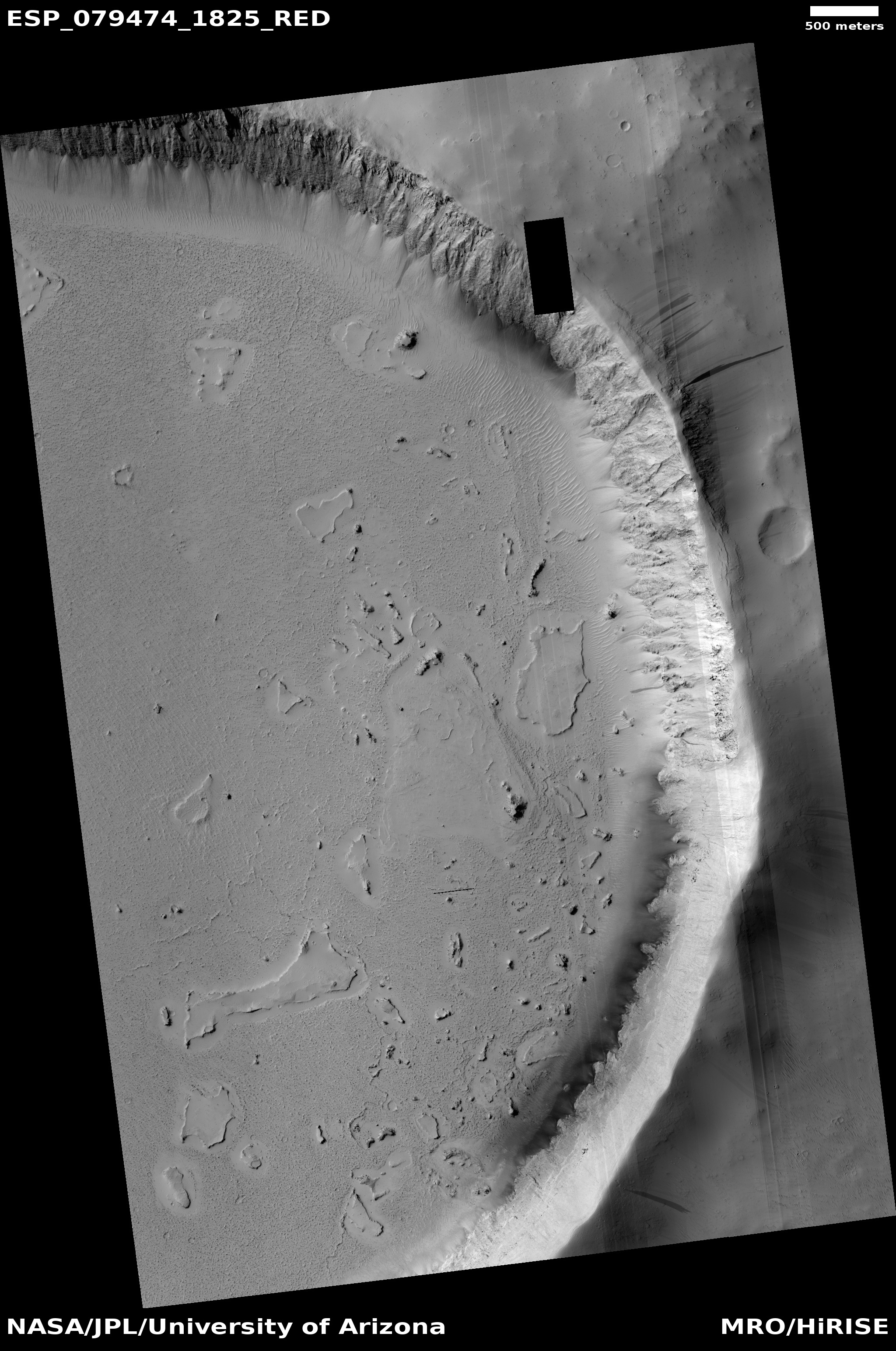
Cool image time! The picture to the right, rotated, cropped, and sharpened to post here, was taken on July 29, 2024 by the high resolution camera on Mars Reconnaissance Orbiter (MRO). It shows a section at the Martian south pole at the very high latitude of 87 degrees south, only about 100 miles from the pole itself.

The label for this picture is “possible water ice and mesas,” suggesting we are looking at an ice cap of water that is partly sublimated away.

In truth, things are much more complicated. It was summer when this photo was taken. Note the drainage in the lower right and the dark spidery lines there. In the winter on Mars atmospheric carbon dioxide falls as snow and coats the poles to about 60 degrees latitude with a thin mantle of dry ice. In the spring this mantle sublimates away, but does so in an counter-intuitive manner. The sublimation first occurs at the mantle’s base, and the trapped gas flows up until it finds a weak spot in the mantle and cracks through, spewing out and deposting dark splotches of dust.

At the south pole this upward flow always follows the same paths, producing the dark spidery patterns we see here. In the case of the drainage in the lower right, this is a drainage of gas eastward until it pops out at the slope, causing that depression to become darkly stained.

This is only part of the story of this complex geology, however.
» Read more

0 comments

Mid-October date for the 5th Starship/Superheavy test orbital launch?

A US Coast Guard announcement issued today includes a notice to mariners of a rocket launch window at Boca Chica from October 12th to October 19th, suggesting that SpaceX has gotten an update from the FAA that a launch license will be issued for those dates, more than a month earlier than previously predicted by the FAA.

It must be emphasized that this notice is from the Coast Guard, not the FAA. The FAA has said nothing new about SpaceX’s launch license application. This notice suggests several possiblilites, all or none of which may be true:

1. The FAA has told SpaceX privately that it expects to issue that license in time for a launch in two weeks, and SpaceX then moved quickly to get the Coast Guard in line.

2. SpaceX and the Coast Guard are working together to increase the pressure on the FAA to get out of the way.

3. The public condemnations of the FAA by SpaceX in the past few weeks have worked to force that agency to back off its hardnosed regulatory over-reach.

All of this is wild speculation. For all we know, this Coast Guard notice is something it always issues prior to major static fire tests at Boca Chica. We shall have to wait to get a better sense of what is happening.

Hat tip to reader Steve Richter.

4 comments

Scientists detect jets of carbon dioxide and carbon monoxide from asteroid

Jets from asteroid
Click for original graphic.

Using the spectroscopy from the Webb Space Telescope, scientists have now detected jets of carbon dioxide and carbon monoxide spewing from the very active asteroid 29P/Schwassmann-Wachmann-1 (29P).

Based on the data gathered by Webb, the team created a 3D model of the jets to understand their orientation and origin. They found through their modeling efforts that the jets were emitted from different regions on the centaur’s nucleus, even though the nucleus itself cannot be resolved by Webb. The jets’ angles suggest the possibility that the nucleus may be an aggregate of distinct objects with different compositions; however, other scenarios can’t yet be excluded.

The graphic to the right illustrates the modeling of these jets. That the center of this two-lobed asteroid could have been created from distinct objects suggests a very complex formation process, since those objects would have had to have formed themselves in different locations in the solar system and then somehow come together.

2 comments

ESA awards Polish rocket startup €2.4 million contract

The European Space Agency (ESA) has awarded a Polish rocket startup, dubbed SpaceForest, €2.4 million to upgrade its suborbital Perun rocket that the company has test launched twice in last year.

Perun runs on modified paraffin, commonly used as candle wax, and so its propellant is non-toxic. The rocket can be launched on a mobile launch pad, allowing for easy deployment at launch facilities around Europe. Last year, SpaceForest launched two full-scale models of its Perun rocket that flew to 22 km and 13 km altitude from the coastal town of Ustka, Poland, on the Baltic Sea.

This company is now the second Polish rocket startup to have successfully tested its rocket. The Łukasiewicz Institute of Aviation has completed suborbital test flights of its ILR-33 Amber 2K rocket, and has a deal to fly its next test from Norway’s commercial Andoya spaceport.

0 comments

ISRO reveals design of its Chandrayaan-4 lunar sample return mission

India’s space agency ISRO yesterday unveiled its design concept for its Chandrayaan-4 lunar sample return mission, requiring two launches and five modules that will dock in Earth orbit before traveling to the Moon.

“After two launches, the stacks will be docked together in elliptical Earth orbit to form an integrated stack. Subsequent to docking, the Integrated Stack will perform the first set of Earth-bound manoeuvres with the PM propulsion system. Once the PM is depleted, it gets jettisoned from the Integrated stack,” Isro said Tuesday.

The integrated stack then performs all the manoeuvres to achieve the lunar orbit, such that the orbit plane has the pre-determined landing site. In the final lunar orbit, the descender module and ascender module get separated from the transfer module and re-entry module. The descender and ascender modules then undergo powered descent to achieve a soft landing on the lunar surface.

Both a robot arm and a drill will then grab samples, deposit them separately in the ascender, which will then launch and redock with the stack. It will then take the re-entry module back toward Earth, where it will be released prior to its return.

This plan is essentially the same as the first proposal last year, but with many more added details.

A landing site has apparently not yet been chosen.

1 comment

Orbital tug startup Impulse Space raises $150 million

The orbital tug startup Impulse Space announced yesterday that it has raised $150 million in private investment capital, money it will use to develop its planned two tugs, dubbed Mira and Helios.

So far the company, founded by former SpaceX engineer Tom Mueller, has only flown one mission, a demo mission of Mira last year that had some communications and software problems but was still declared a success.

Both Mira and Helios use chemical propulsion systems that offer large amounts of delta-v, or change in velocity, that can be provided quickly. Impulse said when it announced Helios that the vehicle could take a five-ton satellite from low Earth orbit to geostationary orbit in less than a day.

It hopes to fly an upgraded version of Mira late next year, and the first Helios mission in 2026.

0 comments

Carbon dioxide and hydrogen peroxide found on the surface of Pluto’s moon Charon

Using spectroscopic data from the Webb Space Telescope, scientists have detected both carbon dioxide and hydrogen peroxide on the surface of Pluto’s moon Charon, adding these chemicals to the previously detected water ice and ammonia-bearing chemicals that give the planet its gray and red colors.

The team compared the spectroscopic observations with laboratory measurements and detailed spectral models of the surface, concluding that carbon dioxide is present primarily as a surface veneer on a water ice-rich subsurface. “Our preferred interpretation is that the upper layer of carbon dioxide originates from the interior and has been exposed to the surface through cratering events. Carbon dioxide is known to be present in regions of the protoplanetary disk from which the Pluto system formed,” Protopapa said.

The presence of hydrogen peroxide on the surface of Charon clearly indicates that the water ice-rich surface is altered by solar ultraviolet light and energetic particles from the solar wind and galactic cosmic rays. Hydrogen peroxide forms from oxygen and hydrogen atoms originating from the breakup of water ice due to incoming ions, electrons or photons.

The theory proposing the dry ice comes from the interior is interesting, but there simply is not enough data to take it very seriously at this point.

1 comment

Russia delays first launch of new Soyuz-5 rocket to 2026

According to Russia’s state-run press, the first launch of its new Soyuz-5 rocket will not occur in 2025 as previously predicted, but has been delayed to 2026.

No reason for the delay was given, but I suspect it is because Russia has still been unable to negotiate a deal with Kazakhstan for the use of the planned launchpad at Baikonur. In 2023 Kazakhstan seized control of the Soyuz-5 launchpad, and has apparently so far refused to agree to a new deal for allowing Russia to use it.

These negotiating delays with Kazakhstan are not the Soyuz-5 rocket’s only issues. Russia first announced the rocket in 2015, with its first launch planned for 2022. Thus, long before Kazakhstan retook its launchpad in 2023 the project was behind schedule. Other plans in 2019 to launch it from the former commercial Sea Launch platform that Russia took over have come to nothing.

Kazakhstan’s unwillingness to negotiate almost certainly stems from Russia’s invasion of the Ukraine. It now fears Russia, and is very reluctant to give it more control of Kazakhstan’s assets.

1 comment

Engineers shut down one science instrument on Voyager-2 to conserve power

In order to keep the spacecraft functioning as its nuclear power source dwindles, engineers have now shut down one of Voyager-2’s operating science instruments in order to keep four instruments operating.

Mission engineers at NASA have turned off the plasma science instrument aboard the Voyager 2 spacecraft due to the probe’s gradually shrinking electrical power supply.

Traveling more than 12.8 billion miles (20.5 billion kilometers) from Earth, the spacecraft continues to use four science instruments to study the region outside our heliosphere, the protective bubble of particles and magnetic fields created by the Sun. The probe has enough power to continue exploring this region with at least one operational science instrument into the 2030s. [emphasis mine]

The highlighted sentence is the first time I have ever seen any prediction for the life of Voyager-2 to extend past 2030. Previously, project engineers have consistently stated that the power would run down sometime around 2026. This extension suggests the decision has been made to do whatever can be done to keep the spacecraft functioning for as long as possible, not so much to do science but to test the limits of its engineering. To do so, they will step-by-step shut down instruments rather than keep them all going.

9 comments

Astronomers detect exoplanet half as massive as the Earth around second closest star system

Using the Very Large Telescope (VLT) in Chile, astronomers have detected evidence of an exoplanet about half as massive as the Earth orbiting Barnard’s Star, only six light years away and the second closest star system.

Barnard’s Star is a prime target in the search for exoplanets due to its proximity and its status as a red dwarf, a common type of star where low-mass planets are often found. Despite a promising signal detected in 2018, no planet had been definitively confirmed around it until now. The ESPRESSO spectrograph [on VLT] … enabled the astronomers to detect Barnard b, a subterrestrial planet that orbits the star in 3.15 days. The team also identified signals indicating the possible presence of three other candidate exoplanets, which have yet to be confirmed.

Back in the 1960s using the less precise instruments of the time, astronomers thought they had detected an exoplanet orbiting Barnard’s Star. That detection however proved false. The detection is real, however, and adds weight to the growing evidence that planets can form around red dwarf stars, the most common stars in the universe with the longest lifespan, predicted to be many tens of billions of years. Having planets around such stars significantly increases the chances of habitable planets, even if those planets do not harbor life of its own.

4 comments

Data from two different studies suggest Betelgeuse has a Sun-sized companion star

Betelqeuse
An optical image of Betelgeuse taken in 2017 by a ground-based
telescope, showing its not unusual aspherical shape.
Click for original image.

Two different independent studies have uncovered evidence that the red giant star Betalgeuse likely has an unseen companion star about the mass of the Sun and orbiting it every six years.

MacLeod and colleagues linked a six-year cycle of Betelgeuse brightening and dimming to a companion star tweaking its orbit, in a paper submitted to arXiv.org September 17. MacLeod examined global, historical measurements dating back to 1896.

Separately, Jared Goldberg of the Flatiron Institute in New York and colleagues used the last 20-odd years of measurements of Betelgeuse’s motion on the sky, which have the highest precision. That team also found evidence of a companion nudging the bigger star, submitted to arXiv.org August 17.

Previous observers noticed Betelgeuse’s light varying on a roughly six-year cycle. In 1908, English astronomer Henry Cozier Plummer suggested the cycle could be from the gravity of a companion star tugging Betelgeuse back and forth.

You can download the two papers here and here. This quote from the first paper’s abstract not only explains why the star has not been detected previously, but suggests its doomed future:

The companion star would be nearly twenty times less massive and a million times fainter than Betelgeuse, with similar effective temperature, effectively hiding it in plain sight near one of the best-studied stars in the night sky. The astrometric data favor an edge-on binary with orbital plane aligned with Betelgeuse’s measured spin axis. Tidal spin-orbit interaction drains angular momentum from the orbit and spins up Betelgeuse, explaining the spin–orbit alignment and Betelgeuse’s anomalously rapid spin. In the future, the orbit will decay until the companion is swallowed by Betelgeuse in the next 10,000 years. [emphasis mine]

The presence and future capture of this small companion star will help astronomers better calculate future fluctuations of Betelgesue itself. That capture is also going to occur relatively soon, on astronomical time scales.

3 comments

During fly-by Juice snaps picture of Earth’s radiation belts

Juice image of Earth's radiation belts
Click for original graphic.

During its fly-by of Earth on August 19-20, the European Jupiter orbiter Juice used its NASA instruments, designed to study the radiation environment around the gas giant, to snap a false color image of the Earth’s radiation belts, as shown in the graphic to the right. From the caption:

On Aug. 19, JENI and its companion particle instrument Jovian Energetic Electrons (JoEE) made the most of their brief 30-minute encounter with the Moon. As Juice zoomed just 465 miles (750 kilometers) above the lunar surface, the instruments gathered data on the space environment’s interaction with our nearest celestial companion. It’s an interaction scientists expect to see magnified at Jupiter’s moons, as the gas giant’s radiation-rich magnetosphere barrels over them.

On Aug. 20, Juice hurled into Earth’s magnetosphere, passing some 37,000 miles (60,000 km) above the Pacific Ocean, where the instruments got their first taste of the harsh environment that awaits at Jupiter. Racing through the magnetotail, JoEE and JENI encountered the dense, lower-energy plasma characteristic of this region before plunging into the heart of the radiation belts. There, the instruments measured the million-degree plasma encircling Earth to investigate the secrets of plasma heating that are known to fuel dramatic phenomena in planetary magnetospheres.

The dotted line shows the trajectory of ESA’s Juice spacecraft during its lunar-Earth gravity assist, with the white rings indicating equatorial distances of 4 and 6 Earth radii. The colors indicate the strength of the energetic neutral atoms detected by the instruments, and show the million-degree hot plasma halo that circles the Earth.

The data proved that the instruments are functioning as intended, and will thus be able to achieve their main goal, studying the much more active and energetic radiation belts of Jupiter.

2 comments
1 169 170 171 172 173 1,352