Watching the first manned launch of Boeing’s Starliner capsule

NASA has now announced the broadcast schedule for tomorrow’s 12:35 pm (Eastern) launch of Boeing’s Starliner capsule on its first manned mission to ISS.

NASA will provide live coverage of prelaunch and launch activities for the agency’s Boeing Crew Flight Test, which will carry NASA astronauts Butch Wilmore and Suni Williams to and from the International Space Station.

Launch of the ULA (United Launch Alliance) Atlas V rocket and Boeing Starliner spacecraft is targeted for 12:25 p.m. EDT Saturday, June 1, from Space Launch Complex-41 at Cape Canaveral Space Force Station in Florida. Starliner will dock to the forward-facing port of the station’s Harmony module at approximately 1:50 p.m., Sunday, June 2.

The live stream will begin on NASA TV at 8:15 am (Eastern). I will embed that live stream here tomorrow. As this start time is more than four hours before launch, expect there to be endless NASA propaganda for most of that time. My advice is to tune in at around noon.

Let us all pray that all goes well on this flight. Boeing’s recent track record has generally be horrible. We can only hope its engineers have gotten all of the kinks out of this capsule.

1 comment

SpaceX completes second Starship/Superheavy dress rehearsal countdown; no launch licence yet from FAA

Though SpaceX has now successfully completed a second Starship/Superheavy dress rehearsal countdown in preparation for its targeted June 5, 2024 launch date, the FAA has still not issued the company a launch licence.

The report at the link is very optimistic about the FAA issuing the license, though there as yet no indication that it will do so.

There are two ways to return to flight. Previously, all Starship mishaps were closed using Path One, which means the FAA accepts a SpaceX-led mishap investigation report, where the operator identifies corrective actions for the vehicle and implements them on future flights.

For this flight, SpaceX chose Path Two, which involves an FAA public safety determination. In this process, the FAA makes a safety determination based on all available information to see if the previous flight involved safety-critical system failures. If successful, a return to flight can be conducted even without the closure of the mishap report.

In a statement to [NASASpaceFlight], the FAA reported: “After a comprehensive review, the FAA determined no public safety issues were involved in the anomaly that occurred during the SpaceX Starship OFT-3 launch on March 14. This public safety determination means the Starship vehicle may return to flight operations while the overall investigation remains open, provided all other license requirements are met.

SpaceX has not yet received FAA license authorization for the next Starship launch.”

We shall see. I suspect the people at the FAA want to issue that license. I also suspect that the White House is demanding the full investigation be completed beforehand.

3 comments

Engineers lose contact with Japan’s Akatsuki Venus orbiter

According to a terse announcement by Japan’s space agency JAXA on May 29, 2024, engineers from its Institute of Space and Astronautical Science (ISAS) have lost contact with Japan’s Akatsuki Venus orbiter.

ISAS has lost contact with Akatsuki after an operation in late April due to an extended period of low attitude stability control mode, and is currently making efforts to reestablish communication with the spacecraft.

Akatsuki has had a spotty and complex life. It was launched in 2010, but failed to enter Venus orbit as planned in two attempts in 2010 and 2011 because of a failure in its main engine. Engineers then improvised and — after orbiting the Sun for several years — were able to get it into Venus orbit in 2015 using only its attitude thrusters. Its primary mission ended in 2018, but it continued to study Venus’ atmosphere since.

Assuming Akatsuki is not recovered, as of now there are no operating orbiters at Venus. A mission by the private company Rocket Lab is expected to launch before the end of this year, followed by an orbiter from India in 2026. A NASA mission meanwhile is in limbo and will likely never fly, due to budget decisions at the agency, which took its funding and gave it to the troubled Mars Sample Return mission.

1 comment

Starlab space station signs cargo contract with French startup

The French startup, The Exploration Company, on May 28, 2024 signed a contract with the consortium of American and European companies building the Starlab space station to fly three cargo missions using its proposed reusable Nyx unmanned freighter.

The Exploration Company is developing its reusable Nyx spacecraft, which will initially ferry cargo to and from low Earth orbit. The company also plans to offer versions of the spacecraft for crewed spaceflight in low Earth orbit and missions to the surface of the Moon. Earlier this month, The Exploration Company was awarded an initial €25 million European Space Agency (ESA) contract to perform a demonstration mission to ferry cargo to and from the International Space Station (ISS) as part of the agency’s LEO Cargo Return Services initiative.

Starlab, first proposed by the American company Voyager Space, has a development contract with NASA. Its partnership includes Lockheed Martin, Northrop Grumman, Airbus, Mitsubishi, and MDA Space. It has also signed a similar deal with India’s space agency ISRO to use its Gaganyaan manned capsule, as well as another deal with SpaceX’s Starship.

0 comments

Chinese pseudo-company launches five satelites

The Chinese pseudo-company Galactic Energy today successfully launched five satelites, its Ceres-1 rocket lifting off from the Jiuquan spaceport in northwest China.

This was Galactic Energy’s second launch in the past two days. China’s state-run press however made no mention of the company in its report, a lack that is now routine. Apparently the Chinese government recognizes these pseudo-companies might eventually pose a threat to its power, and doesn’t wish to give them any extra publicity.

The report also made no mention of where the rocket’s solid-fueled lower stages crashed inside China.

The leaders in the 2024 launch race:

57 SpaceX
26 China
8 Russia
6 Rocket Lab

American private enterprise still leads the world combined in successful launches, 65 to 40, while SpaceX by itself leads the entire world, including other American companies, 57 to 48.

0 comments

Gully erosion in a Martian dune field

Overview map

Gully erosion in a Martian dune field
Click for original image.

Today’s cool image is another example of how little we really understand the geology of Mars. The picture to the right, rotated, cropped, reduced, and enhanced to post here, was taken on February 22, 2024 by the high resolution camera on Mars Reconnaissance Orbiter (MRO).

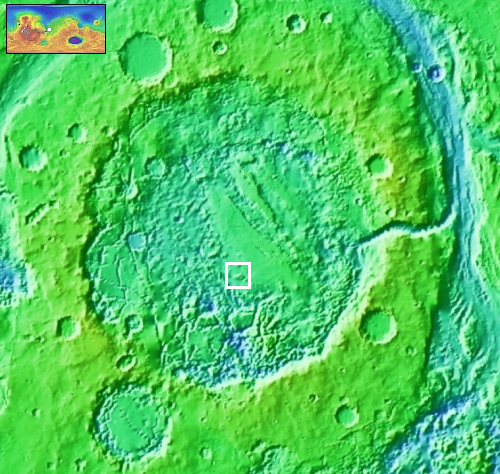
The focus of the image is the eastern end of a large and very distinct dune field inside 31-mile-wide Matera Crater, as shown by the white rectangle in the overview map above. The field fills an area 10 by 11 miles inside the floor of the crater. On that eastern end is a very pronounced drainage gully dropping downhill about 2,000 feet to the east.

Gullies on Martian slopes, especially on the interior rims of craters, are not unusual. Though their true cause is not yet confirmed, the theories behind their existence all relate to some form of water/ice process, mostly relating to the seasonal freeze-thaw cycle.

This picture was taken in the spring, exactly when seasonal changes might be spotted. In fact, scientists have been taking regular MRO images of this gully since 2007, when it was featured image. From that 2007 caption:
» Read more

0 comments

Astronomers find another record-setting most distant galaxy

The uncertainty of science: Using the Webb Space Telescope, astonomers have identified another record-setting most distant galaxy, believed to exist only 300 million years after the Big Bang and once again far more massive and developed than expected that early in the universe.

The galaxy was actually one of two very early galaxies identified that lie close to each other on the sky but are not linked in any way.

The two record-breaking galaxies are called JADES-GS-z14-0 and JADES-GS-z14-1, the former being the more distant of the two. In addition to being the new distance record holder, JADES-GS-z14-0 is remarkable for how big and bright it is. “The size of the galaxy clearly proves that most of the light is being produced by large numbers of young stars,” said Eisenstein, a Harvard professor and chair of the astronomy department, “rather than material falling onto a supermassive black hole in the galaxy’s center, which would appear much smaller.”

The combination of the extreme brightness and the fact that young stars are fueling this high luminosity makes JADES-GS-z14-0 the most striking evidence yet found for the rapid formation of large, massive galaxies in the early Universe.

All the early galaxies that Webb has found so far have been far more massive and developed than cosmologists had predicted. The expectation had been that there wouldn’t have been enough time after the Big Bang for such galaxies to develop. Yet they have, suggesting something is not right with our theories about the beginning of the universe.

5 comments

A second Indian rocket startup completes suborbital launch

Agnikul's first suborbital test launch
Yesterday’s launch. Click for original image.

The Indian rocket startup Agnikul Cosmos yesterday successfully completed a suborbital test launch, flying a prototype stage using a single 3-D printed engine that lifted off from India’s Sriharikota spaceport on its eastern coast. From the first link:

All the mission objectives of this controlled vertical ascent flight were met and performance was nominal. The vehicle was completely designed in-house and was powered by the world’s first single piece 3d printed engine and also happens to be India’s first flight with a semi cryo engine.

The company claims this launch took place at its privately built launchpad, but that pad is located south of ISRO’s Sriharikota spaceport. Did it shift the launch back to Sriharikota, or are the reports incorrect? It is not clear.

Another Indian rocket startup, Skyroot, completed a similar suborbital test launch in November 2022, and has since followed this up with static fire tests of the upper stage of its Vikram-1 rocket.

Both companies hope to complete their first orbital launches before the end of 2025.

1 comment

Launches by China and Russia

Earlier today both China and Russia successfully completed launches.

First, China launched a Chinese-built Pakistani communications satellite into orbit, its Long March 3B rocket lifting off from its Xichang spaceport from the southwest of China.

No real information was released about the satellite, or the fate of the rocket’s lower stages and four strap-on boosters, all of which use toxic hypergolic fuels and certainly crashed somewhere in China.

Next, Russia successfully launched a new Progress cargo ship to ISS, its Soyuz-2 rocket lifting off from Baikonur in Kazakhstan. The freighter will dock with ISS tomorrow. I have embedded video of the launch below, cued to T-30 seconds.

The rocket’s flight path took it over Kazakstan, Russia, and China, with drop zones for the lower stages in the first two. No word on whether the lower stages and four strap-on boosters crashed near habitable areas.

The leaders in the 2024 launch race:

57 SpaceX
25 China
8 Russia
6 Rocket Lab

American private enterprise still leads the world combined in successful launches, 65 to 39, while SpaceX by itself leads the entire world, including other American companies, 57 to 47.

» Read more

4 comments

The wind-carved north edge of Mars’ largest volcanic ash field

The wind-carved north edge of Mars' largest volcanic ash field
Click for original image.

Cool image time! The picture to the right, cropped, reduced, and sharpened to post here, was taken on February 26, 2024 by the high resolution camera on Mars Reconnaissance Orbiter (MRO). It shows what the scientists label as the “relation between flutes and flows”.

The flood lava plain in the northern part of this picture represents the flows. At some point in the distant past some event, either a volcanic eruption, or a large impact, caused lava to spew out across this terrain, leaving behind a smooth plain that has only partly been marked by later crater impacts.

The many parallel ridges pointing to the northeast in the southern part of the picture represent the flutes.

One other very important flow is not directly visible. The prevailing winds that blow to the southwest are what carved these flutes, slowly pushing the material southward while carving out the many gaps between the ridges.
» Read more

0 comments

Scientists propose three scenarios for the creation of Dinkinesh’s contact-binary moon Selam

Three scenarios for creating Dinkinesh and Salem
Click for original graphic.

Dinkinesh's contact binary moon
Click for original image.

Scientists have now used the data obtained during Lucy’s close fly-by of the asteroid Dinkinesh in November 2023 to propose three scenarios to explain the existence of its contact-binary moon Selam, as well as the trough and equatorial ridge on Dinkinesh.

The image to the right shows Selam to the right of Dinkenesh. The graphic above shows the three scenarios proposed for Selam’s creation. This is figure 4 from the paper published today. From the caption:

Asteroids with diameters less than approximately 10 km are subject to spin-up by the YORP effect [changes to rotation and motion due to solar radiation impacting the asteroid’s surface]. Rapid spin of the primary and the associated centrifugal force eventually trigger a structural failure that leads to sudden mass shedding. This event might also have created the trough seen on Dinkinesh through the mass movement of a portion of the body. The shed material forms a ring, with some material coalescing into a satellite(s) and closer material eventually falling back to the surface at the equator to form the ridge. The formation of the contact binary may be the result of a merger of two satellites formed either in a single mass-shedding event (a) or in two separate events (b). An alternative scenario (c) is that Selam formed as a single object that subsequently underwent fission owing to spin–orbit coupling.

Of course, none of this is confirmed, though these hypotheses fit the available facts.

Lucy is presently heading to a fly-by of Earth in December 2024. It will then zip past another main belt asteroid in April 2025 before arriving in August 2027 among the Trojan asteroids in Jupter’s orbit. Once there it will visit at least eight different asteroids.

1 comment

The “Vulcan” exoplanet discovered in 2018 now refuted

In 2018 astronomers had thought they had detected an exoplanet orbiting the star 40 Eridani A — which is where in Star Trek the home world Mr. Spock was supposed to be located.

That discovery has now been refuted by much more precise observations.

[T]he planet signal is really the flickering of something on the star’s surface that coincides with a 42-day rotation – perhaps the roiling of hotter and cooler layers beneath the star’s surface, called convection, combined with stellar surface features such as spots and “plages,” which are bright, active regions.

In other words, this exoplanet does not exist. For once at least life did not imitate art.

4 comments
1 210 211 212 213 214 1,353