SpaceX successfully launches Superheavy and Starship

Superheavy & Starship, on their way
Note how all 33 Superheavy engines are firing.

SpaceX this morning successfully launched its Superheavy/Starship heavy lift rocket into its test orbit.

The test flight achieved far more than the first test in April. First, during the entire flight of Superheavy all 33 Raptor-2 engines fired normally. None cut out prematurely. Then at very risky hot fire stage separation — where the second stage (Starship) ignited prior to separation from Superheavy — the correct number of engines shut down, Starship’s engines fired, and Superheavy successfully separated and began its maneuvers for a soft splashdown in the Gulf of Mexico.

At that point mission controllers issued the self-destruct command to destroy Superheavy. Though it appeared that the stage was struggling to flip for its controlled return to Earth, it is also very likely that mission controllers wanted to test that flight termination system after its not perfect performance on the first test flight. Then, the self-destruct command did not activate the instant the command was given, being delayed by about 40 seconds. This time it appeared it worked as planned.
» Read more

71 comments

SpaceX launches 23 Starlink satellites

While everyone is focused on the Starship/Superheavy launch scheduled for tomorrow at 7 am (Central) at Boca Chica, SpaceX tonight launched another 23 Starlink satellites, its Falcon 9 rocket lifting off from Cape Canaveral.

The first stage successfully completed it eleventh flight, landing on a drone ship in the Atlantic.

The leaders in the 2023 launch race:

84 SpaceX
52 China
14 Russia
7 Rocket Lab
7 India

American private enterprise still leads China 96 to 52 in successful launches, and the entire world combined 96 to 81. SpaceX by itself is now leads the rest of the world (excluding American companies) 84 to 81.

6 comments

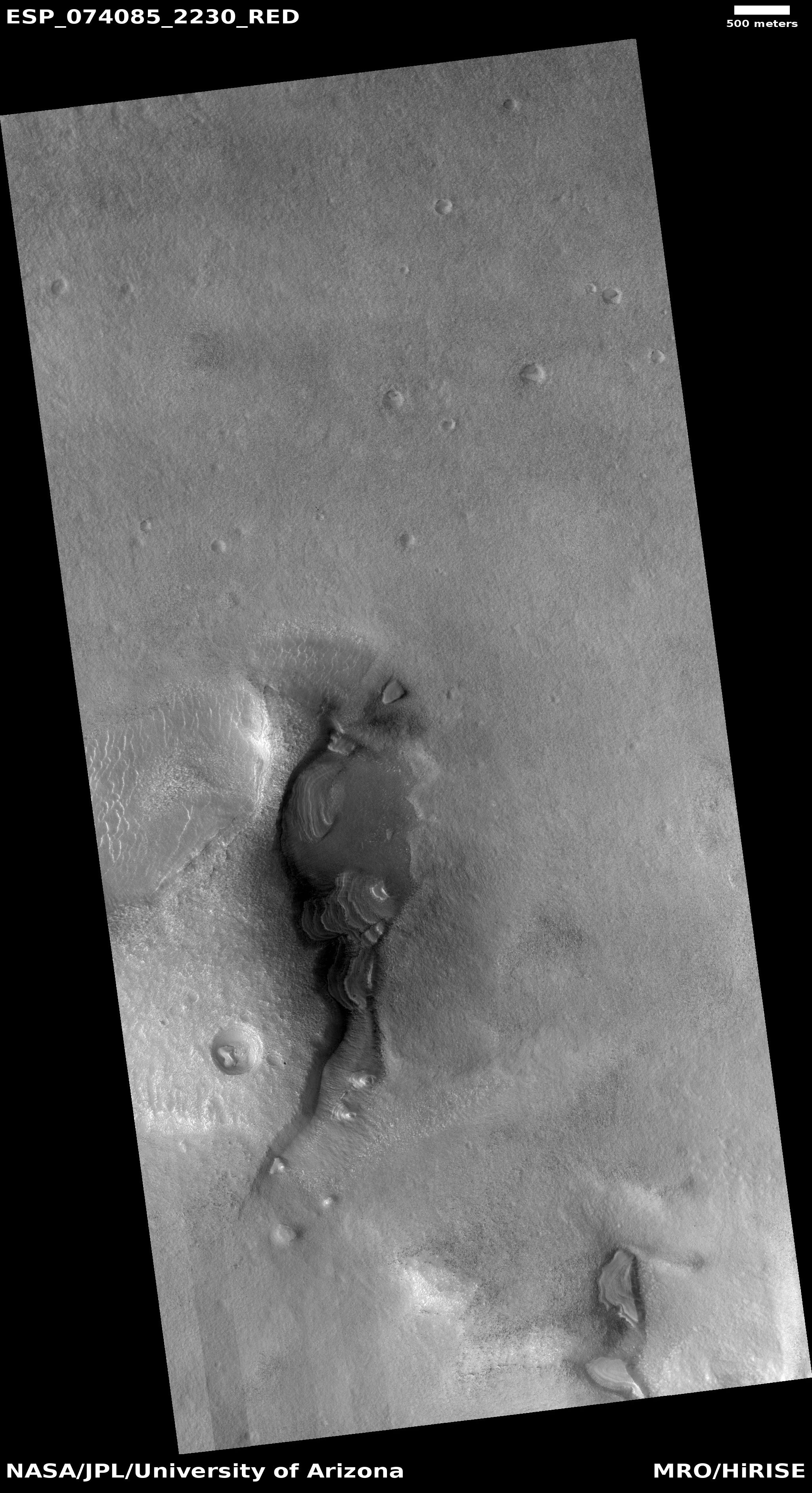
The southernmost extent of Mars’ youngest lava flood event

The southernmost edge of Mars' youngest lava event
Click for original image.

Cool image time! The picture to the right, rotated, cropped, reduced, and sharpened to post here, was taken on August 24, 2023 by the high resolution camera on Mars Reconnaissance Orbiter (MRO).

Labeled “flow margin in Elysium Planitia,” it shows the very edge of what scientists believe was the most recent large lava event on Mars, dubbed the Athabasca Valles, that is thought to have occurred only 600 million years ago. In only a matter of weeks the fast flowing lava covered a region about the size of Great Britain. What we see here is the southernmost edge of that flow, with the smooth terrain on the west an older lava flood plain, covered by the new flood lava from Athabasca on the east.

The polygon cracks likely indicate cracks that formed during the hardening process (like the polygon cracks in drying mud). Hot lava then pushed up from below to form the ridges. It is also possible the ridges are what scientists call “wrinkle ridges,” formed when material shrinks during the drying process.
» Read more

1 comment

Salt glaciers on Mercury?

From Figure A1 of paper
From Figure A1 of paper.

Based on a new analysis of data from the Messenger spacecrat that orbited Mercury from 2011 to 2015, scientists today posited the possibility that salt glaciers exist on Mercury and have reshaped its terrain in manner vaguely comparable to what Mars Reconnaissance Orbiter (MRO) has found on Mars.

You can read the paper here [pdf]. The image to the right, enhanced by the scientists to bring out the faint blue in the hollows, is remarkably reminiscent of the hollows and scallop terrain found in many places in the high Martian latitudes. From its conclusion:

Detecting widespread elemental volatile surface compositions, ubiquitous sublimation hollows, and extensive chaotic terrains has significantly reshaped our perception of Mercury’s geological past. These observations collectively point to the presence of volatile-rich strata spanning several kilometers in depth and likely formed before the [Late Heavy Bombardment] (∼3.8 billion years ago). This notion challenges the conventional view of a volatile-depleted Mercurian crust.

The morphologies within Mercury’s Raditladi basin bear a striking morphologic resemblance to glaciers on Earth and Mars, suggesting their origin from an impact-exposed [volatile-rich layer], likely containing halite. Our numerical simulations show that the unique rheological properties of halite, including the high thermal sensitivity of its viscosity, reinforce this hypothesis. These glacier-like features occur beyond the chaotic terrain boundaries, indicating a potentially global yet concealed, volatile-rich upper stratigraphy. We posit that the exposure of these volatile-rich materials, instigated by impact events, could have been instrumental in the formation and evolution of hollow features, signifying a complex geodynamic history of volatile migration and redistribution, essentially interconnecting some of the oldest and youngest stratigraphic materials on the planet.

The scientists do not have enough information as yet to determine if these glaciers are still active or not. Moreover, the theorized layer of volatile material near the surface remains unconfirmed, requiring in situ investigation to determine its existence with certainty. Like Mars, if it exists it likely only does so in the high latitudes.

0 comments

Researchers confirm it was a Chinese rocket stage that impacted Moon in 2022

Impact, before and after
The crash site is the double crater in the
lower image.

Researchers have now confirmed that the unknown rocket stage that impacted the Moon in 2022 was from a Chinese rocket, a Long March 3B that launched China’s Chang’e-5 lunar sample return mission in November 2020.

“In this paper, we present a trajectory and spectroscopic analysis using ground-based telescope observations to show conclusively that WE0913A is the Long March 3C rocket body (R/B) from the Chang’e 5-T1 mission,” the researchers, led by Tanner Campbell, a doctoral student in the UA’s Department of Aerospace and Mechanical Engineering, wrote in a study that came out Thursday (Nov. 16) in the Planetary Science Journal. These two lines of evidence — how the object was moving and what it was made of — leave little doubt about WE0913A’s provenance, Campbell and his colleagues report.

The data, combined with the unusual double crater caused by the impact, also suggests that this stage had additional unknown equipment at its top, matching the mass of its engines at the bottom. Since the Chinese continue to deny it was their stage and have said nothing about it, we have no idea what that extra equipment might have been.

4 comments

German rocket startup signs deal with Norwegian spaceport

Map of northern European spaceports

The German rocket startup Isar Aerospace has signed a deal to provide the Andoya spaceport in the north of Norway with a new flight tracking and safety system, to be used by all launches including Isar’s own Spectrum rocket.

The purpose of the autonomous flight tracking system is to precisely and reliably keeping track of the Spectrum launch vehicle’s position, speed and direction of travel as it ascends to orbit, which is important to guarantee Andøya Spaceport’s flight safety requirements. The objective is to further evaluate the use of the system in enabling automated flight termination functionality for launches by Andøya Spaceport’s ground system, autonomously triggering an abort of the mission if ever operational parameters of the launch vehicle are out of bounds.

This announcement today illustrates the rising competition between German rocket startups and European spaceports. Yesterday the Saxavord spaceport in Scotland and another German rocket startup, HyImpulse, announced their own launch deal. Today’s announcement is the response from Andoya and Isar.

Today’s announcement also increases the pressure in the UK’s Civil Aviation Authority (CAA) to get its regulatory act together. Andoya is positioning itself as a good alternative to the two new British spaceports in Scotland, as shown by the red dots on the map above, should red tape in the UK slow launches there.

1 comment

Sierra Space shakes up its staffing

Sierra Space yesterday did a major staffing shake up, laying off 165 workers while shifting 150 with secruity clearances from its parent company Sierra Nevada.

Sierra Space this week shipped the first Dream Chaser, named Tenacity, for pre-launch testing at NASA’s Armstrong facility in Ohio. The layoffs began soon after, the Sierra Space spokesperson said, noting the company conducted a surge in hiring this year to complete work on the Tenacity spacecraft.

With Tenacity shipped, Sierra Space’s spokesperson said the company is realigning to focus on the operations phase of Dream Chaser’s first mission, as well as on classified national security work. The latter part of Sierra Space’s realignment includes adding nearly 150 employees with security clearances from Sierra Nevada Corp., the aerospace and defense contractor owned by Fatih and Eren Ozmen, which the space company was spun out of two years ago. Sierra Space’s spokesperson said the company is creating a national security space team to work on several classified contracts.

This shift suggests that at least in the short run, Sierra is putting more focus on future military contracts rather than its civilian manned space projects like its LIFE space module (for the Orbital Reef space station) and future manner versions of its Dream Chaser mini-shuttle. I wonder if the company is having more internal doubts about Orbital Reef and its main partner, Blue Origin. Unlike the stations being built by Axiom and Voyager Space, which have already garnered contracts from both national and international customers, Orbital Reef has not done the same. There could be great doubts in the space community it will be built because of Blue Origin’s absymal record for building anything.

2 comments

November 16, 2023 Quick space links

Courtesy of BtB’s stringer Jay, who notes it has been “a slow news day. I guess everyone is waiting to see SpaceX launch.” For me this has been good, as the day has mostly been tied up with doctors (nothing serious).


1 comment

Amazon’s first two Kuiper satellites in orbit worked exactly as planned

Amazon announced today that its first two Kuiper satellites, launched into orbit by ULA’s Atlas-5 rocket on October 6, 2023, have worked exactly as planned, thus allowing the company to begin building operational satellites.

With the prototypes’ testing in space now complete, Badyal said Amazon plans to begin building the first production Kuiper satellites in December and launch the first satellites for its network in the “latter part of the first half” of 2024. Badyal emphasized that Amazon wasn’t sure what performance to expect from the prototype satellites, since “you don’t know how well it’s going to work in space.”

“They’re working brilliantly,” Badyal said.

The need of Amazon to start launching lots of satellites next year — in order to meet its FCC license requirements to put half of its 3,000+ constellation in orbit by 2026 — puts great pressure on ULA, Blue Origin, and Arianespace to get their new but as yet unlaunchd rockets operating. All three have big launch contracts with Amazon, but none presently appear to have the capability to meet the demands of those contracts.

6 comments

Starship/Superheavy test launch delayed to November 18, 2023

SpaceX has pushed back the orbital test launch of its Starship/Superheavy rocket one day, to November 18, 2023, because one of the rocket’s grid fins was not working properly during a prelaunch test.

The new launch window opens at 7 am (Central), but is now only twenty minutes long. SpaceX says it will begin its live stream on X and here 35 minutes before liftoff.

13 comments

Jupiter’s Great Red Spot continues to shrink, possibly to its smallest size ever measured

Jupiter, as seen by Hubble in 2020
A 2020 Hubble picture of Jupiter.
Click for full image.

Long term data from numerous observatories shows that the Great Red Spot on Jupiter, the largest and longest lasting storm in the solar system, has been continuously shrinking for decades, and appears approaching this year its smallest size ever measured.

Despite so many factors working to keep it “alive” the Spot may be in need of life support. It’s been shrinking for decades. In 2012 the rate of shrinkage abruptly accelerated, something many amateur observers have commented on since that time. Several years later, while still shrinking in diameter, it expanded in latitude becoming more circular. Now it’s narrowed again and continues to diminish in both axes. This observing season I’ve been struck by the Spot’s unusually small size. That, along with its pale pink color and turbulent environment, have made it less obvious than ever.

…Using the WinJUPOS program and one of his recent high-resolution images, Peach measured the Great Red Spot’s diameter on November 6, 2023, at 12,500 kilometers or about 7,770 miles across. If confirmed it would make this season’s GRS not only smaller than the Earth (12,756 kilometers or 7,926 miles across) but the smallest size in observational history. A British Astronomical Association Jupiter section bulletin on October 30th described it as “the smallest it has ever been.” That’s a far cry from the late 1800s when the Spot ballooned to 41,000 kilometers (25,500 miles) — big enough to swallow three Earths with room to spare. Now it can barely contain one!

No one knows if this shrinkage is merely a normal long term fluctuation, or a sign that this many-centuries-old storm is finally dissippating. When it comes to the solar system’s gas giants, their size and long orbits make any firm conclusion difficult in only a few centuries of observation. To understand them properly will likely require thousands of years of observations, covering many orbits and seasons.

7 comments
1 268 269 270 271 272 1,354