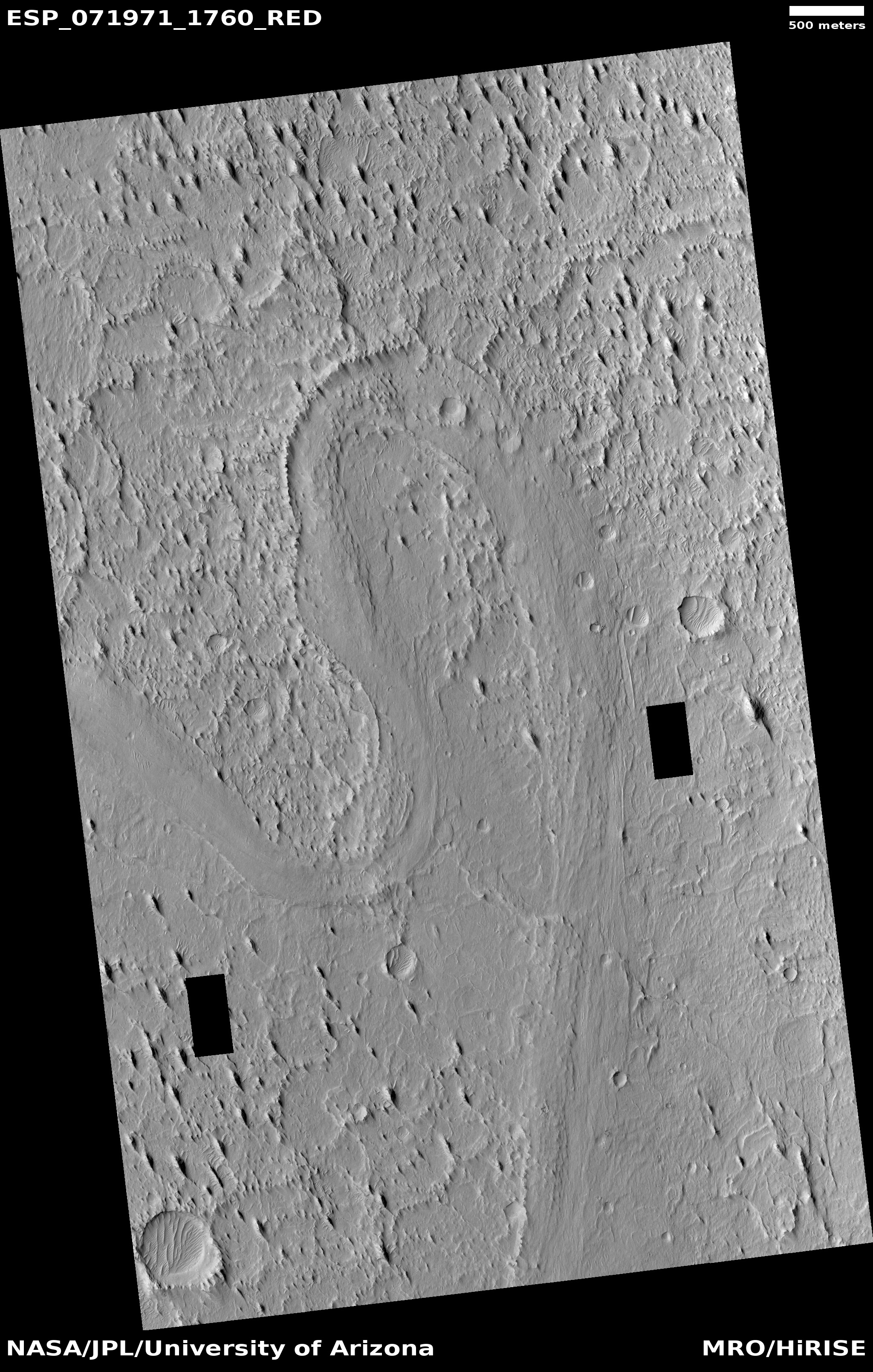
The flat and mostly featureless flood lava plains of Mars

The flat and mostly featureless lava plains of Mars
Click for original image.

Cool image time! The picture to the right, rotated, cropped, reduced, and sharpened to post here, was taken on July 3, 2023 by the high resolution camera on Mars Reconnaissance Orbiter (MRO). Dubbed a “terrain sample” by the camera team, it was likely taken not as part of any scientist’s specific research program but to fill a gap in the camera’s schedule in order to maintain its proper temperature. When the camera team needs to do this they try to pick something of interest that is below during that gap.

In this case MRO was over the vast flood lava plains of Mars where for many hundreds of miles the only features are small variations produced from different overlapping lava flood events. The layers of lava in this region in fact appear so thick that there are relatively few places where the older topography still sticks up through the lava. In the case of this picture, the ridges might indicate such buried topography, but they also might simply be dikes of lava, pushed up through fissures from underground.
» Read more

0 comments

Scientists: Saturn has rainstorms of ammonia lasting hundreds of years

Using radio telescope data of Saturn scientists now believe that the big storm first detected in 2011 produced rainstorms of ammonia which are expected to last hundreds of years.

As reported in the new study, de Pater, Li and UC Berkeley graduate student Chris Moeckel found something surprising in the radio emissions from the planet: anomalies in the concentration of ammonia gas in the atmosphere, which they connected to the past occurrences of megastorms in the planet’s northern hemisphere.

According to the team, the concentration of ammonia is lower at midaltitudes, just below the uppermost ammonia-ice cloud layer, but has become enriched at lower altitudes, 100 to 200 kilometers deeper in the atmosphere. They believe that the ammonia is being transported from the upper to the lower atmosphere via the processes of precipitation and reevaporation. What’s more, that effect can last for hundreds of years. [emphasis mine]

In other words, Saturn has an ammonia cycle similar to the water cycle on Earth.

Need I add that this study carries great uncertainties, and that the amount of data about Saturn’s interior and atmosphere is sparse, at best?

3 comments

Perseverance videotapes Ingenuity’s 54th flight, a short hop up and down

Ingenuity in flight on August 3, 2023

As I predicted last week, the Perseverance science team have successfully filmed the 54th flight of Ingenuity on August 3, 2023, using the high resolution cameras on masts on top of the Mars rover.

I have embedded that movie below. The image to the right is a screen capture from that movie, when the helicopter was hovering at sixteen feet elevation. Since Perseverance was about 200 feet away to the northeast, the horizon line in the background is the southwest rim of Jezero crater, about ten miles away, with the intervening hills about five miles closer.

The flight was a simple hop, up and down, to verify Ingenuity’s systems after its previous flight had ended prematurely.

The helicopter’s 55th flight was scheduled to occur yesterday, traveling 820 feet for 134 seconds, but so far there is no word on whether it happened as planned.
» Read more

2 comments

India approves new spaceport for private launches of SSLV rocket

map of India's two spaceports
India’s two spaceports

The Modi government in India has now approved the use of its new spaceport in Kulasekarapattinam by private operators, including the private operator who wins control of the SSLV rocket that was developed by ISRO, India’s space agency.

On the new launch pad that ISRO is building at Kulasekarapattinam in Thoothukudi district along the coast in Tamil Nadu, SIRO Chairman S Somanath said that nearly 99 per cent of the 2,000 acres has been transferred to ISRO by the Tamil Nadu government. “It takes at least two years to become fully functional after the commencement of the construction work. However, we will be able to conduct some sub-orbital launches there,” he added.

In December about 80% of that land had been purchased, so the government is now close to owning everything it needs.

Though the government is accepting bids from private companies to operate SSLV, it is not clear if that will be an exclusive right, or whether ISRO will continue to do its own launches. Either way, this new spaceport is being designed to enable private operators to launch from it.

0 comments

SpaceX launches another 22 Starlink satellites

In what is turning into routine clockwork, SpaceX tonight completed its fourth launch in only the first ten days of August, placing 22 Starlink satellites into orbit using its Falcon 9 rocket lifting off from Cape Canaveral.

The first stage completed its ninth flight, landing safely on a drone ship in the Atlantic. The two fairings completed their tenth and eleventh flights respectively. At the time of posting the satellites themselves had not yet been deployed.

The leaders in the 2023 launch race:

55 SpaceX
33 China
11 Russia
6 Rocket Lab
6 India

American private enterprise now leads China in successful launches 63 to 33, and the entire world combined 63 to 55. SpaceX by itself is now tied with the entire world (excluding American companies) 55 to 55.

3 comments

Russia launches Luna-25 to the Moon


Click for interactive map.

After almost two decades of development, Russia today used its Soyuz-2 rocket to launch Luna-25, its first lander to the Moon since the 1970s.

The link is cued to the live stream, just prior to launch. It will take several days to get to the Moon and enter orbit, make some orbital adjustments, then land in Boguslawsky crater, as shown on the map to the right. It is likely its landing will occur before India’s Chandrayaan-3 lands on August 23rd but not certain, depending on the adjustments needed in lunar orbit. Both could even land on the same day.

The leaders in the 2023 launch race:

54 SpaceX
33 China
11 Russia
6 Rocket Lab
6 India

American private enterprise still leads China in successful launches 62 to 33, and the entire world combined 62 to 55, while SpaceX by itself now trails the entire world (excluding American companies) 54 to 55.

1 comment

The icy mountains close to where SpaceX hopes to land Starship on Mars

The icy mountains near Starship's landing site on Mars
Click for original image.

Cool image time! The photo to the right, rotated, cropped, reduced, and sharpened to post here, was taken on June 25, 2023 by the high resolution camera on Mars Reconnaissance Orbiter (MRO). Labeled as showing “flow features” by the scientists, it gives us a nice example of many of the different types of glacial and near-surface ice features seen routinely in the Martian latitudes above 30 degrees, especially in the northern hemisphere.

First there is the apron around the mound. Its layering suggests the many cycles that Mars’ climate has undergone as its rotational tilt swung back and forth from as low as 11 to as much as 60 degrees (it is presently at 25 degrees).

The mound, with those two depressions at its peak, suggests the possibility that it is some form of ice/mud volcano, similar to the suspected ice/mud volcanoes routinely seen in the northern lowland plains of Utopia Basin.
» Read more

4 comments

Juno gets new close-up images of Jupiter’s moon Io

Io as seen by Juno in July 2023
Click for original image.

During its July close fly-by of Jupiter the orbiter Juno also flew past the moon Io, getting within 14,000 miles. The picture to the right, cropped and reduced to post here, was one of the images taken during that fly-by and subsequently processed and color enhanced by citizen scientist Thomas Thomopoulos.

The picture was taken at about the spacecraft’s closest point. It shows the splotched and volcanic surface of Io, which because it orbits close to Jupiter tidal forces cause it to have an intensely active volcanic surface. All the black features are either volcanoes or lava flows. This set of all of Juno’s Io images taken during the fly-by, enhanced by citizen scientist Gerald Eichstädt, also shows a volcanic plume in the shadowed portion of the planet, just beyond the terminator, which Eichstädt believes is a mountain dubbed Tohil Mons.

Even closer flybys are scheduled for December ’23 and February ’24, both getting within 1,000 miles of the surface.

2 comments

Astronomers: Binary system creates tidal waves on star’s surface 3x larger than our own Sun

Tidal waves on star's surface

Based on computer simulations, astronomers believe that the monthly light changes in a binary star system are partly caused by gigantic tidal waves on the surface of the system’s larger star, waves that are three times higher than the diameter of our own Sun.

The larger star in the system is nearly 35 times the mass of the Sun and, together with its smaller companion star, is officially designated MACHO 80.7443.1718 — not because of any stellar brawn, but because the system’s brightness changes were first recorded by the MACHO Project in the 1990s, which sought signs of dark matter in our galaxy.

Most heartbeat stars vary in brightness only by about 0.1%, but MACHO 80.7443.1718 jumped out to astronomers because of its unprecedentedly dramatic brightness swings, up and down by 20%. “We don’t know of any other heartbeat star that varies this wildly,” says MacLeod.

To unravel the mystery, MacLeod created a computer model of MACHO 80.7443.1718. His model captured how the interacting gravity of the two stars generates massive tides in the bigger star. The resulting tidal waves rise to about a fifth of the behemoth star’s radius, which equates to waves about as tall as three Suns stacked on top of each other, or roughly 2.7 million miles high.

The image on the right is a screen capture from the computer simulation. The bulges on the right side of the larger star are the hypothesized tidal waves.

2 comments

Update on the development of a new first stage for Northrop Grumman’s Antares rocket

Link here. The first stage of the Antares rocket has previously relied on Russian engines in a Ukrainian-built body. The Ukraine War made getting both impossible, and thus Northrop Grumman hired Firefly to provide it a new first stage, presently targeting mid-2025 for its first flight. In the meantime in order to meet its contractual obligations with NASA, it has hired SpaceX’s Falcon 9 rocket to fly the next three Cygnus freighters to ISS.

The report at the link gets some interesting details about Firefly’s engines and first stage. Both will raise the payload capabilities of Antares, which as yet has failed to garner any commercial payloads outside of Northrop’s own Cygnus capsule. That increase in capability might make it more appealing to commercial satellite companies.

0 comments

Chinese pseudo-company Galactic Energy launches seven satellites

China's spaceports
China’s spaceports

One of China’s pseudo-companies, Galactic Energy, yesterday successfully placed seven small satellites into orbit, using its Ceres-1 solid-fueled rocket that lifted off from China’s Jiuquan spaceport in the Gobi Desert.

Considering that a launch two days ago from the Taiyuan spaceport apparently dropped sections of its first stage near habitable areas, I though it worthwhile to post again the map to the right, showing which Chinese spaceports expose China’s inhabitants to risk.

It also appears that even the state-run press of China knows Galactic Energy really isn’t a privately owned commercial company, as it doesn’t even mention the company’s name in its news report at the link. While it gets investment capital and functions kind of like a private company, everything it does is supervised by the Chinese government, which can take full control of the company whenever it wants. Moreover, the technology of its solid-fueled rocket was derived entirely from military technology, which means the Chinese government supervised its development every step of the way.

The leaders in the 2023 launch race:

54 SpaceX
33 China
10 Russia
6 Rocket Lab
6 India

American private enterprise still leads China in successful launches 62 to 33, and the entire world combined 62 to 54, while SpaceX by itself is now tied the world (excluding American companies) 54 to 54.

0 comments

Martian craters or volcanoes?

Martian craters or volcanoes?
Click for original image.

Cool image time! The picture to the right, cropped and reduced to post here, was taken on June 30, 2023 by the high resolution camera on Mars Reconnaissance Orbiter (MRO). The scientists label these features “cones” because many of the depressions sit on top of a mound or hill, suggesting some form of volcanic feature, either from erupting lava, ice, or mud.

Yet, are they volcanoes? Some or even many could instead be impact craters, created when a asteroid broke up during infall, creating a spray of bolides. Erosion of surrounding terrain can create what scientists call pedestal craters, but if all these craters were from an impact than all would either be pedestal craters, or not. Instead, we have a mix of some craters above and others level with the terrain.
» Read more

1 comment
1 297 298 299 300 301 1,353