Ancient lava vent high on a Martian volcano

Ancient lava vent high on a Martian volcano
Click for original image.

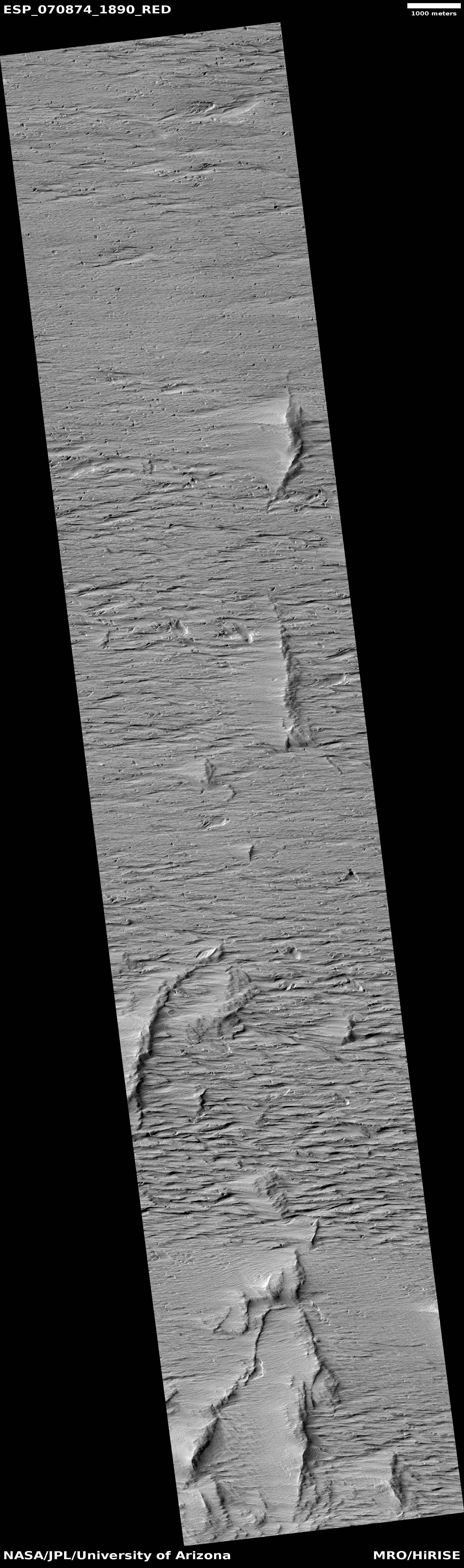
Today’s cool image illustrates the once violent and active volcanic past of Mars, now long dormant. The picture to the right, cropped, reduced, and sharpened to post here, was taken on May 11, 2023 by the high resolution camera on Mars Reconnaissance Orbiter (MRO). It shows what the scientists label as a “vent and channel” located high on the northeast flanks of the giant volcano Arsia Mons.

The rim around the vent suggests that lava had once bubbled up out of the vent and hardened around it, as most of the lava flowed downhill along the channel. And though this vent appears to be the source of this channel, it is not. The channel continues to the southwest uphill until it reaches the edge of Arsia Mons’ caldera, a region where there are many such vents, many much larger and deeper than this one.
» Read more

0 comments

Ohio Attorney General to college administrators: Discriminate and YOU will be personally liable

Making the law mean something again

Bring a gun to a knife fight: In what is certain to become the most powerful deterrent to leftist bigotry in academia, Ohio attorney general Dave Yost has notified the administrators in his state’s public colleges that “qualified immunity” will not be available to them if they are personally sued for discriminating against any individuals and lose.

Employees found guilty of such practices as employing application essays to discern an applicant’s race “might not be protected by qualified immunity, a doctrine that protects public officials from being personally liable in certain situations,” Yost wrote, according to The Dispatch. “Any attempt to invoke that doctrine would likely be frivolous, and my office may be unable to raise any qualified immunity defense on your employees’ behalf,” Yost wrote.

» Read more

11 comments

Glacial evidence in the dry equatorial regions of Mars?

Is this evidence of glacial ice in the Martian dry equatorial regions?
Click for original image.

Cool image time! The picture to the right, rotated, cropped, rotated, and sharpened to post here, was taken on June 3, 2023 by the high resolution camera on Mars Reconnaissance Orbiter (MRO). It shows the eastern half of a six-mile-wide unnamed crater with a depth of about 1,500 to 2,000 feet from rim to floor.

What makes this picture significant is the patchy material in the center of that crater floor, some of which looks almost like very old peeling paint. It also resembles the kind of glacial features routinely seen in many craters poleward of 30 degrees latitude on Mars.

Is this another example of such glacial features? If so, its location is what makes it significant.
» Read more

0 comments

SpaceX to raise another $750 million in stock sale; earnings rise to $8 billion in ’23

According to anonymous sources, a new stock sale at SpaceX is likely to raise another $750 million because of enthusiasm on Wall Street for the stock due to the company’s growing earnings, which are expected to double to $8 billion this year.

Last week, CNBC reported that Elon Musk’s SpaceX valuation reached nearly $150B following an announcement of a stock sale by existing investors. According to a copy of the purchase offer sent by CFO Bret Johnsen, which CNBC obtained, the company has entered into an agreement with new and existing investors to sell up to $750 million in stock at a price of $81 per share. This represents a 5% increase from the previous secondary sale at $77 per share, which valued the company at approximately $140B. SpaceX has not provided any comments regarding the purchase offer.

Though the article does not say, that revenue comes from two sources, SpaceX’s rocket launches and its Starlink constellation. In the first case the company dominates the launch industry, because its launch price is so much cheaper than everyone else. In the second case, Starlink is producing so much revenue because Elon Musk forced the company to move fast and get its satellites in orbit quickly. Though both SpaceX and Amazon announced their internet constellations at about the same time, Amazon has still not launched any satellites, while SpaceX has more than 4,000 in orbit. This active and operating constellation has allowed SpaceX to grab market share that Amazon is now likely never to get, even when it begins launching.

All this makes SpaceX very appealing to investors, which is why its private stock price has gone up. It is also why it has been able to raise now almost $11 billion in private investment capital for building both Starlink and its Starship/Superheavy rocket.

12 comments

Rocket Lab launches seven satellites; recovers first stage from ocean

Rocket Lab today successfully used its Electron rocket to place seven smallsats into orbit, lifting off from New Zealand.

The first stage used parachutes to softly splash down in the ocean, where it was recovered for refurbishment and relaunch. As this stage is the first in which this full reuse will be attempted, the ability to refurbish the stage after its salt water swim remains the critical factor. We will not know its state until a complete inspection plus static fire engine tests are completed.

The leaders in the 2023 launch race:

47 SpaceX
26 China
9 Russia
6 Rocket Lab
5 India

American private enterprise now leads China in successful launches 54 to 26, and the entire world combined 54 to 45, while SpaceX alone still leads the rest of the world (excluding other American companies) 47 to 45.

6 comments

July 17, 2023 Quick space links

Courtesy of BtB’s stringer Jay.


6 comments

Flat-topped Martian mesa

Flat-topped mesa on Mars
Click for original image.

Cool image time! The picture to the right, rotated, cropped, and reduced to post here, was taken on April 18, 2023 by the high resolution camera on Mars Reconnaissance Orbiter (MRO). It shows only one of many flat-topped mesas in a chaos terrain region dubbed Oxia Chaos.

The mesa top is about 540 feet above the floor of the canyon to the north, which in turn is about 840 feet below the flat terrain north of it. That flat terrain to the north is not part of the chaos terrain, however, but the northern rim of the plateau that surrounds the chaos. Moreover, this particular piece of rim is separating from the plateau, as shown near the top of this January 16, 2008 context camera image from MRO. At some point in the future it will break off and fall into that canyon and on top of this mesa.
» Read more

0 comments

Chandrayaan-3 completes second orbital maneuver

Chandrayaan-3's mission profile

According to India’s space agency ISRO, its lunar lander/rover Chandrayaan-3 today completed second orbital maneuver, raising the spacecraft’s orbit around the Earth from 41,762 by 173 kilometers to 41,603 x 226 kilometers.

The graphic to the right shows the entire mission profile of Chandayaan-3. It still has three more orbital adjustments to make in Earth orbit before it does its trans-lunar-injection burn to send it to the Moon. Once it arrives in lunar orbit it will then have to make six orbital adjustments to lower its orbit before making the descent to the surface.

The lunar landing itself is presently scheduled for August 23, 2023.

0 comments

An apparent rocket section washes up on Australian coast

What appears to be a section of India’s PSLV rocket washed up on the western Australian coast yesterday, though at the moment the identity of the wreckage as not been confirmed.

Dr Alice Gorman, an expert in the field of space archaeology, said she believes the object is a fuel cylinder that came from the the third stage of India’s polar satellite launch vehicle rocket (PSLV), as many have suggested on social media.

The article includes a picture of that stage in orbit during a 2017 launch, and the similarity is obvious. If true, its specific launch at present remains unknown, though it appears it could have been floating in the ocean for years, a fact that is surprising in itself.

2 comments

SpaceX launches using its second Falcon 9 first stage on its sixteenth flight

SpaceX tonight successfully launched 54 Starlink satellites into orbit, lifting off from Cape Canaveral.

The Falcon 9 rocket used a first stage flying on its sixteenth flight, landing successfully on a drone ship in the Atlantic. That is the second 1st stage in SpaceX’s fleet to complete that many flights. Both first stages completed their sixteen flights in only three years, which means that those two first stages have actually flown more times than the entire United States rocket industry did annually from 2000 to 2019. I don’t have a full count, but I suspect both stages have launched in those three years more satellites then the totals for almost all other nations, excepting possibly Russia and the U.S. Both probably allowed SpaceX to amortize the cost of those launches considerably, possibly as much as 90%.

Just remember: Rocket industry experts were insisting even as late as 2016 that it was impractical to make rocket stages reusable, that to make a profit “a partially reusable rocket would need to launch 35-40 times per year to maintain a sizable production facility while introducing reused hardware into the manifest.” Based on that calculation, these experts determined with utmost certainty that a partly reusable rocket — like the Falcon 9 — could never make a profit.

Elon Musk must have agreed, and decided he needed an extra profit center for the Falcon 9. Starlink has provided that profit center. It not only needs that many launches, and pays for them, its profit stream from its internet customers is already adding to SpaceX’s bottom line.

Regardless, Musk has proved these “experts” utterly wrong. I always thought they were talking through their hat, but had no way to prove it. Thank you Mr. Musk for proving the point.

Note too that the two fairing halves on this flight were also reused, completing their ninth and tenth flights respectively.

The leaders in the 2023 launch race:

47 SpaceX
26 China
9 Russia
5 Rocket Lab
5 India

American private enterprise now leads China in successful launches 53 to 26, and the entire world combined 53 to 45, while SpaceX alone now leads the rest of the world (excluding other American companies) 47 to 45.

And it is doing this with that impractical, unprofitable, and impossible reusable Falcon 9 rocket. Heh.

15 comments

Chase Hiller – Skateboarding down a mountain in Columbia

An evening pause: For the weekend, some recreational activity. There are two or three cuts, but in general he makes the whole run non-stop. If you want to get your palms sweating play some of this at 2x normal speed. The location is in San Felix, Columbia.

Hat tip Tom Wilson.

6 comments

Another look at the vastness of Valles Marineris on Mars

The vast Valles Marineris
Click for interactive map.

This week I have returned several times to the giant Valles Marineris canyon on Mars in an attempt to capture its incomprehensible and glorious scale. Without question this canyon is going to become one of the prime tourist spots when humans begin living and working throughout the solar system. Fortunately, its vast size will mean that it will take many many centuries before it even becomes close to crowded there.

Today I try a different approach, using the global mosaic created by scientists at Caltech from the context camera images taken by Mar Reconnaissance Orbiter (MRO). That mosaic processes the images to allow one to see the surface from an oblique angle. The picture to the right covers one small part of the eastern end of Valles Marineris (the white rectangle in the inset), but though small the scale once again is gigantic.

The three white dots are our reference points, one on the north rim, one on the south, and one in the middle on the peak of that central mountain chain. Beginning from the south, the distance from the rim to the middle mountain peak is 43 miles, with the elevation dropping almost 13,000 feet to the floor of the south canyon, than rising almost 10,000 feet to the middle peak. The northern canyon is smaller. From the peak to the north rim is 27 miles, dropping about 9,300 feet and then rising about 8,500 feet to the north rim.

From rim to rim the distance is about 70 miles. Since the middle mountain chain about 18 miles wide, it fills only about 25% of the entire canyon.

In every case, the Grand Canyon would be merely be a small side canyon here. The depths are twice as deep, and the distances are many times larger. In width alone at this point Valles Marineris is seven times wider than the widest part of the Grand Canyon, and this is by far not Valles Marineris’s widest point.
» Read more

0 comments
1 306 307 308 309 310 1,353