South Korea: North Korean spy satellite of “no military utility”

Having completed its salvage operations to recover rocket and satellite remains from North Korea’s failed launch on May 31st, the South Korean military today revealed that the satellite had “no military utility as a reconnaissance satellite.”

As expected, it also provided few details to back up that claim:

The JCS [South Korea’s joint chiefs of staff] did not detail the findings through the allies’ analysis of the wreckage nor did it disclose any photos of the retrieved part of the satellite. Last month, a Seoul official struck a cautious note, insinuating that disclosing all the information the military gleaned from the salvage operation would rather benefit the North Korean military.

It is likely true that the North Korea satellite was of limited value, but it is also true that secrecy and disinformation works to the advantage of South Korea’s military. We therefore would be wise to remain skeptical about any of its claims, one way or the other.

1 comment

Instrument designed to detect lightning releases first data

Lightning over Europe
Lightning over Europe. Click for original movie.

The first data from the Lightning Imager launched in December 2022 on Europe’s Meteosat weather satellite has now been released, the images compiled into movies showing lightning activity across Europe, Africa, the Middle East and parts of South America.

While the animations are a first initial result from the Lightning Imager, the Meteosat Third Generation Imager is currently undergoing its commissioning phase during which the instruments are calibrated and the data is validated. Data from the Lightning Imager will be available for operational use in early-2024 at an increased sensitivity.

You can see all the movies here. The lightning is found almost exclusively over land. In fact, you can see the lightning in one storm vanish as the storm drifts out into the Mediterranean.

3 comments

Parker completes 16th orbit of the Sun

On June 22, 2023 the Parker Solar Probe completed its 16th close approach to the Sun, passing within 5.3 million miles of the solar surface while moving at 364,610 miles per hour.

The mission team at the Johns Hopkins Applied Physics Laboratory (APL) in Laurel, Maryland, noted the close approach was preceded by a small trajectory correction maneuver (TCM) on June 7 —​ the first course correction since March 2022. Mission Design and Navigation Manager​ Yanping Guo of APL said TCMs are performed periodically to ensure that the​ spacecraft remains on course, and the latest maneuver kept Parker on track to hit the “aim point” for the mission’s sixth Venus flyby on Aug. 21. ​

With each perihelion now, Parker sets new records of speed. No human spacecraft has ever flown so fast.

0 comments

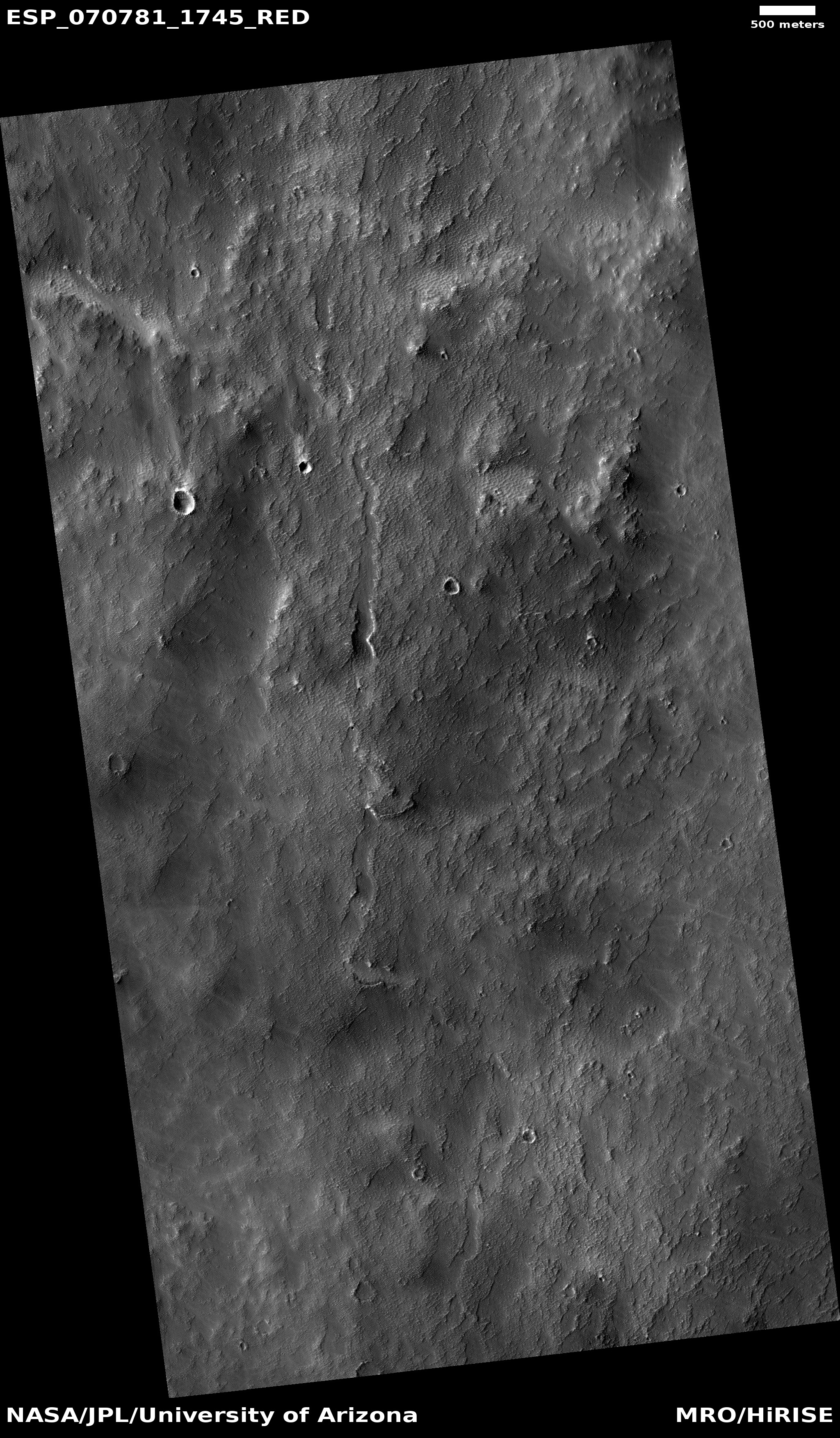
A Martian volcanic ash field covering an ancient lava flow

A Martian volcanic ash field covering an ancient lava flow
Click for original image.

Cool image time! The picture to the right, rotated, cropped, reduced, and sharpened to post here, was taken on April 16, 2023 by the high resolution camera on Mars Reconnaissance Orbiter (MRO). It shows in the center an ancient tongue of lava flow that is surrounded by thick dust fields on the north and the south.

The arrow indicates the downhill grade. It also shows the direction of the prevailing winds, downhill to sculpt the volcanic ash into long streamers of parallel grooves, with obvious eddies forming around bits of older lava that still stick up through the ash. On the lava flow can also be seen one small volcano cone, on the picture’s right edge, suggesting that either during this flow or after it hardened magma bubbled up from below.

The location is fascinating, and in fact puts this picture into its much more spectacular context.
» Read more

0 comments

A spiral galaxy as seen by Hubble

A spiral galaxy as seen by Hubble
Click for original image.

Cool image time! The picture to the right, cropped, reduced, and sharpened to post here, was taken as part of a research project to use the Hubble Space Telescope to photograph galaxies where supernovae had recently occurred. From the caption:

UGC 11860 lies around 184 million light-years away in the constellation Pegasus, and its untroubled appearance can be deceiving; this galaxy recently played host to an almost unimaginably energetic stellar explosion.

A supernova explosion — the catastrophically violent end of a massive star’s life — was detected in UGC 11860 in 2014 by a robotic telescope dedicated to scouring the skies for transient astronomical phenomena; astronomical objects which are only visible for a short period of time. Two different teams of astronomers used Hubble’s Wide Field Camera 3 to search through the aftermath and unpick the lingering remnants of this vast cosmic explosion.

This Hubble image once again illustrates the vastness of the universe. Note that every single dot surrounding UGC 11860 in this picture is another far more distant galaxy. As much as UGC 11860 is in our local intergalactic neighborhood, it is still so distant that this field of view is small enough that it contains no stars.

2 comments

Another flying car gets FAA approval for flight testing

Aska-5 flying car
The Aska-5 flying car

The FAA has approved another flying car for flight testing, this time for a flying car designed to also be able to do vertical take-offs if necessary.

The Aska A5 … has four wheels and four seats. Like the Klein Vision [another flying car proposal], it can take off on a runway if there’s one available. Unlike the Klein Vision, it can also takeoff on a very short runway, or indeed no runway at all, thanks to an electric VTOL [vertical take-off and landing] system that folds out at the touch of a button. And unlike, say, the Xpeng AeroHT [a different flying car proposal], it’s capable of transitioning to efficient, winged cruise mode to expand its range.

The A5 will look fairly ridiculous driving down the road, all propellers and struts, a clog with a dishrack full of cutlery piled on top. But when the main rear wing and canard fold out, it all makes a lot more sense. There are six large propellers, four at the back, two at the front, and in VTOL operations these will lift the Aska off the ground and allow it to hover. For forward flight, the two inner rear propellers can tilt forward, allowing horizontal thrust in cruise mode with the rest of the props switched off and the car’s weight supported by its wings.

The proposed price tag for the Aska-5 is presently just under $800K, though it will be a while before you can buy one. The company says it is doing both driving and flight testing, but provided no images or data of it in the air. Thus, a lot of work remains before you could climb in, drive from your home to an airport and take off.

The company says it has $50 million in preorders. If so, at least 50 people think this might be the real deal.

10 comments

ISRO aborts first static fire test of prototype of a new upper stage rocket engine

According to India’s space agency ISRO, on July 1st engineers were forced to abort the first static fire test of prototype of a new upper stage rocket engine, planned to last 4.5 seconds but stopped after 1.9 seconds.

The test proceeded as predicted till 1.9 s validating the ignition and subsequent performance of PHTA [Power Head Test Article]. At 2.0 s, an unanticipated spike in the turbine pressure and subsequent loss of turbine-speed was observed. As a precautionary step, the test was terminated. Analysis under progress would offer further understanding before proceeding with further hot-tests for longer duration.

This was not a test of a real rocket engine, but an engineering test prototype, designed “to validate the integrated performance of the critical subsystems such as the gas generator, turbo pumps, pre-burner and control components.” That the test showed issues without exploding is actually very good news. Engineers still have the prototype to quickly figure out what went wrong and fix it.

0 comments

Ingenuity responds after 63 days of silence

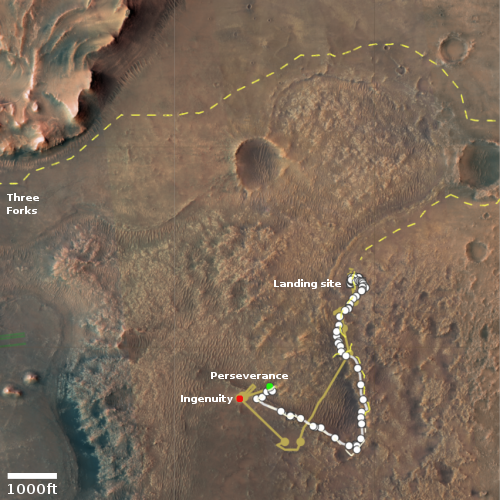
Overview map
Click for interactive map.

For the past two months the science and engineering teams for the Perseverance rover and the Ingenuity helicopter in Jezero Crater have been very silent as to the status of Ingenuity. On April 25, 2023 the Ingenuity team had posted their flight plan for the helicopter’s 52nd flight, with an expected flight date the next day.

Until today, however, no information about the results of that flight had been released. Except for one update in late May describing earlier issues with communications after flight 49, the science and engineering teams maintained radio silence about that 52nd flight in April.

Today’s update finally explained that silence:

The flight took place back on April 26, but mission controllers at NASA’s Jet Propulsion Laboratory in Southern California lost contact with the helicopter as it descended toward the surface for landing.

The Ingenuity team expected the communications dropout because a hill stood between the helicopter’s landing location and the Perseverance rover’s position, blocking communication between the two. The rover acts as a radio relay between the helicopter and mission controllers at JPL. In anticipation of this loss of communications, the Ingenuity team had already developed re-contact plans for when the rover would drive back within range. Contact was re-established June 28 when Perseverance crested the hill and could see Ingenuity again.

The flight plan for the 52nd flight in April had been to fly 1,191 feet to the west. Though the Ingenuity team has not yet released the actual flight details, I have indicated with the green line on the overview map above the estimated distance and direction planned. The green dot marks Ingenuity’s position before the flight, with the blue dot marking Perseverance’s present location. The red dotted line indicates the planned route for Perseverance.

11 comments

SpaceX launches Europe’s Euclid space telescope

SpaceX this morning successfully launched Europe’s Euclid space telescope, designed to map the spatial distribution of several billion galaxies across one third of the sky.

The first stage successfully completed its second flight, landing on a drone ship in the Atlantic. The two fairing halves completed their first flight.

This ESA science mission would have normally been launched on an Arianespace rocket, but Europe’s ability to launch anything now is nil, as it is about to retire its Ariane-5 rocket (with one launch left) and has so failed to get its replacement, Ariane-6, operational. As such, SpaceX got the business, since it is the cheapest and most reliable alternative.

The leaders in the 2023 launch race:

44 SpaceX
24 China
9 Russia
5 Rocket Lab

In the national rankings, American private enterprise now leads China in successful launches 50 to 24, and the entire world combined 50 to 41, with SpaceX by itself leads the entire world, excluding other American companies, 44 to 41.

7 comments

Another layered mesa in the Cydonia region of Mars

Another layered mesa in the Cydonia region of Mars
Click for original image.

Cool image time! The picture to the right, cropped, reduced, and sharpened to post here, was taken on March 22, 2023, and shows a 100-foot-high many-layered mesa in the Cydonia region of Mars.

The shadows in this picture are deceptive. The mesa’s high point is not the narrow ridge-line, but at the green dot just beyond that ridge’s northern terminus. In fact, if you were walking south from that dot and then along the crest of that ridge you would be walking downhill the entire length.

Cydonia is in the Martian northern lowland plains, in the mid-latitudes. Thus, there are many features in this picture suggesting near surface ice, such as the mounds with craters at their peak. All could be mud volcanoes as seen in many places in the northern lowland plains.
» Read more

1 comment

Curiosity tops a ridge to see its rough path forward

Curiosity's view ahead on June 29, 2023
Click for original image.

Overview map
Click for interactive map

After more than a month of struggle to get Curiosity to maneuver uphill through a very rocky and steep terrain, the science team today finally announced that the rover had topped the ridge and could once again see its way forward into Gediz Vallis, the slot canyon it plans to use as its route up Mount Sharp.

The panorama above, cropped, reduced, sharpened, and annotated to post here, was taken on June 29, 2023 following Curiosity’s last move forward. The yellow lines on the overview map to the right indicate the approximate area covered by this panorama. The red dotted line on both images indicates Curiosity’s planned route, with the white dotted line its actual course.

The white ridge to either side of the central peak dubbed Kukenan is actually the higher flanks of Mount Sharp. The peak of Kukenan is about a half mile away and about 400 feet higher, with those white flanks about 2.5 miles beyond. The actual peak of Mount Sharp is about 25 miles farther south and about 17,000 feet higher.

The panorama makes clear that the path forward is not going to be any less rough for Curiosity and its damaged wheels. Expect progress to be slow for many months to come.

0 comments

Dragon cargo freighter safely splashes down in Atlantic

After three months docked to ISS, one of SpaceX’s reusable Dragon cargo freighters safely splashed down today off the coast of Florida in the Atlantic.

This was SpaceX’s 28th cargo mission to ISS, all successful except for one launch failure not caused by the capsule itself, which post-failure analysis suggested that if it had been equipped to release parachutes it might have landed in the ocean undamaged.

This capsule brought back 3,600 pounds from the station, including some experiments that had been on the station for six years.

2 comments
1 310 311 312 313 314 1,353