An update on China’s private smallsat rocket companies

Link here. The article describes the most recent news from OneSpace (which recently secured $44 million in financing), Landspace (building larger rockets), and Exspace (next launch planned for September).

While these companies are structured like American private companies, in China nothing having anything to do with space is really private. None of these companies can do anything without the full approval of China’s authoritarian communist government. Unlike Russia, however, China, has decided to allow competition to drive its space industry, not central control. It is encouraging small independent operations to come up with their own ideas and to compete with each other.

In the end, they will all be co-opted by the government, but for now this policy is producing for China some real results.

0 comments

SpaceX unveils interior of manned Dragon

Capitalism in space: Earlier this week SpaceX unveiled the interior of its Dragon capsule, along with the suits and other details, to reporters in California.

The article at the link has some good videos showing the capsule interior as well as its touchscreen control panel. It also includes quotes from SpaceX’s president Gwynne Shotwell repeating their intention to launch the manned mission by April 2019.

“Whenever we talk about dates we’re always confident and then something crops up,” Shotwell said. “Predicting launch dates can make a liar out of the best of us. I hope I am not proven to be a liar on this one. We are targeting November for Demo 1 and April for Demo 2.”

“I would love to say that this mission is going to be like every other mission, because I want every rocket and every capsule to be reliable, but I can tell you there will be about 7000 extra sets of eyes on the build of this system, the testing of this system and all the interfaces,” Shotwell added.

I would not be surprised if there was a few months slip in that schedule. I will be surprised if it slips more than that.

3 comments

India’s prime minister: manned mission by 2022

The new colonial movement: Facing an election next year, India’s prime minister Narendra Modi produced his own Kennedy-like space speech today, announcing a plan to launch a manned Indian mission by 2022.

Wearing a flowing saffron turban, the Hindu nationalist leader also announced the plan to take the “Indian tricolor to space” in a manned mission that would make India the fourth nation to launch one, after the United States, Russia and China. “India is proud of our scientists, who are excelling in their research and are at the forefront of innovation,” Modi said from the ramparts of the Mughal-era Red Fort in Delhi to a crowd numbering in the tens of thousands.

“In the year 2022 or, if possible, before, India will unfurl the tricolor in space.”

He also announced a healthcare initiative that has been dubbed “Modicare.” He was elected in a landslide to replace the socialist policies of the leftwing Congress Party. He is now beginning to act like the U.S.’s establishment Republican Party, who love to mouth conservative values but advocate leftist programs to win re-election.

The question is whether the Indian people will be more like Americans of the 20th century, buying into these government programs proposed by a fake-conservative, or whether they will be more like an increasing number of Americans today, sick of too much government. I suspect the former, which will bode ill for India’s future.

0 comments

Google lied when it said it would allow you to block it from tracking you

Reason #1,238,435 for not using Google: Google lied when it said you can shut off its location tracking functions on your smartphone. Even if you do so, numerous Google applications ignore that instruction and track you anyway.

Google wants to know where you go so badly that it records your movements even when you explicitly tell it not to.

An Associated Press investigation found that many Google services on Android devices and iPhones store your location data even if you’ve used a privacy setting that says it will prevent Google from doing so. Computer-science researchers at Princeton confirmed these findings at the AP’s request…

Google’s support page on the subject states: “You can turn off Location History at any time. With Location History off, the places you go are no longer stored.”

That isn’t true. Even with Location History paused, some Google apps automatically store time-stamped location data without asking.

The article at the link outlines numerous other examples where Google tracks and records your location, even if you have set your privacy functions to prevent that.

Essentially, the large software companies such as Google and Facebook have no ethics. They are not trustworthy partners, which is why I do not use them. And if an alternative to youtube existed, I would switch from that in a nanosecond.

11 comments

One “tiny” storm on Jupiter

A

Cool image time! The image on the right, cropped to post here, shows the white center of one of the smaller giant storms on Jupiter, taken by Juno. The image was processed by citizen scientists Gerald Eichstädt and Seán Doran. If you click on the image you can see the entire picture, which has a host of spectacular details surrounding the white spot.

Unfortunately, they do not provide a scale. Based on past experience, I would guess that this tiny storm probably exceeds the size of the Earth. What makes the image so impressive however are the white cloudtops visible as they swirl around the storm’s center. Sunlight shadows clearly shows that these thunderheads rise above rest of the storm.

The full image shows even more fascinating details. It is worthwhile studying, though one can certainly get lost in that vast and turbulent Jupiter atmosphere.

0 comments

Excavation begins on site for Giant Magellan Telescope

Excavation has begun for the site where the Giant Magellan Telescope (GMT) will be built in Chile.

Using a combination of hydraulic drilling and hammering, the excavation work is expected to take about five months to complete. Excavation is a key step towards the construction of the GMT, which is expected to see first light as early as 2024.

The 25-meter diameter GMT, expected to have a final weight of about 1,600 metric tons, will comprise seven 8.4-meter mirrors supported by a steel telescope structure that will be seated on the concrete pier. It will be housed inside a rotating enclosure that will measure 65 meters (~22 stories) tall and 56 meters wide. As well as working on the enclosure and telescope pier foundations, Conpax will excavate a recess in the summit rock for the lower portion of the mirror coating chamber and foundations for a utility building and tunnel on the summit.

Of the next generation of big telescopes, GMT is the closest to completion.

1 comment

More testing of “Roc,” Stratolaunch’s giant airplane

This past weekend Stratolaunch completed more tests on its giant airplane, now nicknamed “Roc.”

They had intended to do another taxi test, but didn’t for some reason. Instead, they did test fueling operations. full-power engine tests, and communication tests.

Their upcoming schedule appears to me to be very extended.

Stratolaunch executives laid out the test schedule for the plane, which was built by Mojave-based Scaled Composites, during a space conference in April. The company plans to follow up on the first two taxi tests (at runway speeds of 15 mph and 40 knots) with three more at speeds of 70, 85 and 120 knots.

The last speed is roughly what’s needed for takeoff.

After the fifth taxi test, Stratolaunch would put the plane into the air for a series of flight tests over the course of what’s expected to be 18 to 24 months. In April, executives said they were targeting the first flight test for this summer (which technically runs until Sept. 23).

They also have not yet announced any launch contracts, though there have been announcements that both Northrop Grumman’s Pegasus and Virgin Orbit’s LauncherOne will fly on Roc.

2 comments

Curiosity successfully drills another hole

Successful drill hole on Vera Rubin Ridge

Curiosity has finally drilled its first successful hole in the geology layer found on Vera Rubin Ridge.

This weekend’s plan is focused on the Stoer drill hole, the tailings derived from the drill and on portion characterization observations. The portion characterization is done prior to sending samples to the analytical instruments, SAM and CheMin, to ensure that the materials will not pose any threat to the instruments. ChemCam passive and Mastcam multispectral imaging will be taken of the drill tailings, to identify any potential differences between the surface and material from deeper within the drill hole. The ChemCam laser (LIBS) will be used to characterize the Stoer drill hole and a bedrock target “Greian,” which appears to show some colour variations. Mastcam will provide colour documentation for Greian.

In order to find rock soft enough on Vera Rubin Ridge, they had to once again retrace their route, retreating back down off the ridge slightly, to a lower point. The image on the right, cropped to post here, shows the drill hole. If you click on the image you can see the full picture.

With this successful drilling, I suspect they will now finally cross Vera Rubin Ridge and head up Mount Sharp.

2 comments

ISRO schedules Chandrayaan-2 launch for January 3rd

The new colonial movement: ISRO has now scheduled the launch of the lunar rover/lander Chandrayaan-2 on its most powerful rocket for January 3, 2019.

An increase in the spacecraft’s weight forced the space agency to switch launch rockets and use India’s most powerful rocket, the GSLV Mark 3.

The 3,890-kg Chandrayaan-2, which will be launched onboard the Geosynchronous Satellite Launch Vehicle (GSLV) Mk-3, will orbit around the moon and study its lunar conditions to collect data on its topography, mineralogy and exosphere.

A lander with rover which will separate from the spacecraft will orbit the moon, and then gradually descend on the lunar surface at a designated spot. The rover’s instruments will observe and study the lunar surface.

The lander has been named “Vikram” as a tribute to the pioneer of India’s space programme and former ISRO chairman (1963-71), Vikram Sarabhai, Sivan said.

0 comments

ULA’s Delta-4 Heavy successfully launches the Parker Solar Probe

ULA’s Delta-4 Heavy has successfully launched the Parker Solar Probe.

As I write this the spacecraft is in orbit, but there are several more steps needed to confirm the spacecraft is on course, including a second burn of the upper stage, its separation from the spacecraft, followed by the firing of the solid rocket kick stage and then its separation from the spacecraft. All these steps will take another 40 minutes or so, so reporting them will have to wait until tomorrow.

Update: The spacecraft has successfully separated from its last stage and is on its way.

Over the next two months, Parker Solar Probe will fly towards Venus, performing its first Venus gravity assist in early October – a maneuver a bit like a handbrake turn – that whips the spacecraft around the planet, using Venus’s gravity to trim the spacecraft’s orbit tighter around the Sun. This first flyby will place Parker Solar Probe in position in early November to fly as close as 15 million miles from the Sun – within the blazing solar atmosphere, known as the corona – closer than anything made by humanity has ever gone before.

The leaders in the 2018 launch standings:

22 China
15 SpaceX
8 Russia
6 ULA
4 Japan
4 Europe

The U.S. and China are once again tied in the national rankings, 22 each.

4 comments

ISRO head: Recall of India satellite prevented a failure

K. Sivan, the chairman of ISRO, India’s space agency, revealed today that the decision to recall GSAT-11 in April just as it arrived in French Guiana for a May Ariane 5 launch prevented a major failure.

They had decided to recall it because two previous satellites had failed, using almost identical equipment. As he notes,

GSAT-11 had the same set of power system configuration that two older satellites had. RISAT-1 died prematurely and GSAT-6A lost communication contact soon after launch on March 29 because of suspected power system failure, harnesses etc… We had just sent GSAT-11 [to Guiana] and no one was sure if the same issue was there in GSAT-11,” he said.

Checks found that the provision or “margin” for the deployment of the solar panel was much smaller than was required. “Had it gone in that configuration, the panel [which generates power for the 15-year life] would not have deployed in space. The satellite would have been a failure.”

Because the recall cost money and delayed the launch significantly, it required the ability to look at the engineering honestly and not let politics interfere. Sivan and his managers did that, which speaks well for future space engineering from ISRO.

1 comment

A spinning heat shield to lower their cost and weight

Link here. Key quote:

Made of a flexible, strong and heat-resistant material that folds down when not in use, his shield automatically starts spinning like a samara-type tree seed when exposed to the onrush of air that a spacecraft would experience when dropping through a planet’s atmosphere.

As it spins, centrifugal force causes its skirt-like sides to flare out and stiffen. This creates the drag needed to help slow the descent, while also providing a large protective surface for the dissipation of heat. No additional machinery, other than the shield itself, is required for its deployment.

“Since this prototype is lightweight and flexible enough for use on smaller satellites, research could be made easier and cheaper,” says Wu. “The heat shield would also help save cost in recovery missions, as its high induced drag reduces the amount of fuel burned upon re-entry.”

More details here. Very clever. It needs to be tested to see if it can work.

6 comments

Parker Solar Probe launch scrubbed two minutes prior to launch

The launch of the Parker Solar Probe on a ULA Delta 4-Heavy rocket was scrubbed early this morning two minutes prior to launch.

[A] member of the launch team announced a gaseous helium regulator alarm at T-minus 1 minute, 55 seconds. There was not enough time remaining in the launch window Saturday to resolve the alarm, so launch managers declared a scrub for the day.

In a brief statement, ULA said the launch was scrubbed “due to a violation of a launch limit, resulting in a hold.”

No other information about the gaseous helium system alarm, or the other technical concerns during the countdown, were released by NASA or ULA.

They are going to try again tonight, at 3:31 am Eastern. You can watch it here. The launch window closes on August 23. If they do not launch by then, they will have to wait until May 2019.

The spacecraft will fly closer to the Sun then any spacecraft ever has in order to study the Sun’s corona.

3 comments

Researchers say cubesats with propulsion systems must have encrypted software

Capitalism in space: Researchers from Yale University are recommending that the smallsat industry establish rules requiring all future cubesats that carry their own propulsion systems be encrypted to prevent them from being hacked.

That research by a team of graduate students, presented at the AIAA/Utah State University Conference on Small Satellites here Aug. 9, recommended the space industry take steps to prevent the launch of such satellites to avoid an incident that could lead to a “regulatory overreaction” by government agencies. “We would propose as a policy that, for those cubesats and smallsats that have propulsion, that the industry adopt a ‘no encryption, no fly’ rule,” said Andrew Kurzrok of Yale University.

That recommendation comes as cubesat developers, who once had few, if any, options for onboard propulsion, are now looking to make use of more advanced chemical and electric propulsion systems. Some of those technologies can provide smallsats with large changes in velocity, which can enable major orbital changes.

Kurzrok and colleagues at Stanford University and the University of Colorado modeled several different propulsion systems on a notional 10-kilogram nanosatellite, assuming the spacecraft was in a 300-kilometer orbit and that the propulsion systems accounted for half the spacecraft’s mass. The results ranged from the satellite reaching medium Earth orbit altitudes within two hours when using chemical propulsion to passing geostationary orbit in about a year with an electric propulsion system.

The scenario involving the nanosatellite with chemical propulsion is particularly troubling, he said. “What are the abilities within two hours to track that something isn’t where it’s supposed to be and then warn or take some sort of secondary action?” he said, concluding that the satellite reaching GEO in a year is a much less plausible threat.

The concern, then is a scenario where hackers are able to take control of a satellite and redirect it quickly.

Getting encryption for their software would raise costs, but it really is the cost of doing business. Better for the industry to create these rules than wait for the federal government to step in, as the government regulation will certainly end up being more odious and difficult to change.

3 comments

Russian lawmaker threatens to block sale of Russian rocket engines to ULA

In response to new U.S. sanctions, a Russian lawmaker has now threatened to block the sale of the Russian RD-180 rocket engine that ULA uses in its Atlas 5 rocket.

Russian lawmaker Sergei Ryabukhin, who heads the budget committee in the upper house of the Russian parliament, responded to the new sanctions by vowing: “The United States needs to finally understand that it’s useless to fight with Russia, including with the help of sanctions.”

According to the Russian news agency RIA, Ryabukhin found a place to hit Washington where it’s soft: the rocket engine. Losing access to the RD-180 would make American access to space—something Donald Trump desires enough to create a separate military service branch devoted to it—much more complicated. The engine helps get everything from satellites to astronauts into orbit.

More details here.

If Russia does this they will be shooting themselves in the foot. ULA is their only customer for the RD-180 engine. Without those sales, they would cut themselves off from one of the few remaining international space contracts they still have, further bankrupting their dying space industry. Furthermore, the U.S. has many other options even if the Atlas 5 can no longer fly. ULA might suffer until it can get a replacement engine, but in the meantime the Falcon Heavy is now available to replace it, at less cost.

3 comments

The two things SpaceX must do for NASA to okay the first manned Dragon mission

Link here.

First, they must successfully recover the Dragon capsule from the first unmanned test flight in November so that they can use it in a launch abort test to follow.

Second, they must demonstrate seven successful flights of the Block 5 version of the Falcon 9 rocket.

Right now it appears that, though the schedule is very very tight, it is possible that SpaceX will be able to accomplish these tasks in time to do its manned flight in April 2019, as presently scheduled. At the moment SpaceX’s launch schedule calls for 11 Falcon 9 launches between now and April. Getting seven Block 5 launches should therefore be likely, though not certain, since some of those launches will probably not use the final full Block 5 configuration.

I notice that the article makes no mention of the massive paperwork that the GAO says must be done before a manned flight. No surprise. In the end the paperwork will not delay this mission, despite what the GAO and NASA’s bureaucracy says.

UPDATE: NASA has now withdrawn its objections to SpaceX’s fueling plans. This is also no surprise, as their objections to fueling the rocket while astronauts were on board were always bogus. The risks are essentially the same whether you fuel before boarding or after. Either way, there is a lot of very explosive fuel present. To say NASA’s way, fueling first, is the only way never made sense.

9 comments

UK estimates its new spaceport could capture thousands of smallsat launches

Capitalism in space: Estimates by the United Kingdom’s space agency suggest that its new spaceport in Scotland could capture thousands of smallsat launches by the end of the 2020s.

Figures released … suggest that existing ‘rideshare’ small satellite launches (small satellites piggybacking on larger missions) are capable of meeting less than 35% of the total demand. This reveals a significant gap in commercial small satellite launch provision for which future UK spaceports are well placed to compete.

The press release also gives an update on the recent actions of the two smallsat rocket companies, Orbex and Lockheed Martin (in partnership with Rocket Lab), to establish operations in Scotland.

It remains to be seen whether these predictions will come true. Right now it appears that a giant boom in the smallsat industry is about to happen, and if it does the need for launchpads will become critical. If so, the policy shift in the UK to favor private spaceflight is arriving at just the right time.

0 comments

The history of SpaceX’s Big Falcon Rocket

Link here. This is a ten part very detailed history, and includes a great deal of background into the history of SpaceX as well. Very much worth reading.

In the end, I remain skeptical that this rocket will end up being built as SpaceX presently envisions it. I also believe however that out of this engineering research will come a new rocket that is nonetheless revolutionary.

8 comments

Scientists create coldest spot ever on ISS

Using a compact lab called the Cold Atom Lab and launched to ISS in a Cygnus freighter in May, scientists have now successfully created coldest spot ever.

The government agency created atoms known as Bose-Einstein condensates (BECs) for the first time in orbit to focus on their unusual quantum behavior. A team of astronauts on the International Space Station (ISS) was able to take the Cold Atom Lab (CAL), which was loaded with lasers and a vacuum chamber, to understand how BECs interact with gravity.

…The scientists produced the BECs with temperatures as “as low as 100 nanoKelvin, or one ten-millionth of one Kelvin above absolute zero,” NASA added, in the statement. Zero Kelvin, also known as absolute zero, is the equivalent of minus 459 degrees Fahrenheit. The average temperature of space is approximately 3 Kelvin or minus 454 degrees Fahrenheit.

In a sense, they didn’t so much create a cold spot as create conditions that allowed the Bose-Einstein condensates to form so that they could study them. The article provides some background about this research, which is focused mostly on trying to figure out how to unify quantum mechanics (which explains the interactions at the atomic level) with general relativity (which explains the actions of matter and energy at large scales). Physicists have been trying unify both for decades, with little success.

2 comments

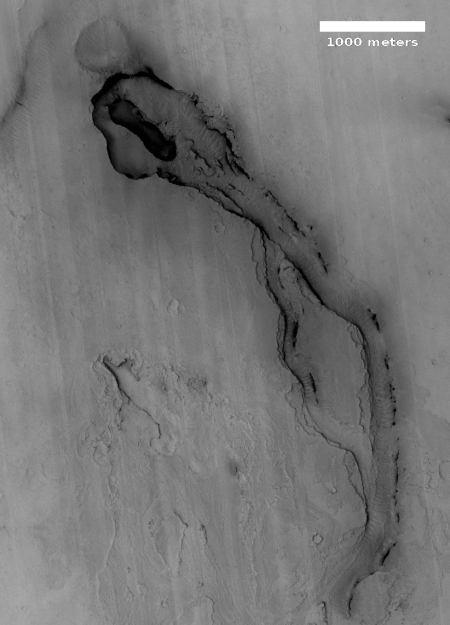
Weird Martian crater?

Weird crater on Mars

Time for another cool image! The image on the left, cropped to post here, was taken by the high resolution camera on Mars Reconnaissance Orbiter (MRO) on May 31, 2018, and shows a very strange layered mesa sitting in what looks like a crater or collapse feature. If you click on the image you can see the entire picture.

The location of this image is out in the middle of the vast northern plains of Mars. This region has few pronounced features, and generally sits at a lower elevation to the rest of Mars. It is suspected by some scientists that an intermittent ocean was once here, and that we are looking at the floor of a now dry sea.

This image was part of the July image release from MRO, and thus included no caption. They simply refer to it as a layered feature. It sits about a half mile (about 800 meters) to the west of a rough and indistinct cliff that drops down into an area of rougher terrain. This suggests that if this was formed by an impact, it cut down into that lower rougher layer, and since the impact there has been some upwelling from below creating the layered mesa.

I would not take my hypothesis very seriously, however. This feature could have nothing to do with an impact. It might also have been a mesa that now sits in a collapsed sinkhole. Or not. I could come up with many theories, all of which are likely wrong. What I do see here is something that geologically is very strange and baffling.

2 comments
1 484 485 486 487 488 813